

 搜索
搜索
第62页
- 第1页
- 第2页
- 第3页
- 第4页
- 第5页
- 第6页
- 第7页
- 第8页
- 第9页
- 第10页
- 第11页
- 第12页
- 第13页
- 第14页
- 第15页
- 第16页
- 第17页
- 第18页
- 第19页
- 第20页
- 第21页
- 第22页
- 第23页
- 第24页
- 第25页
- 第26页
- 第27页
- 第28页
- 第29页
- 第30页
- 第31页
- 第32页
- 第33页
- 第34页
- 第35页
- 第36页
- 第37页
- 第38页
- 第39页
- 第40页
- 第41页
- 第42页
- 第43页
- 第44页
- 第45页
- 第46页
- 第47页
- 第48页
- 第49页
- 第50页
- 第51页
- 第52页
- 第53页
- 第54页
- 第55页
- 第56页
- 第57页
- 第58页
- 第59页
- 第60页
- 第61页
- 第62页
- 第63页
- 第64页
- 第65页
- 第66页
- 第67页
- 第68页
- 第69页
- 第70页
- 第71页
- 第72页
- 第73页
- 第74页
- 第75页
- 第76页
- 第77页
- 第78页
- 第79页
- 第80页
- 第81页
- 第82页
- 第83页
- 第84页
- 第85页
- 第86页
- 第87页
- 第88页
- 第89页
- 第90页
- 第91页
- 第92页
- 第93页
- 第94页
- 第95页
- 第96页
- 第97页
- 第98页
- 第99页
- 第100页
- 第101页
- 第102页
- 第103页
- 第104页
- 第105页
- 第106页
- 第107页
- 第108页
- 第109页
- 第110页
- 第111页
- 第112页
- 第113页
- 第114页
- 第115页
- 第116页
- 第117页
5. 小胖同学发现这样一个规律:两个顶角相等的等腰三角形,如果具有公共的顶角的顶点,并把它们的底角顶点连接起来,那么形成一组旋转全等的三角形。小胖把具有这个规律的图形称为“手拉手”图形。如图①,在“手拉手”图形中,小胖发现若$\angle BAC= \angle DAE$,$AB = AC$,$AD = AE$,则$BD = CE$。
(1) 在图①中证明小胖的发现;
证明: $\because \angle BAC = \angle DAE$, $\therefore$
(2) 借助小胖同学总结的规律,构造“手拉手”图形来解答下面的问题:如图②,$AB = BC$,$\angle ABC= \angle BDC = 60^{\circ}$,求证:$AD + CD = BD$。
证明:延长 $DC$ 到点 $E$,使
(1) 在图①中证明小胖的发现;
证明: $\because \angle BAC = \angle DAE$, $\therefore$
$\angle DAB = \angle EAC$
. 在 $\triangle DAB$ 和 $\triangle EAC$ 中, $\left\{\begin{array}{l} AD = AE, \\ \angle DAB = \angle EAC, \\ AB = AC, \end{array}\right.$ $\therefore$$\triangle DAB \cong \triangle EAC$
. $\therefore$$BD = EC$
. (2) 借助小胖同学总结的规律,构造“手拉手”图形来解答下面的问题:如图②,$AB = BC$,$\angle ABC= \angle BDC = 60^{\circ}$,求证:$AD + CD = BD$。
证明:延长 $DC$ 到点 $E$,使
$DB = DE$
,连接 $BE$. $\because DB = DE$, $\angle BDC = 60^{\circ}$, $\therefore$$\triangle BDE$是等边三角形
. $\therefore BD = BE$, $\angle DBE = \angle ABC = 60^{\circ}$. $\therefore$$\angle ABD = \angle CBE$
. $\because AB = BC$, $\therefore$$\triangle ABD \cong \triangle CBE$
. $\therefore$$AD = EC$
. $\therefore BD = DE = DC + CE = DC + AD$. $\therefore AD + CD = BD$.
答案:
(1) 证明: $\because \angle BAC = \angle DAE$, $\therefore \angle DAB = \angle EAC$. 在 $\triangle DAB$ 和 $\triangle EAC$ 中, $\left\{\begin{array}{l} AD = AE, \\ \angle DAB = \angle EAC, \\ AB = AC, \end{array}\right.$ $\therefore \triangle DAB \cong \triangle EAC$. $\therefore BD = EC$.
(2) 证明:延长 $DC$ 到点 $E$,使 $DB = DE$,连接 $BE$. $\because DB = DE$, $\angle BDC = 60^{\circ}$, $\therefore \triangle BDE$ 是等边三角形. $\therefore BD = BE$, $\angle DBE = \angle ABC = 60^{\circ}$. $\therefore \angle ABD = \angle CBE$. $\because AB = BC$, $\therefore \triangle ABD \cong \triangle CBE$. $\therefore AD = EC$. $\therefore BD = DE = DC + CE = DC + AD$. $\therefore AD + CD = BD$.
(1) 证明: $\because \angle BAC = \angle DAE$, $\therefore \angle DAB = \angle EAC$. 在 $\triangle DAB$ 和 $\triangle EAC$ 中, $\left\{\begin{array}{l} AD = AE, \\ \angle DAB = \angle EAC, \\ AB = AC, \end{array}\right.$ $\therefore \triangle DAB \cong \triangle EAC$. $\therefore BD = EC$.
(2) 证明:延长 $DC$ 到点 $E$,使 $DB = DE$,连接 $BE$. $\because DB = DE$, $\angle BDC = 60^{\circ}$, $\therefore \triangle BDE$ 是等边三角形. $\therefore BD = BE$, $\angle DBE = \angle ABC = 60^{\circ}$. $\therefore \angle ABD = \angle CBE$. $\because AB = BC$, $\therefore \triangle ABD \cong \triangle CBE$. $\therefore AD = EC$. $\therefore BD = DE = DC + CE = DC + AD$. $\therefore AD + CD = BD$.
6. 如图①,$C为线段AB$上任意一点(点$C不与点A$、$B$重合),分别以$AC$、$BC为一腰在AB的同侧作等腰三角形ACD和等腰三角形BCE$,$CA = CD$,$CB = CE$,$\angle ACD= \angle BCE = 30^{\circ}$,连接$AE交CD于点M$,连接$BD交CE于点N$,$AE与BD交于点P$,连接$CP$。
(1) 线段$AE与DB$的数量关系为
(2) 将$\triangle BCE绕点C$旋转到如图②所示的位置,其他条件不变,探究线段$AE与DB$的数量关系,并说明理由;求出此时$\angle APD$的度数;
(3) 在(2)的条件下,求证:$\angle APC= \angle BPC$。
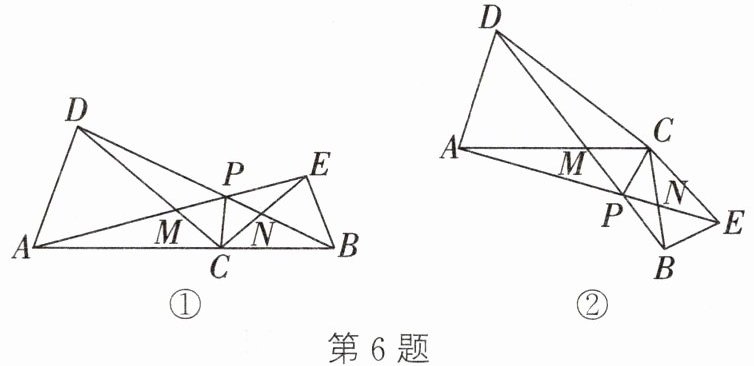
(1) 线段$AE与DB$的数量关系为
$AE = BD$
;$\angle APD$的度数为$30^{\circ}$
;(2) 将$\triangle BCE绕点C$旋转到如图②所示的位置,其他条件不变,探究线段$AE与DB$的数量关系,并说明理由;求出此时$\angle APD$的度数;
(3) 在(2)的条件下,求证:$\angle APC= \angle BPC$。
答案:
(1) $AE = BD$ $30^{\circ}$
(2) 解:结论: $AE = BD$, $\angle APD = 30^{\circ}$. 理由: $\because \angle ACD = \angle BCE$, $\therefore \angle ACD + \angle ACB = \angle BCE + \angle ACB$, 即 $\angle DCB = \angle ACE$. 又 $\because CA = CD$, $CE = CB$, $\therefore \triangle ACE \cong \triangle DCB$. $\therefore AE = BD$, $\angle CAE = \angle CDB$. $\because \angle AMP = \angle DMC$, $\therefore \angle APD = \angle ACD = 30^{\circ}$;
(3) 证明:过点 $C$ 作 $CH \perp AE$,垂足为 $H$,过点 $C$ 作 $CG \perp BD$,垂足为 $G$. $\because \triangle ACE \cong \triangle DCB$, $\therefore S_{\triangle ACE} = S_{\triangle DCB}$. 又 $\because AE = BD$, $\therefore CH = CG$. $\therefore \angle DPC = \angle EPC$. $\because \angle APD = \angle BPE$, $\angle APC = \angle DPC + \angle APD$, $\angle BPC = \angle EPC + \angle BPE$, $\therefore \angle APC = \angle BPC$.
(1) $AE = BD$ $30^{\circ}$
(2) 解:结论: $AE = BD$, $\angle APD = 30^{\circ}$. 理由: $\because \angle ACD = \angle BCE$, $\therefore \angle ACD + \angle ACB = \angle BCE + \angle ACB$, 即 $\angle DCB = \angle ACE$. 又 $\because CA = CD$, $CE = CB$, $\therefore \triangle ACE \cong \triangle DCB$. $\therefore AE = BD$, $\angle CAE = \angle CDB$. $\because \angle AMP = \angle DMC$, $\therefore \angle APD = \angle ACD = 30^{\circ}$;
(3) 证明:过点 $C$ 作 $CH \perp AE$,垂足为 $H$,过点 $C$ 作 $CG \perp BD$,垂足为 $G$. $\because \triangle ACE \cong \triangle DCB$, $\therefore S_{\triangle ACE} = S_{\triangle DCB}$. 又 $\because AE = BD$, $\therefore CH = CG$. $\therefore \angle DPC = \angle EPC$. $\because \angle APD = \angle BPE$, $\angle APC = \angle DPC + \angle APD$, $\angle BPC = \angle EPC + \angle BPE$, $\therefore \angle APC = \angle BPC$.
查看更多完整答案,请扫码查看

