

 搜索
搜索
第72页
- 第1页
- 第2页
- 第3页
- 第4页
- 第5页
- 第6页
- 第7页
- 第8页
- 第9页
- 第10页
- 第11页
- 第12页
- 第13页
- 第14页
- 第15页
- 第16页
- 第17页
- 第18页
- 第19页
- 第20页
- 第21页
- 第22页
- 第23页
- 第24页
- 第25页
- 第26页
- 第27页
- 第28页
- 第29页
- 第30页
- 第31页
- 第32页
- 第33页
- 第34页
- 第35页
- 第36页
- 第37页
- 第38页
- 第39页
- 第40页
- 第41页
- 第42页
- 第43页
- 第44页
- 第45页
- 第46页
- 第47页
- 第48页
- 第49页
- 第50页
- 第51页
- 第52页
- 第53页
- 第54页
- 第55页
- 第56页
- 第57页
- 第58页
- 第59页
- 第60页
- 第61页
- 第62页
- 第63页
- 第64页
- 第65页
- 第66页
- 第67页
- 第68页
- 第69页
- 第70页
- 第71页
- 第72页
- 第73页
- 第74页
- 第75页
- 第76页
- 第77页
- 第78页
- 第79页
- 第80页
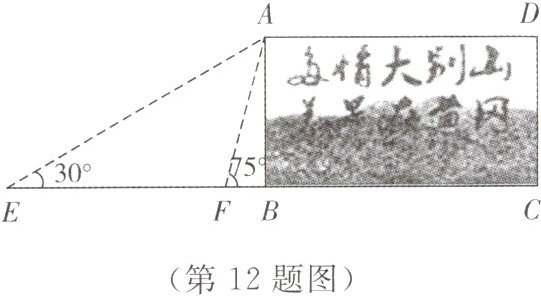
12. 在黄冈长江大桥的东端一处空地上,有一块矩形的标语牌$ABCD$(如图所示). 已知标语牌的高$AB = 5$m. 在地面的点$E$处,测得标语牌点$A$的仰角为$30^{\circ}$,在地面的点$F$处,测得标语牌点$A$的仰角为$75^{\circ}$,且点$E$,$F$,$B$,$C$在同一直线上,求点$E$与点$F$之间的距离.(计算结果精确到$0.1$m,参考数据:$\sqrt{2}\approx1.41$,$\sqrt{3}\approx1.73$)
答案:
【解】过点$F$作$FH\perp AE$于点$H$,则$\angle FHE=\angle FHA = 90^{\circ}$。
设$AH = x$m。
$\because\angle AFB=\angle E+\angle EAF = 75^{\circ}$,
$\therefore\angle EAF = 75^{\circ}-30^{\circ}=45^{\circ}$。
在$Rt\triangle AFH$中,
$\tan\angle HAF=\tan45^{\circ}=\frac{FH}{AH}=1$,
$\therefore AH = FH = x$m。
在$Rt\triangle EFH$中,
$\tan\angle HEF=\tan30^{\circ}=\frac{FH}{EH}=\frac{\sqrt{3}}{3}$,
$\therefore EH=\sqrt{3}x$m,$\therefore AE=(x+\sqrt{3}x)$m。
在$Rt\triangle ABE$中,$\angle E = 30^{\circ}$,
$\therefore AE = 2AB = 10 = x+\sqrt{3}x$,
解得$x = 5\sqrt{3}-5$。
在$Rt\triangle EFH$中,$\angle E = 30^{\circ}$,
$\therefore EF = 2FH = 2x = 10\sqrt{3}-10\approx7.3$(m)。
答:点$E$与点$F$之间的距离约是$7.3$m。
设$AH = x$m。
$\because\angle AFB=\angle E+\angle EAF = 75^{\circ}$,
$\therefore\angle EAF = 75^{\circ}-30^{\circ}=45^{\circ}$。
在$Rt\triangle AFH$中,
$\tan\angle HAF=\tan45^{\circ}=\frac{FH}{AH}=1$,
$\therefore AH = FH = x$m。
在$Rt\triangle EFH$中,
$\tan\angle HEF=\tan30^{\circ}=\frac{FH}{EH}=\frac{\sqrt{3}}{3}$,
$\therefore EH=\sqrt{3}x$m,$\therefore AE=(x+\sqrt{3}x)$m。
在$Rt\triangle ABE$中,$\angle E = 30^{\circ}$,
$\therefore AE = 2AB = 10 = x+\sqrt{3}x$,
解得$x = 5\sqrt{3}-5$。
在$Rt\triangle EFH$中,$\angle E = 30^{\circ}$,
$\therefore EF = 2FH = 2x = 10\sqrt{3}-10\approx7.3$(m)。
答:点$E$与点$F$之间的距离约是$7.3$m。
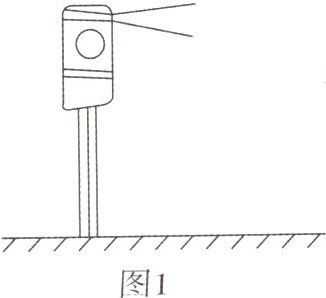
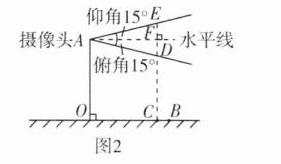
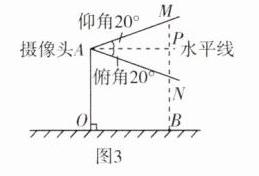
13. 图1是某住宅单元楼的人脸识别系统(整个头部需在摄像头视角范围内才能被识别),其示意图如图2,摄像头$A$的仰角、俯角均为$15^{\circ}$,摄像头高度$OA = 160$cm,识别的最远水平距离$OB = 150$cm.
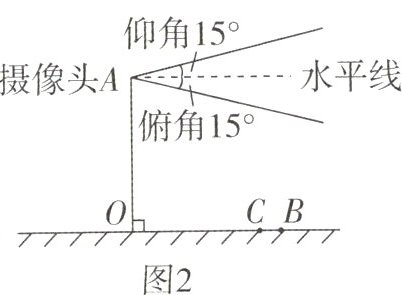
(1)身高$208$cm的小杜,头部高度为$26$cm,他站在离摄像头水平距离$130$cm的点$C$处,请问小杜最少需要下蹲多少厘米才能被识别.
(2)身高$120$cm的小若,头部高度为$15$cm,踮起脚尖可以增高$3$cm,但仍无法被识别. 社区及时将摄像头的仰角、俯角都调整为$20^{\circ}$(如图3),此时小若能被识别吗?请计算说明.(结果精确到$0.1$cm,参考数据$\sin15^{\circ}\approx0.26$,$\cos15^{\circ}\approx0.97$,$\tan15^{\circ}\approx0.27$,$\sin20^{\circ}\approx0.34$,$\cos20^{\circ}\approx0.94$,$\tan20^{\circ}\approx0.36$)
(1)身高$208$cm的小杜,头部高度为$26$cm,他站在离摄像头水平距离$130$cm的点$C$处,请问小杜最少需要下蹲多少厘米才能被识别.
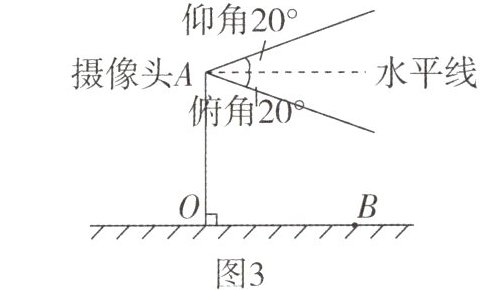
(2)身高$120$cm的小若,头部高度为$15$cm,踮起脚尖可以增高$3$cm,但仍无法被识别. 社区及时将摄像头的仰角、俯角都调整为$20^{\circ}$(如图3),此时小若能被识别吗?请计算说明.(结果精确到$0.1$cm,参考数据$\sin15^{\circ}\approx0.26$,$\cos15^{\circ}\approx0.97$,$\tan15^{\circ}\approx0.27$,$\sin20^{\circ}\approx0.34$,$\cos20^{\circ}\approx0.94$,$\tan20^{\circ}\approx0.36$)
答案:
【解】
(1)过点$C$作$OB$的垂线分别交仰角、俯角线于点$E$,$D$,交水平线于点$F$,如答图1所示,
(第13题答图1)
在$Rt\triangle AEF$中,$\tan\angle EAF=\frac{EF}{AF}$,
$\therefore EF = AF\cdot\tan15^{\circ}\approx130\times0.27 = 35.1$(cm)。
$\because AF = AF$,$\angle EAF=\angle DAF$,$\angle AFE=\angle AFD = 90^{\circ}$,
$\therefore\triangle ADF\cong\triangle AEF$,$\therefore EF = DF = 35.1$cm,
$\therefore CE = CF + EF = 160 + 35.1 = 195.1$(cm),$ED = 2EF = 35.1\times2 = 70.2$(cm)$>26$(cm),
$\therefore$小杜下蹲的最小距离为$208 - 195.1 = 12.9$(cm)。
(2)小若能被识别. 理由如下:
过点$B$作$OB$的垂线分别交仰角、俯角线于点$M$,$N$,交水平线于点$P$,如答图2所示,
(第13题答图2)
在$Rt\triangle APM$中,$\tan\angle MAP=\frac{MP}{AP}$。
$\therefore MP = AP\cdot\tan20^{\circ}\approx150\times0.36 = 54.0$(cm)。
$\because\angle MAP=\angle NAP$,$AP = AP$,$\angle APM=\angle APN = 90^{\circ}$,
$\therefore\triangle AMP\cong\triangle ANP$,$\therefore PN = MP = 54.0$(cm),
$\therefore BN = BP - PN = 160 - 54.0 = 106.0$(cm)。
小若垫起脚尖后头顶的高度为$120 + 3 = 123$(cm)。
$\therefore$小若头顶超出点$N$的高度$123 - 106.0 = 17.0$(cm)$>15$(cm),
$\therefore$小若垫起脚尖后能被识别。
【解】
(1)过点$C$作$OB$的垂线分别交仰角、俯角线于点$E$,$D$,交水平线于点$F$,如答图1所示,
(第13题答图1)
在$Rt\triangle AEF$中,$\tan\angle EAF=\frac{EF}{AF}$,
$\therefore EF = AF\cdot\tan15^{\circ}\approx130\times0.27 = 35.1$(cm)。
$\because AF = AF$,$\angle EAF=\angle DAF$,$\angle AFE=\angle AFD = 90^{\circ}$,
$\therefore\triangle ADF\cong\triangle AEF$,$\therefore EF = DF = 35.1$cm,
$\therefore CE = CF + EF = 160 + 35.1 = 195.1$(cm),$ED = 2EF = 35.1\times2 = 70.2$(cm)$>26$(cm),
$\therefore$小杜下蹲的最小距离为$208 - 195.1 = 12.9$(cm)。
(2)小若能被识别. 理由如下:
过点$B$作$OB$的垂线分别交仰角、俯角线于点$M$,$N$,交水平线于点$P$,如答图2所示,
(第13题答图2)
在$Rt\triangle APM$中,$\tan\angle MAP=\frac{MP}{AP}$。
$\therefore MP = AP\cdot\tan20^{\circ}\approx150\times0.36 = 54.0$(cm)。
$\because\angle MAP=\angle NAP$,$AP = AP$,$\angle APM=\angle APN = 90^{\circ}$,
$\therefore\triangle AMP\cong\triangle ANP$,$\therefore PN = MP = 54.0$(cm),
$\therefore BN = BP - PN = 160 - 54.0 = 106.0$(cm)。
小若垫起脚尖后头顶的高度为$120 + 3 = 123$(cm)。
$\therefore$小若头顶超出点$N$的高度$123 - 106.0 = 17.0$(cm)$>15$(cm),
$\therefore$小若垫起脚尖后能被识别。
查看更多完整答案,请扫码查看

