

 搜索
搜索
第40页
- 第1页
- 第2页
- 第3页
- 第4页
- 第5页
- 第6页
- 第7页
- 第8页
- 第9页
- 第10页
- 第11页
- 第12页
- 第13页
- 第14页
- 第15页
- 第16页
- 第17页
- 第18页
- 第19页
- 第20页
- 第21页
- 第22页
- 第23页
- 第24页
- 第25页
- 第26页
- 第27页
- 第28页
- 第29页
- 第30页
- 第31页
- 第32页
- 第33页
- 第34页
- 第35页
- 第36页
- 第37页
- 第38页
- 第39页
- 第40页
- 第41页
- 第42页
- 第43页
- 第44页
- 第45页
- 第46页
- 第47页
- 第48页
- 第49页
- 第50页
- 第51页
- 第52页
- 第53页
- 第54页
- 第55页
- 第56页
- 第57页
- 第58页
- 第59页
- 第60页
- 第61页
- 第62页
- 第63页
- 第64页
- 第65页
- 第66页
- 第67页
- 第68页
- 第69页
- 第70页
- 第71页
- 第72页
- 第73页
- 第74页
- 第75页
- 第76页
- 第77页
- 第78页
- 第79页
- 第80页
- 第81页
- 第82页
- 第83页
- 第84页
- 第85页
- 第86页
12. 某学校为丰富同学们的课余生活,购买了一批数量相等的象棋和围棋供兴趣小组使用,其中购买象棋用了$420$元,购买围棋用了$756$元,已知每副围棋比每副象棋贵$8$元.
(1)求每副围棋和象棋各是多少元.
(2)若该校决定再次购买同种围棋和象棋共$40$副,且再次购买的费用不超过$600$元,则该校最多可再购买多少副围棋?
(1)求每副围棋和象棋各是多少元.
(2)若该校决定再次购买同种围棋和象棋共$40$副,且再次购买的费用不超过$600$元,则该校最多可再购买多少副围棋?
答案:
(1)每副围棋 18 元,每副象棋 10 元. (2)该校最多可再购买 25 副围棋.
13. 如图,在矩形$ABCD$中,$AB=6\mathrm{cm}$,$AD=2\mathrm{cm}$,动点$P$,$Q$分别从点$A$,$C$同时出发,点$P$以$2\mathrm{cm}/\mathrm{s}$的速度向终点$B$移动,点$Q$以$1\mathrm{cm}/\mathrm{s}$的速度向点$D$移动,当有一动点到达终点时,另一动点也停止运动.设运动的时间为$t\mathrm{s}$,问:
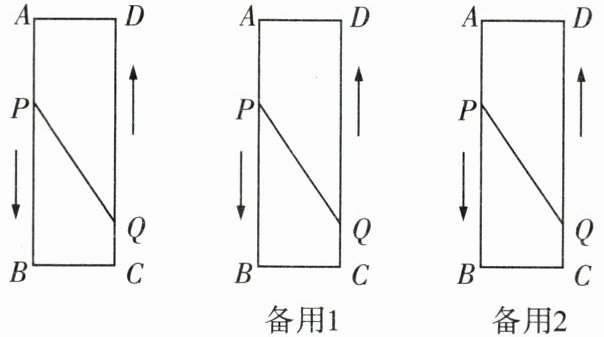
(1)当$t$为何值时,点$P$和点$Q$之间的距离是$3\mathrm{cm}$?
(2)当$t$为何值时,以点$P$,$Q$,$D$为顶点的三角形是以$PQ$为腰的等腰三角形?
(1)当$t$为何值时,点$P$和点$Q$之间的距离是$3\mathrm{cm}$?
(2)当$t$为何值时,以点$P$,$Q$,$D$为顶点的三角形是以$PQ$为腰的等腰三角形?
答案:
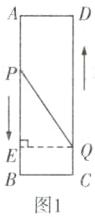
(1)如图 1,作$ QE \perp AB $于点$ E $,$ \therefore \angle PEQ = 90 ^ { \circ } $。$ \because \angle B = \angle C = 90 ^ { \circ } $,$ \therefore $四边形$ BCQE $是矩形,$ \therefore QE = BC = 2 $,$ BE = CQ = t $。$ \because AP = 2t $,$ \therefore PE = 6 - 2t - t = 6 - 3t $,在$ \mathrm { Rt } \triangle PQE $中,由勾股定理,得$ ( 6 - 3t ) ^ { 2 } + 4 = 9 $,解得$ t _ { 1 } = \frac { 6 - \sqrt { 5 } } { 3 } $,$ t _ { 2 } = \frac { 6 + \sqrt { 5 } } { 3 } $。
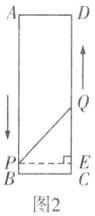
如图 2,作$ PE \perp CD $于点$ E $,$ \therefore \angle PEQ = 90 ^ { \circ } $,$ PE = BC = 2 $,$ BP = CE = 6 - 2t $,$ CQ = t $,$ \therefore QE = t - ( 6 - 2t ) = 3t - 6 $。在$ \mathrm { Rt } \triangle PEQ $中,由勾股定理,得$ ( 3t - 6 ) ^ { 2 } + 4 = 9 $,解得$ t _ { 1 } = \frac { 6 - \sqrt { 5 } } { 3 } $,$ t _ { 2 } = \frac { 6 + \sqrt { 5 } } { 3 } $。
综上所述$ t _ { 1 } = \frac { 6 - \sqrt { 5 } } { 3 } $,$ t _ { 2 } = \frac { 6 + \sqrt { 5 } } { 3 } $。
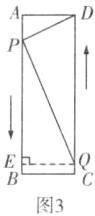
(2)如图 3,当$ PQ = DQ $时,作$ QE \perp AB $于点$ E $,$ \therefore \angle PEQ = 90 ^ { \circ } $。$ \because \angle B = \angle C = 90 ^ { \circ } $,$ \therefore $四边形$ BCQE $是矩形,$ \therefore QE = BC = 2 $,$ BE = CQ = t $。$ \because AP = 2t $,$ \therefore PE = 6 - 2t - t = 6 - 3t $,$ DQ = 6 - t $。$ \because PQ = DQ $,$ \therefore PQ = 6 - t $。在$ \mathrm { Rt } \triangle PQE $中,由勾股定理,得$ ( 6 - 3t ) ^ { 2 } + 4 = ( 6 - t ) ^ { 2 } $,解得$ t _ { 1 } = \frac { 3 + \sqrt { 7 } } { 2 } $,$ t _ { 2 } = \frac { 3 - \sqrt { 7 } } { 2 } $。
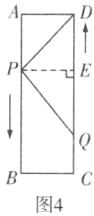
如图 4,当$ PD = PQ $时,作$ PE \perp DQ $于$ E $,$ \therefore DE = QE = \frac { 1 } { 2 } QD $,$ \angle PED = 90 ^ { \circ } $。$ \because \angle A = \angle ADE = 90 ^ { \circ } $,$ \therefore $四边形$ ADEP $是矩形,$ \therefore AP = DE $。$ \because DQ = 6 - t $,$ \therefore DE = \frac { 1 } { 2 } ( 6 - t ) $,$ \therefore 2t = \frac { 1 } { 2 } ( 6 - t ) $,解得$ t = \frac { 6 } { 5 } $。
综上所述,$ t = \frac { 3 + \sqrt { 7 } } { 2 } $,$ \frac { 3 - \sqrt { 7 } } { 2 } $,$ \frac { 6 } { 5 } $。
(1)如图 1,作$ QE \perp AB $于点$ E $,$ \therefore \angle PEQ = 90 ^ { \circ } $。$ \because \angle B = \angle C = 90 ^ { \circ } $,$ \therefore $四边形$ BCQE $是矩形,$ \therefore QE = BC = 2 $,$ BE = CQ = t $。$ \because AP = 2t $,$ \therefore PE = 6 - 2t - t = 6 - 3t $,在$ \mathrm { Rt } \triangle PQE $中,由勾股定理,得$ ( 6 - 3t ) ^ { 2 } + 4 = 9 $,解得$ t _ { 1 } = \frac { 6 - \sqrt { 5 } } { 3 } $,$ t _ { 2 } = \frac { 6 + \sqrt { 5 } } { 3 } $。
如图 2,作$ PE \perp CD $于点$ E $,$ \therefore \angle PEQ = 90 ^ { \circ } $,$ PE = BC = 2 $,$ BP = CE = 6 - 2t $,$ CQ = t $,$ \therefore QE = t - ( 6 - 2t ) = 3t - 6 $。在$ \mathrm { Rt } \triangle PEQ $中,由勾股定理,得$ ( 3t - 6 ) ^ { 2 } + 4 = 9 $,解得$ t _ { 1 } = \frac { 6 - \sqrt { 5 } } { 3 } $,$ t _ { 2 } = \frac { 6 + \sqrt { 5 } } { 3 } $。
综上所述$ t _ { 1 } = \frac { 6 - \sqrt { 5 } } { 3 } $,$ t _ { 2 } = \frac { 6 + \sqrt { 5 } } { 3 } $。
(2)如图 3,当$ PQ = DQ $时,作$ QE \perp AB $于点$ E $,$ \therefore \angle PEQ = 90 ^ { \circ } $。$ \because \angle B = \angle C = 90 ^ { \circ } $,$ \therefore $四边形$ BCQE $是矩形,$ \therefore QE = BC = 2 $,$ BE = CQ = t $。$ \because AP = 2t $,$ \therefore PE = 6 - 2t - t = 6 - 3t $,$ DQ = 6 - t $。$ \because PQ = DQ $,$ \therefore PQ = 6 - t $。在$ \mathrm { Rt } \triangle PQE $中,由勾股定理,得$ ( 6 - 3t ) ^ { 2 } + 4 = ( 6 - t ) ^ { 2 } $,解得$ t _ { 1 } = \frac { 3 + \sqrt { 7 } } { 2 } $,$ t _ { 2 } = \frac { 3 - \sqrt { 7 } } { 2 } $。
如图 4,当$ PD = PQ $时,作$ PE \perp DQ $于$ E $,$ \therefore DE = QE = \frac { 1 } { 2 } QD $,$ \angle PED = 90 ^ { \circ } $。$ \because \angle A = \angle ADE = 90 ^ { \circ } $,$ \therefore $四边形$ ADEP $是矩形,$ \therefore AP = DE $。$ \because DQ = 6 - t $,$ \therefore DE = \frac { 1 } { 2 } ( 6 - t ) $,$ \therefore 2t = \frac { 1 } { 2 } ( 6 - t ) $,解得$ t = \frac { 6 } { 5 } $。
综上所述,$ t = \frac { 3 + \sqrt { 7 } } { 2 } $,$ \frac { 3 - \sqrt { 7 } } { 2 } $,$ \frac { 6 } { 5 } $。
查看更多完整答案,请扫码查看

