

 搜索
搜索
第4页
- 第1页
- 第2页
- 第3页
- 第4页
- 第5页
- 第6页
- 第7页
- 第8页
- 第9页
- 第10页
- 第11页
- 第12页
- 第13页
- 第14页
- 第15页
- 第16页
- 第17页
- 第18页
- 第19页
- 第20页
- 第21页
- 第22页
- 第23页
- 第24页
- 第25页
- 第26页
- 第27页
- 第28页
- 第29页
- 第30页
- 第31页
- 第32页
- 第33页
- 第34页
- 第35页
- 第36页
- 第37页
- 第38页
- 第39页
- 第40页
- 第41页
- 第42页
- 第43页
- 第44页
- 第45页
- 第46页
- 第47页
- 第48页
- 第49页
- 第50页
- 第51页
- 第52页
- 第53页
- 第54页
- 第55页
- 第56页
- 第57页
- 第58页
- 第59页
- 第60页
- 第61页
- 第62页
- 第63页
- 第64页
- 第65页
- 第66页
- 第67页
- 第68页
- 第69页
- 第70页
- 第71页
- 第72页
- 第73页
- 第74页
- 第75页
- 第76页
- 第77页
- 第78页
- 第79页
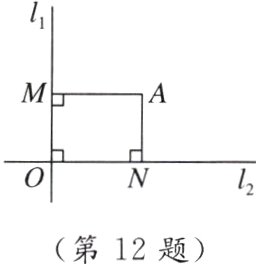
12. 如图,已知直线$l_{1}$⊥直线$l_{2}$于点O,AM⊥$l_{1}$于点M,AN⊥$l_{2}$于点N,AM = 4,AN = 3,以点A为圆心,r为半径作⊙A,若⊙A与两直线有四个公共点,则r的取值范围是______.
答案:
$r>4$且$r\neq5$ 【点拨】若$\odot A$与两直线有四个公共点,则$\odot A$与直线$l_{1}$,$l_{2}$都相交且不经过点O,则$r$的取值范围是$r>4$且$r\neq5$.
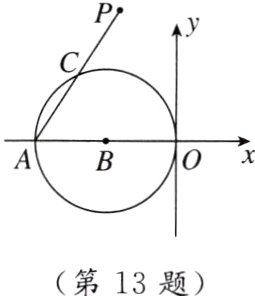
13. [2024无锡模拟] 如图,点A的坐标是(-2,0),点C是以OA为直径的⊙B上的一动点,点A关于点C的对称点为P(x,y),则3x + 4y的最小值为______.
答案:
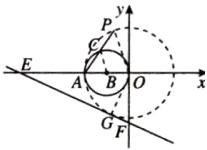
-10 【点拨】如图,连接BC,OP,
$\because$点A关于点C的对称点为$P(x,y)$,点C是以OA为直径的$\odot B$上的一动点,
$\therefore OP = 2BC$.
$\therefore$点P运动的轨迹是以O为圆心,AO长为半径的圆.
设$3x + 4y = k$,则点P在直线$y=-\frac{3}{4}x+\frac{k}{4}$上.
$\therefore$当直线$y=-\frac{3}{4}x+\frac{k}{4}$与$\odot O$相切且在$\odot O$的下方时,$k<0$,$\frac{k}{4}$的值最小,此时$3x + 4y$的值最小.
设此时直线$y=-\frac{3}{4}x+\frac{k}{4}$与$x$轴交于点E,与$y$轴交于点F,$\odot O$与直线$y=-\frac{3}{4}x+\frac{k}{4}$的切点为G,连接OG,则点$E(\frac{k}{3},0)$,$F(0,\frac{k}{4})$,$\therefore OE=-\frac{k}{3}$,$OF = -\frac{k}{4}$. $\therefore EF=-\frac{5}{12}k$.
$\because S_{\triangle OEF}=\frac{1}{2}OE\cdot OF=\frac{1}{2}OG\cdot EF$,
$\therefore\frac{1}{2}\times(-\frac{k}{3})\times(-\frac{k}{4})=\frac{1}{2}\times2\times(-\frac{5k}{12})$,
解得$k = -10$.
$\therefore 3x + 4y$的最小值为-10. 故答案为-10.
-10 【点拨】如图,连接BC,OP,
$\because$点A关于点C的对称点为$P(x,y)$,点C是以OA为直径的$\odot B$上的一动点,
$\therefore OP = 2BC$.
$\therefore$点P运动的轨迹是以O为圆心,AO长为半径的圆.
设$3x + 4y = k$,则点P在直线$y=-\frac{3}{4}x+\frac{k}{4}$上.
$\therefore$当直线$y=-\frac{3}{4}x+\frac{k}{4}$与$\odot O$相切且在$\odot O$的下方时,$k<0$,$\frac{k}{4}$的值最小,此时$3x + 4y$的值最小.
设此时直线$y=-\frac{3}{4}x+\frac{k}{4}$与$x$轴交于点E,与$y$轴交于点F,$\odot O$与直线$y=-\frac{3}{4}x+\frac{k}{4}$的切点为G,连接OG,则点$E(\frac{k}{3},0)$,$F(0,\frac{k}{4})$,$\therefore OE=-\frac{k}{3}$,$OF = -\frac{k}{4}$. $\therefore EF=-\frac{5}{12}k$.
$\because S_{\triangle OEF}=\frac{1}{2}OE\cdot OF=\frac{1}{2}OG\cdot EF$,
$\therefore\frac{1}{2}\times(-\frac{k}{3})\times(-\frac{k}{4})=\frac{1}{2}\times2\times(-\frac{5k}{12})$,
解得$k = -10$.
$\therefore 3x + 4y$的最小值为-10. 故答案为-10.
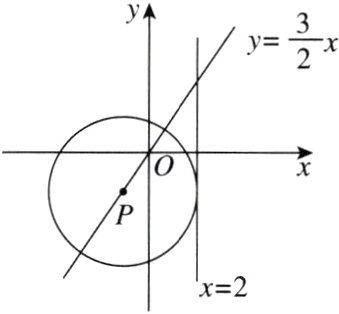
14. 如图,P为正比例函数$y = \frac{3}{2}x$图象上的一个动点,⊙P的半径为3,设点P的坐标为(x,y).
(1)求⊙P与直线x = 2相切时点P的坐标;
(2)请直接写出⊙P与直线x = 2相交、相离时x的取值范围.
(1)求⊙P与直线x = 2相切时点P的坐标;
(2)请直接写出⊙P与直线x = 2相交、相离时x的取值范围.
答案:
【解】
(1)$\because\odot P$与直线$x = 2$相切,$\odot P$的半径为3,
$\therefore$点P到直线$x = 2$的距离是3.
当点P在直线$x = 2$右侧时,点P的横坐标是$2 + 3 = 5$.
将$x = 5$代入$y=\frac{3}{2}x$,得$y=\frac{15}{2}$.
$\therefore P(5,\frac{15}{2})$.
当点P在直线$x = 2$左侧时,点P的横坐标是$2 - 3 = -1$.
将$x = -1$代入$y=\frac{3}{2}x$,得$y=-\frac{3}{2}$.
$\therefore P(-1,-\frac{3}{2})$.
综上所述,点P的坐标为$(5,\frac{15}{2})$或$(-1,-\frac{3}{2})$.
(2)当$-1<x<5$时,$\odot P$与直线$x = 2$相交;
当$x<-1$或$x>5$时,$\odot P$与直线$x = 2$相离.
(1)$\because\odot P$与直线$x = 2$相切,$\odot P$的半径为3,
$\therefore$点P到直线$x = 2$的距离是3.
当点P在直线$x = 2$右侧时,点P的横坐标是$2 + 3 = 5$.
将$x = 5$代入$y=\frac{3}{2}x$,得$y=\frac{15}{2}$.
$\therefore P(5,\frac{15}{2})$.
当点P在直线$x = 2$左侧时,点P的横坐标是$2 - 3 = -1$.
将$x = -1$代入$y=\frac{3}{2}x$,得$y=-\frac{3}{2}$.
$\therefore P(-1,-\frac{3}{2})$.
综上所述,点P的坐标为$(5,\frac{15}{2})$或$(-1,-\frac{3}{2})$.
(2)当$-1<x<5$时,$\odot P$与直线$x = 2$相交;
当$x<-1$或$x>5$时,$\odot P$与直线$x = 2$相离.
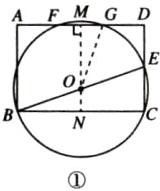
15. 新视角 动点探究题 如图,在矩形ABCD中,AB = 4,BC = 6. 点E为CD边上的一个动点(E不与C,D重合),⊙O是△BCE的外接圆.
(1)若CE = 2,⊙O交AD于点F,G,求FG的长度;
(2)若CE的长度为m,⊙O与AD的位置关系随着m的值的变化而变化,试探索⊙O与AD的位置关系及对应的m的取值范围.

(1)若CE = 2,⊙O交AD于点F,G,求FG的长度;
(2)若CE的长度为m,⊙O与AD的位置关系随着m的值的变化而变化,试探索⊙O与AD的位置关系及对应的m的取值范围.
答案:
【解】
(1)如图①,过点O作$OM\perp FG$于点M,延长MO交BC于点N,连接OG,则$FG = 2MG$.
$\because$四边形ABCD是矩形,
$\therefore\angle BCD=\angle D = 90^{\circ}$,$CD = AB = 4$.
$\therefore BE$是$\odot O$的直径.
$\because OM\perp FG$,$\angle BCD=\angle D = 90^{\circ}$,
$\therefore$四边形MNCD是矩形.
$\therefore MN\perp BC$,$MN = CD = 4$. $\therefore BN = CN$.
$\because OB = OE$,$\therefore ON$是$\triangle BCE$的中位线.
$\therefore ON=\frac{1}{2}CE = 1$,$\therefore OM = 4 - 1 = 3$.
在$Rt\triangle BCE$中,$BE=\sqrt{BC^{2}+CE^{2}} = 2\sqrt{10}$.
$\therefore OG=\frac{1}{2}BE=\sqrt{10}$.
在$Rt\triangle OMG$中,$MG=\sqrt{OG^{2}-OM^{2}} = 1$.
$\therefore FG = 2MG = 2$.
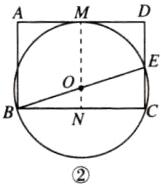
(2)如图②,当$\odot O$与AD相切于点M时,连接OM并反向延长,交BC于点N.
由
(1)易得$ON=\frac{1}{2}CE=\frac{1}{2}m$,$OB = OM = 4-\frac{1}{2}m$,$BN = 3$.
在$Rt\triangle BON$中,$ON^{2}+BN^{2}=OB^{2}$,
即$(\frac{1}{2}m)^{2}+3^{2}=(4-\frac{1}{2}m)^{2}$,解得$m=\frac{7}{4}$.
$\therefore$当$0<m<\frac{7}{4}$时,$\odot O$与AD相离,
当$m=\frac{7}{4}$时,$\odot O$与AD相切,
当$\frac{7}{4}<m<4$时,$\odot O$与AD相交.
【解】
(1)如图①,过点O作$OM\perp FG$于点M,延长MO交BC于点N,连接OG,则$FG = 2MG$.
$\because$四边形ABCD是矩形,
$\therefore\angle BCD=\angle D = 90^{\circ}$,$CD = AB = 4$.
$\therefore BE$是$\odot O$的直径.
$\because OM\perp FG$,$\angle BCD=\angle D = 90^{\circ}$,
$\therefore$四边形MNCD是矩形.
$\therefore MN\perp BC$,$MN = CD = 4$. $\therefore BN = CN$.
$\because OB = OE$,$\therefore ON$是$\triangle BCE$的中位线.
$\therefore ON=\frac{1}{2}CE = 1$,$\therefore OM = 4 - 1 = 3$.
在$Rt\triangle BCE$中,$BE=\sqrt{BC^{2}+CE^{2}} = 2\sqrt{10}$.
$\therefore OG=\frac{1}{2}BE=\sqrt{10}$.
在$Rt\triangle OMG$中,$MG=\sqrt{OG^{2}-OM^{2}} = 1$.
$\therefore FG = 2MG = 2$.
(2)如图②,当$\odot O$与AD相切于点M时,连接OM并反向延长,交BC于点N.
由
(1)易得$ON=\frac{1}{2}CE=\frac{1}{2}m$,$OB = OM = 4-\frac{1}{2}m$,$BN = 3$.
在$Rt\triangle BON$中,$ON^{2}+BN^{2}=OB^{2}$,
即$(\frac{1}{2}m)^{2}+3^{2}=(4-\frac{1}{2}m)^{2}$,解得$m=\frac{7}{4}$.
$\therefore$当$0<m<\frac{7}{4}$时,$\odot O$与AD相离,
当$m=\frac{7}{4}$时,$\odot O$与AD相切,
当$\frac{7}{4}<m<4$时,$\odot O$与AD相交.
查看更多完整答案,请扫码查看

