

 搜索
搜索
第25页
- 第1页
- 第2页
- 第3页
- 第4页
- 第5页
- 第6页
- 第7页
- 第8页
- 第9页
- 第10页
- 第11页
- 第12页
- 第13页
- 第14页
- 第15页
- 第16页
- 第17页
- 第18页
- 第19页
- 第20页
- 第21页
- 第22页
- 第23页
- 第24页
- 第25页
- 第26页
- 第27页
- 第28页
- 第29页
- 第30页
- 第31页
- 第32页
- 第33页
- 第34页
- 第35页
- 第36页
- 第37页
- 第38页
- 第39页
- 第40页
- 第41页
- 第42页
- 第43页
- 第44页
- 第45页
- 第46页
- 第47页
- 第48页
- 第49页
- 第50页
- 第51页
- 第52页
- 第53页
- 第54页
- 第55页
- 第56页
- 第57页
- 第58页
- 第59页
- 第60页
- 第61页
- 第62页
- 第63页
- 第64页
- 第65页
- 第66页
- 第67页
- 第68页
- 第69页
- 第70页
- 第71页
- 第72页
- 第73页
- 第74页
- 第75页
- 第76页
- 第77页
- 第78页
- 第79页
- 第80页
- 第81页
- 第82页
- 第83页
- 第84页
- 第85页
7. 用适当的方法解方程:
(1) $x^{2}-4x + 2 = 0$;
(2) $(x + 3)^{2}+2(x + 3)=0$;
(3) $2x^{2}+3x = 7$.
(1) $x^{2}-4x + 2 = 0$;
(2) $(x + 3)^{2}+2(x + 3)=0$;
(3) $2x^{2}+3x = 7$.
答案:
(1)$x^{2}-4x=-2.x^{2}-4x + 4=-2 + 4$,即$(x - 2)^{2}=2.x - 2=\pm\sqrt{2}$.解得$x_{1}=2+\sqrt{2},x_{2}=2-\sqrt{2}$.
(2)$(x + 3)(x + 3 + 2)=0$.$\therefore x+3=0$或$x + 5=0$.解得$x_{1}=-3,x_{2}=-5$.
(3)原方程化为$2x^{2}+3x-7=0.\because a=2,b=3,c=-7,\therefore b^{2}-4ac=9 + 56=65$.$\therefore x=\frac{-3\pm\sqrt{65}}{4}$ $\therefore x_{1}=\frac{-3+\sqrt{65}}{4},x_{2}=\frac{-3-\sqrt{65}}{4}$.
(1)$x^{2}-4x=-2.x^{2}-4x + 4=-2 + 4$,即$(x - 2)^{2}=2.x - 2=\pm\sqrt{2}$.解得$x_{1}=2+\sqrt{2},x_{2}=2-\sqrt{2}$.
(2)$(x + 3)(x + 3 + 2)=0$.$\therefore x+3=0$或$x + 5=0$.解得$x_{1}=-3,x_{2}=-5$.
(3)原方程化为$2x^{2}+3x-7=0.\because a=2,b=3,c=-7,\therefore b^{2}-4ac=9 + 56=65$.$\therefore x=\frac{-3\pm\sqrt{65}}{4}$ $\therefore x_{1}=\frac{-3+\sqrt{65}}{4},x_{2}=\frac{-3-\sqrt{65}}{4}$.
8. (2024·南阳镇平县月考)以 $x=\frac{b\pm\sqrt{b^{2}-4c}}{2}$ 为根的一元二次方程可能是(
A.$x^{2}+bx + c = 0$
B.$x^{2}+bx - c = 0$
C.$x^{2}-bx + c = 0$
D.$x^{2}-bx - c = 0$
C
)A.$x^{2}+bx + c = 0$
B.$x^{2}+bx - c = 0$
C.$x^{2}-bx + c = 0$
D.$x^{2}-bx - c = 0$
答案:
C
9. (2024·赤峰)等腰三角形的两边长分别是方程 $x^{2}-10x + 21 = 0$ 的两个根,则这个三角形的周长为(
A.$17$ 或 $13$
B.$13$ 或 $21$
C.$17$
D.$13$
C
)A.$17$ 或 $13$
B.$13$ 或 $21$
C.$17$
D.$13$
答案:
C
10. 已知关于 $x$ 的方程 $x(x - 1)=3(x - 1)$,则下列解法中,完全正确的是(
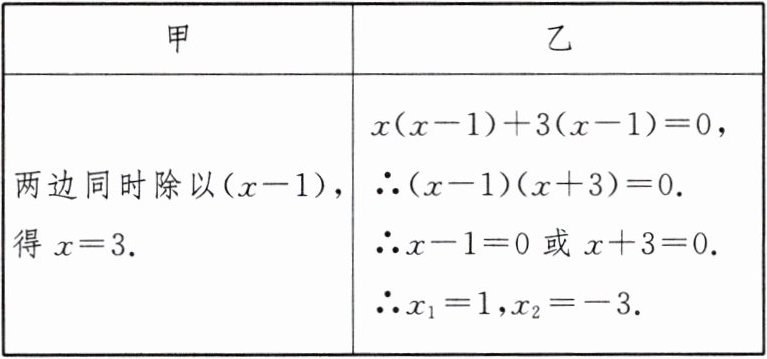
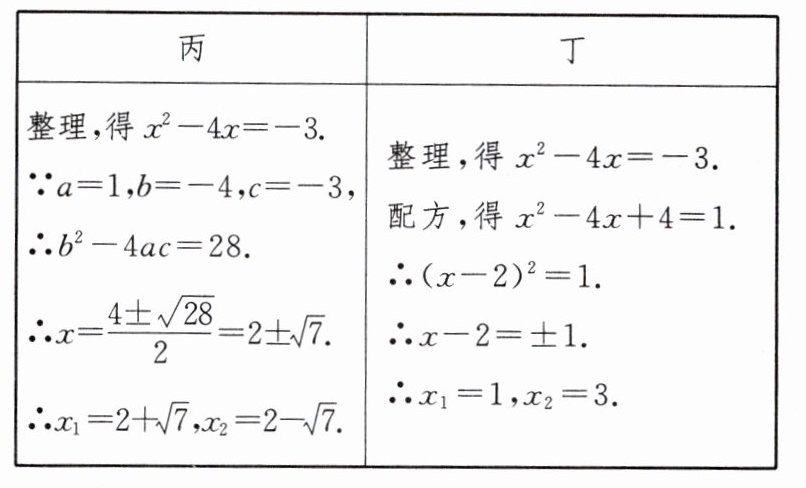
A.甲
B.乙
C.丙
D.丁
D
)A.甲
B.乙
C.丙
D.丁
答案:
D
11. 【数形结合思想】如图,点 在数轴的负半轴上,点 在数轴的正半轴上,且点 对应的数是 ,点 对应的数是 .已知 ,则 的值为
 ]
]
$\frac{1 - \sqrt{17}}{2}$
.]
答案:
$\frac{1 - \sqrt{17}}{2}$
12. 用公式法解下列方程:
(1) $2x^{2}+\sqrt{2}x = 3$;
(2) $(3x + 2)(x + 3)=x + 14$.
(1) $2x^{2}+\sqrt{2}x = 3$;
(2) $(3x + 2)(x + 3)=x + 14$.
答案:
(1)原方程化为$2x^{2}+\sqrt{2}x-3=0.\because a=2,b=\sqrt{2},c=-3,\therefore b^{2}-4ac=(\sqrt{2})^{2}-4×2×(-3)=26.\therefore x=\frac{-\sqrt{2}\pm\sqrt{26}}{2×2}$ $\therefore x_{1}=\frac{-\sqrt{2}+\sqrt{26}}{4},x_{2}=\frac{-\sqrt{2}-\sqrt{26}}{4}$.
(2)原方程化为$3x^{2}+10x-8=0.\because a=3,b=10,c=-8,\therefore b^{2}-4ac=196.\therefore x=\frac{-10\pm\sqrt{196}}{6}$,即$x=\frac{-5\pm7}{3}$ $\therefore x_{1}=\frac{2}{3},x_{2}=-4$.
(1)原方程化为$2x^{2}+\sqrt{2}x-3=0.\because a=2,b=\sqrt{2},c=-3,\therefore b^{2}-4ac=(\sqrt{2})^{2}-4×2×(-3)=26.\therefore x=\frac{-\sqrt{2}\pm\sqrt{26}}{2×2}$ $\therefore x_{1}=\frac{-\sqrt{2}+\sqrt{26}}{4},x_{2}=\frac{-\sqrt{2}-\sqrt{26}}{4}$.
(2)原方程化为$3x^{2}+10x-8=0.\because a=3,b=10,c=-8,\therefore b^{2}-4ac=196.\therefore x=\frac{-10\pm\sqrt{196}}{6}$,即$x=\frac{-5\pm7}{3}$ $\therefore x_{1}=\frac{2}{3},x_{2}=-4$.
13. 如图,将图 1 正方形剪成四块,恰能拼成图 2 的矩形.若 $a = 1$,则 $b=$
]
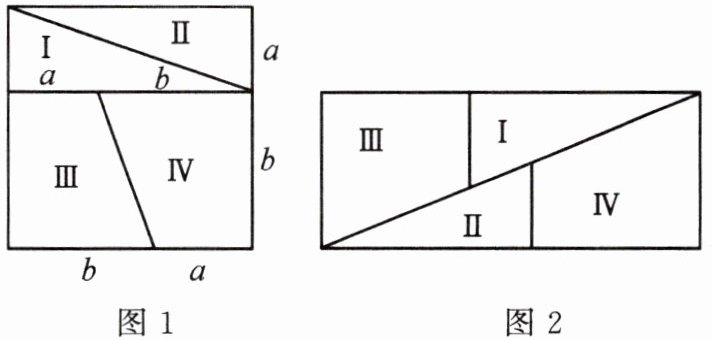
$\frac{1 + \sqrt{5}}{2}$
.]
答案:
$\frac{1 + \sqrt{5}}{2}$
查看更多完整答案,请扫码查看

