

 搜索
搜索
2025年经纶学霸阅读英语100篇五年级英语
注:目前有些书本章节名称可能整理的还不是很完善,但都是按照顺序排列的,请同学们按照顺序仔细查找。练习册 2025年经纶学霸阅读英语100篇五年级英语 答案主要是用来给同学们做完题方便对答案用的,请勿直接抄袭。
第47页
- 第1页
- 第2页
- 第3页
- 第4页
- 第5页
- 第6页
- 第7页
- 第8页
- 第9页
- 第10页
- 第11页
- 第12页
- 第13页
- 第14页
- 第15页
- 第16页
- 第17页
- 第18页
- 第19页
- 第20页
- 第21页
- 第22页
- 第23页
- 第24页
- 第25页
- 第26页
- 第27页
- 第28页
- 第29页
- 第30页
- 第31页
- 第32页
- 第33页
- 第34页
- 第35页
- 第36页
- 第37页
- 第38页
- 第39页
- 第40页
- 第41页
- 第42页
- 第43页
- 第44页
- 第45页
- 第46页
- 第47页
- 第48页
- 第49页
- 第50页
- 第51页
- 第52页
- 第53页
- 第54页
- 第55页
- 第56页
- 第57页
- 第58页
- 第59页
- 第60页
- 第61页
- 第62页
- 第63页
- 第64页
- 第65页
- 第66页
- 第67页
- 第68页
- 第69页
- 第70页
- 第71页
- 第72页
- 第73页
- 第74页
- 第75页
- 第76页
- 第77页
- 第78页
- 第79页
- 第80页
- 第81页
- 第82页
- 第83页
- 第84页
- 第85页
- 第86页
- 第87页
- 第88页
- 第89页
- 第90页
- 第91页
- 第92页
- 第93页
- 第94页
- 第95页
- 第96页
- 第97页
- 第98页
- 第99页
- 第100页
- 第101页
- 第102页
- 第103页
- 第104页
- 第105页
- 第106页
Saturday周末集训 训练2
Saturday周末集训 训练2
Saturday 周末集训 Week 6
计划安排
训练 2 短文填空
二十四节气:中国人的自然时间哲学
Last summer, I
One day, when my grandmother came to talk to me, I was
24 solar terms play an

For example, they named the day with the longest daytime of the year as xiazhi. The shortest one is called dongzhi. And dahan is the coldest day of the year. In Northern China, it often snows
The solar terms are really useful
Thanks
一、阅读短文,根据所给单词、音标或语境的提示,在每个空格内填入一个适当的单词,要求所填的单词意义准确,拼写正确,使短文意思完整、行文连贯。
1.
6.
二、新考法 文化意识 查阅相关资料,完成下面的研究。
The 24 solar terms are based on the lunar calendar(阴历). Western seasons use the solar calendar(阳历).
Research: Find one similarity and one difference between these two systems.
Saturday周末集训 训练2
Saturday 周末集训 Week 6
计划安排
训练 2 短文填空
二十四节气:中国人的自然时间哲学
Last summer, I
spent
(spend) my vacation with my grandmother. My grandmother is a
farmer in a mountain village.One day, when my grandmother came to talk to me, I was
reading
(read) a book about 24 solar terms, also called jieqi. My grandmother told me many things about 24 solar terms.24 solar terms play an
important
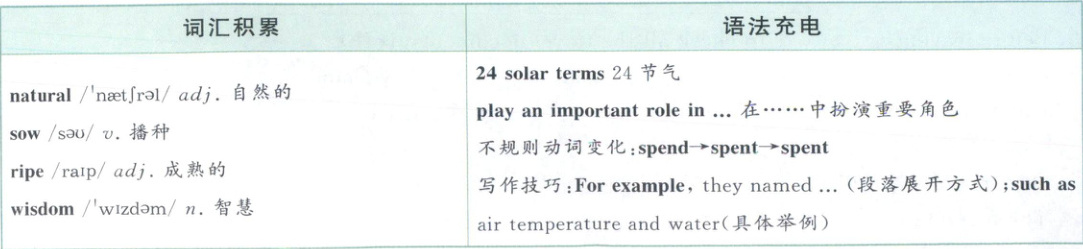
(/ɪm'pɔːtnt/) role in Chinese culture. About 2,000 years ago, Chinese people studied natural changes, such
(/sʌtʃ/) as air temperature and water. They then made 24 solar terms to show the changes in seasons and weather.For example, they named the day with the longest daytime of the year as xiazhi. The shortest one is called dongzhi. And dahan is the coldest day of the year. In Northern China, it often snows
heavily
(heavy).The solar terms are really useful
because
they help farmers make plans
(plan). When lichun comes, the weather gets warm. The trees and grass
(/grɑːs/) turn green. Farmers are going to sow seeds. When mangzhong comes, wheat is ripe. The harvest time is coming!Thanks
to
the wisdom of Chinese people, now, the solar terms are still helpful to our life in many aspects!一、阅读短文,根据所给单词、音标或语境的提示,在每个空格内填入一个适当的单词,要求所填的单词意义准确,拼写正确,使短文意思完整、行文连贯。
1.
spent
2. a
3. reading
4. important
5. such
6.
heavily
7. because
8. plans
9. grass
10. to
二、新考法 文化意识 查阅相关资料,完成下面的研究。
The 24 solar terms are based on the lunar calendar(阴历). Western seasons use the solar calendar(阳历).
Research: Find one similarity and one difference between these two systems.
答案:
一、1. spent 句意:去年夏天,我和祖母一起度过了暑假。根据“Last summer”可知时态为一般过去时,所以将 spend 变为 spent。故填 spent。
2. a 句意:我的祖母是山村里的一个农民。横线上表示泛指一个,由于 farmer 的发音为辅音音素开头,所以是 a。故填 a。
3. reading 句意:一天,当我的祖母和我说话,我正在读一本关于 24 节气的书。根据语境是当祖母来时,“我”正在读书,所以是过去进行时,已有 was,所以将 read 变为 reading。故填 reading。
4. important 句意:24 节气在中国文化中扮演着重要的角色。根据音标提示,应是形容词 important“重要的”。故填 important。
5. such 句意:大约 2000 年前,中国人研究了自然变化,例如气温和水。根据音标提示,应是 such,such as“例如”。故填 such。
6. heavily 句意:在中国北方,(这一天)常常大雪纷飞。分析句子可知,横线上是副词修饰动词 snow,所以将 heavy 变为副词 heavily。故填 heavily。
7. because 句意:节气真的非常有用,因为它们帮助农民制订计划。横线后解释原因,所以是 because。故填 because。
8. plans 句意:节气真的非常有用,因为它们帮助农民制订计划。plan“计划”是可数名词,make plans“制定计划”,所以变为复数 plans。故填 plans。
9. grass 句意:树木和青草变绿。根据音标提示应是不可数名词 grass“青草”。故填 grass。
10. to 句意:多亏了中国人民的智慧,如今,节气在许多方面仍然对我们的生活有帮助!考查短语 thanks to“多亏了”。故填 to。
A 文化拓展 24 节气的起源与发展
24 节气起源于中国古代的农业文明,最早可追溯到殷商时期。当时人们通过观察太阳的运行规律和自然现象的变化,逐渐形成了节气的概念。到了秦汉时期,24 节气已经基本确立,并被纳入历法体系。24 节气不仅在中国广泛传播,还对东亚其他国家如日本、韩国等产生了深远影响。这些国家在历史上借鉴了中国的历法和节气制度,将其融入到自己的文化和农业实践中。24 节气与农业密切相关,每个节气都对应着特定的农事活动。例如,“清明前后,种瓜点豆”,“谷雨前后,埯(ǎn)瓜点豆”,这些农谚反映了节气对播种、收获等农事活动的指导作用。
二、Similarity:Both the lunar calendar and the solar calendar are used to divide and mark time, helping people organize their lives and activities.
Difference: The lunar calendar is based on the cycles of the Moon, while the solar calendar is based on the Earth’s revolution around the Sun. This leads to differences in the length of months and the alignment with seasons between the two calendars.
2. a 句意:我的祖母是山村里的一个农民。横线上表示泛指一个,由于 farmer 的发音为辅音音素开头,所以是 a。故填 a。
3. reading 句意:一天,当我的祖母和我说话,我正在读一本关于 24 节气的书。根据语境是当祖母来时,“我”正在读书,所以是过去进行时,已有 was,所以将 read 变为 reading。故填 reading。
4. important 句意:24 节气在中国文化中扮演着重要的角色。根据音标提示,应是形容词 important“重要的”。故填 important。
5. such 句意:大约 2000 年前,中国人研究了自然变化,例如气温和水。根据音标提示,应是 such,such as“例如”。故填 such。
6. heavily 句意:在中国北方,(这一天)常常大雪纷飞。分析句子可知,横线上是副词修饰动词 snow,所以将 heavy 变为副词 heavily。故填 heavily。
7. because 句意:节气真的非常有用,因为它们帮助农民制订计划。横线后解释原因,所以是 because。故填 because。
8. plans 句意:节气真的非常有用,因为它们帮助农民制订计划。plan“计划”是可数名词,make plans“制定计划”,所以变为复数 plans。故填 plans。
9. grass 句意:树木和青草变绿。根据音标提示应是不可数名词 grass“青草”。故填 grass。
10. to 句意:多亏了中国人民的智慧,如今,节气在许多方面仍然对我们的生活有帮助!考查短语 thanks to“多亏了”。故填 to。
A 文化拓展 24 节气的起源与发展
24 节气起源于中国古代的农业文明,最早可追溯到殷商时期。当时人们通过观察太阳的运行规律和自然现象的变化,逐渐形成了节气的概念。到了秦汉时期,24 节气已经基本确立,并被纳入历法体系。24 节气不仅在中国广泛传播,还对东亚其他国家如日本、韩国等产生了深远影响。这些国家在历史上借鉴了中国的历法和节气制度,将其融入到自己的文化和农业实践中。24 节气与农业密切相关,每个节气都对应着特定的农事活动。例如,“清明前后,种瓜点豆”,“谷雨前后,埯(ǎn)瓜点豆”,这些农谚反映了节气对播种、收获等农事活动的指导作用。
二、Similarity:Both the lunar calendar and the solar calendar are used to divide and mark time, helping people organize their lives and activities.
Difference: The lunar calendar is based on the cycles of the Moon, while the solar calendar is based on the Earth’s revolution around the Sun. This leads to differences in the length of months and the alignment with seasons between the two calendars.
查看更多完整答案,请扫码查看

