

 搜索
搜索
第47页
- 第1页
- 第2页
- 第3页
- 第4页
- 第5页
- 第6页
- 第7页
- 第8页
- 第9页
- 第10页
- 第11页
- 第12页
- 第13页
- 第14页
- 第15页
- 第16页
- 第17页
- 第18页
- 第19页
- 第20页
- 第21页
- 第22页
- 第23页
- 第24页
- 第25页
- 第26页
- 第27页
- 第28页
- 第29页
- 第30页
- 第31页
- 第32页
- 第33页
- 第34页
- 第35页
- 第36页
- 第37页
- 第38页
- 第39页
- 第40页
- 第41页
- 第42页
- 第43页
- 第44页
- 第45页
- 第46页
- 第47页
- 第48页
- 第49页
- 第50页
- 第51页
- 第52页
- 第53页
- 第54页
- 第55页
- 第56页
- 第57页
- 第58页
- 第59页
- 第60页
- 第61页
- 第62页
- 第63页
- 第64页
- 第65页
- 第66页
- 第67页
- 第68页
- 第69页
- 第70页
- 第71页
- 第72页
- 第73页
- 第74页
- 第75页
- 第76页
- 第77页
- 第78页
- 第79页
- 第80页
- 第81页
- 第82页
- 第83页
- 第84页
- 第85页
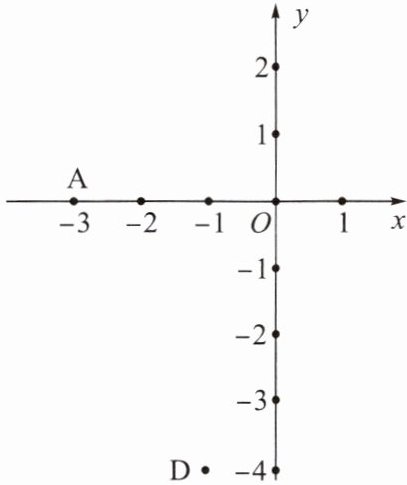
例2 如图,已知点 $A(-3,0)$,$D(-1,-4)$,在 $y$ 轴上找一点 $P$,使 $\triangle ADP$ 是直角三角形.
答案:
点$P(0,\frac{3}{2})$或$(0,-1)$或$(0,-3)$或$(0,-\frac{7}{2})$.
2. 如图,已知二次函数 $y = x^2 + bx + c$ 经过 $A$,$B$ 两点,$BC \perp x$ 轴于点 $C$,且点 $A(-1,0)$,$C(4,0)$,$AC = BC$.
(1) 求抛物线的解析式;
(2) 点 $P$ 是抛物线对称轴上的一个动点,是否存在这样的点 $P$,使 $\triangle ABP$ 成为直角三角形?若存在,求出所有点 $P$ 的坐标;若不存在,请说明理由.
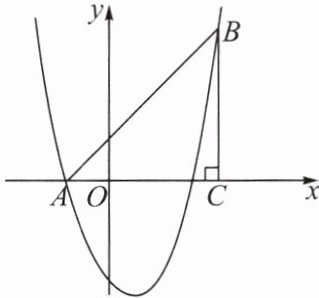
(1) 求抛物线的解析式;
(2) 点 $P$ 是抛物线对称轴上的一个动点,是否存在这样的点 $P$,使 $\triangle ABP$ 成为直角三角形?若存在,求出所有点 $P$ 的坐标;若不存在,请说明理由.
答案:
(1)$\because$点$A(-1,0)$,$C(4,0)$,$\therefore AC=5$,$OC=4$.$\because AC=BC=5$,$\therefore B(4,5)$.
把$A(-1,0)$和$B(4,5)$代入二次函数$y=x^{2}+bx+c$中得
$\begin{cases} 1-b+c=0 \\ 16+4b+c=5 \end{cases}$,解得$\begin{cases} b=-2 \\ c=-3 \end{cases}$,
$\therefore$二次函数的解析式为$y=x^{2}-2x-3$.
(2)存在
$y=x^{2}-2x-3=(x-1)^{2}-4$,$\therefore$设$P(1,m)$.
分三种情况
①以点$B$为直角顶点时,由勾股定理得$PB^{2}+AB^{2}=PA^{2}$,
$\therefore (4-1)^{2}+(m-5)^{2}+(4+1)^{2}+5^{2}=(1+1)^{2}+m^{2}$,解得$m=8$,$\therefore P(1,8)$;
②以点$A$为直角顶点时,由勾股定理得$PA^{2}+AB^{2}=PB^{2}$,
$\therefore (1+1)^{2}+m^{2}+(4+1)^{2}+5^{2}=(4-1)^{2}+(m-5)^{2}$,
解得$m=-2$,$\therefore P(1,-2)$;
③以点$P$为直角顶点时,由勾股定理得$PB^{2}+PA^{2}=BA^{2}$,
$\therefore (1+1)^{2}+m^{2}+(4-1)^{2}+(m-5)^{2}=(4+1)^{2}+5^{2}$,
解得$m=6$或$-1$,$\therefore P(1,6)$或$(1,-1)$.
综上所述,点$P$的坐标为$(1,8)$或$(1,-2)$或$(1,6)$或$(1,-1)$.
(1)$\because$点$A(-1,0)$,$C(4,0)$,$\therefore AC=5$,$OC=4$.$\because AC=BC=5$,$\therefore B(4,5)$.
把$A(-1,0)$和$B(4,5)$代入二次函数$y=x^{2}+bx+c$中得
$\begin{cases} 1-b+c=0 \\ 16+4b+c=5 \end{cases}$,解得$\begin{cases} b=-2 \\ c=-3 \end{cases}$,
$\therefore$二次函数的解析式为$y=x^{2}-2x-3$.
(2)存在
$y=x^{2}-2x-3=(x-1)^{2}-4$,$\therefore$设$P(1,m)$.
分三种情况
①以点$B$为直角顶点时,由勾股定理得$PB^{2}+AB^{2}=PA^{2}$,
$\therefore (4-1)^{2}+(m-5)^{2}+(4+1)^{2}+5^{2}=(1+1)^{2}+m^{2}$,解得$m=8$,$\therefore P(1,8)$;
②以点$A$为直角顶点时,由勾股定理得$PA^{2}+AB^{2}=PB^{2}$,
$\therefore (1+1)^{2}+m^{2}+(4+1)^{2}+5^{2}=(4-1)^{2}+(m-5)^{2}$,
解得$m=-2$,$\therefore P(1,-2)$;
③以点$P$为直角顶点时,由勾股定理得$PB^{2}+PA^{2}=BA^{2}$,
$\therefore (1+1)^{2}+m^{2}+(4-1)^{2}+(m-5)^{2}=(4+1)^{2}+5^{2}$,
解得$m=6$或$-1$,$\therefore P(1,6)$或$(1,-1)$.
综上所述,点$P$的坐标为$(1,8)$或$(1,-2)$或$(1,6)$或$(1,-1)$.
查看更多完整答案,请扫码查看

