

 搜索
搜索
第43页
- 第1页
- 第2页
- 第3页
- 第4页
- 第5页
- 第6页
- 第7页
- 第8页
- 第9页
- 第10页
- 第11页
- 第12页
- 第13页
- 第14页
- 第15页
- 第16页
- 第17页
- 第18页
- 第19页
- 第20页
- 第21页
- 第22页
- 第23页
- 第24页
- 第25页
- 第26页
- 第27页
- 第28页
- 第29页
- 第30页
- 第31页
- 第32页
- 第33页
- 第34页
- 第35页
- 第36页
- 第37页
- 第38页
- 第39页
- 第40页
- 第41页
- 第42页
- 第43页
- 第44页
- 第45页
- 第46页
- 第47页
- 第48页
- 第49页
- 第50页
- 第51页
- 第52页
- 第53页
- 第54页
- 第55页
- 第56页
- 第57页
- 第58页
- 第59页
- 第60页
- 第61页
- 第62页
- 第63页
- 第64页
- 第65页
- 第66页
- 第67页
- 第68页
- 第69页
- 第70页
- 第71页
- 第72页
- 第73页
- 第74页
- 第75页
- 第76页
- 第77页
- 第78页
- 第79页
- 第80页
- 第81页
- 第82页
- 第83页
- 第84页
- 第85页
- 第86页
- 第87页
- 第88页
- 第89页
- 第90页
- 第91页
- 第92页
- 第93页
- 第94页
- 第95页
- 第96页
- 第97页
- 第98页
- 第99页
- 第100页
- 第101页
- 第102页
- 第103页
- 第104页
- 第105页
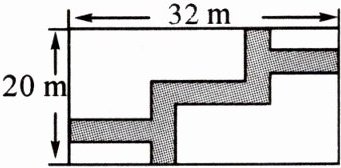
6. (12分)(抚顺新抚区期中)如图,在长为32m,宽为20m的矩形空地上修建同样宽的道路(图中阴影部分),剩余的空地上铺草坪,要使草坪的面积为$540m^2,$求道路的宽.
答案:
解:设道路的宽为x m,根据题意,得$(32-x)$$(20-x)=540$,解得$x_{1}=2$,$x_{2}=50$(不合题意,舍去),$\therefore$道路的宽为2 m
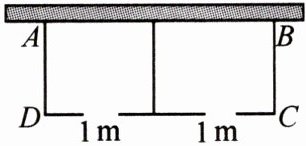
7. (16分)如图,利用一面墙(墙长25m),用总长度为49m的栅栏(图中实线部分)围成一个矩形围栏ABCD,且中间共留两个1m宽的小门,设栅栏BC的长为x m.
(1)若矩形围栏ABCD的面积为$210m^2,$求栅栏BC的长;
(2)矩形围栏ABCD的面积能达到$240m^2$吗?若能,求出相应的x值;若不能,请说明理由.
(1)若矩形围栏ABCD的面积为$210m^2,$求栅栏BC的长;
(2)矩形围栏ABCD的面积能达到$240m^2$吗?若能,求出相应的x值;若不能,请说明理由.
答案:
解:
(1)根据题意,得$x(49+1+1-3x)=210$,解得$x_{1}=7$,$x_{2}=10$,当$x=7$时,$49+1+1-3x=$$30>25$,不符合题意,舍去;当$x=10$时,$49+1+$$1-3x=21<25$,符合题意,$\therefore$栅栏BC的长为10 m
(2)不能,理由如下:当$x(49+1+1-3x)=240$时,整理,得$x^{2}-17x+80=0$,$\because \Delta =(-17)^{2}-$$4× 1× 80=-31<0$,$\therefore$该方程没有实数根,$\therefore$矩形围栏ABCD的面积不能达到$240\ m^{2}$
(1)根据题意,得$x(49+1+1-3x)=210$,解得$x_{1}=7$,$x_{2}=10$,当$x=7$时,$49+1+1-3x=$$30>25$,不符合题意,舍去;当$x=10$时,$49+1+$$1-3x=21<25$,符合题意,$\therefore$栅栏BC的长为10 m
(2)不能,理由如下:当$x(49+1+1-3x)=240$时,整理,得$x^{2}-17x+80=0$,$\because \Delta =(-17)^{2}-$$4× 1× 80=-31<0$,$\therefore$该方程没有实数根,$\therefore$矩形围栏ABCD的面积不能达到$240\ m^{2}$
8. (22分)新趋势 动点探究题(铁岭月考改编)如图,在矩形ABCD中,AB= 4cm,BC= 6cm,点P从点B出发沿边BC以2cm/s的速度向C运动,同时点Q从点C出发沿边CD以1cm/s的速度向点D运动,当一个点到达终点时另一点也同时停止.设运动的时间为t s.
(1)填空:CP=
(2)当t为何值时,PQ的长度为2√5cm?
(3)当t为何值时,△PDQ的面积为$6cm^2?$
(4)是否存在t使得△PDQ为等腰三角形?若存在,请求出t的值;若不存在,请说明理由.
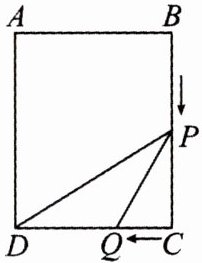
(2)当$PQ=2\sqrt{5}$ cm时,$\because CP^{2}+CQ^{2}=PQ^{2}$,$\therefore (6-2t)^{2}+t^{2}=20$,整理,得$5t^{2}-24t+16=0$,解得$t_{1}=4$(不合题意,舍去),$t_{2}=\frac{4}{5}$,$\therefore$当$t=\frac{4}{5}$时,PQ的长度为$2\sqrt{5}$ cm
(3)当$S_{\triangle PDQ}=\frac{1}{2}DQ\cdot CP=6\ cm^{2}$时,$\frac{1}{2}(4-t)\cdot$$(6-2t)=6$,整理,得$t^{2}-7t+6=0$,解得$t_{1}=1$,$t_{2}=6$(不合题意,舍去),$\therefore$当$t=1$时$\triangle PDQ$的面积为$6\ cm^{2}$
(4)不存在,理由如下:$\because \angle DQP>90^{\circ}$,$\therefore$要使$\triangle PDQ$为等腰三角形,只需$PQ=DQ$,即$CP^{2}+$$CQ^{2}=PQ^{2}=DQ^{2}$,也即$(6-2t)^{2}+t^{2}=(4-t)^{2}$,整理,得$t^{2}-4t+5=0$,$\because \Delta =(-4)^{2}-4× 1× 5=$$-4<0$,$\therefore$方程$t^{2}-4t+5=0$无解,$\therefore$不存在t使得$\triangle PDQ$为等腰三角形
(1)填空:CP=
(6-2t)
cm,DQ= (4-t)
cm(用含t的代数式表示),t的取值范围为0≤t≤3
;(2)当t为何值时,PQ的长度为2√5cm?
(3)当t为何值时,△PDQ的面积为$6cm^2?$
(4)是否存在t使得△PDQ为等腰三角形?若存在,请求出t的值;若不存在,请说明理由.
(2)当$PQ=2\sqrt{5}$ cm时,$\because CP^{2}+CQ^{2}=PQ^{2}$,$\therefore (6-2t)^{2}+t^{2}=20$,整理,得$5t^{2}-24t+16=0$,解得$t_{1}=4$(不合题意,舍去),$t_{2}=\frac{4}{5}$,$\therefore$当$t=\frac{4}{5}$时,PQ的长度为$2\sqrt{5}$ cm
(3)当$S_{\triangle PDQ}=\frac{1}{2}DQ\cdot CP=6\ cm^{2}$时,$\frac{1}{2}(4-t)\cdot$$(6-2t)=6$,整理,得$t^{2}-7t+6=0$,解得$t_{1}=1$,$t_{2}=6$(不合题意,舍去),$\therefore$当$t=1$时$\triangle PDQ$的面积为$6\ cm^{2}$
(4)不存在,理由如下:$\because \angle DQP>90^{\circ}$,$\therefore$要使$\triangle PDQ$为等腰三角形,只需$PQ=DQ$,即$CP^{2}+$$CQ^{2}=PQ^{2}=DQ^{2}$,也即$(6-2t)^{2}+t^{2}=(4-t)^{2}$,整理,得$t^{2}-4t+5=0$,$\because \Delta =(-4)^{2}-4× 1× 5=$$-4<0$,$\therefore$方程$t^{2}-4t+5=0$无解,$\therefore$不存在t使得$\triangle PDQ$为等腰三角形
答案:
解:
(1)$(6-2t)$ $(4-t)$ $0\leqslant t\leqslant 3$
(2)当$PQ=2\sqrt{5}$ cm时,$\because CP^{2}+CQ^{2}=PQ^{2}$,$\therefore (6-2t)^{2}+t^{2}=20$,整理,得$5t^{2}-24t+16=0$,解得$t_{1}=4$(不合题意,舍去),$t_{2}=\frac{4}{5}$,$\therefore$当$t=\frac{4}{5}$时,PQ的长度为$2\sqrt{5}$ cm
(3)当$S_{\triangle PDQ}=\frac{1}{2}DQ\cdot CP=6\ cm^{2}$时,$\frac{1}{2}(4-t)\cdot$$(6-2t)=6$,整理,得$t^{2}-7t+6=0$,解得$t_{1}=1$,$t_{2}=6$(不合题意,舍去),$\therefore$当$t=1$时$\triangle PDQ$的面积为$6\ cm^{2}$
(4)不存在,理由如下:$\because \angle DQP>90^{\circ}$,$\therefore$要使$\triangle PDQ$为等腰三角形,只需$PQ=DQ$,即$CP^{2}+$$CQ^{2}=PQ^{2}=DQ^{2}$,也即$(6-2t)^{2}+t^{2}=(4-t)^{2}$,整理,得$t^{2}-4t+5=0$,$\because \Delta =(-4)^{2}-4× 1× 5=$$-4<0$,$\therefore$方程$t^{2}-4t+5=0$无解,$\therefore$不存在t使得$\triangle PDQ$为等腰三角形
(1)$(6-2t)$ $(4-t)$ $0\leqslant t\leqslant 3$
(2)当$PQ=2\sqrt{5}$ cm时,$\because CP^{2}+CQ^{2}=PQ^{2}$,$\therefore (6-2t)^{2}+t^{2}=20$,整理,得$5t^{2}-24t+16=0$,解得$t_{1}=4$(不合题意,舍去),$t_{2}=\frac{4}{5}$,$\therefore$当$t=\frac{4}{5}$时,PQ的长度为$2\sqrt{5}$ cm
(3)当$S_{\triangle PDQ}=\frac{1}{2}DQ\cdot CP=6\ cm^{2}$时,$\frac{1}{2}(4-t)\cdot$$(6-2t)=6$,整理,得$t^{2}-7t+6=0$,解得$t_{1}=1$,$t_{2}=6$(不合题意,舍去),$\therefore$当$t=1$时$\triangle PDQ$的面积为$6\ cm^{2}$
(4)不存在,理由如下:$\because \angle DQP>90^{\circ}$,$\therefore$要使$\triangle PDQ$为等腰三角形,只需$PQ=DQ$,即$CP^{2}+$$CQ^{2}=PQ^{2}=DQ^{2}$,也即$(6-2t)^{2}+t^{2}=(4-t)^{2}$,整理,得$t^{2}-4t+5=0$,$\because \Delta =(-4)^{2}-4× 1× 5=$$-4<0$,$\therefore$方程$t^{2}-4t+5=0$无解,$\therefore$不存在t使得$\triangle PDQ$为等腰三角形
查看更多完整答案,请扫码查看

