

 搜索
搜索
第131页
- 第1页
- 第2页
- 第3页
- 第4页
- 第5页
- 第6页
- 第7页
- 第8页
- 第9页
- 第10页
- 第11页
- 第12页
- 第13页
- 第14页
- 第15页
- 第16页
- 第17页
- 第18页
- 第19页
- 第20页
- 第21页
- 第22页
- 第23页
- 第24页
- 第25页
- 第26页
- 第27页
- 第28页
- 第29页
- 第30页
- 第31页
- 第32页
- 第33页
- 第34页
- 第35页
- 第36页
- 第37页
- 第38页
- 第39页
- 第40页
- 第41页
- 第42页
- 第43页
- 第44页
- 第45页
- 第46页
- 第47页
- 第48页
- 第49页
- 第50页
- 第51页
- 第52页
- 第53页
- 第54页
- 第55页
- 第56页
- 第57页
- 第58页
- 第59页
- 第60页
- 第61页
- 第62页
- 第63页
- 第64页
- 第65页
- 第66页
- 第67页
- 第68页
- 第69页
- 第70页
- 第71页
- 第72页
- 第73页
- 第74页
- 第75页
- 第76页
- 第77页
- 第78页
- 第79页
- 第80页
- 第81页
- 第82页
- 第83页
- 第84页
- 第85页
- 第86页
- 第87页
- 第88页
- 第89页
- 第90页
- 第91页
- 第92页
- 第93页
- 第94页
- 第95页
- 第96页
- 第97页
- 第98页
- 第99页
- 第100页
- 第101页
- 第102页
- 第103页
- 第104页
- 第105页
- 第106页
- 第107页
- 第108页
- 第109页
- 第110页
- 第111页
- 第112页
- 第113页
- 第114页
- 第115页
- 第116页
- 第117页
- 第118页
- 第119页
- 第120页
- 第121页
- 第122页
- 第123页
- 第124页
- 第125页
- 第126页
- 第127页
- 第128页
- 第129页
- 第130页
- 第131页
- 第132页
- 第133页
- 第134页
- 第135页
- 第136页
- 第137页
- 第138页
- 第139页
一、完形填空
KEY→P41
范畴:人与自我 主题:方法策略 体裁:记叙文 难度:★★★★ 建议用时:7分钟 评价:____/10
There was a wise man named Abner in a small town. He often 1 ________ people’s problems and tried to give advice. The problem was that it seemed that people always complained about the 2 ________ problems over and over again.
Abner gave good advice to these people in order to help them 3 ________ their problems. But it seemed that they 4 ________ actually took his advice. In fact, it almost seemed that the people simply 5 ________ complaining and didn’t want to listen to Abner.
He came up with an interesting solution to this problem. Every time people came to him with 6 ________ complaints, he told them a joke. The joke was funny the first 7 ________ they heard it. But as they came back over time with the same old complaints, Abner would say the same old joke. It got less and less interesting as time 8 ________.
Finally, one person asked, “Abner, 9 ________ do you always tell the same joke over and over? It isn’t funny any more.”
Abner 10 ________ with a question of his own. “If you can’t laugh at the same joke over and over, then why do you always complain about the same things over and over again?”
( )1. A. looked for B. depended on C. listened to D. hearing of
( )2. A. easy B. same C. important D. strange
( )3. A. design B. check C. solve D. express
( )4. A. never B. sometimes C. always D. often
( )5. A. stopped B. practised C. noticed D. enjoyed
( )6. A. his B. your C. our D. their
( )7. A. week B. time C. night D. lesson
( )8. A. went by B. held up C. set off D. ran away
( )9. A. who B. how C. why D. what
( )10. A. decorated B. answered C. prepared D. recommended
KEY→P41
范畴:人与自我 主题:方法策略 体裁:记叙文 难度:★★★★ 建议用时:7分钟 评价:____/10
There was a wise man named Abner in a small town. He often 1 ________ people’s problems and tried to give advice. The problem was that it seemed that people always complained about the 2 ________ problems over and over again.
Abner gave good advice to these people in order to help them 3 ________ their problems. But it seemed that they 4 ________ actually took his advice. In fact, it almost seemed that the people simply 5 ________ complaining and didn’t want to listen to Abner.
He came up with an interesting solution to this problem. Every time people came to him with 6 ________ complaints, he told them a joke. The joke was funny the first 7 ________ they heard it. But as they came back over time with the same old complaints, Abner would say the same old joke. It got less and less interesting as time 8 ________.
Finally, one person asked, “Abner, 9 ________ do you always tell the same joke over and over? It isn’t funny any more.”
Abner 10 ________ with a question of his own. “If you can’t laugh at the same joke over and over, then why do you always complain about the same things over and over again?”
( )1. A. looked for B. depended on C. listened to D. hearing of
( )2. A. easy B. same C. important D. strange
( )3. A. design B. check C. solve D. express
( )4. A. never B. sometimes C. always D. often
( )5. A. stopped B. practised C. noticed D. enjoyed
( )6. A. his B. your C. our D. their
( )7. A. week B. time C. night D. lesson
( )8. A. went by B. held up C. set off D. ran away
( )9. A. who B. how C. why D. what
( )10. A. decorated B. answered C. prepared D. recommended
答案:
答案速递
完形填空 1~5 C B C A D 6~10 D B A C B
本文主要讲述了一位智者用巧妙的方法让经常抱怨的人停止抱怨的故事。
1. C 根据句中的 tried to give advice 理解可知,阿布纳尽力提供建议,说明他在听到别人的问题之后,想要去帮助他们,所以此处用动词短语 listen to,意思是“倾听”。
2. B 根据本句中的 over and over again 以及第四段中的 tell the same joke over and over 可知,人们总是一次又一次抱怨相同的问题。
3. C 根据前文的 Abner gave good advice 可知,阿布纳给他们提出好建议的目的是帮助他们解决问题,因此此处需要选动词 solve,意思是“解决”。
4. A 根据文章内容可知,阿布纳虽然给出了好建议,但是他们从来没有真正地去接受他的建议,因此此处用频度副词 never,是“从不”的意思。
5. D 根据句意理解可知,人们似乎只是喜欢抱怨,不愿意听阿布纳的话,说明人们很享受抱怨的过程而不听阿布纳的建议,此处应该用动词 enjoy,其后接动名词形式。
6. D 根据后面的 he told them a joke 可知,每当有人带着他们的抱怨来他身边时,他就给他们讲个笑话,根据后面的 them 可知,此处需要用形容词性物主代词 their。
7. B 根据“It got less and less interesting as time...”理解可知,随着时间的逝去,这个同样的旧笑话就变得越来越没趣了,说明他们第一次听到这个笑话时觉得是有趣的,因此此处应该填名词 time,表示“次”,the first time 是“第一次”的意思。
8. A 根据前文理解可知,随着时间的推移,他们又带着同样的抱怨回来了,阿布纳也会说同样的老笑话,所以他们不再感到有趣了,结合空格前的名词 time 可知,此处用动词短语 go by,表示“时间逝去”。
9. C 根据最后一段中的 why do you always complain about the same things over and over again 可知,阿布纳问抱怨者们为什么总是一遍又一遍地抱怨同样的事情,由此推知,此处是抱怨者们问阿布纳为什么总是一遍又一遍讲同样的笑话,用特殊疑问词 why 来询问原因。
10. B 根据空格后面的 a question of his own 以及引号中的问题可知,阿布纳通过他自己的问题来反问抱怨者们,所以此处用动词 answer,意思是“回答,答复”。
完形填空 1~5 C B C A D 6~10 D B A C B
本文主要讲述了一位智者用巧妙的方法让经常抱怨的人停止抱怨的故事。
1. C 根据句中的 tried to give advice 理解可知,阿布纳尽力提供建议,说明他在听到别人的问题之后,想要去帮助他们,所以此处用动词短语 listen to,意思是“倾听”。
2. B 根据本句中的 over and over again 以及第四段中的 tell the same joke over and over 可知,人们总是一次又一次抱怨相同的问题。
3. C 根据前文的 Abner gave good advice 可知,阿布纳给他们提出好建议的目的是帮助他们解决问题,因此此处需要选动词 solve,意思是“解决”。
4. A 根据文章内容可知,阿布纳虽然给出了好建议,但是他们从来没有真正地去接受他的建议,因此此处用频度副词 never,是“从不”的意思。
5. D 根据句意理解可知,人们似乎只是喜欢抱怨,不愿意听阿布纳的话,说明人们很享受抱怨的过程而不听阿布纳的建议,此处应该用动词 enjoy,其后接动名词形式。
6. D 根据后面的 he told them a joke 可知,每当有人带着他们的抱怨来他身边时,他就给他们讲个笑话,根据后面的 them 可知,此处需要用形容词性物主代词 their。
7. B 根据“It got less and less interesting as time...”理解可知,随着时间的逝去,这个同样的旧笑话就变得越来越没趣了,说明他们第一次听到这个笑话时觉得是有趣的,因此此处应该填名词 time,表示“次”,the first time 是“第一次”的意思。
8. A 根据前文理解可知,随着时间的推移,他们又带着同样的抱怨回来了,阿布纳也会说同样的老笑话,所以他们不再感到有趣了,结合空格前的名词 time 可知,此处用动词短语 go by,表示“时间逝去”。
9. C 根据最后一段中的 why do you always complain about the same things over and over again 可知,阿布纳问抱怨者们为什么总是一遍又一遍地抱怨同样的事情,由此推知,此处是抱怨者们问阿布纳为什么总是一遍又一遍讲同样的笑话,用特殊疑问词 why 来询问原因。
10. B 根据空格后面的 a question of his own 以及引号中的问题可知,阿布纳通过他自己的问题来反问抱怨者们,所以此处用动词 answer,意思是“回答,答复”。
二、阅读理解
A
KEY→P42
范畴:人与自然 主题:动物观光 体裁:应用文 难度:★★★ 建议用时:7分钟 评价:____/5
Good news for the week! The City Zoo now has two special programmes for young animal lovers.
Zoo to You
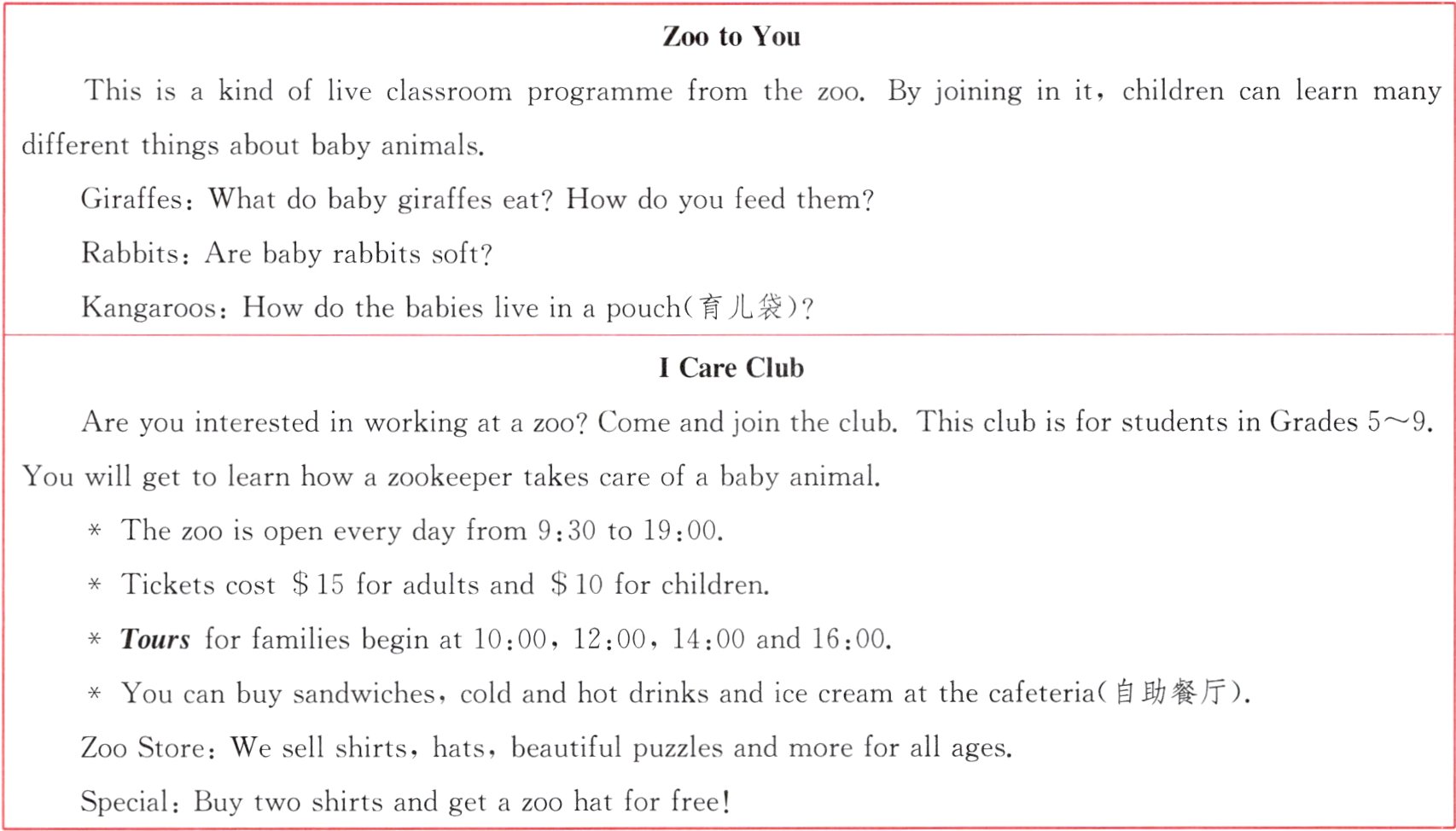
This is a kind of live classroom programme from the zoo. By joining in it, children can learn many different things about baby animals.
Giraffes: What do baby giraffes eat? How do you feed them?
Rabbits: Are baby rabbits soft?
Kangaroos: How do the babies live in a pouch(育儿袋)?
I Care Club
Are you interested in working at a zoo? Come and join the club. This club is for students in Grades 5~9. You will get to learn how a zookeeper takes care of a baby animal.
* The zoo is open every day from 9:30 to 19:00.
* Tickets cost $15 for adults and $10 for children.
* Tours for families begin at 10:00, 12:00, 14:00 and 16:00.
* You can buy sandwiches, cold and hot drinks and ice cream at the cafeteria(自助餐厅).
Zoo Store: We sell shirts, hats, beautiful puzzles and more for all ages.
Special: Buy two shirts and get a zoo hat for free!
( )1. Children can ________ if they join in the Zoo to You programme.
A. live with baby animals B. take baby animals home
C. learn more about baby animals D. dress up as baby animals
( )2. What do we know about the I Care Club?
A. It is a place for baby animals to live. B. It is a club for children in Grades 5~9.
C. It helps children look after their pets. D. It is a club for zookeepers to have fun.
( )3. How much should Mike pay if he visits the zoo with two 11 - year - old sons?
A. $15. B. $20. C. $35. D. $40.
( )4. Which of the following is TRUE?
A. The zoo opens at 10:00 every morning. B. Family tours start only in the afternoon.
C. Every child can get a zoo hat for free. D. Visitors can buy food and drinks at the zoo.
( )5. Where does the material probably come from?
A. A poster. B. A diary. C. A film. D. A game.
A
KEY→P42
范畴:人与自然 主题:动物观光 体裁:应用文 难度:★★★ 建议用时:7分钟 评价:____/5
Good news for the week! The City Zoo now has two special programmes for young animal lovers.
Zoo to You
This is a kind of live classroom programme from the zoo. By joining in it, children can learn many different things about baby animals.
Giraffes: What do baby giraffes eat? How do you feed them?
Rabbits: Are baby rabbits soft?
Kangaroos: How do the babies live in a pouch(育儿袋)?
I Care Club
Are you interested in working at a zoo? Come and join the club. This club is for students in Grades 5~9. You will get to learn how a zookeeper takes care of a baby animal.
* The zoo is open every day from 9:30 to 19:00.
* Tickets cost $15 for adults and $10 for children.
* Tours for families begin at 10:00, 12:00, 14:00 and 16:00.
* You can buy sandwiches, cold and hot drinks and ice cream at the cafeteria(自助餐厅).
Zoo Store: We sell shirts, hats, beautiful puzzles and more for all ages.
Special: Buy two shirts and get a zoo hat for free!
( )1. Children can ________ if they join in the Zoo to You programme.
A. live with baby animals B. take baby animals home
C. learn more about baby animals D. dress up as baby animals
( )2. What do we know about the I Care Club?
A. It is a place for baby animals to live. B. It is a club for children in Grades 5~9.
C. It helps children look after their pets. D. It is a club for zookeepers to have fun.
( )3. How much should Mike pay if he visits the zoo with two 11 - year - old sons?
A. $15. B. $20. C. $35. D. $40.
( )4. Which of the following is TRUE?
A. The zoo opens at 10:00 every morning. B. Family tours start only in the afternoon.
C. Every child can get a zoo hat for free. D. Visitors can buy food and drinks at the zoo.
( )5. Where does the material probably come from?
A. A poster. B. A diary. C. A film. D. A game.
答案:
阅读理解 [A] C B C D A
本文主要介绍了城市动物园向动物爱好者们推出的两个特别项目。
1. C 细节理解题。根据 Zoo to You 中的“By joining in it, children can learn many different things about baby animals.”可知,如果孩子们加入 Zoo to You 这个项目,就可以了解到更多有关动物幼崽的知识。
2. B 细节理解题。根据 I Care Club 中的“This club is for students in Grades 5~9.”可知,这是一个为 5 到 9 年级的孩子们开设的俱乐部。
3. C 推理判断题。根据“Tickets cost $15 for adults and $10 for children.”可知,成人票每张 15 美元,儿童票每张 10 美元。15 + 10×2 = 35,故迈克和他两个 11 岁的儿子一共需要花费 35 美元。
4. D 推理判断题。根据“You can buy sandwiches, cold and hot drinks and ice cream at the cafeteria.”可知,游客们可在动物园内购买食物和饮料。
5. A 推理判断题。根据“Good news for the week!”可知,城市动物园有好消息要告诉年轻的动物爱好者们,即该园即将推出两个特别项目。由此推知,本文很可能来自有关动物园的一张海报。
本文主要介绍了城市动物园向动物爱好者们推出的两个特别项目。
1. C 细节理解题。根据 Zoo to You 中的“By joining in it, children can learn many different things about baby animals.”可知,如果孩子们加入 Zoo to You 这个项目,就可以了解到更多有关动物幼崽的知识。
2. B 细节理解题。根据 I Care Club 中的“This club is for students in Grades 5~9.”可知,这是一个为 5 到 9 年级的孩子们开设的俱乐部。
3. C 推理判断题。根据“Tickets cost $15 for adults and $10 for children.”可知,成人票每张 15 美元,儿童票每张 10 美元。15 + 10×2 = 35,故迈克和他两个 11 岁的儿子一共需要花费 35 美元。
4. D 推理判断题。根据“You can buy sandwiches, cold and hot drinks and ice cream at the cafeteria.”可知,游客们可在动物园内购买食物和饮料。
5. A 推理判断题。根据“Good news for the week!”可知,城市动物园有好消息要告诉年轻的动物爱好者们,即该园即将推出两个特别项目。由此推知,本文很可能来自有关动物园的一张海报。
查看更多完整答案,请扫码查看

