

 搜索
搜索
2025年点对点期末复习及智胜暑假八年级数学北师大版
注:目前有些书本章节名称可能整理的还不是很完善,但都是按照顺序排列的,请同学们按照顺序仔细查找。练习册 2025年点对点期末复习及智胜暑假八年级数学北师大版 答案主要是用来给同学们做完题方便对答案用的,请勿直接抄袭。
第50页
- 第1页
- 第2页
- 第3页
- 第4页
- 第5页
- 第6页
- 第7页
- 第8页
- 第9页
- 第10页
- 第11页
- 第12页
- 第13页
- 第14页
- 第15页
- 第16页
- 第17页
- 第18页
- 第19页
- 第20页
- 第21页
- 第22页
- 第23页
- 第24页
- 第25页
- 第26页
- 第27页
- 第28页
- 第29页
- 第30页
- 第31页
- 第32页
- 第33页
- 第34页
- 第35页
- 第36页
- 第37页
- 第38页
- 第39页
- 第40页
- 第41页
- 第42页
- 第43页
- 第44页
- 第45页
- 第46页
- 第47页
- 第48页
- 第49页
- 第50页
- 第51页
- 第52页
- 第53页
- 第54页
- 第55页
- 第56页
- 第57页
- 第58页
- 第59页
- 第60页
- 第61页
- 第62页
- 第63页
- 第64页
- 第65页
- 第66页
- 第67页
- 第68页
- 第69页
- 第70页
- 第71页
- 第72页
- 第73页
- 第74页
- 第75页
- 第76页
- 第77页
- 第78页
- 第79页
- 第80页
- 第81页
- 第82页
- 第83页
- 第84页
- 第85页
- 第86页
- 第87页
25. 如图,将边长为$4$的正方形纸片置于平面直角坐标系内,顶点$A$在坐标原点,点$B在x$轴的正半轴上,$E$、$F分别是AD$、$BC$的中点,点$M在DC$上. 将$\triangle ADM沿AM$折叠,点$D折叠后恰好落在EF上的点P$处.
(1)求$∠EAP$的度数;
(2)求折痕$AM$所在直线的函数关系式;
(3)设$H为直线AM$上的点,是否存在这样的点$H$,使得以$H$、$A$、$P$为顶点的三角形是等腰三角形?若存在,请直接写出点$H$的坐标;若不存在,请说明理由.
(1)求$∠EAP$的度数;
$60^{\circ}$
(2)求折痕$AM$所在直线的函数关系式;
$y = \sqrt{3}x$
(3)设$H为直线AM$上的点,是否存在这样的点$H$,使得以$H$、$A$、$P$为顶点的三角形是等腰三角形?若存在,请直接写出点$H$的坐标;若不存在,请说明理由.
存在,点$H$的坐标为$(\frac{2\sqrt{3}}{3}, 2)$或$(2, 2\sqrt{3})$或$(-2, -2\sqrt{3})$或$(2\sqrt{3}, 6)$
答案:
解:
(1) 由折叠知, $AP = AD = 4$,
$\because E$ 是 $AD$ 的中点, $\therefore AE = \frac{1}{2}AD = 2$,
$\therefore AE = \frac{1}{2}AP$, $\therefore$ 在 $Rt\triangle AEP$ 中, $\angle EPA = 30^{\circ}$,
$\therefore \angle EAP = 60^{\circ}$;
(2) 由折叠知, $\angle DAM = \angle MAP = \frac{1}{2}\angle EAP = 30^{\circ}$,
在 $Rt\triangle ADM$ 中, $MD = \frac{1}{2}AM$,
$AD^{2} + DM^{2} = AM^{2}$, 即 $16 + DM^{2} = 4DM^{2}$,
解得 $DM = \frac{4\sqrt{3}}{3}, \therefore M(\frac{4\sqrt{3}}{3}, 4)$,
$\therefore$ 折痕 $AM$ 所在直线的函数关系式为 $y = \sqrt{3}x$;
(3) 存在,
设 $H(a, \sqrt{3}a)$,
$\because OE = 2, OP = 4$,
$\therefore PE = \sqrt{OP^{2} - OE^{2}} = 2\sqrt{3}, \therefore P(2\sqrt{3}, 2)$,
$\therefore AH^{2} = a^{2} + (\sqrt{3}a)^{2} = 4a^{2}$,
$PH^{2} = (2\sqrt{3} - a)^{2} + (2 - \sqrt{3}a)^{2} = 4a^{2} - 8\sqrt{3}a + 16$,
① 当 $AH = PH$ 时, $AH^{2} = PH^{2}$,
即 $4a^{2} = 4a^{2} - 8\sqrt{3}a + 16$, 解得 $a = \frac{2\sqrt{3}}{3}$,
$\therefore H(\frac{2\sqrt{3}}{3}, 2)$;
② 当 $AH = AP$ 时, $AH^{2} = AP^{2}$,
即 $4a^{2} = 4^{2}$, 解得 $a = \pm 2$,
$\therefore H(2, 2\sqrt{3})$ 或 $H(-2, -2\sqrt{3})$;
③ 当 $PH = AP$ 时, $PH^{2} = AP^{2}$,
即 $4a^{2} - 8\sqrt{3}a + 16 = 4^{2}$, 解得 $a = 2\sqrt{3}$ 或 0(舍),
$\therefore H(2\sqrt{3}, 6)$,
综上所述, 存在这样的点 H, 使得以 H、A、P 为顶点的三角形是等腰三角形, 点 H 的坐标为 $(\frac{2\sqrt{3}}{3}, 2)$ 或 $(2, 2\sqrt{3})$ 或 $(-2, -2\sqrt{3})$ 或 $(2\sqrt{3}, 6)$.
(1) 由折叠知, $AP = AD = 4$,
$\because E$ 是 $AD$ 的中点, $\therefore AE = \frac{1}{2}AD = 2$,
$\therefore AE = \frac{1}{2}AP$, $\therefore$ 在 $Rt\triangle AEP$ 中, $\angle EPA = 30^{\circ}$,
$\therefore \angle EAP = 60^{\circ}$;
(2) 由折叠知, $\angle DAM = \angle MAP = \frac{1}{2}\angle EAP = 30^{\circ}$,
在 $Rt\triangle ADM$ 中, $MD = \frac{1}{2}AM$,
$AD^{2} + DM^{2} = AM^{2}$, 即 $16 + DM^{2} = 4DM^{2}$,
解得 $DM = \frac{4\sqrt{3}}{3}, \therefore M(\frac{4\sqrt{3}}{3}, 4)$,
$\therefore$ 折痕 $AM$ 所在直线的函数关系式为 $y = \sqrt{3}x$;
(3) 存在,
设 $H(a, \sqrt{3}a)$,
$\because OE = 2, OP = 4$,
$\therefore PE = \sqrt{OP^{2} - OE^{2}} = 2\sqrt{3}, \therefore P(2\sqrt{3}, 2)$,
$\therefore AH^{2} = a^{2} + (\sqrt{3}a)^{2} = 4a^{2}$,
$PH^{2} = (2\sqrt{3} - a)^{2} + (2 - \sqrt{3}a)^{2} = 4a^{2} - 8\sqrt{3}a + 16$,
① 当 $AH = PH$ 时, $AH^{2} = PH^{2}$,
即 $4a^{2} = 4a^{2} - 8\sqrt{3}a + 16$, 解得 $a = \frac{2\sqrt{3}}{3}$,
$\therefore H(\frac{2\sqrt{3}}{3}, 2)$;
② 当 $AH = AP$ 时, $AH^{2} = AP^{2}$,
即 $4a^{2} = 4^{2}$, 解得 $a = \pm 2$,
$\therefore H(2, 2\sqrt{3})$ 或 $H(-2, -2\sqrt{3})$;
③ 当 $PH = AP$ 时, $PH^{2} = AP^{2}$,
即 $4a^{2} - 8\sqrt{3}a + 16 = 4^{2}$, 解得 $a = 2\sqrt{3}$ 或 0(舍),
$\therefore H(2\sqrt{3}, 6)$,
综上所述, 存在这样的点 H, 使得以 H、A、P 为顶点的三角形是等腰三角形, 点 H 的坐标为 $(\frac{2\sqrt{3}}{3}, 2)$ 或 $(2, 2\sqrt{3})$ 或 $(-2, -2\sqrt{3})$ 或 $(2\sqrt{3}, 6)$.
26. 在$□ ABCD$中,$∠ABC= 60^{\circ}$,$AB= 4$,$BC= 6$. 点$E'在BC边上且BE'= 4$,将$BE'绕点B逆时针旋转a^{\circ}(0 < a < 180)得到BE$.
(1)如图$1$,当$∠EBA= 90^{\circ}$时,求$S_{\triangle BCE}$的值;
(2)如图$2$,在旋转过程中,连接$CE$,取$CE中点F$,作射线$BF交直线AD于点G$.
①求线段$BF$长度的取值范围;
②当$∠EBF= 120^{\circ}$时,求证:$BC-DG= 2BF$;
(3)如图$3$,当$∠EBA= 90^{\circ}$时,点$S为线段BE$上一动点,过点$E作EM⊥射线AS于点M$,$N为AM$的中点,直接写出$BN$长度的最大值与最小值.

(1)如图$1$,当$∠EBA= 90^{\circ}$时,求$S_{\triangle BCE}$的值;
(2)如图$2$,在旋转过程中,连接$CE$,取$CE中点F$,作射线$BF交直线AD于点G$.
①求线段$BF$长度的取值范围;
②当$∠EBF= 120^{\circ}$时,求证:$BC-DG= 2BF$;
(3)如图$3$,当$∠EBA= 90^{\circ}$时,点$S为线段BE$上一动点,过点$E作EM⊥射线AS于点M$,$N为AM$的中点,直接写出$BN$长度的最大值与最小值.
答案:
解:
(1) 如图 1, 过点 E 作 $EH \perp BC$ 交 CB 的延长线于点 H,
$\therefore \angle EHC = 90^{\circ}$,
$\because \angle ABC = 60^{\circ}, \angle EBA = 90^{\circ}$,
$\therefore \angle EBH = 180^{\circ} - \angle EBA - \angle ABC = 30^{\circ}$,
将 $BE'$ 绕点 B 逆时针旋转 $\alpha$ 得到 BE,
$\therefore BE = BE' = 4$,
$\therefore EH = \frac{1}{2}BE = \frac{1}{2} × 4 = 2$,
又 $\because BC = 6, \therefore S_{\triangle BCE} = \frac{1}{2}BC \cdot EH = \frac{1}{2} × 6 × 2 = 6$;
(2) ① 解: 如图 2, 过点 E 作 $EK // BC$ 交 BG 于点 K, 则 $\angle FEK = \angle FCB$,
$\because$ 点 F 是 CE 的中点, $\therefore EF = CF$,
在 $\triangle EFK$ 和 $\triangle CFB$ 中, $\left\{\begin{array}{l}\angle FEK = \angle FCB\\EF = CF\\\angle EFK = \angle CFB\end{array}\right.$,
$\therefore \triangle EFK \cong \triangle CFB(ASA)$,
$\therefore EK = BC = 6, FK = FB, \therefore BK = 2BF$,
由旋转得: $BE = BE' = 4$,
在 $\triangle BEK$ 中, $EK - BE < BK < EK + BE$,
$\therefore 6 - 4 < BK < 6 + 4$, 即 $2 < 2BF < 10$,
$\therefore 1 < BF < 5$;
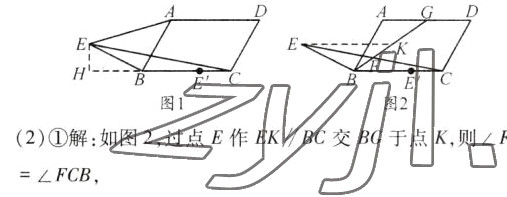
② 证明: $\because$ 四边形 ABCD 是平行四边形, $\angle ABC = 60^{\circ}, AB = 4$,
$\therefore \angle A = 180^{\circ} - \angle ABC = 120^{\circ}, AD // BC, AD = BC, BE = AB$,
$\because \angle EBF = 120^{\circ}$, 即 $\angle EBK = 120^{\circ}, \therefore \angle EBK = \angle A$,
$\because EK // BC, \therefore EK // AD, \therefore \angle EKB = \angle BGA$,
在 $\triangle EKB$ 和 $\triangle BGA$ 中, $\left\{\begin{array}{l}\angle EKB = \angle BGA\\\angle EBK = \angle A\\BE = AB\end{array}\right.$,
$\therefore \triangle EKB \cong \triangle BGA(AAS), \therefore BK = AG$,
由 ① 知: $BK = 2BF$,
又 $\because AD - DG = AG$,
$\therefore BC - DG = 2BF$;
(3) 解: 如图 3, 连接 AE, 取 AE 的中点 P, PA 的中点 Q, 连接 BP、NP、NQ、BQ,
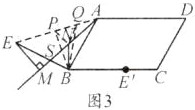
$\because \angle ABE = 90^{\circ}, AB = BE = 4$,
$\therefore \triangle ABE$ 是等腰直角三角形,
$\therefore AE = \sqrt{2}AB = 4\sqrt{2}$,
$\because$ 点 P 是 AE 的中点,
$\therefore BP \perp AE$, 且 $BP = AP = EP = 2\sqrt{2}$,
$\because N$ 是 AM 的中点, P 是 AE 的中点,
$\therefore PN$ 是 $\triangle AEM$ 的中位线, $\therefore PN // EM$,
$\therefore \angle ANP = \angle AME = 90^{\circ}$,
$\because$ 点 Q 是 AP 的中点, $\therefore QN = PQ = \frac{1}{2}AP = \sqrt{2}$,
在 $Rt\triangle BPQ$ 中, $BQ = \sqrt{BP^{2} + PQ^{2}} = \sqrt{10}$,
当 B、Q、N 三点共线时, BN 的长度最小, 最小值为 $BQ - NQ = \sqrt{10} - \sqrt{2}$, 当点 S 与点 E 重合时, $EM = 0, PN = 0$, 此时 BN 的长度最大, 最大值为 $BP = 2\sqrt{2}$.
解:
(1) 如图 1, 过点 E 作 $EH \perp BC$ 交 CB 的延长线于点 H,
$\therefore \angle EHC = 90^{\circ}$,
$\because \angle ABC = 60^{\circ}, \angle EBA = 90^{\circ}$,
$\therefore \angle EBH = 180^{\circ} - \angle EBA - \angle ABC = 30^{\circ}$,
将 $BE'$ 绕点 B 逆时针旋转 $\alpha$ 得到 BE,
$\therefore BE = BE' = 4$,
$\therefore EH = \frac{1}{2}BE = \frac{1}{2} × 4 = 2$,
又 $\because BC = 6, \therefore S_{\triangle BCE} = \frac{1}{2}BC \cdot EH = \frac{1}{2} × 6 × 2 = 6$;
(2) ① 解: 如图 2, 过点 E 作 $EK // BC$ 交 BG 于点 K, 则 $\angle FEK = \angle FCB$,
$\because$ 点 F 是 CE 的中点, $\therefore EF = CF$,
在 $\triangle EFK$ 和 $\triangle CFB$ 中, $\left\{\begin{array}{l}\angle FEK = \angle FCB\\EF = CF\\\angle EFK = \angle CFB\end{array}\right.$,
$\therefore \triangle EFK \cong \triangle CFB(ASA)$,
$\therefore EK = BC = 6, FK = FB, \therefore BK = 2BF$,
由旋转得: $BE = BE' = 4$,
在 $\triangle BEK$ 中, $EK - BE < BK < EK + BE$,
$\therefore 6 - 4 < BK < 6 + 4$, 即 $2 < 2BF < 10$,
$\therefore 1 < BF < 5$;
② 证明: $\because$ 四边形 ABCD 是平行四边形, $\angle ABC = 60^{\circ}, AB = 4$,
$\therefore \angle A = 180^{\circ} - \angle ABC = 120^{\circ}, AD // BC, AD = BC, BE = AB$,
$\because \angle EBF = 120^{\circ}$, 即 $\angle EBK = 120^{\circ}, \therefore \angle EBK = \angle A$,
$\because EK // BC, \therefore EK // AD, \therefore \angle EKB = \angle BGA$,
在 $\triangle EKB$ 和 $\triangle BGA$ 中, $\left\{\begin{array}{l}\angle EKB = \angle BGA\\\angle EBK = \angle A\\BE = AB\end{array}\right.$,
$\therefore \triangle EKB \cong \triangle BGA(AAS), \therefore BK = AG$,
由 ① 知: $BK = 2BF$,
又 $\because AD - DG = AG$,
$\therefore BC - DG = 2BF$;
(3) 解: 如图 3, 连接 AE, 取 AE 的中点 P, PA 的中点 Q, 连接 BP、NP、NQ、BQ,
$\because \angle ABE = 90^{\circ}, AB = BE = 4$,
$\therefore \triangle ABE$ 是等腰直角三角形,
$\therefore AE = \sqrt{2}AB = 4\sqrt{2}$,
$\because$ 点 P 是 AE 的中点,
$\therefore BP \perp AE$, 且 $BP = AP = EP = 2\sqrt{2}$,
$\because N$ 是 AM 的中点, P 是 AE 的中点,
$\therefore PN$ 是 $\triangle AEM$ 的中位线, $\therefore PN // EM$,
$\therefore \angle ANP = \angle AME = 90^{\circ}$,
$\because$ 点 Q 是 AP 的中点, $\therefore QN = PQ = \frac{1}{2}AP = \sqrt{2}$,
在 $Rt\triangle BPQ$ 中, $BQ = \sqrt{BP^{2} + PQ^{2}} = \sqrt{10}$,
当 B、Q、N 三点共线时, BN 的长度最小, 最小值为 $BQ - NQ = \sqrt{10} - \sqrt{2}$, 当点 S 与点 E 重合时, $EM = 0, PN = 0$, 此时 BN 的长度最大, 最大值为 $BP = 2\sqrt{2}$.
查看更多完整答案,请扫码查看

