

 搜索
搜索
2025年单元双测全优测评卷八年级数学下册沪科版
注:目前有些书本章节名称可能整理的还不是很完善,但都是按照顺序排列的,请同学们按照顺序仔细查找。练习册 2025年单元双测全优测评卷八年级数学下册沪科版 答案主要是用来给同学们做完题方便对答案用的,请勿直接抄袭。
第36页
- 第1页
- 第2页
- 第3页
- 第4页
- 第5页
- 第6页
- 第7页
- 第8页
- 第9页
- 第10页
- 第11页
- 第12页
- 第13页
- 第14页
- 第15页
- 第16页
- 第17页
- 第18页
- 第19页
- 第20页
- 第21页
- 第22页
- 第23页
- 第24页
- 第25页
- 第26页
- 第27页
- 第28页
- 第29页
- 第30页
- 第31页
- 第32页
- 第33页
- 第34页
- 第35页
- 第36页
- 第37页
- 第38页
- 第39页
- 第40页
- 第41页
- 第42页
- 第43页
- 第44页
- 第45页
- 第46页
- 第47页
- 第48页
- 第49页
- 第50页
- 第51页
- 第52页
- 第53页
- 第54页
- 第55页
- 第56页
- 第57页
- 第58页
- 第59页
- 第60页
- 第61页
- 第62页
- 第63页
- 第64页
- 第65页
- 第66页
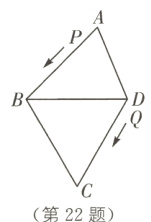
22. 如图,四边形ABCD的三边(AB,BC,CD)和BD的长度都为5厘米,动点P从A出发(A→B→D)到D,速度为2厘米/秒,动点Q从点D出发(D→C→B→A)到A,速度为2.8厘米/秒. 5秒时P,Q相距3厘米,试确定5秒时△APQ的形状.
答案:
$\because AB = BD = 5$厘米,动点$P$从$A$出发$(A\rightarrow B\rightarrow D)$到$D$,速度为2厘米/秒,
$\therefore 5$秒时$P$点运动路程为$2\times5 = 10$(厘米).
又$AB + BD = 10$厘米,
$\therefore$此时$P$与$D$重合.
$\because AB = BC = CD = 5$厘米,动点$Q$从点$D$出发$(D\rightarrow C\rightarrow B\rightarrow A)$到$A$,速度为2.8厘米/秒,$\therefore 5$秒时$Q$点运动路程为$2.8\times5 = 14$(厘米).
又$DC + CB + BA = 15$厘米,
$\therefore Q$在$AB$边上,且$BQ = 4$厘米,如图.

在$\triangle BPQ$中,$\because BQ = 4$厘米,$PQ = 3$厘米,$BP = 5$厘米,$\therefore BQ^{2}+PQ^{2}=BP^{2}$,
$\therefore\triangle BPQ$为直角三角形,$\angle BQP = 90^{\circ}$,
$\therefore\angle AQP = 180^{\circ}-\angle BQP = 90^{\circ}$,
$\therefore\triangle APQ$为直角三角形.
$\because AB = BD = 5$厘米,动点$P$从$A$出发$(A\rightarrow B\rightarrow D)$到$D$,速度为2厘米/秒,
$\therefore 5$秒时$P$点运动路程为$2\times5 = 10$(厘米).
又$AB + BD = 10$厘米,
$\therefore$此时$P$与$D$重合.
$\because AB = BC = CD = 5$厘米,动点$Q$从点$D$出发$(D\rightarrow C\rightarrow B\rightarrow A)$到$A$,速度为2.8厘米/秒,$\therefore 5$秒时$Q$点运动路程为$2.8\times5 = 14$(厘米).
又$DC + CB + BA = 15$厘米,
$\therefore Q$在$AB$边上,且$BQ = 4$厘米,如图.
在$\triangle BPQ$中,$\because BQ = 4$厘米,$PQ = 3$厘米,$BP = 5$厘米,$\therefore BQ^{2}+PQ^{2}=BP^{2}$,
$\therefore\triangle BPQ$为直角三角形,$\angle BQP = 90^{\circ}$,
$\therefore\angle AQP = 180^{\circ}-\angle BQP = 90^{\circ}$,
$\therefore\triangle APQ$为直角三角形.
23. 观察下列各式,你有什么发现?
$3^2 = 4 + 5$,$5^2 = 12 + 13$,$7^2 = 24 + 25$,$9^2 = 40 + 41$,…,
这到底是巧合,还是有什么规律蕴涵其中呢?
(1)填空:$13^2 =$_______ + _______;
(2)请写出你发现的规律;
(3)结合勾股定理有关知识,说明你的结论的正确性.
$3^2 = 4 + 5$,$5^2 = 12 + 13$,$7^2 = 24 + 25$,$9^2 = 40 + 41$,…,
这到底是巧合,还是有什么规律蕴涵其中呢?
(1)填空:$13^2 =$_______ + _______;
(2)请写出你发现的规律;
(3)结合勾股定理有关知识,说明你的结论的正确性.
答案:
(1)84 85
(2)任意一个大于1的奇数的平方可以拆成两个连续整数的和$(2n + 1)^{2}=\frac{(2n + 1)^{2}-1}{2}+\frac{(2n + 1)^{2}+1}{2}$,并且这两个连续整数与原来的奇数构成一组勾股数.
(3)$\frac{(2n + 1)^{2}-1}{2}+\frac{(2n + 1)^{2}+1}{2}=\frac{(2n + 1)^{2}+(2n + 1)^{2}-1 + 1}{2}=(2n + 1)^{2}$,
$(2n + 1)^{2}+(\frac{(2n + 1)^{2}-1}{2})^{2}=(2n + 1)^{2}+\frac{(2n + 1)^{4}-2(2n + 1)^{2}+1}{4}=\frac{4(2n + 1)^{2}}{4}+\frac{(2n + 1)^{4}-2(2n + 1)^{2}+1}{4}=(\frac{(2n + 1)^{2}+1}{2})^{2}$.
故结论正确.
(1)84 85
(2)任意一个大于1的奇数的平方可以拆成两个连续整数的和$(2n + 1)^{2}=\frac{(2n + 1)^{2}-1}{2}+\frac{(2n + 1)^{2}+1}{2}$,并且这两个连续整数与原来的奇数构成一组勾股数.
(3)$\frac{(2n + 1)^{2}-1}{2}+\frac{(2n + 1)^{2}+1}{2}=\frac{(2n + 1)^{2}+(2n + 1)^{2}-1 + 1}{2}=(2n + 1)^{2}$,
$(2n + 1)^{2}+(\frac{(2n + 1)^{2}-1}{2})^{2}=(2n + 1)^{2}+\frac{(2n + 1)^{4}-2(2n + 1)^{2}+1}{4}=\frac{4(2n + 1)^{2}}{4}+\frac{(2n + 1)^{4}-2(2n + 1)^{2}+1}{4}=(\frac{(2n + 1)^{2}+1}{2})^{2}$.
故结论正确.
查看更多完整答案,请扫码查看

