

 搜索
搜索
第53页
- 第1页
- 第2页
- 第3页
- 第4页
- 第5页
- 第6页
- 第7页
- 第8页
- 第9页
- 第10页
- 第11页
- 第12页
- 第13页
- 第14页
- 第15页
- 第16页
- 第17页
- 第18页
- 第19页
- 第20页
- 第21页
- 第22页
- 第23页
- 第24页
- 第25页
- 第26页
- 第27页
- 第28页
- 第29页
- 第30页
- 第31页
- 第32页
- 第33页
- 第34页
- 第35页
- 第36页
- 第37页
- 第38页
- 第39页
- 第40页
- 第41页
- 第42页
- 第43页
- 第44页
- 第45页
- 第46页
- 第47页
- 第48页
- 第49页
- 第50页
- 第51页
- 第52页
- 第53页
- 第54页
- 第55页
- 第56页
- 第57页
- 第58页
- 第59页
- 第60页
- 第61页
- 第62页
- 第63页
- 第64页
- 第65页
- 第66页
- 第67页
- 第68页
22. (10 分) 在古今中外许多著名建筑中,有很多应用圆弧设计的元素。如图 1,哥特式尖拱是由两段不同圆心的圆弧组成的对称图形,叫做两心尖拱。图 2 是两心尖拱的示意图,其中,点 $A$,$B$ 称为起拱处,点 $C$ 称为拱尖,$C$ 到 $AB$ 的距离 $CD$ 称为拱高,$\overset{\frown}{AC}$ 与 $\overset{\frown}{BC}$ 关于直线 $CD$ 成轴对称,$\overset{\frown}{AC}$ 和 $\overset{\frown}{BC}$ 的圆心分别是点 $M$,$N$,且 $M$,$N$ 恰好落在直线 $AB$ 上。
(1)如图 3,当点 $M$ 恰好与 $B$ 重合,点 $N$ 恰好与 $A$ 重合,若 $CD = 9\ m$,求 $\overset{\frown}{AC}$ 所在圆的半径长;
(2)若图 2 中,$CD = 10\ m$,$AB = 12\ m$,求两心尖拱的两个圆心 $M$,$N$ 之间的距离。
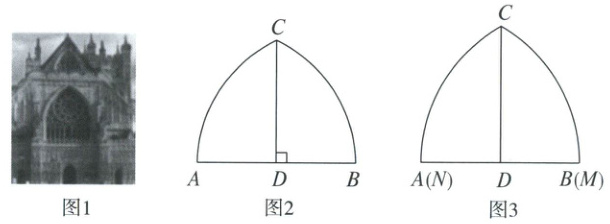
(1)如图 3,当点 $M$ 恰好与 $B$ 重合,点 $N$ 恰好与 $A$ 重合,若 $CD = 9\ m$,求 $\overset{\frown}{AC}$ 所在圆的半径长;
(2)若图 2 中,$CD = 10\ m$,$AB = 12\ m$,求两心尖拱的两个圆心 $M$,$N$ 之间的距离。
答案:
22.解:
(1)连结MC,如图1。
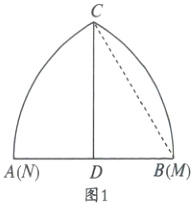
设$MC = MA = Rm$,由题可知$AD = MD = \frac{1}{2}AB = \frac{1}{2}R$,在$Rt\triangle MCD$中,$MD^2 + CD^2 = MC^2$,$\therefore \frac{1}{4}R^2 + 81 = R^2$,解得$R = 6\sqrt{3}$,故$\overset{\frown}{AC}$所在圆的半径长为$6\sqrt{3}m$。
(2)如图2,在图中作出圆心M、圆心N,过M作$MH\perp AC$于点H。
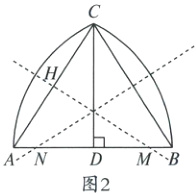
$\because CD = 10m$,$AB = 12m$,$\therefore AD = BD = \frac{1}{2}AB = 6m$,在$Rt\triangle ADC$中,$AC = \sqrt{AD^2 + CD^2} = 2\sqrt{34}$。由垂径定理可知MH垂直平分AC,$\therefore AH = CH = \frac{1}{2}AC = \sqrt{34}$。$\because \angle CAD = \angle HAM$,$\angle AHM = \angle ADC = 90°$,$\therefore \triangle CAD\sim \triangle MAH$,$\therefore \frac{AC}{AM} = \frac{AD}{AH}$,$\therefore \frac{2\sqrt{34}}{AM} = \frac{6}{\sqrt{34}}$,解得$AM = \frac{34}{3} < AB$,$\therefore$点M和点N在线段AB上。$\because AC$与BC关于直线CD成轴对称,$\therefore AM = BN$。$\because AM + BN - MN = AB$,即$\frac{34}{3} + \frac{34}{3} - MN = 12$,$\therefore MN = \frac{32}{3}m$,故两心尖拱的两个圆心M,N之间的距离为$\frac{32}{3}m$。
22.解:
(1)连结MC,如图1。
设$MC = MA = Rm$,由题可知$AD = MD = \frac{1}{2}AB = \frac{1}{2}R$,在$Rt\triangle MCD$中,$MD^2 + CD^2 = MC^2$,$\therefore \frac{1}{4}R^2 + 81 = R^2$,解得$R = 6\sqrt{3}$,故$\overset{\frown}{AC}$所在圆的半径长为$6\sqrt{3}m$。
(2)如图2,在图中作出圆心M、圆心N,过M作$MH\perp AC$于点H。
$\because CD = 10m$,$AB = 12m$,$\therefore AD = BD = \frac{1}{2}AB = 6m$,在$Rt\triangle ADC$中,$AC = \sqrt{AD^2 + CD^2} = 2\sqrt{34}$。由垂径定理可知MH垂直平分AC,$\therefore AH = CH = \frac{1}{2}AC = \sqrt{34}$。$\because \angle CAD = \angle HAM$,$\angle AHM = \angle ADC = 90°$,$\therefore \triangle CAD\sim \triangle MAH$,$\therefore \frac{AC}{AM} = \frac{AD}{AH}$,$\therefore \frac{2\sqrt{34}}{AM} = \frac{6}{\sqrt{34}}$,解得$AM = \frac{34}{3} < AB$,$\therefore$点M和点N在线段AB上。$\because AC$与BC关于直线CD成轴对称,$\therefore AM = BN$。$\because AM + BN - MN = AB$,即$\frac{34}{3} + \frac{34}{3} - MN = 12$,$\therefore MN = \frac{32}{3}m$,故两心尖拱的两个圆心M,N之间的距离为$\frac{32}{3}m$。
23. (10 分) 设二次函数 $y = ax^2 + bx + 1(a \neq 0,a,b$ 是常数),已知函数值 $y$ 和自变量 $x$ 的部分对应取值如表所示:

(1)若 $p = 4$,求二次函数的表达式;
(2)当 $-1 \leq x \leq 4$ 时,$y$ 有最小值为 $-1$,求 $a$ 的值;
(3)求 $2p - q^2$ 的最大值。
(1)若 $p = 4$,求二次函数的表达式;
(2)当 $-1 \leq x \leq 4$ 时,$y$ 有最小值为 $-1$,求 $a$ 的值;
(3)求 $2p - q^2$ 的最大值。
答案:
23.解:
(1)$\because$图象过$(0,1)$,$(2,1)$,$\therefore$对称轴是直线$x = \frac{0 + 2}{2} = 1$,$\therefore -\frac{b}{2a} = 1$,$\therefore b = -2a$,$\therefore$二次函数为$y = ax^2 + bx + 1 = ax^2 - 2ax + 1$。又图象过$(-1,4)$,$\therefore 4 = a + 2a + 1$,$\therefore a = 1$,$\therefore$二次函数的表达式为$y = x^2 - 2x + 1$。
(2)由题意,抛物线的对称轴是直线$x = 1 = -\frac{b}{2a}$,$\therefore b = -2a$。
①当$a > 0$时,$\because -1\leqslant x\leqslant4$,$\therefore$当$x = 1$时,y取最小值为$a + b + 1 = a - 2a + 1 = -1$,$\therefore a = 2$。
②当$a < 0$时,$\because$抛物线上的点离对称轴越远函数值越小,$-1\leqslant x\leqslant4$,$\therefore$当$x = 4$时,y取最小值为$16a + 4b + 1 = 16a - 8a + 1 = -1$,$\therefore a = -\frac{1}{4}$。
综上,$a = 2$或$a = -\frac{1}{4}$。
(3)抛物线的对称轴是直线$x = -\frac{b}{2a} = 1$,$\therefore b = -2a$。又$\because p = a - b + 1$,$q = a + b + 1$,$\therefore p = 3a + 1$,$q = -a + 1$。$\therefore 2p - q^2 = 2(3a + 1) - (-a + 1)^2 = 6a + 2 - a^2 + 2a - 1 = -a^2 + 8a + 1 = -(a - 4)^2 + 17$。$\therefore$当$a = 4$时,$2p - q^2$的最大值为17。
(1)$\because$图象过$(0,1)$,$(2,1)$,$\therefore$对称轴是直线$x = \frac{0 + 2}{2} = 1$,$\therefore -\frac{b}{2a} = 1$,$\therefore b = -2a$,$\therefore$二次函数为$y = ax^2 + bx + 1 = ax^2 - 2ax + 1$。又图象过$(-1,4)$,$\therefore 4 = a + 2a + 1$,$\therefore a = 1$,$\therefore$二次函数的表达式为$y = x^2 - 2x + 1$。
(2)由题意,抛物线的对称轴是直线$x = 1 = -\frac{b}{2a}$,$\therefore b = -2a$。
①当$a > 0$时,$\because -1\leqslant x\leqslant4$,$\therefore$当$x = 1$时,y取最小值为$a + b + 1 = a - 2a + 1 = -1$,$\therefore a = 2$。
②当$a < 0$时,$\because$抛物线上的点离对称轴越远函数值越小,$-1\leqslant x\leqslant4$,$\therefore$当$x = 4$时,y取最小值为$16a + 4b + 1 = 16a - 8a + 1 = -1$,$\therefore a = -\frac{1}{4}$。
综上,$a = 2$或$a = -\frac{1}{4}$。
(3)抛物线的对称轴是直线$x = -\frac{b}{2a} = 1$,$\therefore b = -2a$。又$\because p = a - b + 1$,$q = a + b + 1$,$\therefore p = 3a + 1$,$q = -a + 1$。$\therefore 2p - q^2 = 2(3a + 1) - (-a + 1)^2 = 6a + 2 - a^2 + 2a - 1 = -a^2 + 8a + 1 = -(a - 4)^2 + 17$。$\therefore$当$a = 4$时,$2p - q^2$的最大值为17。
查看更多完整答案,请扫码查看

