

 搜索
搜索
第35页
- 第1页
- 第2页
- 第3页
- 第4页
- 第5页
- 第6页
- 第7页
- 第8页
- 第9页
- 第10页
- 第11页
- 第12页
- 第13页
- 第14页
- 第15页
- 第16页
- 第17页
- 第18页
- 第19页
- 第20页
- 第21页
- 第22页
- 第23页
- 第24页
- 第25页
- 第26页
- 第27页
- 第28页
- 第29页
- 第30页
- 第31页
- 第32页
- 第33页
- 第34页
- 第35页
- 第36页
- 第37页
- 第38页
- 第39页
- 第40页
- 第41页
- 第42页
- 第43页
- 第44页
- 第45页
- 第46页
- 第47页
- 第48页
- 第49页
- 第50页
- 第51页
- 第52页
- 第53页
- 第54页
- 第55页
- 第56页
- 第57页
- 第58页
- 第59页
- 第60页
- 第61页
- 第62页
- 第63页
- 第64页
- 第65页
- 第66页
- 第67页
- 第68页
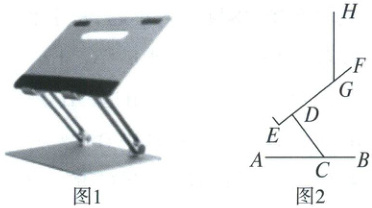
22. (10分)图1是某种笔记本电脑支架。如图2,其底座 $ AB $ 放置在水平桌面上,通过调节点 $ C $,$ D $ 处的角度,控制托盘 $ EF $ 的位置。电脑机身和屏幕分别用线段 $ EG $,$ GH $ 表示,$ CD = 16 cm $,$ EG = GH = 21 cm $,$ ED = 5 cm $。
(1)若 $ \angle ACD = 60° $,$ \angle CDG = 90° $。
① 为使屏幕与桌面保持垂直,求 $ \angle EGH $ 的度数;
② 求点 $ H $ 到桌面的最大距离(不计材料的厚度)。
(2)在(1)的情况下,保持 $ \angle CDG = 90° $,并逐渐减小 $ \angle ACD $ 的度数。圆圆同学说:“点 $ G $ 到桌面的距离越来越小。”点点同学说:“点 $ G $ 到桌面的距离先变大,后变小。”你认为谁的说法正确?请说明理由。
(1)若 $ \angle ACD = 60° $,$ \angle CDG = 90° $。
① 为使屏幕与桌面保持垂直,求 $ \angle EGH $ 的度数;
② 求点 $ H $ 到桌面的最大距离(不计材料的厚度)。
(2)在(1)的情况下,保持 $ \angle CDG = 90° $,并逐渐减小 $ \angle ACD $ 的度数。圆圆同学说:“点 $ G $ 到桌面的距离越来越小。”点点同学说:“点 $ G $ 到桌面的距离先变大,后变小。”你认为谁的说法正确?请说明理由。
答案:
22.解:
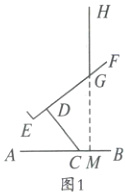
(1)①如图1,延长$HG$交$AB$于点$M$,则$\angle BMG = 90^{\circ}$,
$\because\angle CDG=90^{\circ}$,$\therefore\angle CDE=90^{\circ}$.
$\because$四边形的外角和为$360^{\circ}$,$\angle ACD=60^{\circ}$,$\therefore\angle EGH=360^{\circ}-90^{\circ}-90^{\circ}-60^{\circ}=120^{\circ}$.
②如图2,作$DN\perp GM$于点$N$,$DH\perp AB$于点$P$,

$\therefore\angle DNG=90^{\circ}$,$\angle DPC=90^{\circ}$.
$\because\angle ACD=60^{\circ}$,$CD=16cm$,$\therefore DP=CD·\sin60^{\circ}=8\sqrt{3}(cm)$.
$\because EG=21cm$,$ED=5cm$,$\therefore DG=21 - 5 = 16(cm)$.
$\because\angle EGH=120^{\circ}$,$\therefore\angle DGN=60^{\circ}$,$\therefore GN=16×\cos60^{\circ}=8(cm)$,
$\because GH=21cm$,$\therefore$点$H$到桌面的最大距离为$21 + 8 + 8\sqrt{3}=(29 + 8\sqrt{3})cm$,答:点$H$到桌面的最大距离为$(29 + 8\sqrt{3})cm$.
(2)点点同学的说法正确.理由如下:设$\angle ACD=\alpha$,则$\angle DGH=180^{\circ}-\alpha$,$\therefore\angle DGN=\alpha$,$\therefore$点$G$到桌面的距离为$GN+DP=16×\cos\alpha+16×\sin\alpha$,
当$\angle ACD=60^{\circ}$时,点$G$到桌面的距离为$(8\sqrt{3}+8)cm$,当$\angle ACD=45^{\circ}$时,点$G$到桌面的距离为$16×\cos45^{\circ}+16×\sin45^{\circ}=16\sqrt{2}(cm)$,当$\angle ACD=30^{\circ}$时,点$G$到桌面的距离为$16×\cos30^{\circ}+16×\sin30^{\circ}=(8\sqrt{3}+8)cm$,
$\because8 + 8\sqrt{3}<16\sqrt{2}$,$\therefore$点$G$到桌面的距离先变大,后变小,$\therefore$点点同学的说法正确.
22.解:
(1)①如图1,延长$HG$交$AB$于点$M$,则$\angle BMG = 90^{\circ}$,
$\because\angle CDG=90^{\circ}$,$\therefore\angle CDE=90^{\circ}$.
$\because$四边形的外角和为$360^{\circ}$,$\angle ACD=60^{\circ}$,$\therefore\angle EGH=360^{\circ}-90^{\circ}-90^{\circ}-60^{\circ}=120^{\circ}$.
②如图2,作$DN\perp GM$于点$N$,$DH\perp AB$于点$P$,
$\therefore\angle DNG=90^{\circ}$,$\angle DPC=90^{\circ}$.
$\because\angle ACD=60^{\circ}$,$CD=16cm$,$\therefore DP=CD·\sin60^{\circ}=8\sqrt{3}(cm)$.
$\because EG=21cm$,$ED=5cm$,$\therefore DG=21 - 5 = 16(cm)$.
$\because\angle EGH=120^{\circ}$,$\therefore\angle DGN=60^{\circ}$,$\therefore GN=16×\cos60^{\circ}=8(cm)$,
$\because GH=21cm$,$\therefore$点$H$到桌面的最大距离为$21 + 8 + 8\sqrt{3}=(29 + 8\sqrt{3})cm$,答:点$H$到桌面的最大距离为$(29 + 8\sqrt{3})cm$.
(2)点点同学的说法正确.理由如下:设$\angle ACD=\alpha$,则$\angle DGH=180^{\circ}-\alpha$,$\therefore\angle DGN=\alpha$,$\therefore$点$G$到桌面的距离为$GN+DP=16×\cos\alpha+16×\sin\alpha$,
当$\angle ACD=60^{\circ}$时,点$G$到桌面的距离为$(8\sqrt{3}+8)cm$,当$\angle ACD=45^{\circ}$时,点$G$到桌面的距离为$16×\cos45^{\circ}+16×\sin45^{\circ}=16\sqrt{2}(cm)$,当$\angle ACD=30^{\circ}$时,点$G$到桌面的距离为$16×\cos30^{\circ}+16×\sin30^{\circ}=(8\sqrt{3}+8)cm$,
$\because8 + 8\sqrt{3}<16\sqrt{2}$,$\therefore$点$G$到桌面的距离先变大,后变小,$\therefore$点点同学的说法正确.
23. (10分)在平面直角坐标系中,设函数 $ y_1 = (x - m)(x - n) $,$ y_2 = x^2 + mx + n $,其中 $ m \neq n $。
(1)若函数 $ y_1 $ 的图象过点 $ (0, 2) $,函数 $ y_2 $ 的图象过点 $ (1, 4) $,求 $ m^2 + n^2 $ 的值;
(2)若 $ 0 < m < n < 4 $,判断函数 $ y_2 $ 与 $ x $ 轴的交点个数,说明理由;
(3)若函数 $ y_1 $ 和函数 $ y_2 $ 与 $ x $ 轴的交点均相同,求 $ m $,$ n $ 的值。
(1)若函数 $ y_1 $ 的图象过点 $ (0, 2) $,函数 $ y_2 $ 的图象过点 $ (1, 4) $,求 $ m^2 + n^2 $ 的值;
(2)若 $ 0 < m < n < 4 $,判断函数 $ y_2 $ 与 $ x $ 轴的交点个数,说明理由;
(3)若函数 $ y_1 $ 和函数 $ y_2 $ 与 $ x $ 轴的交点均相同,求 $ m $,$ n $ 的值。
答案:
23.解:
(1)将$(0,2)$代入$y_{1}=(x - m)(x - n)$,将$(1,4)$代入$y_{2}=x^{2}+mx + n$,得$\begin{cases}mn=2\\1 + m + n = 4\end{cases}$,$\therefore m + n = 3$,$mn = 2$,$\therefore m^{2}+n^{2}=(m + n)^{2}-2mn=3^{2}-2×2=5$.
(2)$\because\Delta=m^{2}-4n$,$0<m<n<4$,$\therefore\Delta<0$,$\therefore$函数$y_{2}$与$x$轴无交点.
(3)$\because y_{1}=(x - m)(x - n)$,$\therefore$函数$y_{1}$与$x$轴的交点为$(m,0)$和$(n,0)$,$\therefore m + n=-m$,$mn = n$,$\therefore m = 0$,$n = 0$(舍去)或$m = 1$,$n=-2$.
(1)将$(0,2)$代入$y_{1}=(x - m)(x - n)$,将$(1,4)$代入$y_{2}=x^{2}+mx + n$,得$\begin{cases}mn=2\\1 + m + n = 4\end{cases}$,$\therefore m + n = 3$,$mn = 2$,$\therefore m^{2}+n^{2}=(m + n)^{2}-2mn=3^{2}-2×2=5$.
(2)$\because\Delta=m^{2}-4n$,$0<m<n<4$,$\therefore\Delta<0$,$\therefore$函数$y_{2}$与$x$轴无交点.
(3)$\because y_{1}=(x - m)(x - n)$,$\therefore$函数$y_{1}$与$x$轴的交点为$(m,0)$和$(n,0)$,$\therefore m + n=-m$,$mn = n$,$\therefore m = 0$,$n = 0$(舍去)或$m = 1$,$n=-2$.
查看更多完整答案,请扫码查看

