

 搜索
搜索
第60页
- 第1页
- 第2页
- 第3页
- 第4页
- 第5页
- 第6页
- 第7页
- 第8页
- 第9页
- 第10页
- 第11页
- 第12页
- 第13页
- 第14页
- 第15页
- 第16页
- 第17页
- 第18页
- 第19页
- 第20页
- 第21页
- 第22页
- 第23页
- 第24页
- 第25页
- 第26页
- 第27页
- 第28页
- 第29页
- 第30页
- 第31页
- 第32页
- 第33页
- 第34页
- 第35页
- 第36页
- 第37页
- 第38页
- 第39页
- 第40页
- 第41页
- 第42页
- 第43页
- 第44页
- 第45页
- 第46页
- 第47页
- 第48页
- 第49页
- 第50页
- 第51页
- 第52页
- 第53页
- 第54页
- 第55页
- 第56页
- 第57页
- 第58页
- 第59页
- 第60页
- 第61页
- 第62页
- 第63页
- 第64页
- 第65页
- 第66页
- 第67页
- 第68页
- 第69页
- 第70页
- 第71页
- 第72页
- 第73页
- 第74页
- 第75页
- 第76页
- 第77页
- 第78页
- 第79页
- 第80页
- 第81页
- 第82页
- 第83页
- 第84页
- 第85页
- 第86页
- 第87页
- 第88页
- 第89页
- 第90页
- 第91页
- 第92页
- 第93页
- 第94页
- 第95页
- 第96页
- 第97页
- 第98页
- 第99页
- 第100页
- 第101页
- 第102页
- 第103页
- 第104页
- 第105页
- 第106页
- 第107页
- 第108页
- 第109页
- 第110页
- 第111页
- 第112页
- 第113页
- 第114页
- 第115页
- 第116页
- 第117页
- 第118页
- 第119页
- 第120页
- 第121页
- 第122页
- 第123页
- 第124页
- 第125页
- 第126页
- 第127页
- 第128页
- 第129页
- 第130页
- 第131页
- 第132页
- 第133页
- 第134页
- 第135页
- 第136页
- 第137页
- 第138页
- 第139页
- 第140页
- 第141页
- 第142页
- 第143页
- 第144页
- 第145页
- 第146页
- 第147页
- 第148页
- 第149页
- 第150页
- 第151页
- 第152页
- 第153页
- 第154页
- 第155页
- 第156页
- 第157页
- 第158页
- 第159页
- 第160页
- 第161页
- 第162页
- 第163页
- 第164页
- 第165页
- 第166页
- 第167页
- 第168页
- 第169页
- 第170页
- 第171页
- 第172页
- 第173页
- 第174页
- 第175页
- 第176页
- 第177页
- 第178页
- 第179页
- 第180页
- 第181页
- 第182页
- 第183页
- 第184页
- 第185页
- 第186页
- 第187页
- 第188页
Ⅴ.任务型阅读
阅读下面的短文,并根据所读内容在文章后表格中的空格里填入一个最恰当的单词。(每空一词)
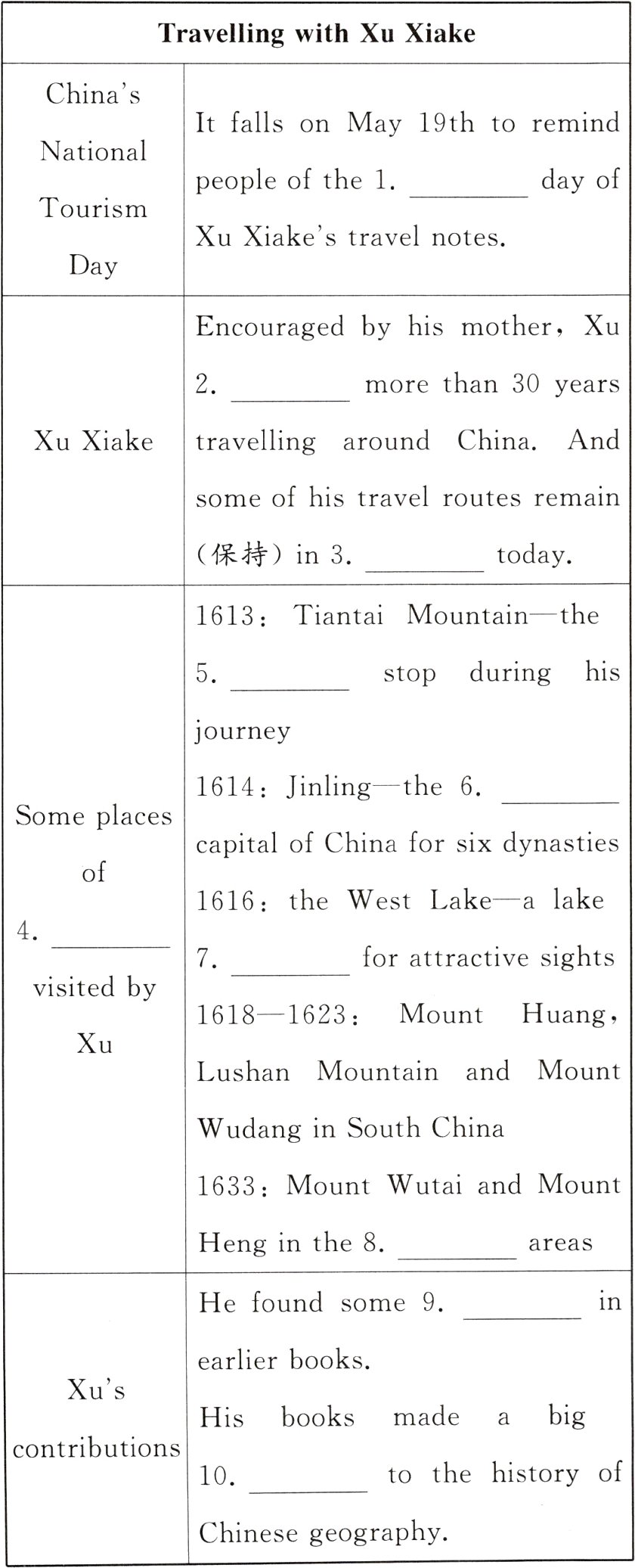
May 19th has been celebrated as China's National Tourism Day since 2011. It was the day when Xu Xiake,a great geographer and writer in the Ming dynasty,started recording what he saw in Travel Notes of Xu Xiake.
With his mother's encouragement,Xu began his journey at the age of 22. He travelled through China for more than 30 years,and several of his routes(路线) are still used today. Now let's follow his footprints(足迹) and visit some tourist attractions in China.
As recorded in his book,the first place Xu travelled to was Tiantai Mountain,the birthplace of China's Buddhism(佛教) and Taoism(道教) where he wrote about the sights of the mountain in 1613. One year later,Xu visited Jinling,the ancient(古代的) name for Nanjing. The city was not only the capital of China for six dynasties,but also a centre for education,research,and transportation in history. In 1616,Xu went on a journey to the West Lake. With an area of around 6.4 square kilometres,the lake is known for its attractive landscape and ancient buildings in the surrounding(周围的) areas. From 1618 to 1623,Xu visited some famous mountains in South China,such as Mount Huang,Lushan Mountain and Mount Wudang. Later,Xu went north to Shanxi Province in 1633 and visited Mount Wutai and Mount Heng.
Xu was on the road all his life. Although he met with many difficulties,he never stopped travelling and writing. His experiences helped him discover several mistakes in earlier books. For example,he found the Minjiang River was not the real birthplace of the Yangtze River. With his 600,000 - word travel notes,Xu had a powerful influence(影响) on the history of Chinese geography.
阅读下面的短文,并根据所读内容在文章后表格中的空格里填入一个最恰当的单词。(每空一词)
May 19th has been celebrated as China's National Tourism Day since 2011. It was the day when Xu Xiake,a great geographer and writer in the Ming dynasty,started recording what he saw in Travel Notes of Xu Xiake.
With his mother's encouragement,Xu began his journey at the age of 22. He travelled through China for more than 30 years,and several of his routes(路线) are still used today. Now let's follow his footprints(足迹) and visit some tourist attractions in China.
As recorded in his book,the first place Xu travelled to was Tiantai Mountain,the birthplace of China's Buddhism(佛教) and Taoism(道教) where he wrote about the sights of the mountain in 1613. One year later,Xu visited Jinling,the ancient(古代的) name for Nanjing. The city was not only the capital of China for six dynasties,but also a centre for education,research,and transportation in history. In 1616,Xu went on a journey to the West Lake. With an area of around 6.4 square kilometres,the lake is known for its attractive landscape and ancient buildings in the surrounding(周围的) areas. From 1618 to 1623,Xu visited some famous mountains in South China,such as Mount Huang,Lushan Mountain and Mount Wudang. Later,Xu went north to Shanxi Province in 1633 and visited Mount Wutai and Mount Heng.
Xu was on the road all his life. Although he met with many difficulties,he never stopped travelling and writing. His experiences helped him discover several mistakes in earlier books. For example,he found the Minjiang River was not the real birthplace of the Yangtze River. With his 600,000 - word travel notes,Xu had a powerful influence(影响) on the history of Chinese geography.
答案:
【文章大意】本文是一篇说明文。文章主要讲述了徐霞客参观过的一些中国旅游景点。
1. beginning/starting 2. spent 3. use 4. interest 5. first
6. ancient 7. famous/known 8. northern 9. mistakes
10. difference
1. beginning/starting 2. spent 3. use 4. interest 5. first
6. ancient 7. famous/known 8. northern 9. mistakes
10. difference
查看更多完整答案,请扫码查看

