

 搜索
搜索
第17页
- 第1页
- 第2页
- 第3页
- 第4页
- 第5页
- 第6页
- 第7页
- 第8页
- 第9页
- 第10页
- 第11页
- 第12页
- 第13页
- 第14页
- 第15页
- 第16页
- 第17页
- 第18页
- 第19页
- 第20页
- 第21页
- 第22页
- 第23页
- 第24页
- 第25页
- 第26页
- 第27页
- 第28页
- 第29页
- 第30页
- 第31页
- 第32页
- 第33页
- 第34页
- 第35页
- 第36页
- 第37页
- 第38页
- 第39页
- 第40页
- 第41页
- 第42页
- 第43页
- 第44页
- 第45页
- 第46页
- 第47页
- 第48页
- 第49页
- 第50页
- 第51页
- 第52页
- 第53页
- 第54页
- 第55页
- 第56页
- 第57页
- 第58页
- 第59页
- 第60页
- 第61页
- 第62页
- 第63页
- 第64页
- 第65页
- 第66页
- 第67页
- 第68页
- 第69页
- 第70页
- 第71页
- 第72页
- 第73页
- 第74页
- 第75页
- 第76页
- 第77页
- 第78页
- 第79页
- 第80页
- 第81页
- 第82页
- 第83页
- 第84页
- 第85页
- 第86页
- 第87页
- 第88页
- 第89页
- 第90页
- 第91页
- 第92页
- 第93页
- 第94页
- 第95页
- 第96页
- 第97页
- 第98页
- 第99页
- 第100页
- 第101页
- 第102页
- 第103页
- 第104页
- 第105页
- 第106页
- 第107页
- 第108页
- 第109页
- 第110页
- 第111页
- 第112页
- 第113页
- 第114页
- 第115页
- 第116页
- 第117页
- 第118页
- 第119页
- 第120页
- 第121页
- 第122页
- 第123页
- 第124页
- 第125页
- 第126页
- 第127页
- 第128页
- 第129页
- 第130页
- 第131页
- 第132页
- 第133页
- 第134页
- 第135页
- 第136页
- 第137页
- 第138页
- 第139页
- 第140页
- 第141页
- 第142页
- 第143页
- 第144页
- 第145页
- 第146页
- 第147页
- 第148页
- 第149页
- 第150页
- 第151页
- 第152页
- 第153页
- 第154页
- 第155页
- 第156页
- 第157页
- 第158页
- 第159页
- 第160页
- 第161页
- 第162页
- 第163页
- 第164页
- 第165页
- 第166页
- 第167页
- 第168页
- 第169页
- 第170页
- 第171页
- 第172页
- 第173页
- 第174页
- 第175页
- 第176页
- 第177页
- 第178页
- 第179页
- 第180页
- 第181页
- 第182页
- 第183页
- 第184页
- 第185页
- 第186页
- 第187页
- 第188页
Ⅱ. 抗战时期的中国大学 国立西南联合大学,是中国抗日战争开始后高校内迁设于昆明的一所综合性大学,前后共存在了8年零11个月,“内树学术自由之规模,外来民主堡垒之称号”,保存了抗战时期的重要科研力量,培养了一大批卓有成就的优秀人才。(选项中有两项多余)
跨学科 历史 National Southwestern Associated University(Xinan Lianda) was a great university. It was open from 1938 to 1946 as a wartime university. How was the university built? Why was it a great university? What was it like to study there? Read on to find out.
Heading to the south In 1937 the Japanese army took over Peking University and Tsinghua University in Beijing and bombed(轰炸) Nankai University in Tianjin. Teachers and students from the three universities first moved to Changsha to work together. 1. ________ And they set up National Southwestern Associated University there. Some teachers and students walked thousands of kilometres from Changsha to Kunming.
Modern teaching Xinan Lianda used modern ways to teach its students. Its principals Jiang Menglin,Mei Yiqi and Zhang Boling received both Chinese and Western education. They provided general education(通识教育). 2. ________ Instead,they first took general courses,such as Chinese and English.
Xinan Lianda was home to many famous teachers. 3. ________ Writers like Wen Yiduo,Shen Congwen and Zhu Ziqing all taught there.
Hard times The school’s teachers and students didn’t have enough food,books or clothing. Forty students had to live in a big thatched(茅草屋顶的) room. There were bugs(虫子) everywhere. Some students caught them and kept them in bottles. 4. ________ Bombings were common. In 1940,Professor Fei Xiaotong’s house was attacked(攻击). He lost his draft(手稿) of a book he was writing. But these hard times didn’t stop the students or teachers.
Coming to an end 5. ________ But Xinan Lianda’s normal college remained and was renamed Yunnan Normal University in 1984.
A. It had 179 professors(教授).
B. Changsha was a safe city at that time.
C. The students’ lives were even in danger.
D. Later in 1938,they moved to Kunming,Yunnan.
E. Many teachers have built new houses for students.
F. Students in their first year didn’t have to pick majors(专业).
G. After the war,the three universities returned to their homes in 1946.
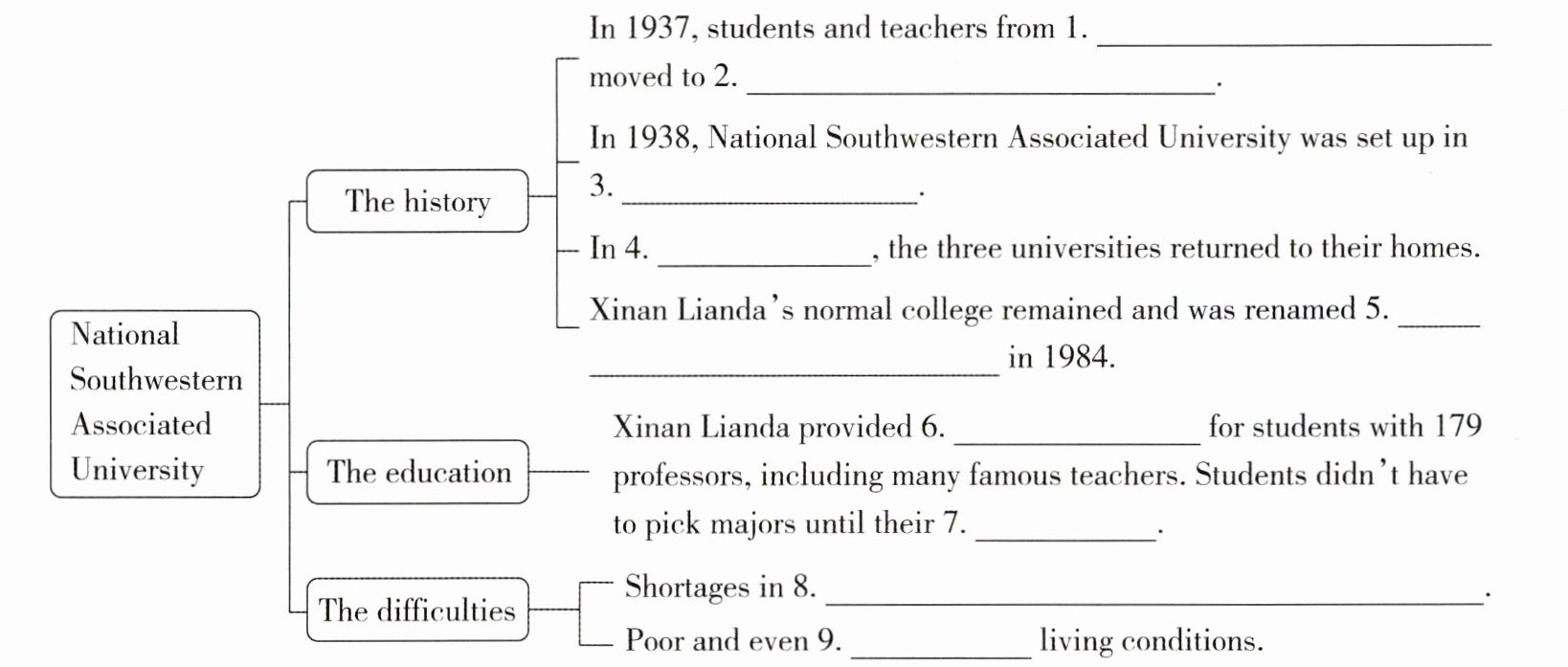
新趋势 思维导图 为了更好地了解西南联大,Millie绘制如下思维导图,请帮她补充完整吧!(每空不限一词)
跨学科 历史 National Southwestern Associated University(Xinan Lianda) was a great university. It was open from 1938 to 1946 as a wartime university. How was the university built? Why was it a great university? What was it like to study there? Read on to find out.
Heading to the south In 1937 the Japanese army took over Peking University and Tsinghua University in Beijing and bombed(轰炸) Nankai University in Tianjin. Teachers and students from the three universities first moved to Changsha to work together. 1. ________ And they set up National Southwestern Associated University there. Some teachers and students walked thousands of kilometres from Changsha to Kunming.
Modern teaching Xinan Lianda used modern ways to teach its students. Its principals Jiang Menglin,Mei Yiqi and Zhang Boling received both Chinese and Western education. They provided general education(通识教育). 2. ________ Instead,they first took general courses,such as Chinese and English.
Xinan Lianda was home to many famous teachers. 3. ________ Writers like Wen Yiduo,Shen Congwen and Zhu Ziqing all taught there.
Hard times The school’s teachers and students didn’t have enough food,books or clothing. Forty students had to live in a big thatched(茅草屋顶的) room. There were bugs(虫子) everywhere. Some students caught them and kept them in bottles. 4. ________ Bombings were common. In 1940,Professor Fei Xiaotong’s house was attacked(攻击). He lost his draft(手稿) of a book he was writing. But these hard times didn’t stop the students or teachers.
Coming to an end 5. ________ But Xinan Lianda’s normal college remained and was renamed Yunnan Normal University in 1984.
A. It had 179 professors(教授).
B. Changsha was a safe city at that time.
C. The students’ lives were even in danger.
D. Later in 1938,they moved to Kunming,Yunnan.
E. Many teachers have built new houses for students.
F. Students in their first year didn’t have to pick majors(专业).
G. After the war,the three universities returned to their homes in 1946.
新趋势 思维导图 为了更好地了解西南联大,Millie绘制如下思维导图,请帮她补充完整吧!(每空不限一词)
答案:
II.[文章大意]本文是一篇说明文,主要介绍了西南联大的发展历程。
1~5 DFACG
[思维导图]
1. Peking University, Tsinghua University and Nankai University
2. Changsha
3. Kunming (Yunnan)
4. 1946
5. Yunnan Normal University
6. general education
7. second year
8. food, books and clothing
9. dangerous
1~5 DFACG
[思维导图]
1. Peking University, Tsinghua University and Nankai University
2. Changsha
3. Kunming (Yunnan)
4. 1946
5. Yunnan Normal University
6. general education
7. second year
8. food, books and clothing
9. dangerous
查看更多完整答案,请扫码查看

