

 搜索
搜索
第128页
- 第1页
- 第2页
- 第3页
- 第4页
- 第5页
- 第6页
- 第7页
- 第8页
- 第9页
- 第10页
- 第11页
- 第12页
- 第13页
- 第14页
- 第15页
- 第16页
- 第17页
- 第18页
- 第19页
- 第20页
- 第21页
- 第22页
- 第23页
- 第24页
- 第25页
- 第26页
- 第27页
- 第28页
- 第29页
- 第30页
- 第31页
- 第32页
- 第33页
- 第34页
- 第35页
- 第36页
- 第37页
- 第38页
- 第39页
- 第40页
- 第41页
- 第42页
- 第43页
- 第44页
- 第45页
- 第46页
- 第47页
- 第48页
- 第49页
- 第50页
- 第51页
- 第52页
- 第53页
- 第54页
- 第55页
- 第56页
- 第57页
- 第58页
- 第59页
- 第60页
- 第61页
- 第62页
- 第63页
- 第64页
- 第65页
- 第66页
- 第67页
- 第68页
- 第69页
- 第70页
- 第71页
- 第72页
- 第73页
- 第74页
- 第75页
- 第76页
- 第77页
- 第78页
- 第79页
- 第80页
- 第81页
- 第82页
- 第83页
- 第84页
- 第85页
- 第86页
- 第87页
- 第88页
- 第89页
- 第90页
- 第91页
- 第92页
- 第93页
- 第94页
- 第95页
- 第96页
- 第97页
- 第98页
- 第99页
- 第100页
- 第101页
- 第102页
- 第103页
- 第104页
- 第105页
- 第106页
- 第107页
- 第108页
- 第109页
- 第110页
- 第111页
- 第112页
- 第113页
- 第114页
- 第115页
- 第116页
- 第117页
- 第118页
- 第119页
- 第120页
- 第121页
- 第122页
- 第123页
- 第124页
- 第125页
- 第126页
- 第127页
- 第128页
- 第129页
- 第130页
- 第131页
- 第132页
- 第133页
- 第134页
- 第135页
- 第136页
- 第137页
- 第138页
- 第139页
- 第140页
- 第141页
- 第142页
- 第143页
- 第144页
- 第145页
- 第146页
- 第147页
- 第148页
- 第149页
- 第150页
- 第151页
- 第152页
- 第153页
- 第154页
- 第155页
- 第156页
- 第157页
- 第158页
- 第159页
- 第160页
- 第161页
- 第162页
- 第163页
- 第164页
- 第165页
- 第166页
- 第167页
- 第168页
- 第169页
- 第170页
- 第171页
- 第172页
- 第173页
- 第174页
- 第175页
- 第176页
- 第177页
- 第178页
- 第179页
- 第180页
- 第181页
- 第182页
- 第183页
- 第184页
- 第185页
- 第186页
- 第187页
- 第188页
- 第189页
Here is a school trip plan for Grade 8 students. There are two interesting lines and many meaningful activities for them to choose from.
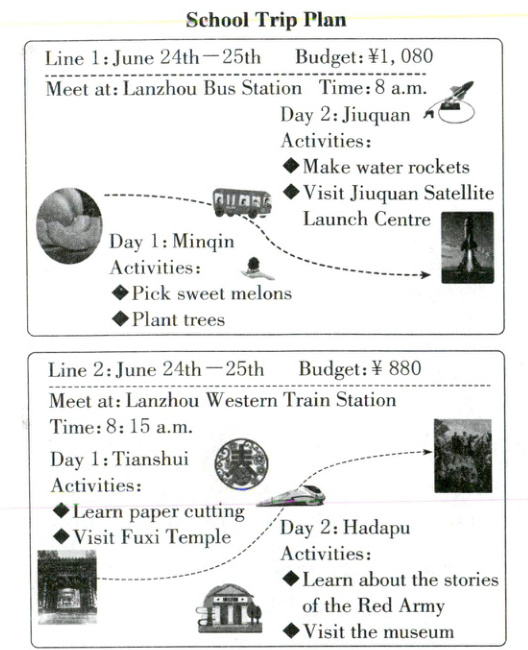
1. Which grade is going to take the school trip?
A. Grade 6.
B. Grade 7.
C. Grade 8.
D. Grade 9.
2. What can students do in Minqin?
A. Plant trees.
B. Make water rockets.
C. Cut paper.
D. Visit the museum.
3. If Xinghan chooses Line 1, what is he probably interested in?
A. Culture.
B. Climate.
C. Space.
D. Music.
4. Tengfei plans to spend at most 950 yuan on his trip. Where is he going?
A. To Minqin and Jiuquan.
B. To Tianshui and Hadapu.
C. To Minqin and Hadapu.
D. To Tianshui and Jiuquan.
5. When do the students visit the museum in Hadapu?
A. On May 24th.
B. On May 25th.
C. On June 24th.
D. On June 25th.
1. Which grade is going to take the school trip?
A. Grade 6.
B. Grade 7.
C. Grade 8.
D. Grade 9.
2. What can students do in Minqin?
A. Plant trees.
B. Make water rockets.
C. Cut paper.
D. Visit the museum.
3. If Xinghan chooses Line 1, what is he probably interested in?
A. Culture.
B. Climate.
C. Space.
D. Music.
4. Tengfei plans to spend at most 950 yuan on his trip. Where is he going?
A. To Minqin and Jiuquan.
B. To Tianshui and Hadapu.
C. To Minqin and Hadapu.
D. To Tianshui and Jiuquan.
5. When do the students visit the museum in Hadapu?
A. On May 24th.
B. On May 25th.
C. On June 24th.
D. On June 25th.
答案:
(二)[主旨大意]本文是学生旅行的活动安排。
1. C 解析:细节理解题。根据“Here is a school trip plan for Grade 8 students.”可知,八年级的学生参加这次旅行。
2. A 解析:细节理解题。根据“Day 1:Minqin”的活动Plant trees可知,可以植树。
3. C 解析:推理判断题。根据“Day 2:Jiuquan”的活动Visit Jiuquan Satellite Launch Centre可知,可能对太空感兴趣。
4. B 解析:推理判断题。根据“Budget:¥880”可知,最多花费950元只能去天水和哈达铺。
5. D 解析:细节理解题。根据“Line 2:June 24th—25th”“Day 2:Hadapu”可知,哈达铺的活动在6月25号。
1. C 解析:细节理解题。根据“Here is a school trip plan for Grade 8 students.”可知,八年级的学生参加这次旅行。
2. A 解析:细节理解题。根据“Day 1:Minqin”的活动Plant trees可知,可以植树。
3. C 解析:推理判断题。根据“Day 2:Jiuquan”的活动Visit Jiuquan Satellite Launch Centre可知,可能对太空感兴趣。
4. B 解析:推理判断题。根据“Budget:¥880”可知,最多花费950元只能去天水和哈达铺。
5. D 解析:细节理解题。根据“Line 2:June 24th—25th”“Day 2:Hadapu”可知,哈达铺的活动在6月25号。
"Going on holiday with blind people opens your eyes," says Wendy Coley. She often goes on tours with Traveleyes, a company that takes tourists on trips around the world. For each tour, half of the people can see and half can't. A person who can see travels with a person who can't. The world is there for sighted(有视力的) people but that can cause problems for the blind. So, sighted members might describe the size and color of a building, or the smiles of strangers passing by. _They_ might explain the food, "Your lunch is a sandwich in the center of your plate, and chips in a bowl to the right of your plate."
Clearly, it is good for blind travelers. They are able to learn about new places and make new friends. "You don't worry about danger any more. That's really important," says Jenny Tween, a blind tourist. But it is also of benefit (益处) to sighted travelers. Wendy is one of them. She says that when you describe what you see, you see things in a very different way. The tour manager Hannah Vince agrees, "Sighted people learn a lot from these trips. It's a two-way thing." Traveling with blind people and describing the world to them makes sighted people go more slowly and look more closely at the colors, shapes, and sizes of things. Blind people can also help sighted people find more about the smells of food or flowers, and the sounds of music or traffic.
In the end, this isn't a story about people who can see helping people who can't. It's about people with different abilities showing each other new ways of experiencing the world and meeting new friends.
1. What do we know about tours with Traveleyes?
A. Most of the tourists are blind people.
B. They are organized by Wendy Coley.
C. A blind person travels with a sighted person.
D. Blind people join in the tours at half the price.
2. Who does the underlined word "They" in Paragraph 1 refer to?
A. Tourists.
B. Strangers.
C. Blind people.
D. Sighted members.
3. How does Jenny Tween feel during the tours?
A. Safe.
B. Sleepy.
C. Nervous.
D. Surprised.
4. What benefit do sighted people get from the tours?
A. They cook better.
B. They walk faster.
C. They speak louder.
D. They notice more.
5. What would be the best title for the passage?
A. Shared travel
B. Help blind people
C. A happy holiday
D. Travel around the world
Clearly, it is good for blind travelers. They are able to learn about new places and make new friends. "You don't worry about danger any more. That's really important," says Jenny Tween, a blind tourist. But it is also of benefit (益处) to sighted travelers. Wendy is one of them. She says that when you describe what you see, you see things in a very different way. The tour manager Hannah Vince agrees, "Sighted people learn a lot from these trips. It's a two-way thing." Traveling with blind people and describing the world to them makes sighted people go more slowly and look more closely at the colors, shapes, and sizes of things. Blind people can also help sighted people find more about the smells of food or flowers, and the sounds of music or traffic.
In the end, this isn't a story about people who can see helping people who can't. It's about people with different abilities showing each other new ways of experiencing the world and meeting new friends.
1. What do we know about tours with Traveleyes?
A. Most of the tourists are blind people.
B. They are organized by Wendy Coley.
C. A blind person travels with a sighted person.
D. Blind people join in the tours at half the price.
2. Who does the underlined word "They" in Paragraph 1 refer to?
A. Tourists.
B. Strangers.
C. Blind people.
D. Sighted members.
3. How does Jenny Tween feel during the tours?
A. Safe.
B. Sleepy.
C. Nervous.
D. Surprised.
4. What benefit do sighted people get from the tours?
A. They cook better.
B. They walk faster.
C. They speak louder.
D. They notice more.
5. What would be the best title for the passage?
A. Shared travel
B. Help blind people
C. A happy holiday
D. Travel around the world
答案:
(三)[主旨大意]本文主要介绍了Traveleyes公司组织的旅行活动,该活动让视力正常的人和盲人一起旅行,互相帮助,共同体验世界。
1. C 解析:细节理解题。根据“For each tour,half of the people can see and half can’t. A person who can see travels with a person who can’t.”可知,每次旅行中,一半的人有视力,一半的人没有。一个有视力的人和一个没有视力的人一起旅行,即盲人和视力正常的人配对旅行。
2. D 解析:代词指代题。根据“So,sighted members might describe the size and color of a building,or the smiles of strangers passing by. They might explain the food...”可知,视力正常的人可能会描述建筑物的大小和颜色,或者路过的陌生人的微笑,他们也许会解释食物。故They指代有视力的成员。
3. A 解析:推理判断题。根据“‘You don’t worry about danger any more. That’s really important,’ says Jenny Tween...”可知,珍妮在旅行中应是感到安全的。
4. D 解析:推理判断题。根据“Traveling with blind people and describing the world to them makes sighted people go more slowly and look more closely at the colors,shapes,and sizes of things.”可知,与盲人一起旅行并向他们描述世界,让视力正常的人放慢脚步,更仔细地观察事物的颜色、形状和大小,即视力正常的人在旅行中会注意到更多细节。
5. A 解析:标题概括题。通读全文并根据“It’s about people with different abilities showing each other new ways of experiencing the world and meeting new friends.”可知,文章的核心是“共享旅行”,强调双方共同受益。
/长难句解读
Traveling with blind people and describing the world to them makes sighted people go more slowly and look more closely at the colors,shapes,and sizes of things.
翻译:和盲人一起旅行并向他们描述世界,让有视力的人放慢脚步,更仔细地观察事物的颜色、形状和大小。
句式结构分析:这是一个简单句。句首Traveling with blind people and describing the world to them是由and连接的两个动名词短语构成的并列主语;谓语是makes,其后sighted people作宾语;“go more slowly and look more closely at the colors,shapes,and sizes of things”是由and连接的两个不定式短语(省略了不定式符号to)作宾语补足语。
1. C 解析:细节理解题。根据“For each tour,half of the people can see and half can’t. A person who can see travels with a person who can’t.”可知,每次旅行中,一半的人有视力,一半的人没有。一个有视力的人和一个没有视力的人一起旅行,即盲人和视力正常的人配对旅行。
2. D 解析:代词指代题。根据“So,sighted members might describe the size and color of a building,or the smiles of strangers passing by. They might explain the food...”可知,视力正常的人可能会描述建筑物的大小和颜色,或者路过的陌生人的微笑,他们也许会解释食物。故They指代有视力的成员。
3. A 解析:推理判断题。根据“‘You don’t worry about danger any more. That’s really important,’ says Jenny Tween...”可知,珍妮在旅行中应是感到安全的。
4. D 解析:推理判断题。根据“Traveling with blind people and describing the world to them makes sighted people go more slowly and look more closely at the colors,shapes,and sizes of things.”可知,与盲人一起旅行并向他们描述世界,让视力正常的人放慢脚步,更仔细地观察事物的颜色、形状和大小,即视力正常的人在旅行中会注意到更多细节。
5. A 解析:标题概括题。通读全文并根据“It’s about people with different abilities showing each other new ways of experiencing the world and meeting new friends.”可知,文章的核心是“共享旅行”,强调双方共同受益。
/长难句解读
Traveling with blind people and describing the world to them makes sighted people go more slowly and look more closely at the colors,shapes,and sizes of things.
翻译:和盲人一起旅行并向他们描述世界,让有视力的人放慢脚步,更仔细地观察事物的颜色、形状和大小。
句式结构分析:这是一个简单句。句首Traveling with blind people and describing the world to them是由and连接的两个动名词短语构成的并列主语;谓语是makes,其后sighted people作宾语;“go more slowly and look more closely at the colors,shapes,and sizes of things”是由and连接的两个不定式短语(省略了不定式符号to)作宾语补足语。
查看更多完整答案,请扫码查看

