

 搜索
搜索
第26页
- 第1页
- 第2页
- 第3页
- 第4页
- 第5页
- 第6页
- 第7页
- 第8页
- 第9页
- 第10页
- 第11页
- 第12页
- 第13页
- 第14页
- 第15页
- 第16页
- 第17页
- 第18页
- 第19页
- 第20页
- 第21页
- 第22页
- 第23页
- 第24页
- 第25页
- 第26页
- 第27页
- 第28页
- 第29页
- 第30页
- 第31页
- 第32页
- 第33页
- 第34页
- 第35页
- 第36页
- 第37页
- 第38页
- 第39页
- 第40页
- 第41页
- 第42页
- 第43页
- 第44页
- 第45页
- 第46页
- 第47页
- 第48页
- 第49页
- 第50页
- 第51页
- 第52页
- 第53页
- 第54页
- 第55页
- 第56页
- 第57页
- 第58页
- 第59页
- 第60页
- 第61页
- 第62页
- 第63页
- 第64页
- 第65页
- 第66页
- 第67页
- 第68页
- 第69页
- 第70页
- 第71页
- 第72页
- 第73页
- 第74页
- 第75页
- 第76页
- 第77页
- 第78页
- 第79页
- 第80页
- 第81页
- 第82页
- 第83页
- 第84页
- 第85页
- 第86页
- 第87页
- 第88页
- 第89页
- 第90页
- 第91页
- 第92页
- 第93页
- 第94页
- 第95页
- 第96页
- 第97页
- 第98页
8. 如图为某种型号的剪叉式高空作业平台。这台机器利用起升电机升降作业平台,方便工人高空作业。该机器的部分数据如表所示。
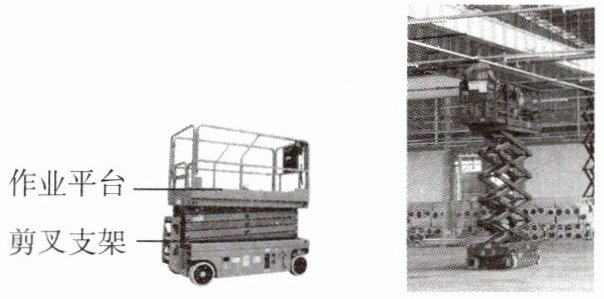
|整机质量(空载)/kg|3200|
|----|----|
|安全工作载荷/kg|200|
|起升电机的功率/kW|4.0|
|轮胎接地总面积$/m^2$|0.08|
(1)这台机器空载且静止时,对水平地面的压强是多大?(g取10N/kg)
(2)起升电机以表中所给功率工作时,将总重为1000N的人和作业工具以0.2m/s的速度举高8m。该机器做的有用功是多少?效率是多少?
(3)(开放性设问)此类机器机械效率一般较低的主要原因是______。
|整机质量(空载)/kg|3200|
|----|----|
|安全工作载荷/kg|200|
|起升电机的功率/kW|4.0|
|轮胎接地总面积$/m^2$|0.08|
(1)这台机器空载且静止时,对水平地面的压强是多大?(g取10N/kg)
4×10^{5}Pa
(2)起升电机以表中所给功率工作时,将总重为1000N的人和作业工具以0.2m/s的速度举高8m。该机器做的有用功是多少?效率是多少?
8×10^{3}J
5%
(3)(开放性设问)此类机器机械效率一般较低的主要原因是______。
机器所做额外功较多(或自重较大)
答案:
(1) 解: 这台机器空载且静止时, 对水平地面的压力
$ F = G_{\text{空}} = mg = 3200 \, \text{kg} \times 10 \, \text{N/kg} = 3.2 \times 10^{4} \, \text{N} $
对水平地面的压强 $ p = \frac{F}{S} = \frac{3.2 \times 10^{4} \, \text{N}}{0.08 \, \text{m}^{2}} = 4 \times 10^{5} \, \text{Pa} $
(2) 解: 该机器做的有用功
$ W_{\text{有用}} = Gh = 1000 \, \text{N} \times 8 \, \text{m} = 8 \times 10^{3} \, \text{J} $
由 $ v = \frac{s}{t} $ 可得, 该机器工作的时间 $ t = \frac{h}{v} = \frac{8 \, \text{m}}{0.2 \, \text{m/s}} = 40 \, \text{s} $
由 $ P = \frac{W}{t} $ 可得, 起升电机做的总功
$ W_{\text{总}} = Pt = 4 \times 10^{3} \, \text{W} \times 40 \, \text{s} = 1.6 \times 10^{5} \, \text{J} $
机器的效率 $ \eta = \frac{W_{\text{有用}}}{W_{\text{总}}} \times 100\% = \frac{8 \times 10^{3} \, \text{J}}{1.6 \times 10^{5} \, \text{J}} \times 100\% = 5\% $
(3) 机器所做额外功较多(或自重较大)
(1) 解: 这台机器空载且静止时, 对水平地面的压力
$ F = G_{\text{空}} = mg = 3200 \, \text{kg} \times 10 \, \text{N/kg} = 3.2 \times 10^{4} \, \text{N} $
对水平地面的压强 $ p = \frac{F}{S} = \frac{3.2 \times 10^{4} \, \text{N}}{0.08 \, \text{m}^{2}} = 4 \times 10^{5} \, \text{Pa} $
(2) 解: 该机器做的有用功
$ W_{\text{有用}} = Gh = 1000 \, \text{N} \times 8 \, \text{m} = 8 \times 10^{3} \, \text{J} $
由 $ v = \frac{s}{t} $ 可得, 该机器工作的时间 $ t = \frac{h}{v} = \frac{8 \, \text{m}}{0.2 \, \text{m/s}} = 40 \, \text{s} $
由 $ P = \frac{W}{t} $ 可得, 起升电机做的总功
$ W_{\text{总}} = Pt = 4 \times 10^{3} \, \text{W} \times 40 \, \text{s} = 1.6 \times 10^{5} \, \text{J} $
机器的效率 $ \eta = \frac{W_{\text{有用}}}{W_{\text{总}}} \times 100\% = \frac{8 \times 10^{3} \, \text{J}}{1.6 \times 10^{5} \, \text{J}} \times 100\% = 5\% $
(3) 机器所做额外功较多(或自重较大)
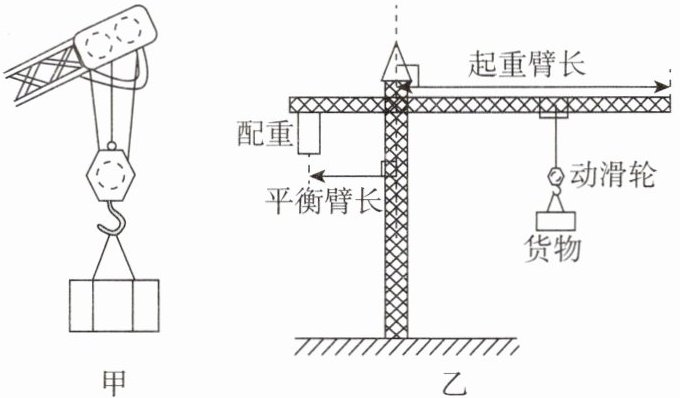
9. [2025·无锡期中]如图甲是一种塔式起重机上的滑轮组,已知起重机匀速吊起$m_1= 600kg$的货物时,货物在t= 10s内匀速上升了h= 5m,滑轮组的机械效率η= 80%;若忽略滑轮组中定滑轮部分质量,不计摩擦和绳重,g取10N/kg。
(1)求绳端的拉力F。
(2)求绳端拉力F的功率P。
(3)图乙中悬吊货物所用动滑轮与图甲中相同,若配重质量M= 3t,平衡臂长$l_1= 5m,$起重臂长$l_2= 15m,$当把货物送至最右端且塔臂在水平位置平衡时,求此时货物的质量$m_2$。
(1)求绳端的拉力F。
2500N
(2)求绳端拉力F的功率P。
3750W
(3)图乙中悬吊货物所用动滑轮与图甲中相同,若配重质量M= 3t,平衡臂长$l_1= 5m,$起重臂长$l_2= 15m,$当把货物送至最右端且塔臂在水平位置平衡时,求此时货物的质量$m_2$。
850kg
答案:
解:
(1) 由图甲可知 $ n = 3 $,货物的重力 $ G = m_{1}g = 600 \, \text{kg} \times 10 \, \text{N/kg} = 6000 \, \text{N} $
因为 $ \eta = \frac{W_{\text{有用}}}{W_{\text{总}}} \times 100\% = \frac{Gh}{Fs} \times 100\% = \frac{Gh}{Fnh} \times 100\% = \frac{G}{nF} \times 100\% $
所以绳端拉力 $ F = \frac{G}{n\eta} = \frac{6000 \, \text{N}}{3 \times 80\%} = 2500 \, \text{N} $
(2) 绳子自由端移动的距离 $ s = nh = 3 \times 5 \, \text{m} = 15 \, \text{m} $
拉力做的总功 $ W_{\text{总}} = Fs = 2500 \, \text{N} \times 15 \, \text{m} = 37500 \, \text{J} $
则拉力的功率 $ P = \frac{W_{\text{总}}}{t} = \frac{37500 \, \text{J}}{10 \, \text{s}} = 3750 \, \text{W} $
(3) 因为不计绳重和摩擦时 $ F = \frac{1}{n}(G + G_{\text{动}}) $,所以动滑轮的重力 $ G_{\text{动}} = nF - G = 3 \times 2500 \, \text{N} - 6000 \, \text{N} = 1500 \, \text{N} $
配重的重力 $ G_{\text{配}} = Mg = 3 \times 10^{3} \, \text{kg} \times 10 \, \text{N/kg} = 3 \times 10^{4} \, \text{N} $
根据杠杆平衡条件有 $ G_{\text{配}}l_{1} = F_{2}l_{2} $
代入数据有 $ 3 \times 10^{4} \, \text{N} \times 5 \, \text{m} = F_{2} \times 15 \, \text{m} $,解得 $ F_{2} = 1 \times 10^{4} \, \text{N} $
所以此时货物的重力 $ G' = F_{2} - G_{\text{动}} = 1 \times 10^{4} \, \text{N} - 1500 \, \text{N} = 8500 \, \text{N} $
所以此时货物的质量 $ m_{2} = \frac{G'}{g} = \frac{8500 \, \text{N}}{10 \, \text{N/kg}} = 850 \, \text{kg} $
(1) 由图甲可知 $ n = 3 $,货物的重力 $ G = m_{1}g = 600 \, \text{kg} \times 10 \, \text{N/kg} = 6000 \, \text{N} $
因为 $ \eta = \frac{W_{\text{有用}}}{W_{\text{总}}} \times 100\% = \frac{Gh}{Fs} \times 100\% = \frac{Gh}{Fnh} \times 100\% = \frac{G}{nF} \times 100\% $
所以绳端拉力 $ F = \frac{G}{n\eta} = \frac{6000 \, \text{N}}{3 \times 80\%} = 2500 \, \text{N} $
(2) 绳子自由端移动的距离 $ s = nh = 3 \times 5 \, \text{m} = 15 \, \text{m} $
拉力做的总功 $ W_{\text{总}} = Fs = 2500 \, \text{N} \times 15 \, \text{m} = 37500 \, \text{J} $
则拉力的功率 $ P = \frac{W_{\text{总}}}{t} = \frac{37500 \, \text{J}}{10 \, \text{s}} = 3750 \, \text{W} $
(3) 因为不计绳重和摩擦时 $ F = \frac{1}{n}(G + G_{\text{动}}) $,所以动滑轮的重力 $ G_{\text{动}} = nF - G = 3 \times 2500 \, \text{N} - 6000 \, \text{N} = 1500 \, \text{N} $
配重的重力 $ G_{\text{配}} = Mg = 3 \times 10^{3} \, \text{kg} \times 10 \, \text{N/kg} = 3 \times 10^{4} \, \text{N} $
根据杠杆平衡条件有 $ G_{\text{配}}l_{1} = F_{2}l_{2} $
代入数据有 $ 3 \times 10^{4} \, \text{N} \times 5 \, \text{m} = F_{2} \times 15 \, \text{m} $,解得 $ F_{2} = 1 \times 10^{4} \, \text{N} $
所以此时货物的重力 $ G' = F_{2} - G_{\text{动}} = 1 \times 10^{4} \, \text{N} - 1500 \, \text{N} = 8500 \, \text{N} $
所以此时货物的质量 $ m_{2} = \frac{G'}{g} = \frac{8500 \, \text{N}}{10 \, \text{N/kg}} = 850 \, \text{kg} $
查看更多完整答案,请扫码查看

