

 搜索
搜索
2024年高职高考全真模拟试卷辽海出版社高中数学全一册人教版
注:目前有些书本章节名称可能整理的还不是很完善,但都是按照顺序排列的,请同学们按照顺序仔细查找。练习册 2024年高职高考全真模拟试卷辽海出版社高中数学全一册人教版 答案主要是用来给同学们做完题方便对答案用的,请勿直接抄袭。
第19页
- 第1页
- 第2页
- 第3页
- 第4页
- 第5页
- 第6页
- 第7页
- 第8页
- 第9页
- 第10页
- 第11页
- 第12页
- 第13页
- 第14页
- 第15页
- 第16页
- 第17页
- 第18页
- 第19页
- 第20页
- 第21页
- 第22页
- 第23页
- 第24页
- 第25页
- 第26页
- 第27页
- 第28页
- 第29页
- 第30页
- 第31页
- 第32页
- 第33页
- 第34页
- 第35页
- 第36页
- 第37页
- 第38页
- 第39页
- 第40页
- 第41页
- 第42页
- 第43页
- 第44页
- 第45页
- 第46页
- 第47页
- 第48页
- 第49页
- 第50页
- 第51页
- 第52页
- 第53页
- 第54页
- 第55页
- 第56页
- 第57页
- 第58页
- 第59页
- 第60页
- 第61页
- 第62页
- 第63页
- 第64页
- 第65页
- 第66页
- 第67页
- 第68页
22. $\triangle ABC$中,点$D$在边$BC$上,且$BD = 4$,$DC = 2$,$\angle B = 60^{\circ}$,$\angle ADC = 150^{\circ}$,求$AC$的长及$\triangle ACD$的面积.
答案:
解:$\because BD = 4$,$DC = 2$,$\angle B = 60^{\circ}$,$\angle ADC=150^{\circ}$
$\because\angle BAD = 150^{\circ}-60^{\circ}=90^{\circ}$
$\therefore\angle ADB = 180^{\circ}-\angle ADC = 30^{\circ}$
$\therefore AB=\frac{1}{2}BD = 2$,$BC = BD + CD = 6$
$\triangle ABC$中,由余弦定理有
$AC^{2}=AB^{2}+BC^{2}-2AB\cdot BC\cos60^{\circ}=2^{2}+6^{2}-2\times2\times6\times\frac{1}{2}=28$
$\therefore AC = 2\sqrt{7}$
直角$\triangle ABD$中,
$AD=\sqrt{BD^{2}-AB^{2}}=\sqrt{4^{2}-2^{2}}=2\sqrt{3}$
$S_{\triangle ACD}=\frac{1}{2}AD\cdot DC\cdot\sin\angle ADC=\frac{1}{2}\times2\sqrt{3}\times2\times\frac{1}{2}=\sqrt{3}$
$\because\angle BAD = 150^{\circ}-60^{\circ}=90^{\circ}$
$\therefore\angle ADB = 180^{\circ}-\angle ADC = 30^{\circ}$
$\therefore AB=\frac{1}{2}BD = 2$,$BC = BD + CD = 6$
$\triangle ABC$中,由余弦定理有
$AC^{2}=AB^{2}+BC^{2}-2AB\cdot BC\cos60^{\circ}=2^{2}+6^{2}-2\times2\times6\times\frac{1}{2}=28$
$\therefore AC = 2\sqrt{7}$
直角$\triangle ABD$中,
$AD=\sqrt{BD^{2}-AB^{2}}=\sqrt{4^{2}-2^{2}}=2\sqrt{3}$
$S_{\triangle ACD}=\frac{1}{2}AD\cdot DC\cdot\sin\angle ADC=\frac{1}{2}\times2\sqrt{3}\times2\times\frac{1}{2}=\sqrt{3}$
23. 已知数列$\{a_{n}\}$是等差数列,且公差$d > 0$,其中$a_{2}+a_{4}=12$,$a_{2}\cdot a_{4}=32$.
(1)求数列$\{a_{n}\}$的通项公式;
(2)设$b_{n}=\sqrt{2^{a_{n}}}$,求数列$\{b_{n}\}$的前$n$项和$T_{n}$.
(1)求数列$\{a_{n}\}$的通项公式;
(2)设$b_{n}=\sqrt{2^{a_{n}}}$,求数列$\{b_{n}\}$的前$n$项和$T_{n}$.
答案:
解:
(1)已知数列$\{a_{n}\}$是等差数列,则$a_{2}=a_{1}+d$,$a_{4}=a_{1}+3d(d\gt0)$
由$\begin{cases}(a_{1}+d)+(a_{1}+3d)=12\\(a_{1}+d)\times(a_{1}+3d)=32\end{cases}$得$\begin{cases}a_{1}=2\\d = 2\end{cases}$
$\therefore a_{n}=a_{1}+(n - 1)d=2+(n - 1)\times2=2n$
(2)由题可知:$b_{n}=\sqrt{2^{a_{n}}}=\sqrt{2^{2n}}=2^{n}$
$\therefore\frac{b_{n + 1}}{b_{n}}=\frac{2^{n + 1}}{2^{n}}=2$
又$b_{1}=2$
$\therefore$数列$\{b_{n}\}$是以公比为2的等比数列
$\therefore T_{n}=\frac{b_{1}(1 - q^{n})}{1 - q}=\frac{2\times(1 - 2^{n})}{1 - 2}=2^{n + 1}-2$
(1)已知数列$\{a_{n}\}$是等差数列,则$a_{2}=a_{1}+d$,$a_{4}=a_{1}+3d(d\gt0)$
由$\begin{cases}(a_{1}+d)+(a_{1}+3d)=12\\(a_{1}+d)\times(a_{1}+3d)=32\end{cases}$得$\begin{cases}a_{1}=2\\d = 2\end{cases}$
$\therefore a_{n}=a_{1}+(n - 1)d=2+(n - 1)\times2=2n$
(2)由题可知:$b_{n}=\sqrt{2^{a_{n}}}=\sqrt{2^{2n}}=2^{n}$
$\therefore\frac{b_{n + 1}}{b_{n}}=\frac{2^{n + 1}}{2^{n}}=2$
又$b_{1}=2$
$\therefore$数列$\{b_{n}\}$是以公比为2的等比数列
$\therefore T_{n}=\frac{b_{1}(1 - q^{n})}{1 - q}=\frac{2\times(1 - 2^{n})}{1 - 2}=2^{n + 1}-2$
24. 已知椭圆$C$的中心在坐标原点,两焦点$F_{1}$,$F_{2}$在$x$轴上,离心率为$\frac{\sqrt{3}}{2}$,椭圆上一点$P$到两焦点$F_{1}$和$F_{2}$的距离之和为12. 圆$C_{k}:x^{2}+y^{2}+2kx - 4y - 21 = 0(k\in\mathbf{R})$的圆心为点$A_{k}$.
(1)求椭圆$C$的方程;
(2)求$\triangle A_{k}F_{1}F_{2}$的面积;
(3)若$k = 0$,判断圆$C_{0}$与椭圆$C$是否有交点?
(1)求椭圆$C$的方程;
(2)求$\triangle A_{k}F_{1}F_{2}$的面积;
(3)若$k = 0$,判断圆$C_{0}$与椭圆$C$是否有交点?
答案:
解:
(1)由已知得$\begin{cases}\frac{c}{a}=\frac{\sqrt{3}}{2}\\2a = 12\end{cases}\Rightarrow\begin{cases}a = 6\\c = 3\sqrt{3}\end{cases}$
$b^{2}=a^{2}-c^{2}=6^{2}-(3\sqrt{3})^{2}=9$
椭圆方程为$\frac{x^{2}}{36}+\frac{y^{2}}{9}=1$
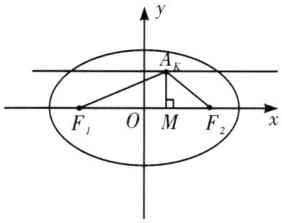
(2)将圆$C_{k}:x^{2}+y^{2}+2kx - 4y - 21 = 0(k\in\mathbf{R})$的方程化为
$(x + k)^{2}+(y - 2)^{2}=k^{2}+25$
圆心$A_{k}(-k,2)$,落在直线$y = 2$上
作$A_{k}M\perp F_{1}F_{2}$于$M$,则$\vert A_{k}M\vert = 2$
由
(1)知$\vert F_{1}F_{2}\vert = 2c = 6\sqrt{3}$
所以$\triangle A_{k}F_{1}F_{2}$的面积为
$S_{\triangle A_{k}F_{1}F_{2}}=\frac{1}{2}\vert F_{1}F_{2}\vert\cdot\vert A_{k}M\vert=\frac{1}{2}\times6\sqrt{3}\times2=6\sqrt{3}$
(3)若$k = 0$,
由
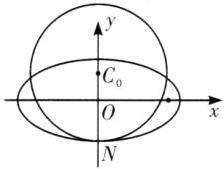
(2)知圆的方程为$x^{2}+(y - 2)^{2}=25$,圆心坐标为$C_{0}(0,2)$,半径为5
又椭圆短半轴长为3,
所以$r=\vert C_{0}N\vert = 5$,圆$C_{0}$必过椭圆的短轴端点$N$
因此圆$C_{0}$与椭圆$C$有交点
解:
(1)由已知得$\begin{cases}\frac{c}{a}=\frac{\sqrt{3}}{2}\\2a = 12\end{cases}\Rightarrow\begin{cases}a = 6\\c = 3\sqrt{3}\end{cases}$
$b^{2}=a^{2}-c^{2}=6^{2}-(3\sqrt{3})^{2}=9$
椭圆方程为$\frac{x^{2}}{36}+\frac{y^{2}}{9}=1$
(2)将圆$C_{k}:x^{2}+y^{2}+2kx - 4y - 21 = 0(k\in\mathbf{R})$的方程化为
$(x + k)^{2}+(y - 2)^{2}=k^{2}+25$
圆心$A_{k}(-k,2)$,落在直线$y = 2$上
作$A_{k}M\perp F_{1}F_{2}$于$M$,则$\vert A_{k}M\vert = 2$
由
(1)知$\vert F_{1}F_{2}\vert = 2c = 6\sqrt{3}$
所以$\triangle A_{k}F_{1}F_{2}$的面积为
$S_{\triangle A_{k}F_{1}F_{2}}=\frac{1}{2}\vert F_{1}F_{2}\vert\cdot\vert A_{k}M\vert=\frac{1}{2}\times6\sqrt{3}\times2=6\sqrt{3}$
(3)若$k = 0$,
由
(2)知圆的方程为$x^{2}+(y - 2)^{2}=25$,圆心坐标为$C_{0}(0,2)$,半径为5
又椭圆短半轴长为3,
所以$r=\vert C_{0}N\vert = 5$,圆$C_{0}$必过椭圆的短轴端点$N$
因此圆$C_{0}$与椭圆$C$有交点
查看更多完整答案,请扫码查看

