

 搜索
搜索
第79页
- 第1页
- 第2页
- 第3页
- 第4页
- 第5页
- 第6页
- 第7页
- 第8页
- 第9页
- 第10页
- 第11页
- 第12页
- 第13页
- 第14页
- 第15页
- 第16页
- 第17页
- 第18页
- 第19页
- 第20页
- 第21页
- 第22页
- 第23页
- 第24页
- 第25页
- 第26页
- 第27页
- 第28页
- 第29页
- 第30页
- 第31页
- 第32页
- 第33页
- 第34页
- 第35页
- 第36页
- 第37页
- 第38页
- 第39页
- 第40页
- 第41页
- 第42页
- 第43页
- 第44页
- 第45页
- 第46页
- 第47页
- 第48页
- 第49页
- 第50页
- 第51页
- 第52页
- 第53页
- 第54页
- 第55页
- 第56页
- 第57页
- 第58页
- 第59页
- 第60页
- 第61页
- 第62页
- 第63页
- 第64页
- 第65页
- 第66页
- 第67页
- 第68页
- 第69页
- 第70页
- 第71页
- 第72页
- 第73页
- 第74页
- 第75页
- 第76页
- 第77页
- 第78页
- 第79页
- 第80页
- 第81页
- 第82页
- 第83页
- 第84页
- 第85页
- 第86页
- 第87页
- 第88页
- 第89页
- 第90页
- 第91页
- 第92页
- 第93页
- 第94页
- 第95页
- 第96页
- 第97页
- 第98页
- 第99页
- 第100页
- 第101页
1.(2024上海崇明区一模改编)Can I ______ your dictionary? I forgot to bring mine to school today. (E9207001)
A.borrow B.lend C.return D.keep
A.borrow B.lend C.return D.keep
答案:
① 1.A 问句的含义是“我可以借一下你的词典吗?”,borrow 表示“借入;借来”,符合题意,故选 A。
2. 人与自我·健康生活 (2024四川泸州中考改编)______ healthy, we students do morning exercises every day at school.
A.Keep B.To keep
C.Keeping D.Keeps
A.Keep B.To keep
C.Keeping D.Keeps
答案:
2.B 由语境可知,为了保持健康,我们学生每天早上在学校做早操,该句中 To keep healthy 作目的状语,符合题意,故选 B。
3. 人与自我·自我管理 (2024河北中考)Jeff still works hard ______ he has achieved great success.
A.if B.before C.though D.because
A.if B.before C.though D.because
答案:
3.C 考查连词的用法。根据本题语境可知,尽管杰夫取得了很大的成功,他仍然努力工作,though 意为“尽管”,用来引导让步状语从句,故选 C。
4. 人与社会·人际交往 (2024黑龙江齐齐哈尔中考改编)—It’s time to graduate. We should say “Thanks” to our teachers.
—I think so. We have made great ______ with the teachers’ help. (E9207001)
A.progress B.suggestions
C.mistakes D.experiences
—I think so. We have made great ______ with the teachers’ help. (E9207001)
A.progress B.suggestions
C.mistakes D.experiences
答案:
4.A 根据本题语境可知,我们在老师们的帮助下取得了很大进步,progress 符合题意,故选 A。
Ⅱ 阅读理解
思维品质·评价思维 (2024四川遂宁中考改编,46—50,★☆☆)
As language learners, it’s important to use dictionaries. Paper dictionaries are often great choices for us. They lead us to think in a more exact way. However, with the rapid development of the Internet, many websites and apps offer us information about the language we are learning, so some language learners like online dictionaries better. Here is what some students think of the two kinds of dictionaries.
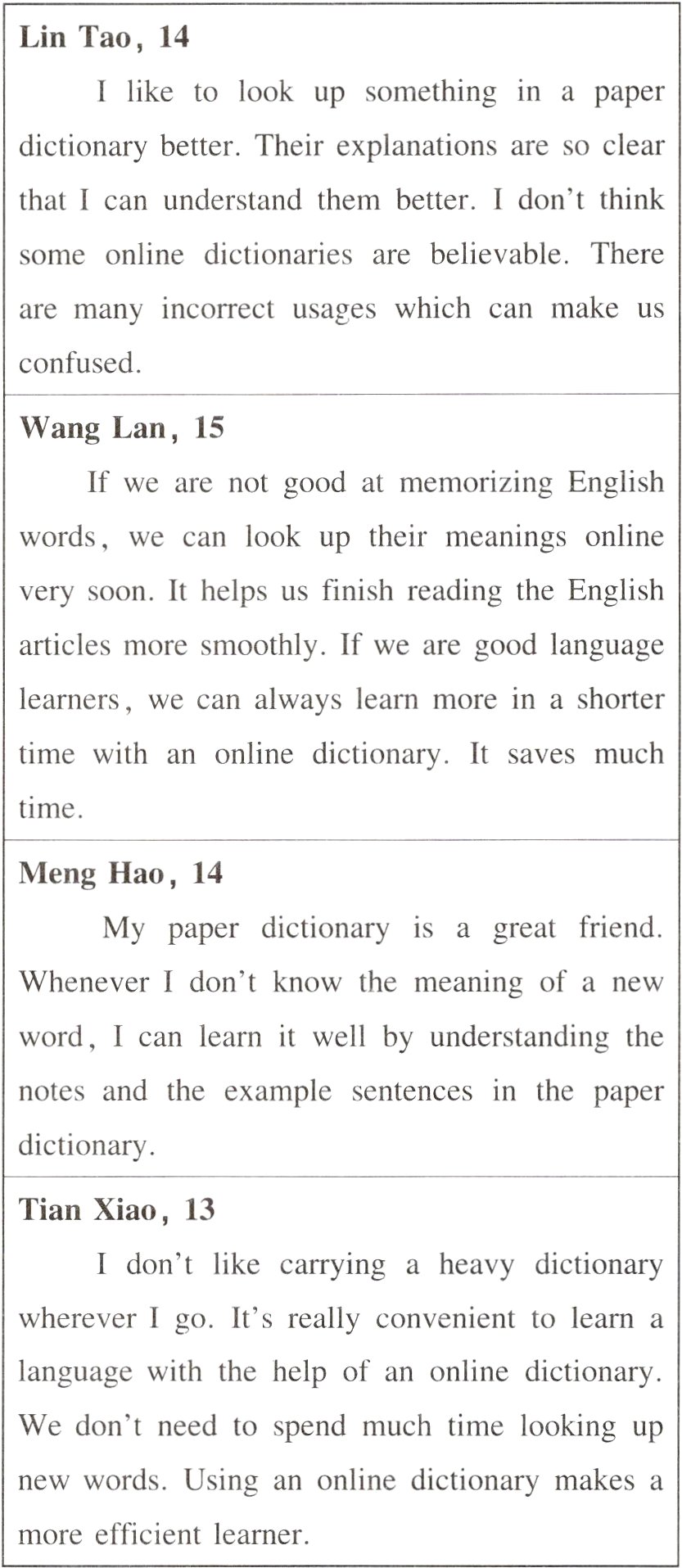
If you want to share your opinions, please e-mail us at 18900053407youthdaily@163.com. And your opinions will be carried on tomorrow’s newspaper. (E9207003)
5.Why does Lin Tao like paper dictionaries better?
A.There are many incorrect usages.
B.Their explanations are clear.
C.It’s a great friend.
D.He can understand the notes.
6.What are the advantages of the online dictionaries according to Tian Xiao?
A.Fast and clear.
B.Correct and clear.
C.Clear and believable.
D.Convenient and efficient.
7.Which two have the same idea?
A.Wang Lan and Tian Xiao.
B.Wang Lan and Meng Hao.
C.Lin Tao and Wang Lan.
D.Meng Hao and Tian Xiao.
8.What does the text mainly talk about?
A.Advantages of online dictionaries.
B.The development of the dictionaries.
C.Different ideas about language learning.
D.Different ideas about paper and online dictionaries.
9.Where is the text probably from?
A.A magazine. B.A newspaper.
C.A textbook. D.A storybook.
思维品质·评价思维 (2024四川遂宁中考改编,46—50,★☆☆)
As language learners, it’s important to use dictionaries. Paper dictionaries are often great choices for us. They lead us to think in a more exact way. However, with the rapid development of the Internet, many websites and apps offer us information about the language we are learning, so some language learners like online dictionaries better. Here is what some students think of the two kinds of dictionaries.
If you want to share your opinions, please e-mail us at 18900053407youthdaily@163.com. And your opinions will be carried on tomorrow’s newspaper. (E9207003)
5.Why does Lin Tao like paper dictionaries better?
A.There are many incorrect usages.
B.Their explanations are clear.
C.It’s a great friend.
D.He can understand the notes.
6.What are the advantages of the online dictionaries according to Tian Xiao?
A.Fast and clear.
B.Correct and clear.
C.Clear and believable.
D.Convenient and efficient.
7.Which two have the same idea?
A.Wang Lan and Tian Xiao.
B.Wang Lan and Meng Hao.
C.Lin Tao and Wang Lan.
D.Meng Hao and Tian Xiao.
8.What does the text mainly talk about?
A.Advantages of online dictionaries.
B.The development of the dictionaries.
C.Different ideas about language learning.
D.Different ideas about paper and online dictionaries.
9.Where is the text probably from?
A.A magazine. B.A newspaper.
C.A textbook. D.A storybook.
答案:
[语篇解读] 本文列举了四名学生对于纸质词典和在线词典的看法。
5.B 细节理解题。根据 Lin Tao 的描述中的“I like to look up...Their explanations are so clear that I can understand them better.”可知,Lin Tao 更喜欢纸质词典是因为它们的解释很清楚,故选 B。
6.D 细节理解题。根据 Tian Xiao 的描述中的“It's really convenient to learn a language with the help of an online dictionary.”和“Using an online dictionary makes a more efficient learner.”可知,Tian Xiao 认为在线词典方便而且效率高,故选 D。
7.A 推理判断题。根据 Wang Lan 和 Tian Xiao 的描述可知,她们观点一致,都觉得在线词典更好,故选 A。
8.D 主旨大意题。本文列举了四名学生对于纸质词典和在线词典的看法,故选 D。
9.B 文章出处题。根据最后一段中的“And your opinions will be carried on tomorrow's newspaper.”可知,你的观点会被刊登在明天的报纸上,合适的出处是“报纸”,故选 B。
5.B 细节理解题。根据 Lin Tao 的描述中的“I like to look up...Their explanations are so clear that I can understand them better.”可知,Lin Tao 更喜欢纸质词典是因为它们的解释很清楚,故选 B。
6.D 细节理解题。根据 Tian Xiao 的描述中的“It's really convenient to learn a language with the help of an online dictionary.”和“Using an online dictionary makes a more efficient learner.”可知,Tian Xiao 认为在线词典方便而且效率高,故选 D。
7.A 推理判断题。根据 Wang Lan 和 Tian Xiao 的描述可知,她们观点一致,都觉得在线词典更好,故选 A。
8.D 主旨大意题。本文列举了四名学生对于纸质词典和在线词典的看法,故选 D。
9.B 文章出处题。根据最后一段中的“And your opinions will be carried on tomorrow's newspaper.”可知,你的观点会被刊登在明天的报纸上,合适的出处是“报纸”,故选 B。
查看更多完整答案,请扫码查看

