

 搜索
搜索
2025年周末C计划高中数学必修第一册人教版
注:目前有些书本章节名称可能整理的还不是很完善,但都是按照顺序排列的,请同学们按照顺序仔细查找。练习册 2025年周末C计划高中数学必修第一册人教版 答案主要是用来给同学们做完题方便对答案用的,请勿直接抄袭。
11. (2025 安徽阜阳阜南实验中学月考)已知函数$f(x)=\lg(\sqrt{x^{2}-2x + 2}-x + 1)$,则下列说法正确的是(
A.$f(x)$的值域为$\mathbf{R}$
B.$f(x + 1)$的图象关于原点对称
C.$f(x)$在$(1,+\infty)$上单调递增
D.若$f(x)$在$x\in[1 - m,1 + m]$上的最大值、最小值分别为$M$,$N$,则$M + N = 0$
ABD
)A.$f(x)$的值域为$\mathbf{R}$
B.$f(x + 1)$的图象关于原点对称
C.$f(x)$在$(1,+\infty)$上单调递增
D.若$f(x)$在$x\in[1 - m,1 + m]$上的最大值、最小值分别为$M$,$N$,则$M + N = 0$
答案:
11.ABD 对于A,$x^{2} - 2x + 2 - (x - 1)^{2} = 1 > 0$,所以$\sqrt{x^{2} - 2x + 2} > (x - 1)^{2} \geq 0$,则$\sqrt{x^{2} - 2x + 2} - x + 1 > 0$恒成立,所以$f(x)$的定义域为$\mathbf{R}$,
又当$x \to + \infty$时,$y = \sqrt{x^{2} - 2x + 2} - x + 1 = \frac{1}{\sqrt{x^{2} - 2x + 2} + x - 1} \to 0$,$\lg y \to - \infty$,
当$x \to - \infty$时,$y = \sqrt{x^{2} - 2x + 2} - x + 1 \to + \infty$,$\lg y \to + \infty$,且$f(1) = 0$,$f(x)$的图象连续不断,所以$f(x)$的值域为$\mathbf{R}$,故A正确;
对于B,$f(x + 1) = \lg(\sqrt{(x + 1)^{2} - 2(x + 1) + 2} - (x + 1) + 1) = \lg(\sqrt{x^{2} + 1} - x)$,
令$k(x) = f(x + 1) = \lg(\sqrt{x^{2} + 1} - x)$,易知$k(x)$的定义域为$\mathbf{R}$,
又$k( - x) + k(x) = \lg(\sqrt{x^{2} + 1} + x) + \lg(\sqrt{x^{2} + 1} - x) = \lg 1 = 0$,所以$k(x)$为奇函数,其图象关于原点对称,即$f(x + 1)$的图象关于原点对称,故B正确;
对于C,由B知$k(x) = \lg(\sqrt{x^{2} + 1} - x) = \lg\frac{1}{\sqrt{x^{2} + 1} + x}$,易知其在$\mathbf{R}$上单调递减,
又$k(x) = f(x + 1)$,所以将$k(x)$的图象向右平移一个单位长度可得$f(x)$的图象,所以$f(x)$在$\mathbf{R}$上单调递减,故C错误;
对于D,由C知$f(x)$在$\mathbf{R}$上单调递减,故$f(x)$在$[1 - m,1 + m]$上单调递减,
则$M = f(1 - m)$,$N = f(1 + m)$,故$M + N = f(1 - m) + f(1 + m) = k( - m) + k(m) = 0$,故D正确。
又当$x \to + \infty$时,$y = \sqrt{x^{2} - 2x + 2} - x + 1 = \frac{1}{\sqrt{x^{2} - 2x + 2} + x - 1} \to 0$,$\lg y \to - \infty$,
当$x \to - \infty$时,$y = \sqrt{x^{2} - 2x + 2} - x + 1 \to + \infty$,$\lg y \to + \infty$,且$f(1) = 0$,$f(x)$的图象连续不断,所以$f(x)$的值域为$\mathbf{R}$,故A正确;
对于B,$f(x + 1) = \lg(\sqrt{(x + 1)^{2} - 2(x + 1) + 2} - (x + 1) + 1) = \lg(\sqrt{x^{2} + 1} - x)$,
令$k(x) = f(x + 1) = \lg(\sqrt{x^{2} + 1} - x)$,易知$k(x)$的定义域为$\mathbf{R}$,
又$k( - x) + k(x) = \lg(\sqrt{x^{2} + 1} + x) + \lg(\sqrt{x^{2} + 1} - x) = \lg 1 = 0$,所以$k(x)$为奇函数,其图象关于原点对称,即$f(x + 1)$的图象关于原点对称,故B正确;
对于C,由B知$k(x) = \lg(\sqrt{x^{2} + 1} - x) = \lg\frac{1}{\sqrt{x^{2} + 1} + x}$,易知其在$\mathbf{R}$上单调递减,
又$k(x) = f(x + 1)$,所以将$k(x)$的图象向右平移一个单位长度可得$f(x)$的图象,所以$f(x)$在$\mathbf{R}$上单调递减,故C错误;
对于D,由C知$f(x)$在$\mathbf{R}$上单调递减,故$f(x)$在$[1 - m,1 + m]$上单调递减,
则$M = f(1 - m)$,$N = f(1 + m)$,故$M + N = f(1 - m) + f(1 + m) = k( - m) + k(m) = 0$,故D正确。
12. (2025 安徽宣城二中月考)一个扇形的弧长和面积都是$\frac{2\pi}{3}$,则这个扇形的半径为
2
.
答案:
12.答案:2
解析:设扇形的弧长为$l$,半径为$r$,面积为$S$,则$l = \frac{2\pi}{3}$,$S = \frac{1}{2}lr = \frac{1}{2} × \frac{2\pi}{3} × r = \frac{2\pi}{3}$,解得$r = 2$。
解析:设扇形的弧长为$l$,半径为$r$,面积为$S$,则$l = \frac{2\pi}{3}$,$S = \frac{1}{2}lr = \frac{1}{2} × \frac{2\pi}{3} × r = \frac{2\pi}{3}$,解得$r = 2$。
13. (2025 湖北武汉调研)为了响应节能减排号召,某地政府决定大规模铺设光伏太阳能板,该地区未来第$x$年年底光伏太阳能板的保有量$y$(单位:万块)满足模型$y=\frac{N}{1+\left(\frac{N}{y_{0}}-1\right)e^{-px}}$,其中$N$为饱和度,$y_{0}$为初始值,$p$为年增长率.若该地区 2024 年年底的光伏太阳能板的保有量约为 20 万块,以此为初始值,以后每年的增长率均为 10%,饱和度为 1020 万块,那么 2030 年年底该地区光伏太阳能板的保有量约为________万块.(结果四舍五入保留整数,参考数据:$e^{-0.5}\approx0.61$,$e^{-0.6}\approx0.55$,$e^{-0.7}\approx0.50$)
36
答案:
13.答案:36
解析:由题意得$y_{0} = 20$,$N = 1020$,$p = 10\% = 0.1$,$x = 6$,
则2030年年底该地区光伏太阳能板的保有量为$\frac{1020}{1 + (\frac{1020}{20} - 1)e^{- 0.1 × 6}} = \frac{1020}{1 + 50e^{- 0.6}}$,
因为$e^{- 0.6} \approx 0.55$,所以$\frac{1020}{1 + 50e^{- 0.6}} \approx \frac{1020}{1 + 50 × 0.55} \approx 36$,
所以2030年年底该地区光伏太阳能板的保有量约为36万块。
解析:由题意得$y_{0} = 20$,$N = 1020$,$p = 10\% = 0.1$,$x = 6$,
则2030年年底该地区光伏太阳能板的保有量为$\frac{1020}{1 + (\frac{1020}{20} - 1)e^{- 0.1 × 6}} = \frac{1020}{1 + 50e^{- 0.6}}$,
因为$e^{- 0.6} \approx 0.55$,所以$\frac{1020}{1 + 50e^{- 0.6}} \approx \frac{1020}{1 + 50 × 0.55} \approx 36$,
所以2030年年底该地区光伏太阳能板的保有量约为36万块。
14. 创新题 新考法 (2025 云南联考)对于任意实数$a$,$b$,定义符号$\max\{a,b\}$,当$a\geq b$时,$\max\{a,b\}=a$;当$a\lt b$时,$\max\{a,b\}=b$.若$f(x)=1 - x^{2}$,$g(x)=\log_{2}|x|$,函数$F(x)=\max\{f(x),g(x)\}-k$有$4$个零点,则$k$的取值范围为________.
答案:
14.答案:$(0,1)$
解析:在同一坐标系内作出$f(x)$,$g(x)$的图象,如图1所示,
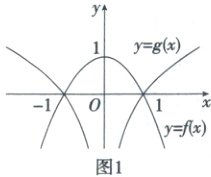
则$\max\{ f(x),g(x)\} = \begin{cases} \log_{2}( - x),x < - 1, \\1 - x^{2}, - 1 \leq x \leq 1, \\\log_{2}x,x > 1, \end{cases}$如图2,
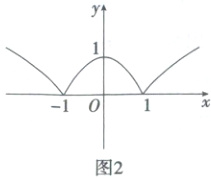
令$F(x) = 0$,则$k = \max\{ f(x),g(x)\}$,
故若$F(x)$有4个零点,则$y = \max\{ f(x),g(x)\}$的图象与直线$y = k$有4个交点,由图2可得$0 < k < 1$,
故$k$的取值范围为$(0,1)$。
14.答案:$(0,1)$
解析:在同一坐标系内作出$f(x)$,$g(x)$的图象,如图1所示,
则$\max\{ f(x),g(x)\} = \begin{cases} \log_{2}( - x),x < - 1, \\1 - x^{2}, - 1 \leq x \leq 1, \\\log_{2}x,x > 1, \end{cases}$如图2,
令$F(x) = 0$,则$k = \max\{ f(x),g(x)\}$,
故若$F(x)$有4个零点,则$y = \max\{ f(x),g(x)\}$的图象与直线$y = k$有4个交点,由图2可得$0 < k < 1$,
故$k$的取值范围为$(0,1)$。
15. (13 分)(2025 浙江宁波期末)如图,单位圆$O$与$x$轴正半轴的交点为$A$,点$B$,$C$在圆$O$上,且点$B$在第一象限内,点$C$在第二象限内.
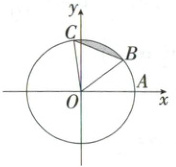
(1)当$\overgroup{BC}$的长为$\frac{\pi}{3}$时,求线段$BC$与$\overgroup{BC}$所围成的弓形(阴影部分)面积;
(2)记$\angle AOC=\alpha,\alpha\in\left(\frac{\pi}{2},\pi\right)$,当$BO\perp CO$,点$B$的横坐标为$\frac{4}{5}$时,求$\sin\alpha+\cos\alpha$的值.
(1)当$\overgroup{BC}$的长为$\frac{\pi}{3}$时,求线段$BC$与$\overgroup{BC}$所围成的弓形(阴影部分)面积;
(2)记$\angle AOC=\alpha,\alpha\in\left(\frac{\pi}{2},\pi\right)$,当$BO\perp CO$,点$B$的横坐标为$\frac{4}{5}$时,求$\sin\alpha+\cos\alpha$的值.
答案:
15.解析:
(1)设$BC$所对的圆心角为$\theta$,$BC$长为$l$,弓形的面积为$S$。
因为$l = \frac{\pi}{3}$,圆$O$的半径$r = 1$,所以$\theta = \frac{l}{r} = \frac{\pi}{3}$,(3分)
故$S_{扇形BOC} = \frac{1}{2}\theta r^{2} = \frac{1}{2} × \frac{\pi}{3} × 1^{2} = \frac{\pi}{6}$,易知$\triangle BOC$为等边三角形,所以$S_{\triangle BOC} = \frac{1}{2} × 1 × \sqrt{1 - (\frac{1}{2})^{2}} = \frac{\sqrt{3}}{4}$,
故$S = S_{扇形BOC} - S_{\triangle BOC} = \frac{\pi}{6} - \frac{\sqrt{3}}{4}$。(6分)
(2)设$\angle AOB = \beta$,则$\alpha = 90^{\circ} + \beta$,由题知$B(\frac{4}{5},\frac{3}{5})$,则$\sin\beta = \frac{3}{5}$,$\cos\beta = \frac{4}{5}$,(9分)
所以$\sin\alpha + \cos\alpha = \sin(90^{\circ} + \beta) + \cos(90^{\circ} + \beta) = \cos\beta - \sin\beta = \frac{4}{5} - \frac{3}{5} = \frac{1}{5}$。(13分)
(1)设$BC$所对的圆心角为$\theta$,$BC$长为$l$,弓形的面积为$S$。
因为$l = \frac{\pi}{3}$,圆$O$的半径$r = 1$,所以$\theta = \frac{l}{r} = \frac{\pi}{3}$,(3分)
故$S_{扇形BOC} = \frac{1}{2}\theta r^{2} = \frac{1}{2} × \frac{\pi}{3} × 1^{2} = \frac{\pi}{6}$,易知$\triangle BOC$为等边三角形,所以$S_{\triangle BOC} = \frac{1}{2} × 1 × \sqrt{1 - (\frac{1}{2})^{2}} = \frac{\sqrt{3}}{4}$,
故$S = S_{扇形BOC} - S_{\triangle BOC} = \frac{\pi}{6} - \frac{\sqrt{3}}{4}$。(6分)
(2)设$\angle AOB = \beta$,则$\alpha = 90^{\circ} + \beta$,由题知$B(\frac{4}{5},\frac{3}{5})$,则$\sin\beta = \frac{3}{5}$,$\cos\beta = \frac{4}{5}$,(9分)
所以$\sin\alpha + \cos\alpha = \sin(90^{\circ} + \beta) + \cos(90^{\circ} + \beta) = \cos\beta - \sin\beta = \frac{4}{5} - \frac{3}{5} = \frac{1}{5}$。(13分)
16. (15 分)(2025 福建部分学校期中)已知$\sin\theta$和$\cos\theta$是关于$x$的方程$x^{2}+mx+\frac{1}{2}=0$的两实根,且$0\lt\theta\lt\frac{\pi}{2}$.
(1)求$m$的值;
(2)求$\sin^{4}\theta+\cos^{4}\theta$的值;
(3)求$\frac{\tan\theta+\tan\frac{7\pi}{3}}{1-\tan\theta\tan\frac{4\pi}{3}}$的值.
(1)求$m$的值;
(2)求$\sin^{4}\theta+\cos^{4}\theta$的值;
(3)求$\frac{\tan\theta+\tan\frac{7\pi}{3}}{1-\tan\theta\tan\frac{4\pi}{3}}$的值.
答案:
16.解析:
(1)因为$\sin\theta$和$\cos\theta$是关于$x$的方程$x^{2} + mx + \frac{1}{2} = 0$的两实根,
所以$\Delta = m^{2} - 2 \geq 0$,$\sin\theta + \cos\theta = - m$①,$\sin\theta\cos\theta = \frac{1}{2}$②,则$m \geq \sqrt{2}$或$m \leq - \sqrt{2}$,(2分)
将①式等号两边平方可得$(\sin\theta + \cos\theta)^{2} = m^{2}$,
即$\sin^{2}\theta + 2\sin\theta\cos\theta + \cos^{2}\theta = m^{2}$,即$\sin\theta\cos\theta = \frac{m^{2} - 1}{2}$,
结合②式得$m^{2} = 2$,解得$m = \pm \sqrt{2}$。(4分)
因为$0 < \theta < \frac{\pi}{2}$,所以$\sin\theta > 0$,$\cos\theta > 0$,
则$\sin\theta + \cos\theta = - m > 0$,则$m < 0$,故$m = - \sqrt{2}$。(5分)
(2)因为$\sin\theta\cos\theta = \frac{1}{2}$,
所以$\sin^{4}\theta + \cos^{4}\theta = (\sin^{2}\theta + \cos^{2}\theta)^{2} - 2\sin^{2}\theta\cos^{2}\theta = 1 - 2 × (\frac{1}{2})^{2} = \frac{1}{2}$。(8分)
(3)由
(1)知$\cos\theta = \sqrt{2} - \sin\theta$,将其代入$\sin\theta\cos\theta = \frac{1}{2}$,
得$\sin\theta(\sqrt{2} - \sin\theta) = \frac{1}{2}$,
整理得$\sin^{2}\theta - \sqrt{2}\sin\theta + \frac{1}{2} = 0$,所以$\sin\theta = \frac{\sqrt{2}}{2}$,故$\cos\theta = \sqrt{2} - \frac{\sqrt{2}}{2} = \frac{\sqrt{2}}{2}$,
所以$\tan\theta = \frac{\sin\theta}{\cos\theta} = \frac{\frac{\sqrt{2}}{2}}{\frac{\sqrt{2}}{2}} = 1$。(12分)
$\frac{\tan\theta + \tan\frac{7\pi}{3}}{1 - \tan\theta\tan\frac{4\pi}{3}} = \frac{\tan\theta + \tan\frac{\pi}{3}}{1 - \tan\theta\tan\frac{\pi}{3}} = \frac{1 + \sqrt{3}}{1 - 1 × \sqrt{3}} = \frac{1 + \sqrt{3}}{1 - \sqrt{3}} = - 2 - \sqrt{3}$。(15分)
(1)因为$\sin\theta$和$\cos\theta$是关于$x$的方程$x^{2} + mx + \frac{1}{2} = 0$的两实根,
所以$\Delta = m^{2} - 2 \geq 0$,$\sin\theta + \cos\theta = - m$①,$\sin\theta\cos\theta = \frac{1}{2}$②,则$m \geq \sqrt{2}$或$m \leq - \sqrt{2}$,(2分)
将①式等号两边平方可得$(\sin\theta + \cos\theta)^{2} = m^{2}$,
即$\sin^{2}\theta + 2\sin\theta\cos\theta + \cos^{2}\theta = m^{2}$,即$\sin\theta\cos\theta = \frac{m^{2} - 1}{2}$,
结合②式得$m^{2} = 2$,解得$m = \pm \sqrt{2}$。(4分)
因为$0 < \theta < \frac{\pi}{2}$,所以$\sin\theta > 0$,$\cos\theta > 0$,
则$\sin\theta + \cos\theta = - m > 0$,则$m < 0$,故$m = - \sqrt{2}$。(5分)
(2)因为$\sin\theta\cos\theta = \frac{1}{2}$,
所以$\sin^{4}\theta + \cos^{4}\theta = (\sin^{2}\theta + \cos^{2}\theta)^{2} - 2\sin^{2}\theta\cos^{2}\theta = 1 - 2 × (\frac{1}{2})^{2} = \frac{1}{2}$。(8分)
(3)由
(1)知$\cos\theta = \sqrt{2} - \sin\theta$,将其代入$\sin\theta\cos\theta = \frac{1}{2}$,
得$\sin\theta(\sqrt{2} - \sin\theta) = \frac{1}{2}$,
整理得$\sin^{2}\theta - \sqrt{2}\sin\theta + \frac{1}{2} = 0$,所以$\sin\theta = \frac{\sqrt{2}}{2}$,故$\cos\theta = \sqrt{2} - \frac{\sqrt{2}}{2} = \frac{\sqrt{2}}{2}$,
所以$\tan\theta = \frac{\sin\theta}{\cos\theta} = \frac{\frac{\sqrt{2}}{2}}{\frac{\sqrt{2}}{2}} = 1$。(12分)
$\frac{\tan\theta + \tan\frac{7\pi}{3}}{1 - \tan\theta\tan\frac{4\pi}{3}} = \frac{\tan\theta + \tan\frac{\pi}{3}}{1 - \tan\theta\tan\frac{\pi}{3}} = \frac{1 + \sqrt{3}}{1 - 1 × \sqrt{3}} = \frac{1 + \sqrt{3}}{1 - \sqrt{3}} = - 2 - \sqrt{3}$。(15分)
查看更多完整答案,请扫码查看

