

 搜索
搜索
2025年综合应用创新题典中点八年级英语下册鲁教版
注:目前有些书本章节名称可能整理的还不是很完善,但都是按照顺序排列的,请同学们按照顺序仔细查找。练习册 2025年综合应用创新题典中点八年级英语下册鲁教版 答案主要是用来给同学们做完题方便对答案用的,请勿直接抄袭。
第86页
- 第1页
- 第2页
- 第3页
- 第4页
- 第5页
- 第6页
- 第7页
- 第8页
- 第9页
- 第10页
- 第11页
- 第12页
- 第13页
- 第14页
- 第15页
- 第16页
- 第17页
- 第18页
- 第19页
- 第20页
- 第21页
- 第22页
- 第23页
- 第24页
- 第25页
- 第26页
- 第27页
- 第28页
- 第29页
- 第30页
- 第31页
- 第32页
- 第33页
- 第34页
- 第35页
- 第36页
- 第37页
- 第38页
- 第39页
- 第40页
- 第41页
- 第42页
- 第43页
- 第44页
- 第45页
- 第46页
- 第47页
- 第48页
- 第49页
- 第50页
- 第51页
- 第52页
- 第53页
- 第54页
- 第55页
- 第56页
- 第57页
- 第58页
- 第59页
- 第60页
- 第61页
- 第62页
- 第63页
- 第64页
- 第65页
- 第66页
- 第67页
- 第68页
- 第69页
- 第70页
- 第71页
- 第72页
- 第73页
- 第74页
- 第75页
- 第76页
- 第77页
- 第78页
- 第79页
- 第80页
- 第81页
- 第82页
- 第83页
- 第84页
- 第85页
- 第86页
- 第87页
- 第88页
- 第89页
- 第90页
- 第91页
- 第92页
- 第93页
- 第94页
- 第95页
- 第96页
- 第97页
- 第98页
- 第99页
- 第100页
一、用括号内所给词的适当形式填空
1. She rang the bell for the ________ (three) time, but there was still no reply.
2. What do you think of these after - school ________ (activity)?
3. As we all know, the elderly should be spoken to ________ (polite).
4. Programming ________ (course) have become popular with teenagers these years.
5. Would you like ________ (join) us in having a drink in the newly - opened pub after work?
6. Now people find it ________ (convenience) to order a taxi on the phone.
7. — Could you tell me how soon the world - class museum ______________ (open) to the public? — Maybe next year.
8. He lost his way, but he had no one to ask for ________ (direct).
9. You have to make your own ________ (choose) in your lives, girls.
1. She rang the bell for the ________ (three) time, but there was still no reply.
2. What do you think of these after - school ________ (activity)?
3. As we all know, the elderly should be spoken to ________ (polite).
4. Programming ________ (course) have become popular with teenagers these years.
5. Would you like ________ (join) us in having a drink in the newly - opened pub after work?
6. Now people find it ________ (convenience) to order a taxi on the phone.
7. — Could you tell me how soon the world - class museum ______________ (open) to the public? — Maybe next year.
8. He lost his way, but he had no one to ask for ________ (direct).
9. You have to make your own ________ (choose) in your lives, girls.
答案:
1. third【点拨】根据句意可知,此处指第三次,应用序数词third。
2. activities 3. politely 4. courses
5. to join【点拨】would like to do sth.“想要做某事”,故填to join。
6. convenient【点拨】分析句子结构可知,“it”为形式宾语,空白处应用形容词来作宾语补足语,故填convenient。
7. will open【点拨】根据“Maybe next year.”以及所给单词提示可知,此处用一般将来时。故填will open。
8. direction
9. choices【点拨】根据“own”及结合所给词可知,此处应该填名词,又由“in your lives, girls”可知,此处应该填名词的复数形式。故填choices。
2. activities 3. politely 4. courses
5. to join【点拨】would like to do sth.“想要做某事”,故填to join。
6. convenient【点拨】分析句子结构可知,“it”为形式宾语,空白处应用形容词来作宾语补足语,故填convenient。
7. will open【点拨】根据“Maybe next year.”以及所给单词提示可知,此处用一般将来时。故填will open。
8. direction
9. choices【点拨】根据“own”及结合所给词可知,此处应该填名词,又由“in your lives, girls”可知,此处应该填名词的复数形式。故填choices。
二、用适当的词填空
10. Pardon ________, I didn't understand what you said.
11. Every morning, the students go to the classroom ________ a rush.
12. I am looking forward ________ travelling to Africa for a long time.
13. Jim, stand ________ your brother so that I can take a photo of you.
14. ________ whom do you want to talk when you're sad or lonely?
15. Please tell me ________ cartoon you like best.
16. — Do you know ________ the Italian team first won the Football World Cup? — In 1934.
10. Pardon ________, I didn't understand what you said.
11. Every morning, the students go to the classroom ________ a rush.
12. I am looking forward ________ travelling to Africa for a long time.
13. Jim, stand ________ your brother so that I can take a photo of you.
14. ________ whom do you want to talk when you're sad or lonely?
15. Please tell me ________ cartoon you like best.
16. — Do you know ________ the Italian team first won the Football World Cup? — In 1934.
答案:
10. me 11. in 12. to
13. beside 14. With
15. which 16. when
13. beside 14. With
15. which 16. when
三、阅读理解
主题:人与社会·历史、社会与文化 素养:文化意识
体裁:说明文 词数:约290 建议用时:7分钟
Have you ever wondered why we say shangcesuo (上厕所) instead of xiacesuo, and yijianxiangzuo (意见相左) instead of yijianxiangyou? Many Chinese words have directions in them, and there is lots of history and culture hidden behind.
Up or down
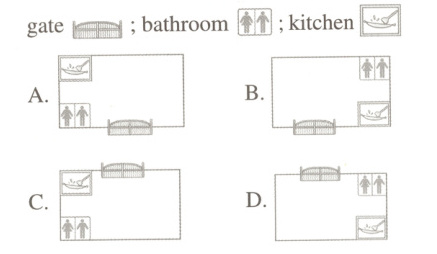
We use shangcesuo to mean “go to the bathroom” and xiachufang to mean “go to the kitchen”. Why? In ancient times, houses were laid out (布局) in a certain way. The gate of the house would face south, with the bathroom in the northeastern part of the house and the kitchen in the southeastern part. In Chinese, we talk about the north as shang and the south as xia. So people would say they're going up to the bathroom and down to the kitchen.
Ancient Chinese not only used shang and xia to refer to (指代) directions but also social positions. For example, people used huangshang to refer to the emperor and dianxia to refer to princes who had a lower position than the emperor.
Left or right
Most people today are right - handed. They feel uncomfortable if they try to use their left hand to write or use chopsticks. This was true in old times as well. So in ancient China, “left” was related to (与……有关联) being different, such as in yijianxiangzuo. If people don't accept common beliefs (信念), we still say they are following ▲.
“Left” and “right” also have something to do with people's social position. For a long time in ancient China, “right” stood for higher position than “left”. For example, the character “佑”, developed from “右”, means a person in a higher position would protect someone in a lower position.
17. Why does the writer use shangcesuo and yijianxiangzuo in the first paragraph?
A. To tell a story.
B. To introduce the topic.
C. To give an example.
D. To solve a mystery.
18. 新考法 内容还原 Which of the following can be best put in ▲?
A. qishangmanxia
B. shangchuanxiatiao
C. pangmenzuodao
D. zuosiyouxiang
19. Which picture shows the layout of houses in ancient China according to the passage?
20. What's the main idea of this text?
A. It tells us how to use some Chinese sayings.
B. It tells us what the meaning of some Chinese sayings is.
C. It tells us some words about directions or positions have different meanings now.
D. It tells us the Chinese history and culture are hidden behind these words about directions or positions.
主题:人与社会·历史、社会与文化 素养:文化意识
体裁:说明文 词数:约290 建议用时:7分钟
Have you ever wondered why we say shangcesuo (上厕所) instead of xiacesuo, and yijianxiangzuo (意见相左) instead of yijianxiangyou? Many Chinese words have directions in them, and there is lots of history and culture hidden behind.
Up or down
We use shangcesuo to mean “go to the bathroom” and xiachufang to mean “go to the kitchen”. Why? In ancient times, houses were laid out (布局) in a certain way. The gate of the house would face south, with the bathroom in the northeastern part of the house and the kitchen in the southeastern part. In Chinese, we talk about the north as shang and the south as xia. So people would say they're going up to the bathroom and down to the kitchen.
Ancient Chinese not only used shang and xia to refer to (指代) directions but also social positions. For example, people used huangshang to refer to the emperor and dianxia to refer to princes who had a lower position than the emperor.
Left or right
Most people today are right - handed. They feel uncomfortable if they try to use their left hand to write or use chopsticks. This was true in old times as well. So in ancient China, “left” was related to (与……有关联) being different, such as in yijianxiangzuo. If people don't accept common beliefs (信念), we still say they are following ▲.
“Left” and “right” also have something to do with people's social position. For a long time in ancient China, “right” stood for higher position than “left”. For example, the character “佑”, developed from “右”, means a person in a higher position would protect someone in a lower position.
17. Why does the writer use shangcesuo and yijianxiangzuo in the first paragraph?
A. To tell a story.
B. To introduce the topic.
C. To give an example.
D. To solve a mystery.
18. 新考法 内容还原 Which of the following can be best put in ▲?
A. qishangmanxia
B. shangchuanxiatiao
C. pangmenzuodao
D. zuosiyouxiang
19. Which picture shows the layout of houses in ancient China according to the passage?
20. What's the main idea of this text?
A. It tells us how to use some Chinese sayings.
B. It tells us what the meaning of some Chinese sayings is.
C. It tells us some words about directions or positions have different meanings now.
D. It tells us the Chinese history and culture are hidden behind these words about directions or positions.
答案:
【主旨大意】本文介绍了汉语中包含方向词的词汇背后的历史和文化含义。
17. B【点拨】推理判断题。根据“Have you ever wondered why we say... and there is lots of history and culture hidden behind.”可知,是为了引出本文将介绍的相关话题。故选B。
18. C【点拨】推理判断题。根据“So in ancient China, ‘left’ was related to (与……有关联) being different, such as in yijianxiangzuo.”可知,“左”通常表示与别人意见不一致,因此此空可以填选项C“旁门左道”。故选C。
19. B【点拨】推理判断题。根据“In ancient times, houses were laid out (布局) ...the kitchen in the southeastern part.”可知,中国古代房子的布局是:房子的大门朝南,厕所在房子的东北部,厨房在东南部,因此选项B中的布局符合题意。故选B。
20. D【点拨】主旨大意题。根据第一段内容可知,主要讲述了一些中文词汇中包含的方位词如“上”、“下”、“左”、“右”等背后隐藏的中国历史和文化。故选D。
17. B【点拨】推理判断题。根据“Have you ever wondered why we say... and there is lots of history and culture hidden behind.”可知,是为了引出本文将介绍的相关话题。故选B。
18. C【点拨】推理判断题。根据“So in ancient China, ‘left’ was related to (与……有关联) being different, such as in yijianxiangzuo.”可知,“左”通常表示与别人意见不一致,因此此空可以填选项C“旁门左道”。故选C。
19. B【点拨】推理判断题。根据“In ancient times, houses were laid out (布局) ...the kitchen in the southeastern part.”可知,中国古代房子的布局是:房子的大门朝南,厕所在房子的东北部,厨房在东南部,因此选项B中的布局符合题意。故选B。
20. D【点拨】主旨大意题。根据第一段内容可知,主要讲述了一些中文词汇中包含的方位词如“上”、“下”、“左”、“右”等背后隐藏的中国历史和文化。故选D。
查看更多完整答案,请扫码查看

