

 搜索
搜索
2025年综合应用创新题典中点八年级英语下册鲁教版
注:目前有些书本章节名称可能整理的还不是很完善,但都是按照顺序排列的,请同学们按照顺序仔细查找。练习册 2025年综合应用创新题典中点八年级英语下册鲁教版 答案主要是用来给同学们做完题方便对答案用的,请勿直接抄袭。
第77页
- 第1页
- 第2页
- 第3页
- 第4页
- 第5页
- 第6页
- 第7页
- 第8页
- 第9页
- 第10页
- 第11页
- 第12页
- 第13页
- 第14页
- 第15页
- 第16页
- 第17页
- 第18页
- 第19页
- 第20页
- 第21页
- 第22页
- 第23页
- 第24页
- 第25页
- 第26页
- 第27页
- 第28页
- 第29页
- 第30页
- 第31页
- 第32页
- 第33页
- 第34页
- 第35页
- 第36页
- 第37页
- 第38页
- 第39页
- 第40页
- 第41页
- 第42页
- 第43页
- 第44页
- 第45页
- 第46页
- 第47页
- 第48页
- 第49页
- 第50页
- 第51页
- 第52页
- 第53页
- 第54页
- 第55页
- 第56页
- 第57页
- 第58页
- 第59页
- 第60页
- 第61页
- 第62页
- 第63页
- 第64页
- 第65页
- 第66页
- 第67页
- 第68页
- 第69页
- 第70页
- 第71页
- 第72页
- 第73页
- 第74页
- 第75页
- 第76页
- 第77页
- 第78页
- 第79页
- 第80页
- 第81页
- 第82页
- 第83页
- 第84页
- 第85页
- 第86页
- 第87页
- 第88页
- 第89页
- 第90页
- 第91页
- 第92页
- 第93页
- 第94页
- 第95页
- 第96页
- 第97页
- 第98页
- 第99页
- 第100页
一、用括号内所给词的适当形式填空
1. I'd like to buy a pair of running __________ (shoe) for my daughter.
2. When eating Western food, people __________ (normal) use knives and forks.
3. The firemen __________ (rush) out as soon as they received the phone call for help.
4. [山东人文信息题] The lovely apples on these __________ (stamp) remind me of my sweet childhood in Yantai.
5. Can you tell me how __________ (celebrate) Children's Day in China?
6. How excited they were __________ (hear) they were chosen to play the lead roles in the play.
1. I'd like to buy a pair of running __________ (shoe) for my daughter.
2. When eating Western food, people __________ (normal) use knives and forks.
3. The firemen __________ (rush) out as soon as they received the phone call for help.
4. [山东人文信息题] The lovely apples on these __________ (stamp) remind me of my sweet childhood in Yantai.
5. Can you tell me how __________ (celebrate) Children's Day in China?
6. How excited they were __________ (hear) they were chosen to play the lead roles in the play.
答案:
1. shoes【点拨】“a pair of 一双”,后加可数名词复数,故填 shoes。
2. normally【点拨】根据“use”可知,要用副词修饰动词,故填 normally。
3. rushed【点拨】根据“as soon as they received the phone call”可知,时态用一般过去时,动词用过去式。故填 rushed。
4. stamps
5. to celebrate【点拨】由“how”可知,此处是“疑问词 + 不定式”结构作动词 tell 的宾语。故填 to celebrate。
6. to hear【点拨】be excited to do sth. 意为“很激动做某事”,故填 to hear。
2. normally【点拨】根据“use”可知,要用副词修饰动词,故填 normally。
3. rushed【点拨】根据“as soon as they received the phone call”可知,时态用一般过去时,动词用过去式。故填 rushed。
4. stamps
5. to celebrate【点拨】由“how”可知,此处是“疑问词 + 不定式”结构作动词 tell 的宾语。故填 to celebrate。
6. to hear【点拨】be excited to do sth. 意为“很激动做某事”,故填 to hear。
二、把A栏与B栏的单词合成新的单词,完成下列句子
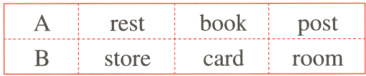
7. There was a long line waiting to use the __________ during the concert.
8. I found an old __________ in my grandmother's things.
9. The __________ has a wide variety of books for all ages.
7. There was a long line waiting to use the __________ during the concert.
8. I found an old __________ in my grandmother's things.
9. The __________ has a wide variety of books for all ages.
答案:
7. restroom 8. postcard 9. bookstore
三、用适当的介词或连接词填空
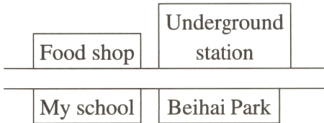
10. After school, my friends and I sometimes go to Beihai Park __________ my school.
11. Pardon me __________ asking such a personal question, but I'm curious.
12. As we all know, every English sentence should start __________ a capital letter.
13. The sign at the end of the corridor (走廊) will tell you __________ the bathroom is.
14. — Can you tell me __________ to get to the King Restaurant?
— Sure. Just walk __________ this road until you get to the end, and then you will find it __________ your left.
10. After school, my friends and I sometimes go to Beihai Park __________ my school.
11. Pardon me __________ asking such a personal question, but I'm curious.
12. As we all know, every English sentence should start __________ a capital letter.
13. The sign at the end of the corridor (走廊) will tell you __________ the bathroom is.
14. — Can you tell me __________ to get to the King Restaurant?
— Sure. Just walk __________ this road until you get to the end, and then you will find it __________ your left.
答案:
10. beside 11. for 12. with 13. where
14. how; along; on
14. how; along; on
四、阅读还原(有一项多余)
主题:人与社会·社会服务与人际沟通 素养:语言能力
体裁:说明文 词数:约220 建议用时:6分钟
How to Greet People in Different Languages
Have you ever stopped to think about how many people are saying “Hello” to greet each other today, and in how many different languages? If you want to say “Hello” to everyone on the planet, you would have to learn at least 7,000 languages and greet at least 7,800,000,000 people. 15. __________ Hola in Spanish, Ciao in Italian, Nihao in Chinese or Bonjour in French, and many more!
Sounds hard to learn to say so many “Hellos”? Don’t worry! It seems that nowadays the English word “Hello” is getting accepted in more and more cultures. 16. __________ Here is a simple and amusing way to greet foreigners wherever you might travel around the world.
17. __________ But she tries to say “Beautiful” in the local language. She can use it to “greet” a mother holding a baby, or to “greet” an old lady watering her flowers, or to “greet” a lonely salesman showing a photo of his family. 18. __________ So why not say it when even one word can bring about such pleasure? Fun, isn’t it? And we don’t need to pronounce those different local greeting words. With a hearty smile, it can be well understood and appreciated (欣赏). 19. __________ So let’s learn to say “Beautiful” in the local language whenever and wherever we travel around the world!
A. It’s very difficult for us to learn so many languages.
B. Here are some ways of saying “Hello” around the world.
C. A friend of mine who travels widely does not say “Hello”.
D. The ability has helped her win friendship all over the world.
E. Besides, you can find some other ways to greet people, too.
F. The “Beautiful” greeting is like sunlight that melts (融化) the coldness between people.
主题:人与社会·社会服务与人际沟通 素养:语言能力
体裁:说明文 词数:约220 建议用时:6分钟
How to Greet People in Different Languages
Have you ever stopped to think about how many people are saying “Hello” to greet each other today, and in how many different languages? If you want to say “Hello” to everyone on the planet, you would have to learn at least 7,000 languages and greet at least 7,800,000,000 people. 15. __________ Hola in Spanish, Ciao in Italian, Nihao in Chinese or Bonjour in French, and many more!
Sounds hard to learn to say so many “Hellos”? Don’t worry! It seems that nowadays the English word “Hello” is getting accepted in more and more cultures. 16. __________ Here is a simple and amusing way to greet foreigners wherever you might travel around the world.
17. __________ But she tries to say “Beautiful” in the local language. She can use it to “greet” a mother holding a baby, or to “greet” an old lady watering her flowers, or to “greet” a lonely salesman showing a photo of his family. 18. __________ So why not say it when even one word can bring about such pleasure? Fun, isn’t it? And we don’t need to pronounce those different local greeting words. With a hearty smile, it can be well understood and appreciated (欣赏). 19. __________ So let’s learn to say “Beautiful” in the local language whenever and wherever we travel around the world!
A. It’s very difficult for us to learn so many languages.
B. Here are some ways of saying “Hello” around the world.
C. A friend of mine who travels widely does not say “Hello”.
D. The ability has helped her win friendship all over the world.
E. Besides, you can find some other ways to greet people, too.
F. The “Beautiful” greeting is like sunlight that melts (融化) the coldness between people.
答案:
【主旨大意】本文介绍了如何用不同的语言和人们打招呼。
15. B【点拨】此空需要引出下文列举的不同语言中的“Hello”的表达方式,B 项“这里有一些世界各地说‘你好’的方式”符合语境,引出后文对不同语言中“Hello”的介绍。
16. E【点拨】前文提到学习这么多“Hello”的表达方式听起来很难,但不用担心,因为英语中的“Hello”正在被越来越多的文化所接受。接着 E 项“此外,你也可以找到一些其他打招呼的方式”作为过渡,引出后文提到的用“Beautiful”来打招呼的有趣方式。
17. C【点拨】后文提到她可以用当地语言说“Beautiful”来“问候”各种人,因此可以推断出前文是在描述一个喜欢旅行的人,并且她不以“Hello”作为唯一的打招呼方式。C 项“我的一个周游世界的朋友不说‘Hello’”符合语境,引出后文她使用“Beautiful”作为打招呼的方式。
18. F【点拨】前文提到她可以用当地语言说“Beautiful”来“问候”各种人,后文又提到“所以为什么不说呢?即使一个词也能带来如此多的快乐”,因此可以推断出中间需要一个过渡句来解释为什么“Beautiful”能带来快乐。F 项“‘Beautiful’的问候就像阳光一样融化了人们之间的冷漠”符合语境,解释了“Beautiful”作为打招呼方式的美好之处。
19. D【点拨】前文提到我们不需要发音那些不同的当地问候语,只需要一个衷心的微笑就能被很好地理解和欣赏。接着 D 项“这种能力帮助她赢得了全世界的友谊”作为总结,强调了使用“Beautiful”作为打招呼方式的好处和效果。
15. B【点拨】此空需要引出下文列举的不同语言中的“Hello”的表达方式,B 项“这里有一些世界各地说‘你好’的方式”符合语境,引出后文对不同语言中“Hello”的介绍。
16. E【点拨】前文提到学习这么多“Hello”的表达方式听起来很难,但不用担心,因为英语中的“Hello”正在被越来越多的文化所接受。接着 E 项“此外,你也可以找到一些其他打招呼的方式”作为过渡,引出后文提到的用“Beautiful”来打招呼的有趣方式。
17. C【点拨】后文提到她可以用当地语言说“Beautiful”来“问候”各种人,因此可以推断出前文是在描述一个喜欢旅行的人,并且她不以“Hello”作为唯一的打招呼方式。C 项“我的一个周游世界的朋友不说‘Hello’”符合语境,引出后文她使用“Beautiful”作为打招呼的方式。
18. F【点拨】前文提到她可以用当地语言说“Beautiful”来“问候”各种人,后文又提到“所以为什么不说呢?即使一个词也能带来如此多的快乐”,因此可以推断出中间需要一个过渡句来解释为什么“Beautiful”能带来快乐。F 项“‘Beautiful’的问候就像阳光一样融化了人们之间的冷漠”符合语境,解释了“Beautiful”作为打招呼方式的美好之处。
19. D【点拨】前文提到我们不需要发音那些不同的当地问候语,只需要一个衷心的微笑就能被很好地理解和欣赏。接着 D 项“这种能力帮助她赢得了全世界的友谊”作为总结,强调了使用“Beautiful”作为打招呼方式的好处和效果。
查看更多完整答案,请扫码查看

