

 搜索
搜索
第108页
- 第1页
- 第2页
- 第3页
- 第4页
- 第5页
- 第6页
- 第7页
- 第8页
- 第9页
- 第10页
- 第11页
- 第12页
- 第13页
- 第14页
- 第15页
- 第16页
- 第17页
- 第18页
- 第19页
- 第20页
- 第21页
- 第22页
- 第23页
- 第24页
- 第25页
- 第26页
- 第27页
- 第28页
- 第29页
- 第30页
- 第31页
- 第32页
- 第33页
- 第34页
- 第35页
- 第36页
- 第37页
- 第38页
- 第39页
- 第40页
- 第41页
- 第42页
- 第43页
- 第44页
- 第45页
- 第46页
- 第47页
- 第48页
- 第49页
- 第50页
- 第51页
- 第52页
- 第53页
- 第54页
- 第55页
- 第56页
- 第57页
- 第58页
- 第59页
- 第60页
- 第61页
- 第62页
- 第63页
- 第64页
- 第65页
- 第66页
- 第67页
- 第68页
- 第69页
- 第70页
- 第71页
- 第72页
- 第73页
- 第74页
- 第75页
- 第76页
- 第77页
- 第78页
- 第79页
- 第80页
- 第81页
- 第82页
- 第83页
- 第84页
- 第85页
- 第86页
- 第87页
- 第88页
- 第89页
- 第90页
- 第91页
- 第92页
- 第93页
- 第94页
- 第95页
- 第96页
- 第97页
- 第98页
- 第99页
- 第100页
- 第101页
- 第102页
- 第103页
- 第104页
- 第105页
- 第106页
- 第107页
- 第108页
- 第109页
- 第110页
- 第111页
- 第112页
- 第113页
- 第114页
- 第115页
- 第116页
- 第117页
- 第118页
- 第119页
- 第120页
- 第121页
- 第122页
- 第123页
- 第124页
- 第125页
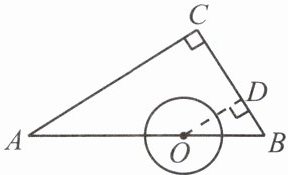
【例题1】如图,在$Rt \triangle ABC$中,$\angle C = 90^{\circ}$,$\angle A = 30^{\circ}$,$O为AB$上一点,$OB = m$,$\odot O的半径r = \frac{1}{2}$. 问:当$m$在什么取值范围内时,$BC与\odot O$相离、相切、相交?
答案:
思路导引 判断直线和圆的位置关系时,一定要找准半径的长和圆心到直线的距离,然后比较两者的大小,从而判断位置关系.
解:过点$O作OD \perp BC于点D$. $\because \angle A = 30^{\circ}$,$\angle C = 90^{\circ}$,$\therefore \angle B = 60^{\circ}$.
在$Rt \triangle ODB$中,$OB = m$,$\therefore BD = \frac{m}{2}$,$OD = d = \sqrt{m^{2} - (\frac{m}{2})^{2}} = \frac{\sqrt{3}}{2}m$.
$\therefore$①当$\odot O与BC$相离时,$d > r$,即$\frac{\sqrt{3}}{2}m > \frac{1}{2}$ $\therefore m > \frac{\sqrt{3}}{3}$. ②当$\odot O与BC$相切时,$d = r$,即$\frac{\sqrt{3}}{2}m = \frac{1}{2}$,$\therefore m = \frac{\sqrt{3}}{3}$. ③当$\odot O与BC$相交时,$d < r$,即$\frac{\sqrt{3}}{2}m < \frac{1}{2}$,$\therefore m < \frac{\sqrt{3}}{3}$.
综上所述,当$m > \frac{\sqrt{3}}{3}$时,$BC与\odot O$相离;当$m = \frac{\sqrt{3}}{3}$时,$BC与\odot O$相切;当$m < \frac{\sqrt{3}}{3}$时,$BC与\odot O$相交.
解:过点$O作OD \perp BC于点D$. $\because \angle A = 30^{\circ}$,$\angle C = 90^{\circ}$,$\therefore \angle B = 60^{\circ}$.
在$Rt \triangle ODB$中,$OB = m$,$\therefore BD = \frac{m}{2}$,$OD = d = \sqrt{m^{2} - (\frac{m}{2})^{2}} = \frac{\sqrt{3}}{2}m$.
$\therefore$①当$\odot O与BC$相离时,$d > r$,即$\frac{\sqrt{3}}{2}m > \frac{1}{2}$ $\therefore m > \frac{\sqrt{3}}{3}$. ②当$\odot O与BC$相切时,$d = r$,即$\frac{\sqrt{3}}{2}m = \frac{1}{2}$,$\therefore m = \frac{\sqrt{3}}{3}$. ③当$\odot O与BC$相交时,$d < r$,即$\frac{\sqrt{3}}{2}m < \frac{1}{2}$,$\therefore m < \frac{\sqrt{3}}{3}$.
综上所述,当$m > \frac{\sqrt{3}}{3}$时,$BC与\odot O$相离;当$m = \frac{\sqrt{3}}{3}$时,$BC与\odot O$相切;当$m < \frac{\sqrt{3}}{3}$时,$BC与\odot O$相交.
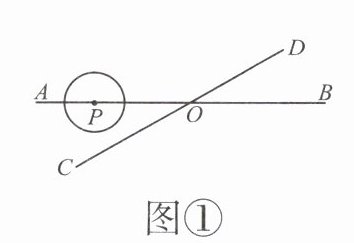
【例题2】如图①,直线$AB$,$CD交于点O$,$\angle AOC = 30^{\circ}$,半径为$1 cm的\odot P的圆心在射线OA$上,开始时$PO = 6 cm$. 如果$\odot P以1 cm/s的速度沿由点A向点B$的方向移动,那么当$\odot P的运动时间t$(单位:s)满足什么条件时,$\odot P与直线CD$相交?
答案:
思路导引 本题以动态几何形式呈现,解答此类问题首先要“以静制动”“动静结合”,即把变化的过程分解成几个关键点,再结合运动确定最后答案. 此题先确定$\odot P与直线CD$相切有两个位置,如图②.
图① 图②
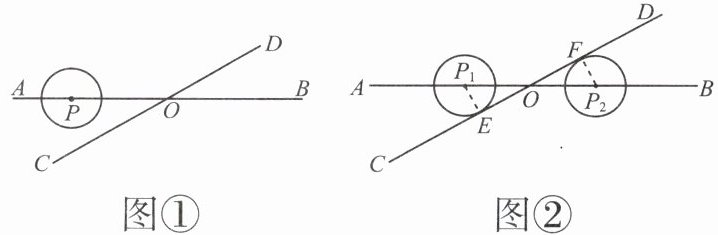
解:如图②,当$\odot P运动到\odot P_1与点C$相切时,可得$P_1E \perp CD$. 又$\angle AOC = 30^{\circ}$,$\therefore OP_1 = 2P_1E = 2 × 1 = 2(cm)$. $\therefore \odot P运动到\odot P_1所用的时间t_1 = \frac{6 - 2}{1} = 4(s)$.
当$\odot P继续向点B$运动,到达$\odot P_2$时,
同理可得$t_2 = 8(s)$.
综上所述,当$4 s < t < 8 s$时,$\odot P与直线CD$相交.
思路导引 本题以动态几何形式呈现,解答此类问题首先要“以静制动”“动静结合”,即把变化的过程分解成几个关键点,再结合运动确定最后答案. 此题先确定$\odot P与直线CD$相切有两个位置,如图②.
图① 图②
解:如图②,当$\odot P运动到\odot P_1与点C$相切时,可得$P_1E \perp CD$. 又$\angle AOC = 30^{\circ}$,$\therefore OP_1 = 2P_1E = 2 × 1 = 2(cm)$. $\therefore \odot P运动到\odot P_1所用的时间t_1 = \frac{6 - 2}{1} = 4(s)$.
当$\odot P继续向点B$运动,到达$\odot P_2$时,
同理可得$t_2 = 8(s)$.
综上所述,当$4 s < t < 8 s$时,$\odot P与直线CD$相交.
查看更多完整答案,请扫码查看

