

 搜索
搜索
第60页
- 第1页
- 第2页
- 第3页
- 第4页
- 第5页
- 第6页
- 第7页
- 第8页
- 第9页
- 第10页
- 第11页
- 第12页
- 第13页
- 第14页
- 第15页
- 第16页
- 第17页
- 第18页
- 第19页
- 第20页
- 第21页
- 第22页
- 第23页
- 第24页
- 第25页
- 第26页
- 第27页
- 第28页
- 第29页
- 第30页
- 第31页
- 第32页
- 第33页
- 第34页
- 第35页
- 第36页
- 第37页
- 第38页
- 第39页
- 第40页
- 第41页
- 第42页
- 第43页
- 第44页
- 第45页
- 第46页
- 第47页
- 第48页
- 第49页
- 第50页
- 第51页
- 第52页
- 第53页
- 第54页
- 第55页
- 第56页
- 第57页
- 第58页
- 第59页
- 第60页
- 第61页
- 第62页
- 第63页
- 第64页
- 第65页
- 第66页
- 第67页
- 第68页
- 第69页
- 第70页
- 第71页
- 第72页
- 第73页
- 第74页
- 第75页
- 第76页
- 第77页
- 第78页
- 第79页
- 第80页
- 第81页
- 第82页
- 第83页
- 第84页
- 第85页
- 第86页
- 第87页
- 第88页
- 第89页
- 第90页
- 第91页
- 第92页
- 第93页
- 第94页
- 第95页
- 第96页
- 第97页
- 第98页
- 第99页
- 第100页
- 第101页
- 第102页
- 第103页
- 第104页
- 第105页
- 第106页
B(2024·泰州中考)
I love snakes, while my mother does not. Lots of people who are afraid of snakes have never seen one. Neither has my mother. So where does the fear come from?
To find out the answer, scientists put pictures with snakes, pandas, cats, flowers and many other things in front of a group of people of all ages, even babies. People found snakes faster than flowers. It wasn't just snakes. They found "black faces", another example, spiders(蜘蛛), faster than "safe" things like flowers. It seems we find things that might be dangerous to us faster. Maybe we are born to be afraid of them.
Scientists also found people learned to fear snakes faster. Why did they fear snakes? Most of them said that in their experiences, they were influenced by the scared voice and faces of those who met snakes, but wasn't bitten by snakes. After all, if we had to be bitten by a snake to learn that it's dangerous, we might learn our lesson too late.
So why is it important whether we are afraid of snakes or not? It may not matter much to us, but it is really very important to snakes. People protect animals they like, not animals they fear. Snakes may not be as cute as pandas, but they're just of the same importance to the environment. Snakes eat insects and mice that are pests(害虫$) to humans. Snakes are also food for other animals, so, when we kill snakes, we're breaking the balance.How can we reduce our fears to give snakes a chance? Scientists did a study recently. Some volunteer students went on a field trip. With the help of safety tips, everyone could safely touch and hold a snake. It turns out that snakes aren't so bad when you know the way to stay with them. Most people who were afraid of snakes before the field trip weren't afraid afterwards. In fact, snakes even became some students' favourite animal. Hmm, maybe I should take my mom on the next field trip.
1. In the writer's opinion, what are "black faces"?
A. Things that make people feel dangerous.
B. Faces of animals in the picture.
C. Things that have black faces.
D. Faces of people in danger.
2. What does the writer mean by saying "we might learn our lesson too late" in the third paragraph?
A. We might never see any snakes.
B. We are not in danger any longer.
C. We might not fear snakes any more.
D. We might already be killed by snakes.
3. How do the scientists help people reduce the fear of snakes?
A. By teaching people skills of killing snakes.
B. By driving snakes away through a field trip.
C. By teaching people the right way to stay with them.
D. By giving snakes a chance to show they are good.
4. What can we learn from the scientists after reading the passage?
A. Don't be afraid and find chances in danger.
B. Always remember to give people safety tips.
C. Face failures bravely and never give up trying.
D. Find problems and do research to solve them.
5. Which fits the scientists' idea best?
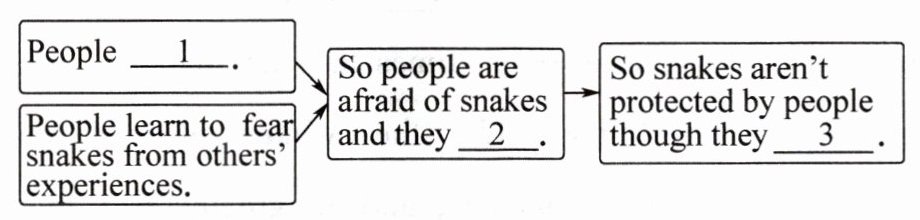
A. 1-c, 2-a, 3-b
B. 1-b, 2-a, 3-c
C. 1-a, 2-c, 3-b
D. 1-a, 2-b, 3-c$
I love snakes, while my mother does not. Lots of people who are afraid of snakes have never seen one. Neither has my mother. So where does the fear come from?
To find out the answer, scientists put pictures with snakes, pandas, cats, flowers and many other things in front of a group of people of all ages, even babies. People found snakes faster than flowers. It wasn't just snakes. They found "black faces", another example, spiders(蜘蛛), faster than "safe" things like flowers. It seems we find things that might be dangerous to us faster. Maybe we are born to be afraid of them.
Scientists also found people learned to fear snakes faster. Why did they fear snakes? Most of them said that in their experiences, they were influenced by the scared voice and faces of those who met snakes, but wasn't bitten by snakes. After all, if we had to be bitten by a snake to learn that it's dangerous, we might learn our lesson too late.
So why is it important whether we are afraid of snakes or not? It may not matter much to us, but it is really very important to snakes. People protect animals they like, not animals they fear. Snakes may not be as cute as pandas, but they're just of the same importance to the environment. Snakes eat insects and mice that are pests(害虫$) to humans. Snakes are also food for other animals, so, when we kill snakes, we're breaking the balance.How can we reduce our fears to give snakes a chance? Scientists did a study recently. Some volunteer students went on a field trip. With the help of safety tips, everyone could safely touch and hold a snake. It turns out that snakes aren't so bad when you know the way to stay with them. Most people who were afraid of snakes before the field trip weren't afraid afterwards. In fact, snakes even became some students' favourite animal. Hmm, maybe I should take my mom on the next field trip.
1. In the writer's opinion, what are "black faces"?
A. Things that make people feel dangerous.
B. Faces of animals in the picture.
C. Things that have black faces.
D. Faces of people in danger.
2. What does the writer mean by saying "we might learn our lesson too late" in the third paragraph?
A. We might never see any snakes.
B. We are not in danger any longer.
C. We might not fear snakes any more.
D. We might already be killed by snakes.
3. How do the scientists help people reduce the fear of snakes?
A. By teaching people skills of killing snakes.
B. By driving snakes away through a field trip.
C. By teaching people the right way to stay with them.
D. By giving snakes a chance to show they are good.
4. What can we learn from the scientists after reading the passage?
A. Don't be afraid and find chances in danger.
B. Always remember to give people safety tips.
C. Face failures bravely and never give up trying.
D. Find problems and do research to solve them.
5. Which fits the scientists' idea best?
A. 1-c, 2-a, 3-b
B. 1-b, 2-a, 3-c
C. 1-a, 2-c, 3-b
D. 1-a, 2-b, 3-c$
答案:
1. A 提示:词义猜测题。根据第二段中“It wasn't just snakes. They found ‘black faces’, another example, spiders, faster than ‘safe’ things like flowers.”可推断,black faces 是令人感觉危险的事物。
2. D 提示:推理判断题。根据上文“After all, if we had to be bitten by a snake to learn that it's dangerous”可推断,画线句子表示“我们可能已经被蛇咬死了”。
3. C 提示:推理判断题。根据最后一段第四、五句可知,科学家们通过教人们与蛇相处的正确方法来减少人们对蛇的恐惧。
4. D 提示:推理判断题。选项 A:不要害怕,在危险中寻找机会;选项 B:永远记得给人们安全提示;选项 C:勇敢面对失败,永不放弃尝试;选项 D:找到问题,做研究以解决它们。通读全文可知,文章从第二段开始一直在叙述科学家们的调查和研究过程,最后一段科学家们组织学生志愿者和蛇直接接触,从而克服他们对蛇的恐惧。由此推断,科学家们一直在寻找问题然后做研究来解决问题。
5. C 提示:推理判断题。a:生来怕蛇;b:需要保护;c:不保护他们害怕的动物。根据第二段最后一句“Maybe we are born to be afraid of them.”可知,科学家们推测人们生来就怕蛇,排除选项 A、B;根据第四段第三句“People protect animals they like, not animals they fear.”可知,人们保护自己喜欢的动物,不保护自己害怕的动物,所以尽管蛇需要保护,人们也不保护它们。由此推断,选项 C 正确。
2. D 提示:推理判断题。根据上文“After all, if we had to be bitten by a snake to learn that it's dangerous”可推断,画线句子表示“我们可能已经被蛇咬死了”。
3. C 提示:推理判断题。根据最后一段第四、五句可知,科学家们通过教人们与蛇相处的正确方法来减少人们对蛇的恐惧。
4. D 提示:推理判断题。选项 A:不要害怕,在危险中寻找机会;选项 B:永远记得给人们安全提示;选项 C:勇敢面对失败,永不放弃尝试;选项 D:找到问题,做研究以解决它们。通读全文可知,文章从第二段开始一直在叙述科学家们的调查和研究过程,最后一段科学家们组织学生志愿者和蛇直接接触,从而克服他们对蛇的恐惧。由此推断,科学家们一直在寻找问题然后做研究来解决问题。
5. C 提示:推理判断题。a:生来怕蛇;b:需要保护;c:不保护他们害怕的动物。根据第二段最后一句“Maybe we are born to be afraid of them.”可知,科学家们推测人们生来就怕蛇,排除选项 A、B;根据第四段第三句“People protect animals they like, not animals they fear.”可知,人们保护自己喜欢的动物,不保护自己害怕的动物,所以尽管蛇需要保护,人们也不保护它们。由此推断,选项 C 正确。
查看更多完整答案,请扫码查看

