

 搜索
搜索
2025年小题狂做高中英语选择性必修第四册译林版
注:目前有些书本章节名称可能整理的还不是很完善,但都是按照顺序排列的,请同学们按照顺序仔细查找。练习册 2025年小题狂做高中英语选择性必修第四册译林版 答案主要是用来给同学们做完题方便对答案用的,请勿直接抄袭。
第8页
- 第1页
- 第2页
- 第3页
- 第4页
- 第5页
- 第6页
- 第7页
- 第8页
- 第9页
- 第10页
- 第11页
- 第12页
- 第13页
- 第14页
- 第15页
- 第16页
- 第17页
- 第18页
- 第19页
- 第20页
- 第21页
- 第22页
- 第23页
- 第24页
- 第25页
- 第26页
- 第27页
- 第28页
- 第29页
- 第30页
- 第31页
- 第32页
- 第33页
- 第34页
- 第35页
- 第36页
- 第37页
- 第38页
- 第39页
- 第40页
- 第41页
- 第42页
- 第43页
- 第44页
- 第45页
- 第46页
- 第47页
- 第48页
- 第49页
- 第50页
- 第51页
- 第52页
- 第53页
- 第54页
- 第55页
- 第56页
- 第57页
- 第58页
- 第59页
- 第60页
- 第61页
- 第62页
- 第63页
- 第64页
- 第65页
- 第66页
- 第67页
- 第68页
- 第69页
- 第70页
- 第71页
- 第72页
- 第73页
- 第74页
[江苏灌南高级中学月考] You might text your friend a white lie to get out of going to dinner, exaggerate your height on a CV online to appear more attractive or invent an excuse for your boss over email to save face.
Social psychologists have long wondered where people tend to lie the most—that is, in person or through some other communication medium. A 2004 study was among the first to investigate the connection between deception( 欺骗) rates and technology. Jeff Hancock’s team had 28 students report the number of social interactions they had through face-to-face communication, the phone, instant messaging and email over seven days. Students also reported the number of times they lied in each social interaction.
The results suggested people told the most lies on the phone and the fewest through email, which is broadly in line with a “feature-based model”. According to the model, specific aspects of a technology—whether people can communicate back and forth smoothly, whether the messages are fleeting and whether communicators are distant—predict where people tend to lie the most.
When Hancock conducted his study, few students had a Facebook account. The iPhone was in its early stage. What would his results look like nearly 20 years later?
In a new study, I recruited( 招募) 250 people and studied interactions from more forms of technology. The participants recorded their social interactions and number of interactions with a lie over seven days, across face-to-face communication, social media, the phone, texting, video chat and email. The results show people seem to lie according to the “feature-based model”.
There are several possible explanations for these results. Phone and video chat, for example, might make deception less costly to a social relationship if caught. Deception rates might also differ across technology because people use some forms of technology for certain social relationships. For example, people might only email their colleagues( 同事), while video chat might be a better fit for more personal relationships.
People often believe just because we use technology to interact, honesty is harder to come by. Not only is this perception( 看法) misguided, but it is also unsupported by enough evidence. The belief that lying is common in the digital age just doesn’t match the data.
(
A. Reveal the tendency of people to tell lies on social media.
B. Introduce the topic of technology’s role in people’s telling lies.
C. Demonstrate the increasing popularity of social media.
D. Illustrate people’s ways of social interactions.
(
A. Their participants were all students.
B. They both aimed to reduce deception rates.
C. Their results were both consistent with a certain model.
D. They analysed the same kind of social relationships.
(
A. Social media users tend to lie more.
B. Close people are more likely to lie to each other.
C. Lying can greatly influence friendships.
D. Deception rates can be reduced by using technology.
(
A. It is unacceptable among friends.
B. It worsens interpersonal relationships.
C. It doesn’t happen as frequently as expected.
D. It is in line with advances in technology.
Social psychologists have long wondered where people tend to lie the most—that is, in person or through some other communication medium. A 2004 study was among the first to investigate the connection between deception( 欺骗) rates and technology. Jeff Hancock’s team had 28 students report the number of social interactions they had through face-to-face communication, the phone, instant messaging and email over seven days. Students also reported the number of times they lied in each social interaction.
The results suggested people told the most lies on the phone and the fewest through email, which is broadly in line with a “feature-based model”. According to the model, specific aspects of a technology—whether people can communicate back and forth smoothly, whether the messages are fleeting and whether communicators are distant—predict where people tend to lie the most.
When Hancock conducted his study, few students had a Facebook account. The iPhone was in its early stage. What would his results look like nearly 20 years later?
In a new study, I recruited( 招募) 250 people and studied interactions from more forms of technology. The participants recorded their social interactions and number of interactions with a lie over seven days, across face-to-face communication, social media, the phone, texting, video chat and email. The results show people seem to lie according to the “feature-based model”.
There are several possible explanations for these results. Phone and video chat, for example, might make deception less costly to a social relationship if caught. Deception rates might also differ across technology because people use some forms of technology for certain social relationships. For example, people might only email their colleagues( 同事), while video chat might be a better fit for more personal relationships.
People often believe just because we use technology to interact, honesty is harder to come by. Not only is this perception( 看法) misguided, but it is also unsupported by enough evidence. The belief that lying is common in the digital age just doesn’t match the data.
(
B
) 1. What does the author intend to do in the first paragraph?A. Reveal the tendency of people to tell lies on social media.
B. Introduce the topic of technology’s role in people’s telling lies.
C. Demonstrate the increasing popularity of social media.
D. Illustrate people’s ways of social interactions.
(
C
) 2. What do the studies by Hancock and the author have in common?A. Their participants were all students.
B. They both aimed to reduce deception rates.
C. Their results were both consistent with a certain model.
D. They analysed the same kind of social relationships.
(
B
) 3. What can be inferred from Paragraph 6?A. Social media users tend to lie more.
B. Close people are more likely to lie to each other.
C. Lying can greatly influence friendships.
D. Deception rates can be reduced by using technology.
(
C
) 4. What does the author think of people lying in social interactions?A. It is unacceptable among friends.
B. It worsens interpersonal relationships.
C. It doesn’t happen as frequently as expected.
D. It is in line with advances in technology.
答案:
一、阅读理解
[语篇结构分析]
举例:人们在不同场合会说谎(如在短信中、简历中、邮件中)
引入话题
提出问题:社会心理学家想知道人们在何种场合最容易说谎
研究背景 研究一:2004年Jeff Hancock的团队研究欺骗率与技术的关系 方法:28名学生记录7天内的社交互动及说谎次数
结果:打电话时说谎次数最多,发电子邮件时最少,符合“基于特征的模型”
科技与 研究二:在技术形式更多样的情况下进行的新研究 方法:250人记录7天内的社交互动及说谎次数
欺骗 结果:人们的说谎行为似乎遵循“基于特征的模型”
解释 打电话和视频聊天时,说谎对社交关系的损害更小
技术形式影响说谎率
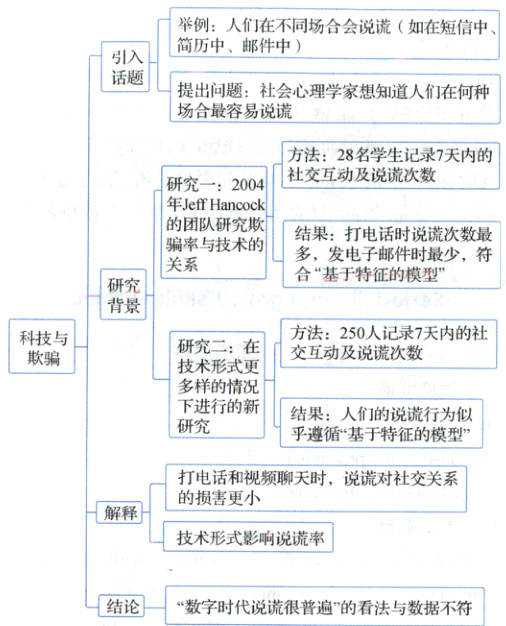
结论 “数字时代说谎很普遍”的看法与数据不符
[语篇导读]本文是一篇说明文。文章主要介绍了关于科技与说谎行为的研究,阐述了相关研究内容及结果,并分析了其内在机制。
1.B 推理判断题
[关键句1]You might text your friend a white lie to get out of going to dinner, exaggerate your height on a CV online to appear more attractive or invent an excuse for your boss over email to save face.
释义:你可能会给你的朋友发送善意的谎言,以推脱外出吃饭的邀请,也可能会在在线简历中夸大自己的身高,以显得更有吸引力,还可能会通过电子邮件编造一个借口搪塞你的老板以保全颜面。
[关键句2]Social psychologists have long wondered where people tend to lie the most—that is, in person or through some other communication medium.
释义:社会心理学家一直想知道人们在什么场合最容易说谎——是面对面交流时,还是通过其他某种沟通媒介。
[解析]第一段中列举了人们在不同场合说谎的例子,随后第二段首句指出社会心理学家对说谎场合的关注,进而引出下文关于科技与说谎行为的研究。由此不难推知,第一段的写作意图在于引入科技在人们说谎中所起的作用这一话题。故选B项。
2.C 细节理解题
[关键句1]The results suggested people told the most lies on the phone and the fewest through email, which is broadly in line with a “feature-based model”.
释义:研究结果表明,人们在电话中说谎的次数最多,在电子邮件中说谎的次数最少,这基本符合“基于特征的模型”。
[关键句2]The results show people seem to lie according to the “feature-based model”.
释义:研究结果显示,人们的说谎行为似乎遵循“基于特征的模型”。
[解析]根据两个关键句可知,Hancock和作者的研究结果都符合“基于特征的模型”,也就是说他们研究的共同点在于结果均与某种模型一致。故选C项。
3.B 推理判断题
[关键句1]Phone and video chat, for example, might make deception less costly to a social relationship if caught.
释义:例如,电话或视频聊天时如果被发现说谎,对社交关系的损害可能相对较小。
[关键句2]Deception rates might also differ across technology because people use some forms of technology for certain social relationships. For example, people might only email their colleagues, while video chat might be a better fit for more personal relationships.
释义:欺骗率也可能因技术而异,因为人们针对特定的社交关系会使用某些形式的技术。例如,人们可能只给同事发电子邮件,而视频聊天可能更适合更亲密的人际关系。
[解析]根据关键句1可推知,人们在视频聊天时更容易说谎,因为被发现后对关系的损害较小;根据关键句2可知,关系亲密的人会进行视频聊天。综上可推知,关系亲密的人更可能对彼此说谎。故选B项。
4.C 推理判断题
[关键句]Not only is this perception misguided, but it is also unsupported by enough evidence. The belief that lying is common in the digital age just doesn’t match the data.
释义:这种看法不仅是误解,而且缺乏足够的证据支持。“在数字时代说谎很普遍”这个看法与数据并不相符。
[解析]根据关键句可知,作者认为人们的“在数字时代说谎很普遍”这一观点与数据不符,即人们说谎的频率并不像想象的那么高。故选C项。
[重点词积累]
exaggerate v. 夸张,夸大
misguided adj. 搞错的
broadly adv. 大体上,基本上
come by 得到,找到
unsupported adj. 未经证实的,无根据的
[长难句解读]
The results suggested people told the most lies on
主句主语 主句谓语 宾语从句
the phone and the fewest through email,
宾语从句
which is broadly in line with a “feature-based model”.
定语从句
释义:研究结果表明,人们在电话中说谎的次数最多,在电子邮件中说谎的次数最少,这基本符合“基于特征的模型”。
分析:people told ... through email是省略了连接词that的宾语从句;which引导非限制性定语从句,which指代前面整个句子,在定语从句中作主语。
一、阅读理解
[语篇结构分析]
举例:人们在不同场合会说谎(如在短信中、简历中、邮件中)
引入话题
提出问题:社会心理学家想知道人们在何种场合最容易说谎
研究背景 研究一:2004年Jeff Hancock的团队研究欺骗率与技术的关系 方法:28名学生记录7天内的社交互动及说谎次数
结果:打电话时说谎次数最多,发电子邮件时最少,符合“基于特征的模型”
科技与 研究二:在技术形式更多样的情况下进行的新研究 方法:250人记录7天内的社交互动及说谎次数
欺骗 结果:人们的说谎行为似乎遵循“基于特征的模型”
解释 打电话和视频聊天时,说谎对社交关系的损害更小
技术形式影响说谎率
结论 “数字时代说谎很普遍”的看法与数据不符
[语篇导读]本文是一篇说明文。文章主要介绍了关于科技与说谎行为的研究,阐述了相关研究内容及结果,并分析了其内在机制。
1.B 推理判断题
[关键句1]You might text your friend a white lie to get out of going to dinner, exaggerate your height on a CV online to appear more attractive or invent an excuse for your boss over email to save face.
释义:你可能会给你的朋友发送善意的谎言,以推脱外出吃饭的邀请,也可能会在在线简历中夸大自己的身高,以显得更有吸引力,还可能会通过电子邮件编造一个借口搪塞你的老板以保全颜面。
[关键句2]Social psychologists have long wondered where people tend to lie the most—that is, in person or through some other communication medium.
释义:社会心理学家一直想知道人们在什么场合最容易说谎——是面对面交流时,还是通过其他某种沟通媒介。
[解析]第一段中列举了人们在不同场合说谎的例子,随后第二段首句指出社会心理学家对说谎场合的关注,进而引出下文关于科技与说谎行为的研究。由此不难推知,第一段的写作意图在于引入科技在人们说谎中所起的作用这一话题。故选B项。
2.C 细节理解题
[关键句1]The results suggested people told the most lies on the phone and the fewest through email, which is broadly in line with a “feature-based model”.
释义:研究结果表明,人们在电话中说谎的次数最多,在电子邮件中说谎的次数最少,这基本符合“基于特征的模型”。
[关键句2]The results show people seem to lie according to the “feature-based model”.
释义:研究结果显示,人们的说谎行为似乎遵循“基于特征的模型”。
[解析]根据两个关键句可知,Hancock和作者的研究结果都符合“基于特征的模型”,也就是说他们研究的共同点在于结果均与某种模型一致。故选C项。
3.B 推理判断题
[关键句1]Phone and video chat, for example, might make deception less costly to a social relationship if caught.
释义:例如,电话或视频聊天时如果被发现说谎,对社交关系的损害可能相对较小。
[关键句2]Deception rates might also differ across technology because people use some forms of technology for certain social relationships. For example, people might only email their colleagues, while video chat might be a better fit for more personal relationships.
释义:欺骗率也可能因技术而异,因为人们针对特定的社交关系会使用某些形式的技术。例如,人们可能只给同事发电子邮件,而视频聊天可能更适合更亲密的人际关系。
[解析]根据关键句1可推知,人们在视频聊天时更容易说谎,因为被发现后对关系的损害较小;根据关键句2可知,关系亲密的人会进行视频聊天。综上可推知,关系亲密的人更可能对彼此说谎。故选B项。
4.C 推理判断题
[关键句]Not only is this perception misguided, but it is also unsupported by enough evidence. The belief that lying is common in the digital age just doesn’t match the data.
释义:这种看法不仅是误解,而且缺乏足够的证据支持。“在数字时代说谎很普遍”这个看法与数据并不相符。
[解析]根据关键句可知,作者认为人们的“在数字时代说谎很普遍”这一观点与数据不符,即人们说谎的频率并不像想象的那么高。故选C项。
[重点词积累]
exaggerate v. 夸张,夸大
misguided adj. 搞错的
broadly adv. 大体上,基本上
come by 得到,找到
unsupported adj. 未经证实的,无根据的
[长难句解读]
The results suggested people told the most lies on
主句主语 主句谓语 宾语从句
the phone and the fewest through email,
宾语从句
which is broadly in line with a “feature-based model”.
定语从句
释义:研究结果表明,人们在电话中说谎的次数最多,在电子邮件中说谎的次数最少,这基本符合“基于特征的模型”。
分析:people told ... through email是省略了连接词that的宾语从句;which引导非限制性定语从句,which指代前面整个句子,在定语从句中作主语。
查看更多完整答案,请扫码查看

