

 搜索
搜索
2025年小题狂做高中英语选择性必修第四册译林版
注:目前有些书本章节名称可能整理的还不是很完善,但都是按照顺序排列的,请同学们按照顺序仔细查找。练习册 2025年小题狂做高中英语选择性必修第四册译林版 答案主要是用来给同学们做完题方便对答案用的,请勿直接抄袭。
第36页
- 第1页
- 第2页
- 第3页
- 第4页
- 第5页
- 第6页
- 第7页
- 第8页
- 第9页
- 第10页
- 第11页
- 第12页
- 第13页
- 第14页
- 第15页
- 第16页
- 第17页
- 第18页
- 第19页
- 第20页
- 第21页
- 第22页
- 第23页
- 第24页
- 第25页
- 第26页
- 第27页
- 第28页
- 第29页
- 第30页
- 第31页
- 第32页
- 第33页
- 第34页
- 第35页
- 第36页
- 第37页
- 第38页
- 第39页
- 第40页
- 第41页
- 第42页
- 第43页
- 第44页
- 第45页
- 第46页
- 第47页
- 第48页
- 第49页
- 第50页
- 第51页
- 第52页
- 第53页
- 第54页
- 第55页
- 第56页
- 第57页
- 第58页
- 第59页
- 第60页
- 第61页
- 第62页
- 第63页
- 第64页
- 第65页
- 第66页
- 第67页
- 第68页
- 第69页
- 第70页
- 第71页
- 第72页
- 第73页
- 第74页
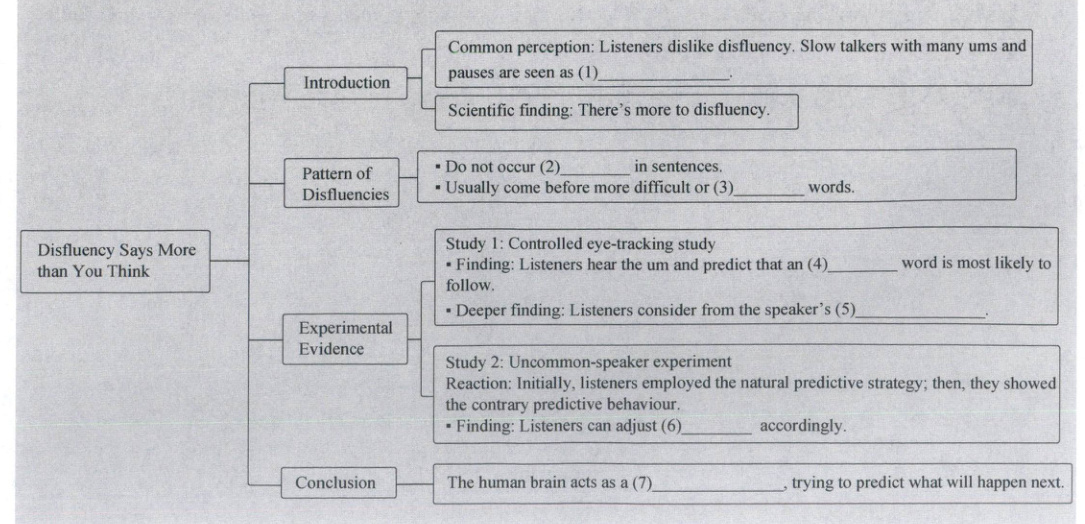
[江苏西安大学苏州附属中学期中] When you ask people to judge others by their speech, a trend emerges: listeners dislike disfluency. Slow talkers producing loads of ums and pauses(停顿) are generally perceived as less charming. But science tells us there may be even more to disfluency.
Disfluencies do not occur in arbitrary positions in sentences. Ums typically occur right before more difficult or low-frequency words. Imagine you’re having dinner with a friend at a restaurant, and there’re three items on the table: a knife, a glass, and a wine decanter(醒酒器). Your friend turns to you and says, “Could you hand me the ... um ...” What would you assume they want? Since it’s unlikely that they will hesitate before such common words as knife and glass, chances are you’ll pick up the decanter and ask, “You mean this?”
This is exactly what we demonstrated through controlled eye-tracking studies in our lab. Apparently, listeners hear the um and predict that an uncommon word is most likely to follow. Such predictions, though, reflect more than just simple association between disfluencies and difficult words; listeners are actively considering from the speaker’s point of view. For example, when hearing a non-native speaker say the same sentence but with a thick foreign accent, listeners don’t show a preference for looking at low-frequency objects. This is probably because listeners assume non-native speakers may have as much trouble coming up with the English word for a common object, like a knife, as for unusual ones and can’t guess their intention.
In another experiment, listeners were presented with an uncommon speaker who produced disfluencies before simple words and never before difficult words. Initially, participants displayed the natural predictive strategy: looking at uncommon objects. However, as more time went by, they gained experience with this uncommon distribution of disfluencies. Listeners started to demonstrate the contrary predictive behaviour: they tended to look at simple objects when hearing the speaker say um.
These findings represent further evidence that the human brain is a prediction machine: we continuously try to predict what will happen next, even though not all disfluencies are created equal.
(
A. Pauses usually follow uncommon words.
B. Slow talkers tend to pause more.
C. Fluent speakers are unlikely to pause.
D. Active listeners only guess difficult words.
(
A. They can be understood easily.
B. They actively put themselves in others’ shoes.
C. Their vocabularies are limited.
D. Their disfluencies are a little less predictive.
(
A. Simple things are difficult in some cases.
B. Listeners can adjust predictions accordingly.
C. Distribution of disfluencies is changeable.
D. Disfluencies in communication can be avoided.
(
A. Pauses Coexist with Hesitation
B. Human Brains Have the Power to Predict
C. Active Listeners Simplify Talks
D. Disfluency Says More than You Think
读后拓展
一、语篇结构梳理
二、语言知识深挖
1. 词义匹配
(1) arbitrary a. connected with the ability to show what will happen in the future
(2) disfluency b. a disruption in the flow of speech
(3) predictive c. not seeming to be based on a reason, system or plan and sometimes seeming unfair
2. 选词填空(使用正确形式)
show a preference for go by be perceived as
(1) The students didn’t notice how quickly time
(2) Some students
(3) Teachers who smile often
3. 长难句分析
These findings represent further evidence that the human brain is a prediction machine:
主句1 同位语从句
we continuously try to predict what will happen next, even though not all disfluencies are created equal.
主句2 宾语从句 让步状语从句
这些研究发现进一步证明,人类大脑就像一台预测机器:我们不断尝试预测接下来会发生的事情,尽管并非所有的不流畅表达都是相同的。
分析:本句中,that引导同位语从句,具体说明evidence的内容;冒号后是独立的分句,对前文进行补充说明,分句中含有what引导的宾语从句和even though引导的让步状语从句。
及时巩固
选择:There is growing evidence
A. which
B. that
C. where
D. when
翻译:成功的学习者总是注意老师在课堂上强调的东西。(what引导宾语从句)
Disfluencies do not occur in arbitrary positions in sentences. Ums typically occur right before more difficult or low-frequency words. Imagine you’re having dinner with a friend at a restaurant, and there’re three items on the table: a knife, a glass, and a wine decanter(醒酒器). Your friend turns to you and says, “Could you hand me the ... um ...” What would you assume they want? Since it’s unlikely that they will hesitate before such common words as knife and glass, chances are you’ll pick up the decanter and ask, “You mean this?”
This is exactly what we demonstrated through controlled eye-tracking studies in our lab. Apparently, listeners hear the um and predict that an uncommon word is most likely to follow. Such predictions, though, reflect more than just simple association between disfluencies and difficult words; listeners are actively considering from the speaker’s point of view. For example, when hearing a non-native speaker say the same sentence but with a thick foreign accent, listeners don’t show a preference for looking at low-frequency objects. This is probably because listeners assume non-native speakers may have as much trouble coming up with the English word for a common object, like a knife, as for unusual ones and can’t guess their intention.
In another experiment, listeners were presented with an uncommon speaker who produced disfluencies before simple words and never before difficult words. Initially, participants displayed the natural predictive strategy: looking at uncommon objects. However, as more time went by, they gained experience with this uncommon distribution of disfluencies. Listeners started to demonstrate the contrary predictive behaviour: they tended to look at simple objects when hearing the speaker say um.
These findings represent further evidence that the human brain is a prediction machine: we continuously try to predict what will happen next, even though not all disfluencies are created equal.
(
A
) 1. Which statement does the example in Paragraph 2 support?A. Pauses usually follow uncommon words.
B. Slow talkers tend to pause more.
C. Fluent speakers are unlikely to pause.
D. Active listeners only guess difficult words.
(
D
) 2. What does the author say about the non-native speakers?A. They can be understood easily.
B. They actively put themselves in others’ shoes.
C. Their vocabularies are limited.
D. Their disfluencies are a little less predictive.
(
B
) 3. What does the experiment in Paragraph 4 show?A. Simple things are difficult in some cases.
B. Listeners can adjust predictions accordingly.
C. Distribution of disfluencies is changeable.
D. Disfluencies in communication can be avoided.
(
D
) 4. Which of the following can be the best title for the article?A. Pauses Coexist with Hesitation
B. Human Brains Have the Power to Predict
C. Active Listeners Simplify Talks
D. Disfluency Says More than You Think
读后拓展
一、语篇结构梳理
二、语言知识深挖
1. 词义匹配
(1) arbitrary a. connected with the ability to show what will happen in the future
(2) disfluency b. a disruption in the flow of speech
(3) predictive c. not seeming to be based on a reason, system or plan and sometimes seeming unfair
2. 选词填空(使用正确形式)
show a preference for go by be perceived as
(1) The students didn’t notice how quickly time
went by
while doing the interesting experiment.(2) Some students
show a preference for
traditional Chinese painting, while others are interested in Western oil painting.(3) Teachers who smile often
are perceived as
more approachable by students.3. 长难句分析
These findings represent further evidence that the human brain is a prediction machine:
主句1 同位语从句
we continuously try to predict what will happen next, even though not all disfluencies are created equal.
主句2 宾语从句 让步状语从句
这些研究发现进一步证明,人类大脑就像一台预测机器:我们不断尝试预测接下来会发生的事情,尽管并非所有的不流畅表达都是相同的。
分析:本句中,that引导同位语从句,具体说明evidence的内容;冒号后是独立的分句,对前文进行补充说明,分句中含有what引导的宾语从句和even though引导的让步状语从句。
及时巩固
选择:There is growing evidence
B
the new teaching method improves students’ creativity.A. which
B. that
C. where
D. when
翻译:成功的学习者总是注意老师在课堂上强调的东西。(what引导宾语从句)
答案:
1.A 细节理解题
【关键句】Ums typically occur right before more difficult or low-frequency words. Imagine you’re having dinner with a friend at a restaurant, and there’re three items on the table: a knife, a glass, and a wine decanter. Your friend turns to you and says, “Could you hand me the ... um ...” What would you assume they want? Since it’s unlikely that they will hesitate before such common words as knife and glass, chances are you’ll pick up the decanter and ask, “You mean this?”
释义:“呃”通常出现在较难或低频率的词之前。想象一下,你和一位朋友在一家餐厅共进晚餐,餐桌上摆着三样东西:一把餐刀、一个玻璃杯和一个醒酒器。这时你的朋友转向你说:“能不能把那个……呃……递给我?”你会认为他/她想要什么?由于他/她在“餐刀”和“玻璃杯”这类常见词前不太可能犹豫,你多半会拿起醒酒器问:“你是要这个吗?”
【解析】根据关键句可知,第二段以餐厅中的场景为例,说明停顿(如“um”)通常出现在不常见的词汇(如“醒酒器”)前。故选A项。
2.D 推理判断题
【关键句】This is probably because listeners assume non-native speakers may have as much trouble coming up with the English word for a common object, like a knife, as for unusual ones and can’t guess their intention.
释义:这可能是因为听者认为非母语使用者在想出如餐刀之类的常见物品的英文单词时,可能与想出不常见物品的英文单词一样困难,因而无法猜出他们的意图。
【解析】根据关键句可知,非母语使用者在想出常见物品的英文单词和不常见物品的英文单词时一样困难,听者无法猜测他们停顿时想表达什么。由此可推知,非母语使用者的不流畅之处较难被预测。故选D项。
3.B 推理判断题
【关键句】Initially, participants displayed the natural predictive strategy: looking at uncommon objects. However, as more time went by, they gained experience with this uncommon distribution of disfluencies. Listeners started to demonstrate the contrary predictive behaviour: they tended to look at simple objects when hearing the speaker say um.
释义:起初,实验参与者展现出了自然的预测策略:看向不常见的物品。然而,随着时间的推移,他们对这种不常见的不流畅表述分布模式有了一定经验。听者开始表现出相反的预测行为:当听到说话者说“呃”时,他们倾向于看向简单的物品。
【解析】根据关键句可推知,第四段的实验表明,听者会根据经验调整相应的预测行为。故选B项。
4.D 标题概括题
【关键句】Slow talkers producing loads of ums and pauses are generally perceived as less charming. But science tells us there may be even more to disfluency.
释义:说话缓慢且频繁发出“呃”并停顿的人,通常会被认为没那么有魅力。但科学告诉我们,不流畅或许还有更多值得探究之处。
【解析】通读全文,结合关键句可知,文章探讨了针对不流畅的表达的研究,指出人类的大脑是一个预测机器,听者能根据不流畅之处对说话者的意图进行预测并根据经验调整预测行为。D项“不流畅传递的信息比想象中多”能总结全文大意,最适合作为文章的标题。
读后拓展
一、语篇结构梳理
(1)less charming
(2)randomly/arbitrarily
(3)low-frequency
(4)uncommon
(5)point of view/standpoint
(6)predictions
(7)prediction machine
二、语言知识深挖
1.词义匹配
(1)c
(2)b
(3)a
2.选词填空
(1)went by
(2)show a preference for
(3)are perceived as
3.长难句分析
及时巩固
B;Successful learners always pay attention to what the teacher emphasizes in class.
【关键句】Ums typically occur right before more difficult or low-frequency words. Imagine you’re having dinner with a friend at a restaurant, and there’re three items on the table: a knife, a glass, and a wine decanter. Your friend turns to you and says, “Could you hand me the ... um ...” What would you assume they want? Since it’s unlikely that they will hesitate before such common words as knife and glass, chances are you’ll pick up the decanter and ask, “You mean this?”
释义:“呃”通常出现在较难或低频率的词之前。想象一下,你和一位朋友在一家餐厅共进晚餐,餐桌上摆着三样东西:一把餐刀、一个玻璃杯和一个醒酒器。这时你的朋友转向你说:“能不能把那个……呃……递给我?”你会认为他/她想要什么?由于他/她在“餐刀”和“玻璃杯”这类常见词前不太可能犹豫,你多半会拿起醒酒器问:“你是要这个吗?”
【解析】根据关键句可知,第二段以餐厅中的场景为例,说明停顿(如“um”)通常出现在不常见的词汇(如“醒酒器”)前。故选A项。
2.D 推理判断题
【关键句】This is probably because listeners assume non-native speakers may have as much trouble coming up with the English word for a common object, like a knife, as for unusual ones and can’t guess their intention.
释义:这可能是因为听者认为非母语使用者在想出如餐刀之类的常见物品的英文单词时,可能与想出不常见物品的英文单词一样困难,因而无法猜出他们的意图。
【解析】根据关键句可知,非母语使用者在想出常见物品的英文单词和不常见物品的英文单词时一样困难,听者无法猜测他们停顿时想表达什么。由此可推知,非母语使用者的不流畅之处较难被预测。故选D项。
3.B 推理判断题
【关键句】Initially, participants displayed the natural predictive strategy: looking at uncommon objects. However, as more time went by, they gained experience with this uncommon distribution of disfluencies. Listeners started to demonstrate the contrary predictive behaviour: they tended to look at simple objects when hearing the speaker say um.
释义:起初,实验参与者展现出了自然的预测策略:看向不常见的物品。然而,随着时间的推移,他们对这种不常见的不流畅表述分布模式有了一定经验。听者开始表现出相反的预测行为:当听到说话者说“呃”时,他们倾向于看向简单的物品。
【解析】根据关键句可推知,第四段的实验表明,听者会根据经验调整相应的预测行为。故选B项。
4.D 标题概括题
【关键句】Slow talkers producing loads of ums and pauses are generally perceived as less charming. But science tells us there may be even more to disfluency.
释义:说话缓慢且频繁发出“呃”并停顿的人,通常会被认为没那么有魅力。但科学告诉我们,不流畅或许还有更多值得探究之处。
【解析】通读全文,结合关键句可知,文章探讨了针对不流畅的表达的研究,指出人类的大脑是一个预测机器,听者能根据不流畅之处对说话者的意图进行预测并根据经验调整预测行为。D项“不流畅传递的信息比想象中多”能总结全文大意,最适合作为文章的标题。
读后拓展
一、语篇结构梳理
(1)less charming
(2)randomly/arbitrarily
(3)low-frequency
(4)uncommon
(5)point of view/standpoint
(6)predictions
(7)prediction machine
二、语言知识深挖
1.词义匹配
(1)c
(2)b
(3)a
2.选词填空
(1)went by
(2)show a preference for
(3)are perceived as
3.长难句分析
及时巩固
B;Successful learners always pay attention to what the teacher emphasizes in class.
查看更多完整答案,请扫码查看

