

 搜索
搜索
2025年小题狂做高中英语选择性必修第四册译林版
注:目前有些书本章节名称可能整理的还不是很完善,但都是按照顺序排列的,请同学们按照顺序仔细查找。练习册 2025年小题狂做高中英语选择性必修第四册译林版 答案主要是用来给同学们做完题方便对答案用的,请勿直接抄袭。
第41页
- 第1页
- 第2页
- 第3页
- 第4页
- 第5页
- 第6页
- 第7页
- 第8页
- 第9页
- 第10页
- 第11页
- 第12页
- 第13页
- 第14页
- 第15页
- 第16页
- 第17页
- 第18页
- 第19页
- 第20页
- 第21页
- 第22页
- 第23页
- 第24页
- 第25页
- 第26页
- 第27页
- 第28页
- 第29页
- 第30页
- 第31页
- 第32页
- 第33页
- 第34页
- 第35页
- 第36页
- 第37页
- 第38页
- 第39页
- 第40页
- 第41页
- 第42页
- 第43页
- 第44页
- 第45页
- 第46页
- 第47页
- 第48页
- 第49页
- 第50页
- 第51页
- 第52页
- 第53页
- 第54页
- 第55页
- 第56页
- 第57页
- 第58页
- 第59页
- 第60页
- 第61页
- 第62页
- 第63页
- 第64页
- 第65页
- 第66页
- 第67页
- 第68页
- 第69页
- 第70页
- 第71页
- 第72页
- 第73页
- 第74页
二、七选五
[江苏连云港两地联考]How can you make sure to have great conversations, especially with people you don’t know well? How do you keep a conversation flowing, especially with someone you’ve just met? Your first and most important step is to make that person feel listened to. 1
The No. 1 way to make someone feel listened to is to actually listen to them. That may sound stupidly obvious, but it can be hard to actually do. When someone is talking to you about something, especially if what they’re saying doesn’t directly relate to your interests, your mind may want to busy itself with other things. 2 The key to better engagement is to push distractions aside and concentrate. The more you can actually focus on what the person is saying, the better you’ll be able to engage with them.
Beyond that, using body language can be very useful. 3 Smile at the other person and nod to let them know you understand the points they’re making. You can take it a step further and mirror them, reflecting back their body positioning and posture. 4 If focusing on body language distracts you from listening, then it isn’t worth it, in my opinion. In that case, I believe it’s better to just focus on what they’re saying. Chances are, your body language will naturally reflect you really are paying attention.
5 It’s a bit like playing tennis, where the objective is to keep the volley going as long as possible. If you always respond to what the other person says with just a word or two, you’re putting too much pressure on them to keep the conversation going. Conversely, if you take a conversational opening and run with it, launching into a detailed explanation of how your company works or a lengthy anecdote, you’re likely to lose their interest. You effectively shut the other person out of the conversation.
A.That’s something most of us desire.
B.However, I’ll add a word of warning.
C.Make eye contact much but not all of the time.
D.It is a great way to learn how to keep the volley going.
E.Being good at starting conversations is an essential skill.
F.You might start thinking about whether you’re wasting time.
G. Then, pay attention to the rhythm and flow of the conversation.
1._______ 2._______ 3._______ 4._______ 5._______
[江苏连云港两地联考]How can you make sure to have great conversations, especially with people you don’t know well? How do you keep a conversation flowing, especially with someone you’ve just met? Your first and most important step is to make that person feel listened to. 1
The No. 1 way to make someone feel listened to is to actually listen to them. That may sound stupidly obvious, but it can be hard to actually do. When someone is talking to you about something, especially if what they’re saying doesn’t directly relate to your interests, your mind may want to busy itself with other things. 2 The key to better engagement is to push distractions aside and concentrate. The more you can actually focus on what the person is saying, the better you’ll be able to engage with them.
Beyond that, using body language can be very useful. 3 Smile at the other person and nod to let them know you understand the points they’re making. You can take it a step further and mirror them, reflecting back their body positioning and posture. 4 If focusing on body language distracts you from listening, then it isn’t worth it, in my opinion. In that case, I believe it’s better to just focus on what they’re saying. Chances are, your body language will naturally reflect you really are paying attention.
5 It’s a bit like playing tennis, where the objective is to keep the volley going as long as possible. If you always respond to what the other person says with just a word or two, you’re putting too much pressure on them to keep the conversation going. Conversely, if you take a conversational opening and run with it, launching into a detailed explanation of how your company works or a lengthy anecdote, you’re likely to lose their interest. You effectively shut the other person out of the conversation.
A.That’s something most of us desire.
B.However, I’ll add a word of warning.
C.Make eye contact much but not all of the time.
D.It is a great way to learn how to keep the volley going.
E.Being good at starting conversations is an essential skill.
F.You might start thinking about whether you’re wasting time.
G. Then, pay attention to the rhythm and flow of the conversation.
1._______ 2._______ 3._______ 4._______ 5._______
答案:
二、七选五
[语篇结构分析]
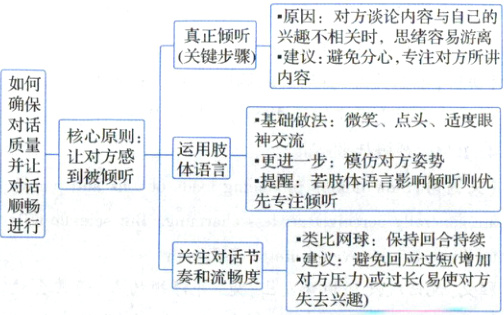
[语篇导读]本文是一篇说明文。文章主要介绍了如何确保与他人展开愉快的对话并让对话流畅进行。
1. A 上文提出了如何确保与不太熟悉的人进行愉快的交流以及让对话流畅进行的问题,并指出第一步是让对方感到被倾听。A项意为“那是我们大多数人渴望的”,自然地承接上文,A项中的That指代空格前一句提到的“让对方感到被倾听”这件事。
2. F 空格前一句提到,当对方跟你谈论某些话题时,尤其是当他们所说的内容并非与你的兴趣直接相关时,你的思绪很容易游离到其他事情上。由此可推知,此空所填句应举例说明你的思绪变化。F项意为“你可能会开始思考自己是否在浪费时间”,与上文衔接连贯,进一步阐述了在上文所提及的情况下可能会产生的心理活动,符合此处语境。
3. C 根据段首主题句可知,本段围绕使用肢体语言展开。下文提到了对别人微笑、点头以及模仿对方的身体姿势等肢体语言,由此推知,此空所填句应提及某一个具体的肢体语言。C项意为“多进行眼神交流,但不用一直进行眼神交流”,符合此处语境,且与前后句衔接连贯。
4. B 上文提到了肢体语言的用处,而空格后一句指出若过度关注肢体语言影响了倾听,这是不值得的,前后语义存在转折。由此可推知,空处应填入过渡衔接句。B项意为“然而,我要提醒一句”,与上文语义构成转折,同时引出下文使用肢体语言可能存在的问题,适合置于此处。
5. G 下文将对话比作打网球,打网球的精彩之处在于尽可能持续的对打,对话也是如此,太简短的回应会给对方压力,而太详细的回应会使对方失去兴趣。这说明空处填入句与注意对话的节奏有关。G项意为“然后,注意对话的节奏和流畅性”,契合本段主题,适合置于此处。
二、七选五
[语篇结构分析]
[语篇导读]本文是一篇说明文。文章主要介绍了如何确保与他人展开愉快的对话并让对话流畅进行。
1. A 上文提出了如何确保与不太熟悉的人进行愉快的交流以及让对话流畅进行的问题,并指出第一步是让对方感到被倾听。A项意为“那是我们大多数人渴望的”,自然地承接上文,A项中的That指代空格前一句提到的“让对方感到被倾听”这件事。
2. F 空格前一句提到,当对方跟你谈论某些话题时,尤其是当他们所说的内容并非与你的兴趣直接相关时,你的思绪很容易游离到其他事情上。由此可推知,此空所填句应举例说明你的思绪变化。F项意为“你可能会开始思考自己是否在浪费时间”,与上文衔接连贯,进一步阐述了在上文所提及的情况下可能会产生的心理活动,符合此处语境。
3. C 根据段首主题句可知,本段围绕使用肢体语言展开。下文提到了对别人微笑、点头以及模仿对方的身体姿势等肢体语言,由此推知,此空所填句应提及某一个具体的肢体语言。C项意为“多进行眼神交流,但不用一直进行眼神交流”,符合此处语境,且与前后句衔接连贯。
4. B 上文提到了肢体语言的用处,而空格后一句指出若过度关注肢体语言影响了倾听,这是不值得的,前后语义存在转折。由此可推知,空处应填入过渡衔接句。B项意为“然而,我要提醒一句”,与上文语义构成转折,同时引出下文使用肢体语言可能存在的问题,适合置于此处。
5. G 下文将对话比作打网球,打网球的精彩之处在于尽可能持续的对打,对话也是如此,太简短的回应会给对方压力,而太详细的回应会使对方失去兴趣。这说明空处填入句与注意对话的节奏有关。G项意为“然后,注意对话的节奏和流畅性”,契合本段主题,适合置于此处。
三、语法填空
UN Chinese Language Day Celebrated in the UK
[江苏南通期末]An event marking 2025’s UN Chinese Language Day was held on May 8 in London, bringing 100 students from six schools across the United Kingdom to celebrate the Chinese language and culture. Established by the UN, UN Chinese Language Day 1 (observe) annually on April 20 to promote multilingualism and cultural diversity. The date was selected from Guyu, “rain of millet”, 2 is the sixth of 24 solar terms in the traditional East Asian calendars.
The event featured eight workshops highlighting various aspects of Chinese culture. Along with workshops, Chinese cultural 3 (exhibit), such as calligraphy brushes, Go boards and hairpins, were displayed. The audience watched in 4 (admire) during the celebration. Each pupil received two books from the organizers, 5 (serve) as both a memento and a resource to further their exploration of Chinese language and culture.
Chinese is challenging 6 (learn) but also incredibly fun and exciting. Over the past few decades, Chinese 7 (emerge) as one of the fast-growing world languages in British K–12 schools. Today, students across the country are learning Chinese not just as a language, 8 as a gateway to understanding, connection and global citizenship.
“By celebrating the UN Chinese Language Day, we are actually celebrating cultural diversity while recognizing 9 (share) values across civilizations. Even though we are different 10 our respective civilization, we share many fundamental values,” says Li Nan, Chinese Consul General in London.
1. 2. 3. 4. 5.
6. 7. 8. 9. 10.
UN Chinese Language Day Celebrated in the UK
[江苏南通期末]An event marking 2025’s UN Chinese Language Day was held on May 8 in London, bringing 100 students from six schools across the United Kingdom to celebrate the Chinese language and culture. Established by the UN, UN Chinese Language Day 1 (observe) annually on April 20 to promote multilingualism and cultural diversity. The date was selected from Guyu, “rain of millet”, 2 is the sixth of 24 solar terms in the traditional East Asian calendars.
The event featured eight workshops highlighting various aspects of Chinese culture. Along with workshops, Chinese cultural 3 (exhibit), such as calligraphy brushes, Go boards and hairpins, were displayed. The audience watched in 4 (admire) during the celebration. Each pupil received two books from the organizers, 5 (serve) as both a memento and a resource to further their exploration of Chinese language and culture.
Chinese is challenging 6 (learn) but also incredibly fun and exciting. Over the past few decades, Chinese 7 (emerge) as one of the fast-growing world languages in British K–12 schools. Today, students across the country are learning Chinese not just as a language, 8 as a gateway to understanding, connection and global citizenship.
“By celebrating the UN Chinese Language Day, we are actually celebrating cultural diversity while recognizing 9 (share) values across civilizations. Even though we are different 10 our respective civilization, we share many fundamental values,” says Li Nan, Chinese Consul General in London.
1. 2. 3. 4. 5.
6. 7. 8. 9. 10.
答案:
三、语法填空
[语篇导读]本文是一篇说明文。文章主要介绍了在伦敦举办的联合国中文日庆祝活动,包括活动的参与者、内容和意义等。
1. is observed 考查动词的时态、语态和主谓一致。分析句子成分可知,空处在句中作谓语。根据时间状语annually on April 20可知,此处描述的是经常性、习惯性的动作,时态用一般现在时。动词observe和主语UN Chinese Language Day之间是被动关系,应用被动语态。主语UN Chinese Language Day为单数,be动词应用is。故填is observed。
2. which 考查定语从句。分析句子成分可知,空处应填引导非限制性定语从句的关系词。先行词为Guyu,指物,关系词在定语从句中作主语。故填关系代词which。
3. exhibits 考查名词的数。空处被定语Chinese cultural修饰,在句中作主语,应用名词。根据其后的such as及动词were可推知,此处应用可数名词的复数形式。故填exhibits,意为“展览品”。
4. admiration 考查固定搭配。in admiration为固定搭配,意为“钦佩地,赞赏地”。故填admiration。
5. serving 考查非谓语动词。本句已有谓语动词received,且空前没有连词,因此空处应用非谓语动词作后置定语,修饰名词短语two books。动词serve与被修饰名词短语two books之间是逻辑上的主动关系,应用其现在分词形式。故填serving。
6. to learn 考查非谓语动词。句意:汉语学习虽颇具挑战性,但同时也趣味十足、令人兴奋不已。“be+性质形容词+to do sth”为常用结构,意为“做某事很……”,通常使用不定式的主动形式表示被动意义。故填to learn。
7. has emerged 考查动词的时态和主谓一致。分析句子成分可知,空处在句中作谓语。根据时间状语Over the past few decades可知,时态为现在完成时。主语Chinese为第三人称单数,助动词应用has。故填has emerged。
8. but 考查连词。句意:如今,全国的学生不仅将汉语作为一门语言来学习,更是将其视作通向理解、联系以及世界公民意识的途径。not just ... but ...为固定搭配,意为“不仅……而且……”。故填but。
9. shared 考查非谓语动词。句意:通过庆祝联合国中文日,我们实际上是在庆祝文化多样性的同时认可文明之间的共同价值观。分析句子成分可知,空处作定语修饰名词values。动词share与被修饰词values之间是被动关系,应用其过去分词形式。故填shared。
10. in 考查介词。be different in为固定搭配,意为“在……方面不同”。故填in。
[语篇导读]本文是一篇说明文。文章主要介绍了在伦敦举办的联合国中文日庆祝活动,包括活动的参与者、内容和意义等。
1. is observed 考查动词的时态、语态和主谓一致。分析句子成分可知,空处在句中作谓语。根据时间状语annually on April 20可知,此处描述的是经常性、习惯性的动作,时态用一般现在时。动词observe和主语UN Chinese Language Day之间是被动关系,应用被动语态。主语UN Chinese Language Day为单数,be动词应用is。故填is observed。
2. which 考查定语从句。分析句子成分可知,空处应填引导非限制性定语从句的关系词。先行词为Guyu,指物,关系词在定语从句中作主语。故填关系代词which。
3. exhibits 考查名词的数。空处被定语Chinese cultural修饰,在句中作主语,应用名词。根据其后的such as及动词were可推知,此处应用可数名词的复数形式。故填exhibits,意为“展览品”。
4. admiration 考查固定搭配。in admiration为固定搭配,意为“钦佩地,赞赏地”。故填admiration。
5. serving 考查非谓语动词。本句已有谓语动词received,且空前没有连词,因此空处应用非谓语动词作后置定语,修饰名词短语two books。动词serve与被修饰名词短语two books之间是逻辑上的主动关系,应用其现在分词形式。故填serving。
6. to learn 考查非谓语动词。句意:汉语学习虽颇具挑战性,但同时也趣味十足、令人兴奋不已。“be+性质形容词+to do sth”为常用结构,意为“做某事很……”,通常使用不定式的主动形式表示被动意义。故填to learn。
7. has emerged 考查动词的时态和主谓一致。分析句子成分可知,空处在句中作谓语。根据时间状语Over the past few decades可知,时态为现在完成时。主语Chinese为第三人称单数,助动词应用has。故填has emerged。
8. but 考查连词。句意:如今,全国的学生不仅将汉语作为一门语言来学习,更是将其视作通向理解、联系以及世界公民意识的途径。not just ... but ...为固定搭配,意为“不仅……而且……”。故填but。
9. shared 考查非谓语动词。句意:通过庆祝联合国中文日,我们实际上是在庆祝文化多样性的同时认可文明之间的共同价值观。分析句子成分可知,空处作定语修饰名词values。动词share与被修饰词values之间是被动关系,应用其过去分词形式。故填shared。
10. in 考查介词。be different in为固定搭配,意为“在……方面不同”。故填in。
查看更多完整答案,请扫码查看

