

 搜索
搜索
2025年小题狂做高中英语选择性必修第四册译林版
注:目前有些书本章节名称可能整理的还不是很完善,但都是按照顺序排列的,请同学们按照顺序仔细查找。练习册 2025年小题狂做高中英语选择性必修第四册译林版 答案主要是用来给同学们做完题方便对答案用的,请勿直接抄袭。
第13页
- 第1页
- 第2页
- 第3页
- 第4页
- 第5页
- 第6页
- 第7页
- 第8页
- 第9页
- 第10页
- 第11页
- 第12页
- 第13页
- 第14页
- 第15页
- 第16页
- 第17页
- 第18页
- 第19页
- 第20页
- 第21页
- 第22页
- 第23页
- 第24页
- 第25页
- 第26页
- 第27页
- 第28页
- 第29页
- 第30页
- 第31页
- 第32页
- 第33页
- 第34页
- 第35页
- 第36页
- 第37页
- 第38页
- 第39页
- 第40页
- 第41页
- 第42页
- 第43页
- 第44页
- 第45页
- 第46页
- 第47页
- 第48页
- 第49页
- 第50页
- 第51页
- 第52页
- 第53页
- 第54页
- 第55页
- 第56页
- 第57页
- 第58页
- 第59页
- 第60页
- 第61页
- 第62页
- 第63页
- 第64页
- 第65页
- 第66页
- 第67页
- 第68页
- 第69页
- 第70页
- 第71页
- 第72页
- 第73页
- 第74页
[湖南长沙第一中学月考]Can only making a promise to be honest without any punishment involved lead people to behave more honestly? A Nature Human Behaviour study confirms they can—if precisely worded.
Psychologist Janis Zickfeld and his team conducted experiments with over 21,000 US and UK participants in a pretend tax-reporting situation where subjects could lie about their earnings without punishment. Participants performed a sorting task where they earned money based on how quickly they finished. They then reported how much they had made, which was taxed at 35 percent. Participants could lie without consequence but were also told the collected tax would go to the Red Cross.
Researchers tested 21 honesty promises. The tax compliance(遵守税法) figure averaged 82.3% for participants in the control group (no promises), compared with 86.2% for all the promise groups. The research found that the promises were far from equal in keeping honest behaviour. Direct promises like “Misreporting is forbidden” cut cheating by nearly 50% compared to vague claims(“I am honest”). Defining dishonesty clearly(“I understand misreporting is forbidden”) or viewing honesty as absolute (“either honest or dishonest”) ranked next to them in effectiveness, alongside appeals to social norms—all showing modest effects.
Almost everyone thinks of themselves as honest, and we behave in ways that allow us to maintain this positive self-image, so it is surprising that appeals to self-image were not effective. But promises that clearly name the targeted behaviour and spell out the rules of how to behave may make it harder to “wriggle out of” being honest without damaging one’s self-image.
These findings have practical effects. As researcher Shaul Shalvi notes, “Precision in wording isn’t just about grammar; it’s what separates symbolic gestures from real behavioural change.” The team is now applying these insights in real-world settings, including hospitals tracking medical equipment returns. “The beauty of these interventions is: they’re very cheap,” Shalvi says. But this study is only a first step. “Once we know what effects are effective, we can go to policymakers and suggest randomized controlled trials in target populations. Then, if that works, we can look at changing tax forms or whatever.”
(
A. Accuracy in wording.
B. Cultural adaptation.
C. Moral appeals.
D. Personality features.
(
A. “Good students don’t cheat.”
B. “Cheating breaks academic rules.”
C. “I value honesty in education.”
D. “Most students prefer fair tests.”
(
A. Defend.
B. Understand.
C. Ignore.
D. Avoid.
(
A. Honesty Promises Universally Prevent Tax Cheating
B. Behavioural Change Relies on Cultural Adaptation
C. Precise Wording Unlocks Honesty Promises’ Potential
D. Self-image Appeals Most Effectively Reduce Lies
读后拓展
一、语篇结构梳理
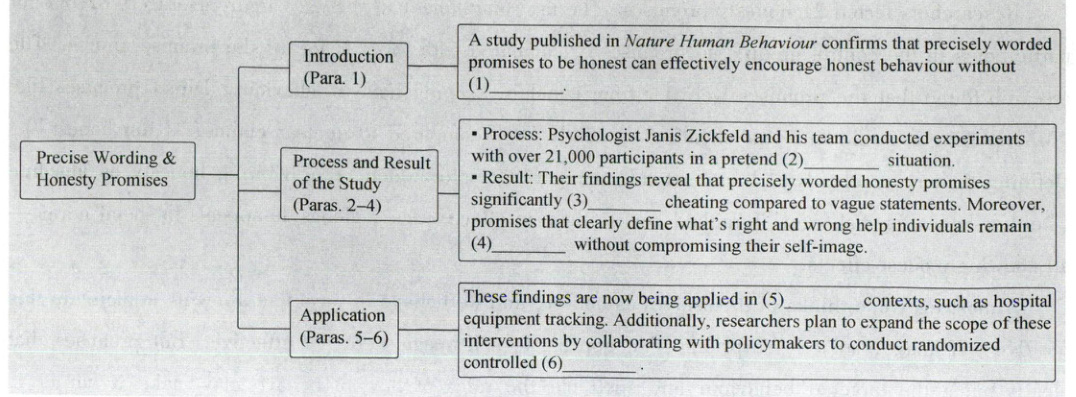
二、语言知识深挖
1. 词义匹配
(1) misreport a. standards of behaviour that are typical of or accepted within a particular group or society
(2) policymaker b. chosen or done without any particular pattern
(3) norm c. people who are involved in making policies and policy decisions
(4) randomized d. give a report of an event, etc. that is not correct
2. 选词填空( 使用正确形式)
spell out be far from compare to
(1)
(2) His explanation
(3) The teacher
3. 长难句分析
Almost everyone thinks of themselves as honest, and we behave in ways that allow us to
分句1 并列连词 分句2 定语从句
maintain this positive self-image, so it is surprising that appeals to self-image were not effective.
结果状语从句 主语从句
几乎每个人都认为自己是诚实的,而且我们会按照能维护这种正面的自我形象的方式行事。因此,诉诸自我形象的手段无效,这一结果令人惊讶。
分析:本句是由 and连接的两个并列分句构成,其中第二个分句包含一个由 that引导的定语从句,修饰先行词 ways。本句还包含一个由 so引导的结果状语从句,该结果状语从句中的 it为形式主语,真正的主语是位于 surprising后面的由 that引导的主语从句。
及时巩固
选择:The GPNP is intended to provide stronger protection for all the species
A. who B. whom C. which D. that
翻译:众所周知,定期锻炼能改善健康状况。(主语从句)
Psychologist Janis Zickfeld and his team conducted experiments with over 21,000 US and UK participants in a pretend tax-reporting situation where subjects could lie about their earnings without punishment. Participants performed a sorting task where they earned money based on how quickly they finished. They then reported how much they had made, which was taxed at 35 percent. Participants could lie without consequence but were also told the collected tax would go to the Red Cross.
Researchers tested 21 honesty promises. The tax compliance(遵守税法) figure averaged 82.3% for participants in the control group (no promises), compared with 86.2% for all the promise groups. The research found that the promises were far from equal in keeping honest behaviour. Direct promises like “Misreporting is forbidden” cut cheating by nearly 50% compared to vague claims(“I am honest”). Defining dishonesty clearly(“I understand misreporting is forbidden”) or viewing honesty as absolute (“either honest or dishonest”) ranked next to them in effectiveness, alongside appeals to social norms—all showing modest effects.
Almost everyone thinks of themselves as honest, and we behave in ways that allow us to maintain this positive self-image, so it is surprising that appeals to self-image were not effective. But promises that clearly name the targeted behaviour and spell out the rules of how to behave may make it harder to “wriggle out of” being honest without damaging one’s self-image.
These findings have practical effects. As researcher Shaul Shalvi notes, “Precision in wording isn’t just about grammar; it’s what separates symbolic gestures from real behavioural change.” The team is now applying these insights in real-world settings, including hospitals tracking medical equipment returns. “The beauty of these interventions is: they’re very cheap,” Shalvi says. But this study is only a first step. “Once we know what effects are effective, we can go to policymakers and suggest randomized controlled trials in target populations. Then, if that works, we can look at changing tax forms or whatever.”
(
A
) 1. What key factor does the research focus on in designing effective honesty promises?A. Accuracy in wording.
B. Cultural adaptation.
C. Moral appeals.
D. Personality features.
(
B
) 2. Which promise would work best in a school exam setting?A. “Good students don’t cheat.”
B. “Cheating breaks academic rules.”
C. “I value honesty in education.”
D. “Most students prefer fair tests.”
(
D
) 3. What does the underlined phrase “wriggle out of” in Paragraph 4 most likely mean?A. Defend.
B. Understand.
C. Ignore.
D. Avoid.
(
C
) 4. Which of the following is the best title for the passage?A. Honesty Promises Universally Prevent Tax Cheating
B. Behavioural Change Relies on Cultural Adaptation
C. Precise Wording Unlocks Honesty Promises’ Potential
D. Self-image Appeals Most Effectively Reduce Lies
读后拓展
一、语篇结构梳理
二、语言知识深挖
1. 词义匹配
(1) misreport a. standards of behaviour that are typical of or accepted within a particular group or society
(2) policymaker b. chosen or done without any particular pattern
(3) norm c. people who are involved in making policies and policy decisions
(4) randomized d. give a report of an event, etc. that is not correct
2. 选词填空( 使用正确形式)
spell out be far from compare to
(1)
Compared to
his previous performance, he has made great progress this semester.(2) His explanation
was far from
convincing, and many people still doubted him.(3) The teacher
spelled out
the steps for solving the maths problem, so even the slowest students could follow.3. 长难句分析
Almost everyone thinks of themselves as honest, and we behave in ways that allow us to
分句1 并列连词 分句2 定语从句
maintain this positive self-image, so it is surprising that appeals to self-image were not effective.
结果状语从句 主语从句
几乎每个人都认为自己是诚实的,而且我们会按照能维护这种正面的自我形象的方式行事。因此,诉诸自我形象的手段无效,这一结果令人惊讶。
分析:本句是由 and连接的两个并列分句构成,其中第二个分句包含一个由 that引导的定语从句,修饰先行词 ways。本句还包含一个由 so引导的结果状语从句,该结果状语从句中的 it为形式主语,真正的主语是位于 surprising后面的由 that引导的主语从句。
及时巩固
选择:The GPNP is intended to provide stronger protection for all the species
D
live within the Giant Panda Range.A. who B. whom C. which D. that
翻译:众所周知,定期锻炼能改善健康状况。(主语从句)
答案:
【语篇导读】本文是一篇说明文。文章主要介绍了心理学家Janis Zickfeld及其团队开展的一项研究,该研究发现,措辞精确的承诺能更有效促使人们保持诚实行为。
1. A 推理判断题
【关键句1】Can only making a promise to be honest without any punishment involved lead people to behave more honestly? A Nature Human Behaviour study confirms they can—if precisely worded.
释义:仅承诺要诚实而不涉及任何惩罚能引导人们更诚实地行事吗?《自然—人类行为》的一项研究证实可以——如果措辞精确的话。
【关键句2】The research found that the promises were far from equal in keeping honest behaviour. Direct promises ... cut cheating by nearly 50% compared to unclear claims(“I am honest”). Defining dishonesty clearly ... or viewing honesty as absolute ... ranked next to them in effectiveness ...
释义:该研究发现,这些承诺在保持诚实的行为方面的效果差异显著。与表述模糊的承诺……相比,直接表述的承诺……使作弊行为减少了近50%。明确地定义不诚实行为……或将诚实视为绝对概念……的效果仅次于前面两种……
【解析】根据关键句1和关键句2介绍的研究结果可知,在设计有效的诚实承诺时,该研究关注的关键因素是措辞的精确性。故选A项。
2. B 推理判断题
【关键句】Direct promises like “Misreporting is forbidden” cut cheating by nearly 50% compared to unclear claims(“I am honest”). Defining dishonesty clearly(“I understand misreporting is forbidden”) or viewing honesty as absolute(“either honest or dishonest”) ranked next to them in effectiveness, alongside appeals to social norms—all showing modest effects.
释义:与表述模糊的承诺(如“我是诚实的”)相比,如“禁止谎报”这样直接表述的承诺使作弊行为减少了近50%。明确地定义不诚实行为(如“我明白谎报是被禁止的”)或将诚实视为绝对概念(“要么诚实,要么不诚实”)的效果仅次于前面两种,与诉诸社会规范的承诺不相上下——这些都产生了一定的效果。
【解析】根据关键句可知,直接表述、明确定义的承诺效果更好。结合四个选项不难推知,B项“作弊违反学术规则”直接表述了不诚实行为的后果,该承诺在考试场景中的效果可能最好。故选B项。
【干扰项辨析】A项“好学生不作弊”表述比较模糊,且“好”属于道德标准范畴,因此效果不佳;C项“我重视教育中的诚实”,没有直接做出承诺,效果不佳;D项“大多数学生更喜欢公平的考试”,没有涉及对作弊行为的约束,且“公平”依赖社会规范,效果有限。故排除A、C、D三项。
3. D 词义猜测题
【关键句1】Almost everyone thinks of themselves as honest, and we behave in ways that allow us to maintain this positive self-image, so it is surprising that appeals to self-image were not effective.
释义:几乎每个人都认为自己是诚实的,而且我们会按照能维护这种正面的自我形象的方式行事。因此,诉诸自我形象的手段无效,这一结果令人惊讶。
【关键句2】But promises that clearly name the targeted behaviour and spell out the rules of how to behave may make it harder to “wriggle out of” being honest without damaging one’s self-image.
释义:但是,那些明确指出目标行为并详细说明行为规范的承诺,可能会让人更难在不损害自我形象的情况下“逃避”诚实。
【解析】根据画线短语所在句(关键句2)中的But可知,画线短语所在句和其前一句(关键句1)在语义上存在转折。根据关键句1可知,用自我形象来约束自己保持诚实的效果不佳,再结合上文提到的研究结果可推知,画线短语所在句表达的意思是:明确表述并说明行为规范的承诺效果会更好,让人很难不诚实。由此推知,画线短语意为“避免(做某事),设法摆脱(某事)”,与avoid的意思相近。故选D项。
4. C 标题概括题
【解析】通读全文可知,文章主要介绍了心理学家Janis Zickfeld及其团队开展的一项研究,涉及具体的研究发现和该发现在现实场景中的应用情况和未来的应用前景。通读四个选项,C项中的“Precise Wording”属于研究的核心内容;“Honesty Promises’ Potential”对应研究的具体应用。由此可知,C项“精确措辞解锁诚信承诺的潜力”准确概括了文章主旨,最适合作为文章的标题。
【重点词积累】
word v. 措辞,用词(熟词生义)
pretend adj. 假装的,假想的
average v. 平均为(熟词生义)
effectiveness n. 有效性,效力
precision n. 精确(性),准确(性)
real-world adj. 现实生活的
读后拓展
一、语篇结构梳理
(1) punishment
(2) tax-reporting
(3) reduce/cut/decrease
(4) honest
(5) real-world
(6) trials
二、语言知识深挖
1. 词义匹配
(1) d
(2) c
(3) a
(4) b
2. 选词填空
(1) Compared to
(2) was far from
(3) spelled out
3. 长难句分析
及时巩固
D; It is well known that regular exercise improves health.
1. A 推理判断题
【关键句1】Can only making a promise to be honest without any punishment involved lead people to behave more honestly? A Nature Human Behaviour study confirms they can—if precisely worded.
释义:仅承诺要诚实而不涉及任何惩罚能引导人们更诚实地行事吗?《自然—人类行为》的一项研究证实可以——如果措辞精确的话。
【关键句2】The research found that the promises were far from equal in keeping honest behaviour. Direct promises ... cut cheating by nearly 50% compared to unclear claims(“I am honest”). Defining dishonesty clearly ... or viewing honesty as absolute ... ranked next to them in effectiveness ...
释义:该研究发现,这些承诺在保持诚实的行为方面的效果差异显著。与表述模糊的承诺……相比,直接表述的承诺……使作弊行为减少了近50%。明确地定义不诚实行为……或将诚实视为绝对概念……的效果仅次于前面两种……
【解析】根据关键句1和关键句2介绍的研究结果可知,在设计有效的诚实承诺时,该研究关注的关键因素是措辞的精确性。故选A项。
2. B 推理判断题
【关键句】Direct promises like “Misreporting is forbidden” cut cheating by nearly 50% compared to unclear claims(“I am honest”). Defining dishonesty clearly(“I understand misreporting is forbidden”) or viewing honesty as absolute(“either honest or dishonest”) ranked next to them in effectiveness, alongside appeals to social norms—all showing modest effects.
释义:与表述模糊的承诺(如“我是诚实的”)相比,如“禁止谎报”这样直接表述的承诺使作弊行为减少了近50%。明确地定义不诚实行为(如“我明白谎报是被禁止的”)或将诚实视为绝对概念(“要么诚实,要么不诚实”)的效果仅次于前面两种,与诉诸社会规范的承诺不相上下——这些都产生了一定的效果。
【解析】根据关键句可知,直接表述、明确定义的承诺效果更好。结合四个选项不难推知,B项“作弊违反学术规则”直接表述了不诚实行为的后果,该承诺在考试场景中的效果可能最好。故选B项。
【干扰项辨析】A项“好学生不作弊”表述比较模糊,且“好”属于道德标准范畴,因此效果不佳;C项“我重视教育中的诚实”,没有直接做出承诺,效果不佳;D项“大多数学生更喜欢公平的考试”,没有涉及对作弊行为的约束,且“公平”依赖社会规范,效果有限。故排除A、C、D三项。
3. D 词义猜测题
【关键句1】Almost everyone thinks of themselves as honest, and we behave in ways that allow us to maintain this positive self-image, so it is surprising that appeals to self-image were not effective.
释义:几乎每个人都认为自己是诚实的,而且我们会按照能维护这种正面的自我形象的方式行事。因此,诉诸自我形象的手段无效,这一结果令人惊讶。
【关键句2】But promises that clearly name the targeted behaviour and spell out the rules of how to behave may make it harder to “wriggle out of” being honest without damaging one’s self-image.
释义:但是,那些明确指出目标行为并详细说明行为规范的承诺,可能会让人更难在不损害自我形象的情况下“逃避”诚实。
【解析】根据画线短语所在句(关键句2)中的But可知,画线短语所在句和其前一句(关键句1)在语义上存在转折。根据关键句1可知,用自我形象来约束自己保持诚实的效果不佳,再结合上文提到的研究结果可推知,画线短语所在句表达的意思是:明确表述并说明行为规范的承诺效果会更好,让人很难不诚实。由此推知,画线短语意为“避免(做某事),设法摆脱(某事)”,与avoid的意思相近。故选D项。
4. C 标题概括题
【解析】通读全文可知,文章主要介绍了心理学家Janis Zickfeld及其团队开展的一项研究,涉及具体的研究发现和该发现在现实场景中的应用情况和未来的应用前景。通读四个选项,C项中的“Precise Wording”属于研究的核心内容;“Honesty Promises’ Potential”对应研究的具体应用。由此可知,C项“精确措辞解锁诚信承诺的潜力”准确概括了文章主旨,最适合作为文章的标题。
【重点词积累】
word v. 措辞,用词(熟词生义)
pretend adj. 假装的,假想的
average v. 平均为(熟词生义)
effectiveness n. 有效性,效力
precision n. 精确(性),准确(性)
real-world adj. 现实生活的
读后拓展
一、语篇结构梳理
(1) punishment
(2) tax-reporting
(3) reduce/cut/decrease
(4) honest
(5) real-world
(6) trials
二、语言知识深挖
1. 词义匹配
(1) d
(2) c
(3) a
(4) b
2. 选词填空
(1) Compared to
(2) was far from
(3) spelled out
3. 长难句分析
及时巩固
D; It is well known that regular exercise improves health.
查看更多完整答案,请扫码查看

