

 搜索
搜索
2025年非常学案高中化学选择性必修第一册人教版
注:目前有些书本章节名称可能整理的还不是很完善,但都是按照顺序排列的,请同学们按照顺序仔细查找。练习册 2025年非常学案高中化学选择性必修第一册人教版 答案主要是用来给同学们做完题方便对答案用的,请勿直接抄袭。
第113页
- 第1页
- 第2页
- 第3页
- 第4页
- 第5页
- 第6页
- 第7页
- 第8页
- 第9页
- 第10页
- 第11页
- 第12页
- 第13页
- 第14页
- 第15页
- 第16页
- 第17页
- 第18页
- 第19页
- 第20页
- 第21页
- 第22页
- 第23页
- 第24页
- 第25页
- 第26页
- 第27页
- 第28页
- 第29页
- 第30页
- 第31页
- 第32页
- 第33页
- 第34页
- 第35页
- 第36页
- 第37页
- 第38页
- 第39页
- 第40页
- 第41页
- 第42页
- 第43页
- 第44页
- 第45页
- 第46页
- 第47页
- 第48页
- 第49页
- 第50页
- 第51页
- 第52页
- 第53页
- 第54页
- 第55页
- 第56页
- 第57页
- 第58页
- 第59页
- 第60页
- 第61页
- 第62页
- 第63页
- 第64页
- 第65页
- 第66页
- 第67页
- 第68页
- 第69页
- 第70页
- 第71页
- 第72页
- 第73页
- 第74页
- 第75页
- 第76页
- 第77页
- 第78页
- 第79页
- 第80页
- 第81页
- 第82页
- 第83页
- 第84页
- 第85页
- 第86页
- 第87页
- 第88页
- 第89页
- 第90页
- 第91页
- 第92页
- 第93页
- 第94页
- 第95页
- 第96页
- 第97页
- 第98页
- 第99页
- 第100页
- 第101页
- 第102页
- 第103页
- 第104页
- 第105页
- 第106页
- 第107页
- 第108页
- 第109页
- 第110页
- 第111页
- 第112页
- 第113页
- 第114页
- 第115页
- 第116页
- 第117页
- 第118页
- 第119页
- 第120页
- 第121页
- 第122页
- 第123页
- 第124页
- 第125页
1. $\mathrm{AlPO}_{4}$ 溶解是吸热的过程, 其沉淀溶解平衡曲线如图所示。下列说法不正确的是 (
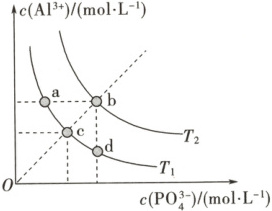
A.从 a 点到 d 点, 可通过加入 $\mathrm{Na}_{3} \mathrm{PO}_{4}$ 溶液实现
B.$\mathrm{AlPO}_{4}$ 在 b 点对应的溶解度大于 c 点
C.$T_{1}>T_{2}$
D.图中四个点的 $K_{sp}: \mathrm{a}=\mathrm{c}=\mathrm{d}<\mathrm{b}$
C
)A.从 a 点到 d 点, 可通过加入 $\mathrm{Na}_{3} \mathrm{PO}_{4}$ 溶液实现
B.$\mathrm{AlPO}_{4}$ 在 b 点对应的溶解度大于 c 点
C.$T_{1}>T_{2}$
D.图中四个点的 $K_{sp}: \mathrm{a}=\mathrm{c}=\mathrm{d}<\mathrm{b}$
答案:
1. C [加入${Na_{3}PO_{4}}$溶液,溶液中${PO^{3-}_{4}}$浓度增大,${Al^{3 + }}$浓度减小,可以从a点移动到d点,故A正确;与c点相比,b点时,$c{(Al^{3 + })}$、$c{(PO^{3-}_{4})}$都较大,则${AlPO_{4}}$在b点对应的溶解度大于c点,故B正确;${AlPO_{4}}$溶解是吸热的过程,温度越高,${AlPO_{4}}$的溶解度大,${AlPO_{4}}$在b点对应的溶解度大于a点,所以$T_{2} > T_{1}$,故C错误;${AlPO_{4}}$溶解是吸热的过程,温度相同,$K_{sp}$相同,温度越高,$K_{sp}$越大,则图像中四个点的$K_{sp}$的大小关系为$a=d=c < b$,故D正确。]
2. 已知相同温度下, $K_{sp}(\mathrm{AgBr})<K_{sp}(\mathrm{AgCl})$。某温度下, 饱和溶液中 $-\lg c\left(\mathrm{Br}^{-}\right)、-\lg c\left(\mathrm{Cl}^{-}\right)$与 $-\lg c\left(\mathrm{Ag}^{+}\right)$的关系如图所示。下列说法正确的是 (
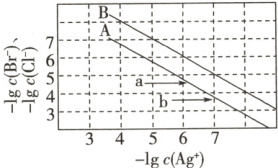
A.曲线 A 代表 $\mathrm{AgBr}$ 的沉淀溶解曲线
B.$c\left(\mathrm{Ag}^{+}\right)=10^{-5}$ 时两溶液中 $c\left(\mathrm{Br}^{-}\right)>c\left(\mathrm{Cl}^{-}\right)$
C.加适量 $\mathrm{AgNO}_{3}$ 固体可使溶液由 a 点变到 b 点
D.该温度下 $\mathrm{AgBr}$ 的 $K_{sp}(\mathrm{AgBr})$ 值为 $1.0 × 10^{-12}$
D
)A.曲线 A 代表 $\mathrm{AgBr}$ 的沉淀溶解曲线
B.$c\left(\mathrm{Ag}^{+}\right)=10^{-5}$ 时两溶液中 $c\left(\mathrm{Br}^{-}\right)>c\left(\mathrm{Cl}^{-}\right)$
C.加适量 $\mathrm{AgNO}_{3}$ 固体可使溶液由 a 点变到 b 点
D.该温度下 $\mathrm{AgBr}$ 的 $K_{sp}(\mathrm{AgBr})$ 值为 $1.0 × 10^{-12}$
答案:
2. D [已知相同温度下,$K_{sp}{(AgBr)} < K_{sp}{(AgCl)}$,$c{(Ag^{ + })}$相同时,$c{(Br^{-})} < c{(Cl^{-})}$,则$-\lg\ c{(Br^{-})} > -\lg\ c{(Cl^{-})}$,故曲线B表示$-\lg\ c{(Br^{-})}$与$-\lg\ c{(Ag^{ + })}$的关系,即曲线B代表${AgBr}$的沉淀溶解曲线,曲线A代表${AgCl}$的沉淀溶解曲线,A错误;已知相同温度下,$K_{sp}{(AgBr)} < K_{sp}{(AgCl)}$,$c{(Ag^{ + })} = 10^{-5}$相同时,$c{(Br^{-})} < c{(Cl^{-})}$,B错误;a点变到b点,$c{(Ag^{ + })}$减小,则加适量${AgNO_{3}}$固体不能使溶液由a点变到b点,C错误;曲线B代表${AgBr}$的沉淀溶解曲线,由图可知$-\lg\ c{(Br^{-})} = -\lg\ c{(Ag^{ + })} = 6$,$c{(Br^{-})} = c{(Ag^{ + })} = 10^{-6}\ mol· L^{-1}$,该温度下${AgBr}$的$K_{sp}{(AgBr)} = c{(Ag^{ + })}· c{(Br^{-})} = 10^{-6}× 10^{-6} = 1.0× 10^{-12}$,D正确。]
3. 常温下, 浓度均为 $0.1 \mathrm{~mol} · \mathrm{L}^{-1}$ 的 $\mathrm{H}_{2} \mathrm{SO}_{3}$ 溶液、$\mathrm{H}_{2} \mathrm{T}$ (酒石酸) 溶液分别用 $0.1 \mathrm{~mol} · \mathrm{L}^{-1}$ 的 $\mathrm{NaOH}$ 溶液滴定, 滴定曲线分别如图所示。下列说法错误的是 (
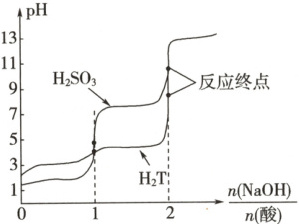
A.相同浓度时, $\mathrm{Na}_{2} \mathrm{SO}_{3}$ 溶液中水的电离程度比 $\mathrm{Na}_{2} \mathrm{T}$ 溶液中的大
B.$0.1 \mathrm{~mol} · \mathrm{L}^{-1}$ 的 $\mathrm{NaHT}$ 溶液中: $c\left(\mathrm{T}^{2-}\right)>c\left(\mathrm{H}_{2} \mathrm{T}\right)$
C.$K_{a1}\left(\mathrm{H}_{2} \mathrm{SO}_{3}\right)>K_{a1}\left(\mathrm{H}_{2} \mathrm{T}\right)$
D.向等体积、浓度均为 $0.1 \mathrm{~mol} · \mathrm{L}^{-1}$ 的 $\mathrm{H}_{2} \mathrm{SO}_{3}$ 溶液、$\mathrm{H}_{2} \mathrm{T}$ 溶液中分别滴加等浓度的 $\mathrm{NaOH}$ 溶液至 $\mathrm{pH}=7, \mathrm{H}_{2} \mathrm{SO}_{3}$ 溶液消耗的 $\mathrm{NaOH}$ 溶液的体积更大
D
)A.相同浓度时, $\mathrm{Na}_{2} \mathrm{SO}_{3}$ 溶液中水的电离程度比 $\mathrm{Na}_{2} \mathrm{T}$ 溶液中的大
B.$0.1 \mathrm{~mol} · \mathrm{L}^{-1}$ 的 $\mathrm{NaHT}$ 溶液中: $c\left(\mathrm{T}^{2-}\right)>c\left(\mathrm{H}_{2} \mathrm{T}\right)$
C.$K_{a1}\left(\mathrm{H}_{2} \mathrm{SO}_{3}\right)>K_{a1}\left(\mathrm{H}_{2} \mathrm{T}\right)$
D.向等体积、浓度均为 $0.1 \mathrm{~mol} · \mathrm{L}^{-1}$ 的 $\mathrm{H}_{2} \mathrm{SO}_{3}$ 溶液、$\mathrm{H}_{2} \mathrm{T}$ 溶液中分别滴加等浓度的 $\mathrm{NaOH}$ 溶液至 $\mathrm{pH}=7, \mathrm{H}_{2} \mathrm{SO}_{3}$ 溶液消耗的 $\mathrm{NaOH}$ 溶液的体积更大
答案:
3. D [根据题图可知,横坐标为2时,酸碱完全反应生成正盐,弱酸根阴离子促进水的电离,相同浓度的正盐${pH}$越大,水的电离程度越大,则相同浓度时,${Na_{2}SO_{3}}$溶液中水的电离程度比${Na_{2}T}$溶液中的大,故A正确;横坐标为1时酸碱恰好反应生成${NaHT}$,溶液的${pH} < 7$,溶液呈酸性,说明${HT^{-}}$的电离程度大于水解程度,所以$c{(T^{2 - })} > c{(H_{2}T)}$,故B正确;相同浓度的二元弱酸,溶液的${pH}$越小,该酸的电离平衡常数越大,根据题图知,未加碱时亚硫酸溶液的${pH}$较小,则电离平衡常数:$K_{a1}{(H_{2}SO_{3})} > K_{a1}{(H_{2}T)}$,故C正确;要使等体积、浓度均为$0.1\ mol· L^{-1}$的${H_{2}SO_{3}}$溶液、${H_{2}T}$溶液分别滴加等浓度的${NaOH}$溶液至${pH}=7$,${pH}$为7时$\dfrac{n{(NaOH)}}{n(酸)}$越大消耗的碱越多,根据题图知${H_{2}T}$溶液消耗的${NaOH}$溶液的体积更大,故D错误。]
4. 已知: $\mathrm{p(A)}=-\lg c(\mathrm{A})$。某温度下, 分别向 $20 \mathrm{~mL}$ 等浓度的 $\mathrm{NaCl}$ 和 $\mathrm{Na}_{2} \mathrm{CrO}_{4}$ 溶液中滴加 $0.1 \mathrm{~mol} · \mathrm{L}^{-1} \mathrm{AgNO}_{3}$ 溶液, 滴加过程中 $\mathrm{p}\left(\mathrm{Cl}^{-}\right)$和 $\mathrm{p}\left(\mathrm{CrO}_{4}^{2-}\right)$ 与加入 $\mathrm{AgNO}_{3}$ 溶液的体积关系如图所示, 下列说法错误的是 (
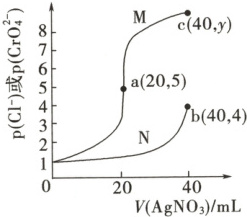
A.$\mathrm{Na}_{2} \mathrm{CrO}_{4}$ 的起始浓度为 $0.1 \mathrm{~mol} · \mathrm{L}^{-1}$
B.曲线 M 代表滴入 $\mathrm{NaCl}$ 溶液情况
C.$K_{sp}\left(\mathrm{Ag}_{2} \mathrm{CrO}_{4}\right)$ 约为 $4 × 10^{-12}$
D.图中 c 点坐标中 $y=9$
D
)A.$\mathrm{Na}_{2} \mathrm{CrO}_{4}$ 的起始浓度为 $0.1 \mathrm{~mol} · \mathrm{L}^{-1}$
B.曲线 M 代表滴入 $\mathrm{NaCl}$ 溶液情况
C.$K_{sp}\left(\mathrm{Ag}_{2} \mathrm{CrO}_{4}\right)$ 约为 $4 × 10^{-12}$
D.图中 c 点坐标中 $y=9$
答案:
4. D [氯化钠溶液、铬酸钠溶液与硝酸银溶液反应的化学方程式分别为${NaCl + AgNO_{3} = AgCl\downarrow + NaNO_{3}}$和${Na_{2}CrO_{4} + 2AgNO_{3} = Ag_{2}CrO_{4}\downarrow + 2NaNO_{3}}$,由化学方程式可知,滴入硝酸银溶液体积为$20\ mL$时,等浓度的氯化钠溶液完全反应,铬酸钠溶液部分反应,反应所得溶液中氯离子浓度小于铬酸根离子浓度,滴入硝酸银溶液体积为$40\ mL$时,铬酸钠完全反应,则曲线M代表氯化钠溶液情况,曲线N代表铬酸钠溶液情况,故A正确;曲线M代表滴入氯化钠溶液情况,曲线N代表滴入铬酸钠溶液情况,故B正确;滴入硝酸银溶液体积为$40\ mL$时,铬酸钠溶液完全反应得到铬酸银饱和溶液,由题图可知,b点铬酸根离子浓度为$10^{-4}\ mol· L^{-1}$,则铬酸银的溶度积为$K_{sp}{(Ag_{2}CrO_{4})} = 10^{-4}× (2× 10^{-4})^{2} = 4× 10^{-12}$,故C正确;滴入硝酸银溶液体积为$20\ mL$时,氯化钠溶液完全反应得到氯化银饱和溶液,溶液中氯离子浓度为$10^{-5}\ mol· L^{-1}$,则氯化银的溶度积为$K_{sp}{(AgCl)} = 10^{-5}× 10^{-5} = 10^{-10}$,则c点溶液中银离子浓度为$\dfrac{0.1\ mol· L^{-1}× 0.04\ L - 0.1\ mol· L^{-1}× 0.02\ L}{0.06\ L} = \dfrac{1}{30}\ mol· L^{-1}$,则氯离子浓度为$\dfrac{10^{-10}}{\dfrac{1}{30}}\ mol· L^{-1} = 3× 10^{-9}\ mol· L^{-1}$,$y = 9 - \lg\ 3 \neq 9$,故D错误。]
查看更多完整答案,请扫码查看

