

 搜索
搜索
2026年高中必刷题高二下英语人教版
注:目前有些书本章节名称可能整理的还不是很完善,但都是按照顺序排列的,请同学们按照顺序仔细查找。练习册 2026年高中必刷题高二下英语人教版 答案主要是用来给同学们做完题方便对答案用的,请勿直接抄袭。
第9页
- 第1页
- 第2页
- 第3页
- 第4页
- 第5页
- 第6页
- 第7页
- 第8页
- 第9页
- 第10页
- 第11页
- 第12页
- 第13页
- 第14页
- 第15页
- 第16页
- 第17页
- 第18页
- 第19页
- 第20页
- 第21页
- 第22页
- 第23页
- 第24页
- 第25页
- 第26页
- 第27页
- 第28页
- 第29页
- 第30页
- 第31页
- 第32页
- 第33页
- 第34页
- 第35页
- 第36页
- 第37页
- 第38页
- 第39页
- 第40页
- 第41页
- 第42页
- 第43页
- 第44页
- 第45页
- 第46页
- 第47页
- 第48页
- 第49页
- 第50页
- 第51页
- 第52页
- 第53页
- 第54页
- 第55页
- 第56页
- 第57页
- 第58页
- 第59页
- 第60页
- 第61页
- 第62页
- 第63页
- 第64页
- 第65页
- 第66页
- 第67页
- 第68页
- 第69页
- 第70页
- 第71页
- 第72页
- 第73页
- 第74页
- 第75页
- 第76页
- 第77页
- 第78页
- 第79页
- 第80页
- 第81页
- 第82页
- 第83页
- 第84页
- 第85页
- 第86页
- 第87页
- 第88页
- 第89页
- 第90页
- 第91页
- 第92页
- 第93页
- 第94页
- 第95页
- 第96页
- 第97页
- 第98页
- 第99页
- 第100页
- 第101页
- 第102页
- 第103页
- 第104页
- 第105页
- 第106页
- 第107页
- 第108页
- 第109页
- 第110页
- 第111页
- 第112页
- 第113页
- 第114页
- 第115页
- 第116页
- 第117页
B
语篇类型:议论文 主题:人工智能时代的人类艺术 词数:347 难度:偏难 建议用时:8 分钟
[广东广州 2025 模拟]For centuries, what has made human creativity so precious is not only the final products it yields, but also the effort behind their creation. But in a world where AI can generate anything with the click of a button, how do we distinguish what truly matters? How does human - made art survive?
Throughout history, the most famous works of art, literature, and music have carried labour, dedication, and mastery. We don't just admire the final product; we admire how it came to be. Masterpieces like Van Gogh's “The Starry Night” survive not simply for their artistic beauty, but for the human stories they carry. They remind us that art is not just about the beauty or skill—it is about intention, persistence, and what makes us human.
As AI floods the world with instant beauty, we're entering an era of “aesthetic inflation”, where perfectly composed images, poetic style, and movie - like storytelling are available to anyone, instantly and at no cost. This makes us think about whether human creations still have value when beauty is effortless and endless.
But human imperfection isn't a weakness—it's part of who we are, shaping our understanding of humanity. Our struggles, mistakes, and limitations aren't just difficulties to overcome—they're part of what gives life meaning. In this light, AI's ability to create perfect art feels almost unnatural—a rejection of the struggle that gives creativity its weight. It may achieve technical perfection—but at the cost of the original energy that makes art stir up feelings within people. Even at its most impressive, AI - generated art often feels empty. It has no real emotions or experiences, and no clear creators, failing to create unexpected surprises and arouse shared emotion with the audience.
Therefore, to preserve meaning, selection and context become more crucial. As AI can produce endless content, the human elements like context, narrative and reasoning behind art become the true source of value. Also, AI can be a creative collaborator rather than a replacement, refining ideas while keeping human imperfection and feelings, and acting as an amplifier (放大器) of human vision.
1. Why do masterpieces like “The Starry Night” remain valuable in the AI era?
A. They represent humans' unique characteristics.
B. They showcase the brilliant artistic creation skill.
C. They are created through long production processes.
D. They contain humans' emotional depth and creative effort.
2. Why does the author mention “aesthetic inflation” in paragraph 3?
A. To demonstrate AI's efficiency in art creation.
B. To prove that AI - generated art is more affordable.
C. To criticise the overuse of technology in art creation.
D. To stress the devaluation of beauty due to mass production.
3. How does the author develop the argument in the passage?
A. By giving examples.
B. By giving definitions.
C. By making comparisons.
D. By making classifications.
4. What is a suitable title for the text?
A. A Guide to Perfect Art With AI
B. How to Create Art in the Age of AI
C. Why Human Art Still Matters in the Age of AI
D. A New Revolution in Art Creation Brought by AI
语篇类型:议论文 主题:人工智能时代的人类艺术 词数:347 难度:偏难 建议用时:8 分钟
[广东广州 2025 模拟]For centuries, what has made human creativity so precious is not only the final products it yields, but also the effort behind their creation. But in a world where AI can generate anything with the click of a button, how do we distinguish what truly matters? How does human - made art survive?
Throughout history, the most famous works of art, literature, and music have carried labour, dedication, and mastery. We don't just admire the final product; we admire how it came to be. Masterpieces like Van Gogh's “The Starry Night” survive not simply for their artistic beauty, but for the human stories they carry. They remind us that art is not just about the beauty or skill—it is about intention, persistence, and what makes us human.
As AI floods the world with instant beauty, we're entering an era of “aesthetic inflation”, where perfectly composed images, poetic style, and movie - like storytelling are available to anyone, instantly and at no cost. This makes us think about whether human creations still have value when beauty is effortless and endless.
But human imperfection isn't a weakness—it's part of who we are, shaping our understanding of humanity. Our struggles, mistakes, and limitations aren't just difficulties to overcome—they're part of what gives life meaning. In this light, AI's ability to create perfect art feels almost unnatural—a rejection of the struggle that gives creativity its weight. It may achieve technical perfection—but at the cost of the original energy that makes art stir up feelings within people. Even at its most impressive, AI - generated art often feels empty. It has no real emotions or experiences, and no clear creators, failing to create unexpected surprises and arouse shared emotion with the audience.
Therefore, to preserve meaning, selection and context become more crucial. As AI can produce endless content, the human elements like context, narrative and reasoning behind art become the true source of value. Also, AI can be a creative collaborator rather than a replacement, refining ideas while keeping human imperfection and feelings, and acting as an amplifier (放大器) of human vision.
1. Why do masterpieces like “The Starry Night” remain valuable in the AI era?
A. They represent humans' unique characteristics.
B. They showcase the brilliant artistic creation skill.
C. They are created through long production processes.
D. They contain humans' emotional depth and creative effort.
2. Why does the author mention “aesthetic inflation” in paragraph 3?
A. To demonstrate AI's efficiency in art creation.
B. To prove that AI - generated art is more affordable.
C. To criticise the overuse of technology in art creation.
D. To stress the devaluation of beauty due to mass production.
3. How does the author develop the argument in the passage?
A. By giving examples.
B. By giving definitions.
C. By making comparisons.
D. By making classifications.
4. What is a suitable title for the text?
A. A Guide to Perfect Art With AI
B. How to Create Art in the Age of AI
C. Why Human Art Still Matters in the Age of AI
D. A New Revolution in Art Creation Brought by AI
答案:
【语篇导读】本文是一篇议论文。文章探讨了在人工智能时代,人类艺术因其背后蕴含的创作努力、意图和人性本质而具有不可替代的价值,并指出人类可以与人工智能协作创作艺术。
1.D 细节理解题。根据第二段中的“Masterpieces like Van Gogh’s ‘The Starry Night’ survive not simply for their artistic beauty, but for the human stories they carry. They remind us that...”可知,《星月夜》这样的杰作在人工智能时代之所以经久不衰,不仅仅是因为艺术美感,还在于它们承载的人类故事,它们提醒我们艺术关乎意图、毅力和人性本质,即它们包含人类的情感深度和创造性的努力。故选D项。
2.D 推理判断题。根据第三段“As AI floods the world with instant beauty, we're entering an era of ‘aesthetic inflation’, where perfectly composed images, poetic style, and movie-like storytelling are available to anyone, instantly and at no cost. This makes us think about whether human creations still have value when beauty is effortless and endless.”可知,人工智能让每个人都能随时且免费获得构图完美的图像、富有诗意的风格和电影般的叙事,这导致人类艺术的价值被贬低。因此,作者提及“审美膨胀”是为了强调“大规模生产导致美的贬值”这一现象。故选D项。
3.C 推理判断题。结合全文内容可知,作者主要通过“对比”的方式展开论证。全文围绕“人类艺术”与“人工智能创作”的核心差异展开:开篇先将“人类创造力须付出努力”与“人工智能一键生成内容”对比,抛出“人类艺术如何存续”的核心问题;接着在分析《星月夜》等杰作的价值时,将“艺术承载人类故事,包含坚持与努力等元素”与“人工智能创作缺乏人类维度”对比,凸显人类艺术的独特性;随后在讨论“人类艺术的不完美”的意义时,又将“人类的挣扎才让创造力拥有了重量”与“人工智能虽技术完美但却空洞且毫无情感”对比,论证人类艺术不完美的价值;最后在结尾部分,通过“人工智能可作为替代品”与“人工智能作为人类创作的协作者”的对比,明确了人工智能的合理定位。因此,“作对比”是本文的主要论证方法。故选C项。
知识拓展 文章或段落展开的常见方法
by making comparisons/contrasts 作比较/作对照
by analysing cause and effect 分析因果关系
by listing reasons 列举原因
by listing/giving/using examples 举例子
by listing figures/data 列数据
by using diagrams 使用图表
by (following) space/time order 按照空间/时间顺序
4.C 主旨大意题。文章开篇便提出问题:人类艺术如何存续?全文围绕“人工智能时代的人类艺术是否仍有价值、为何有价值”展开,先提出人工智能对人类艺术的挑战,再论证人类艺术因情感、努力、不完美等特质而不可替代,最后指出人类可与人工智能协作创作艺术。C项(为什么在人工智能时代人类艺术仍然重要)概括了文章的主要观点,适合做本文的标题。故选C项。
高中必刷题 英语
长难句分析
As AI floods the world with instant beauty, {we're entering an era of “aesthetic inflation”, where perfectly composed images, where引导非限制性定语从句,修饰 an era of “aesthetic inflation”
poetic style, and movie-like storytelling are available to anyone, instantly and at no cost} 主句.
句意:随着人工智能用即时之美充斥世界,我们正进入一个“审美膨胀”的时代,在这个时代里,任何人都能随时且免费获得构图完美的图像、诗意的风格和电影般的叙事。
文本解构
观点类议论文——人工智能时代的人类艺术
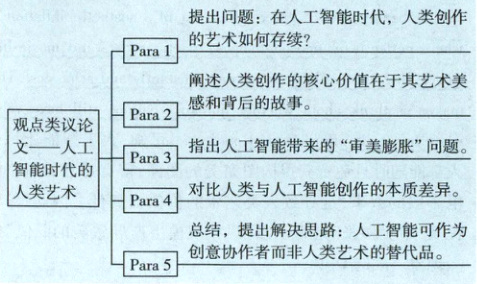
提出问题:在人工智能时代,人类创作的艺术如何存续?
Para 1
阐述人类创作的核心价值在于其艺术美感和背后的故事。
Para 2
指出人工智能带来的“审美膨胀”问题。
Para 3
对比人类与人工智能创作的本质差异。
Para 4
总结,提出解决思路:人工智能可作为创意协作者而非人类艺术的替代品。
Para 5
【语篇导读】本文是一篇议论文。文章探讨了在人工智能时代,人类艺术因其背后蕴含的创作努力、意图和人性本质而具有不可替代的价值,并指出人类可以与人工智能协作创作艺术。
1.D 细节理解题。根据第二段中的“Masterpieces like Van Gogh’s ‘The Starry Night’ survive not simply for their artistic beauty, but for the human stories they carry. They remind us that...”可知,《星月夜》这样的杰作在人工智能时代之所以经久不衰,不仅仅是因为艺术美感,还在于它们承载的人类故事,它们提醒我们艺术关乎意图、毅力和人性本质,即它们包含人类的情感深度和创造性的努力。故选D项。
2.D 推理判断题。根据第三段“As AI floods the world with instant beauty, we're entering an era of ‘aesthetic inflation’, where perfectly composed images, poetic style, and movie-like storytelling are available to anyone, instantly and at no cost. This makes us think about whether human creations still have value when beauty is effortless and endless.”可知,人工智能让每个人都能随时且免费获得构图完美的图像、富有诗意的风格和电影般的叙事,这导致人类艺术的价值被贬低。因此,作者提及“审美膨胀”是为了强调“大规模生产导致美的贬值”这一现象。故选D项。
3.C 推理判断题。结合全文内容可知,作者主要通过“对比”的方式展开论证。全文围绕“人类艺术”与“人工智能创作”的核心差异展开:开篇先将“人类创造力须付出努力”与“人工智能一键生成内容”对比,抛出“人类艺术如何存续”的核心问题;接着在分析《星月夜》等杰作的价值时,将“艺术承载人类故事,包含坚持与努力等元素”与“人工智能创作缺乏人类维度”对比,凸显人类艺术的独特性;随后在讨论“人类艺术的不完美”的意义时,又将“人类的挣扎才让创造力拥有了重量”与“人工智能虽技术完美但却空洞且毫无情感”对比,论证人类艺术不完美的价值;最后在结尾部分,通过“人工智能可作为替代品”与“人工智能作为人类创作的协作者”的对比,明确了人工智能的合理定位。因此,“作对比”是本文的主要论证方法。故选C项。
知识拓展 文章或段落展开的常见方法
by making comparisons/contrasts 作比较/作对照
by analysing cause and effect 分析因果关系
by listing reasons 列举原因
by listing/giving/using examples 举例子
by listing figures/data 列数据
by using diagrams 使用图表
by (following) space/time order 按照空间/时间顺序
4.C 主旨大意题。文章开篇便提出问题:人类艺术如何存续?全文围绕“人工智能时代的人类艺术是否仍有价值、为何有价值”展开,先提出人工智能对人类艺术的挑战,再论证人类艺术因情感、努力、不完美等特质而不可替代,最后指出人类可与人工智能协作创作艺术。C项(为什么在人工智能时代人类艺术仍然重要)概括了文章的主要观点,适合做本文的标题。故选C项。
高中必刷题 英语
长难句分析
As AI floods the world with instant beauty, {we're entering an era of “aesthetic inflation”, where perfectly composed images, where引导非限制性定语从句,修饰 an era of “aesthetic inflation”
poetic style, and movie-like storytelling are available to anyone, instantly and at no cost} 主句.
句意:随着人工智能用即时之美充斥世界,我们正进入一个“审美膨胀”的时代,在这个时代里,任何人都能随时且免费获得构图完美的图像、诗意的风格和电影般的叙事。
文本解构
观点类议论文——人工智能时代的人类艺术
提出问题:在人工智能时代,人类创作的艺术如何存续?
Para 1
阐述人类创作的核心价值在于其艺术美感和背后的故事。
Para 2
指出人工智能带来的“审美膨胀”问题。
Para 3
对比人类与人工智能创作的本质差异。
Para 4
总结,提出解决思路:人工智能可作为创意协作者而非人类艺术的替代品。
Para 5
查看更多完整答案,请扫码查看

