

 搜索
搜索
2026年高中必刷题高二下英语人教版
注:目前有些书本章节名称可能整理的还不是很完善,但都是按照顺序排列的,请同学们按照顺序仔细查找。练习册 2026年高中必刷题高二下英语人教版 答案主要是用来给同学们做完题方便对答案用的,请勿直接抄袭。
第39页
- 第1页
- 第2页
- 第3页
- 第4页
- 第5页
- 第6页
- 第7页
- 第8页
- 第9页
- 第10页
- 第11页
- 第12页
- 第13页
- 第14页
- 第15页
- 第16页
- 第17页
- 第18页
- 第19页
- 第20页
- 第21页
- 第22页
- 第23页
- 第24页
- 第25页
- 第26页
- 第27页
- 第28页
- 第29页
- 第30页
- 第31页
- 第32页
- 第33页
- 第34页
- 第35页
- 第36页
- 第37页
- 第38页
- 第39页
- 第40页
- 第41页
- 第42页
- 第43页
- 第44页
- 第45页
- 第46页
- 第47页
- 第48页
- 第49页
- 第50页
- 第51页
- 第52页
- 第53页
- 第54页
- 第55页
- 第56页
- 第57页
- 第58页
- 第59页
- 第60页
- 第61页
- 第62页
- 第63页
- 第64页
- 第65页
- 第66页
- 第67页
- 第68页
- 第69页
- 第70页
- 第71页
- 第72页
- 第73页
- 第74页
- 第75页
- 第76页
- 第77页
- 第78页
- 第79页
- 第80页
- 第81页
- 第82页
- 第83页
- 第84页
- 第85页
- 第86页
- 第87页
- 第88页
- 第89页
- 第90页
- 第91页
- 第92页
- 第93页
- 第94页
- 第95页
- 第96页
- 第97页
- 第98页
- 第99页
- 第100页
- 第101页
- 第102页
- 第103页
- 第104页
- 第105页
- 第106页
- 第107页
- 第108页
- 第109页
- 第110页
- 第111页
- 第112页
- 第113页
- 第114页
- 第115页
- 第116页
- 第117页
语篇类型:议论文
主题:在数字生活中寻找平衡
词数:381
难度:偏难
建议用时:8 分钟
[浙江湖州 2025 高二期末]In an era when “digital detox” has become a buzzword, people who call themselves digital minimalists proudly delete social apps, set their phone screens to black - and - white, or switch to simple phones. Yet their fight against technology overload often creates a confusing cycle. To reduce screen time, they use apps to track their habits; to replace tablets, they buy about 200 special black - and - white devices; and to learn about minimalism, they spend hours watching online videos. Surprisingly, a 2023 report showed downloads of “digital wellness” apps had a sharp rise, proving that this movement against technology still deeply depends on it.
This contradiction echoes historical patterns. In the late 19th century, the British Arts and Crafts movement fought against factory - made goods by praising handmade items. However, these handmade products became expensive luxuries only the rich could afford. Similarly, today's digital minimalism, while trying to resist distractions from apps and ads, has created a huge industry selling “anti - tech” products. Examples include writing apps without ads, “smart” paper notebooks that need internet updates, and simple - looking gadgets. These products turn the idea of rebellion into something people can buy, like turning protest signs into fashion accessories.
The real problem is showing off simplicity. A 2024 Stanford study found that 62% of people who call themselves digital minimalists spent the same amount of time on their phones—they just switched from social media apps to “approved” apps like e - book readers or meditation tools. This is similar to photos of perfectly clean desks on social media: The empty space looks simple, but behind it are complex phone settings and app algorithms.
Maybe we need a new way of thinking. Scholar Andrew Hui suggests treating technology like water—using it wisely without wasting or nervously measuring every drop. Artist and critic Jenny Odell, in her book How to Do Nothing: Resisting the Attention Economy, argues that real freedom isn't about running away from the digital world but finding balance within it. This could mean allowing small, joyful moments in our digital lives: a funny cat video popping up during work, or understanding that a family member's repeated health posts in a chat group are really about showing love. When we stop judging every tech choice based on the principle of “good” or “bad” and focus on meaningful connections, we might finally feel free in the digital age.
1. What is the main outcome of digital minimalists' efforts?
A. They successfully reduce screen time through strict rules.
B. They depend more on technology to achieve their goals.
C. They inspire others to join the digital detox movement.
D. They completely abandon modern devices like tablets.
2. Why is the late 19th - century British Arts and Crafts movement mentioned?
A. To show anti - tech trends are not new in history.
B. To criticise the high cost of handmade products.
C. To prove that older generations valued simplicity more.
D. To compare traditional crafts with modern digital tools.
3. What did the Stanford study reveal about digital minimalists?
A. They preferred meditation apps to entertainment apps.
B. Their phone settings were simpler than non - minimalists'.
C. They spent less time on social media than average users.
D. Their total screen time remained unchanged despite efforts.
4. What solution does the author support for balancing digital life?
A. Returning to preindustrial lifestyles.
B. Labelling technology as either “good” or “bad”.
C. Strictly avoiding all non - work - related technology.
D. Embracing small digital joys with an open mind.
主题:在数字生活中寻找平衡
词数:381
难度:偏难
建议用时:8 分钟
[浙江湖州 2025 高二期末]In an era when “digital detox” has become a buzzword, people who call themselves digital minimalists proudly delete social apps, set their phone screens to black - and - white, or switch to simple phones. Yet their fight against technology overload often creates a confusing cycle. To reduce screen time, they use apps to track their habits; to replace tablets, they buy about 200 special black - and - white devices; and to learn about minimalism, they spend hours watching online videos. Surprisingly, a 2023 report showed downloads of “digital wellness” apps had a sharp rise, proving that this movement against technology still deeply depends on it.
This contradiction echoes historical patterns. In the late 19th century, the British Arts and Crafts movement fought against factory - made goods by praising handmade items. However, these handmade products became expensive luxuries only the rich could afford. Similarly, today's digital minimalism, while trying to resist distractions from apps and ads, has created a huge industry selling “anti - tech” products. Examples include writing apps without ads, “smart” paper notebooks that need internet updates, and simple - looking gadgets. These products turn the idea of rebellion into something people can buy, like turning protest signs into fashion accessories.
The real problem is showing off simplicity. A 2024 Stanford study found that 62% of people who call themselves digital minimalists spent the same amount of time on their phones—they just switched from social media apps to “approved” apps like e - book readers or meditation tools. This is similar to photos of perfectly clean desks on social media: The empty space looks simple, but behind it are complex phone settings and app algorithms.
Maybe we need a new way of thinking. Scholar Andrew Hui suggests treating technology like water—using it wisely without wasting or nervously measuring every drop. Artist and critic Jenny Odell, in her book How to Do Nothing: Resisting the Attention Economy, argues that real freedom isn't about running away from the digital world but finding balance within it. This could mean allowing small, joyful moments in our digital lives: a funny cat video popping up during work, or understanding that a family member's repeated health posts in a chat group are really about showing love. When we stop judging every tech choice based on the principle of “good” or “bad” and focus on meaningful connections, we might finally feel free in the digital age.
1. What is the main outcome of digital minimalists' efforts?
A. They successfully reduce screen time through strict rules.
B. They depend more on technology to achieve their goals.
C. They inspire others to join the digital detox movement.
D. They completely abandon modern devices like tablets.
2. Why is the late 19th - century British Arts and Crafts movement mentioned?
A. To show anti - tech trends are not new in history.
B. To criticise the high cost of handmade products.
C. To prove that older generations valued simplicity more.
D. To compare traditional crafts with modern digital tools.
3. What did the Stanford study reveal about digital minimalists?
A. They preferred meditation apps to entertainment apps.
B. Their phone settings were simpler than non - minimalists'.
C. They spent less time on social media than average users.
D. Their total screen time remained unchanged despite efforts.
4. What solution does the author support for balancing digital life?
A. Returning to preindustrial lifestyles.
B. Labelling technology as either “good” or “bad”.
C. Strictly avoiding all non - work - related technology.
D. Embracing small digital joys with an open mind.
答案:
【语篇导读】本文是一篇议论文。文章批判性地探讨了“数字极简主义”这一潮流,指出其在实践中常常陷入反技术而又更加依赖科技的矛盾,并催生了新的消费市场。作者认为真正的解决方案并非一刀切,而是以开放的心态接纳数字生活中的多元性,聚焦于技术如何服务于有意义的联结与人性需求。
1.B 细节理解题。第一段中的“To reduce screen time,they use apps… watching online videos.”列举了数字极简主义者所作的努力,如使用应用程序追踪自身习惯、购买专用黑白设备和观看在线视频;结合“downloads of ‘digital wellness’ apps had a sharp rise,proving that this movement against technology still deeply depends on it”可知,这些努力带来的主要结果是他们在试图减少对科技依赖的同时,反而更加依赖于新的科技产品和应用来实现其目标。故选B项。
2.A 推理判断题。第二段开头“This contradiction echoes historical patterns.”指出当前数字极简主义的矛盾(表面反科技,实则依赖科技产业)与历史上的模式类似;接着下文探讨了19世纪晚期英国工艺美术运动反对工业化,推崇手工制品,但手工制品最终成为富人专属的奢侈品,未能真正解决问题。同时作者通过类比指出当今的数字极简主义存在共性问题。由此可推断,作者提到该历史事件是为了将其与当下的数字极简主义进行类比,说明反技术/工业化的潮流最终催生新消费,并陷入自身矛盾的模式,这在历史上已有先例。故选A项。
敲黑板:理解“类比论证”的写作手法是解答本题的关键。作者提及历史事件并非为了讨论历史本身,而是为了用过去相似的模式来佐证当下的现象。
3.D 细节理解题。根据第三段中的“A 2024 Stanford study found that 62% of people who call themselves digital minimalists spent the same amount of time on their phones—they just switched from social media apps to ‘approved’ apps like e-book readers or meditation tools.”可知,斯坦福大学的研究发现,62%自称数字极简主义者的人群尽管作出了一些努力,但其总的屏幕使用时间并未改变,他们只是将这些时间从社交媒体应用转移到了一些“被认可”的应用上。故选D项。
4.D 细节理解题。根据最后一段作者引用的观点和自己的总结“This could mean allowing small, joyful moments in our digital lives:a funny cat video... When we stop judging every tech choice based on the principle of ‘good’ or ‘bad’...”可知,对于平衡数字生活,作者支持的解决方案不是一刀切地评判每一个技术选择,而是以开放的心态在数字生活中接纳并享受那些小小的快乐时刻。故选D项。
文本解构
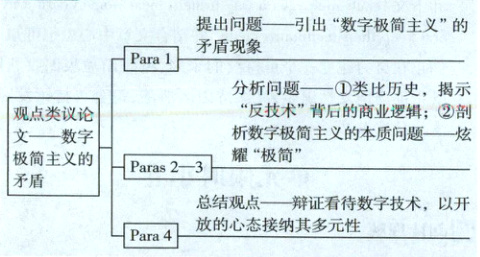
观点类议论文——数字极简主义的矛盾
提出问题——引出“数字极简主义”的矛盾现象 Para 1
分析问题——①类比历史,揭示“反技术”背后的商业逻辑;②剖析数字极简主义的本质问题——炫耀“极简” Paras 2—3
总结观点——辩证看待数字技术,以开放的心态接纳其多元性 Para 4
【语篇导读】本文是一篇议论文。文章批判性地探讨了“数字极简主义”这一潮流,指出其在实践中常常陷入反技术而又更加依赖科技的矛盾,并催生了新的消费市场。作者认为真正的解决方案并非一刀切,而是以开放的心态接纳数字生活中的多元性,聚焦于技术如何服务于有意义的联结与人性需求。
1.B 细节理解题。第一段中的“To reduce screen time,they use apps… watching online videos.”列举了数字极简主义者所作的努力,如使用应用程序追踪自身习惯、购买专用黑白设备和观看在线视频;结合“downloads of ‘digital wellness’ apps had a sharp rise,proving that this movement against technology still deeply depends on it”可知,这些努力带来的主要结果是他们在试图减少对科技依赖的同时,反而更加依赖于新的科技产品和应用来实现其目标。故选B项。
2.A 推理判断题。第二段开头“This contradiction echoes historical patterns.”指出当前数字极简主义的矛盾(表面反科技,实则依赖科技产业)与历史上的模式类似;接着下文探讨了19世纪晚期英国工艺美术运动反对工业化,推崇手工制品,但手工制品最终成为富人专属的奢侈品,未能真正解决问题。同时作者通过类比指出当今的数字极简主义存在共性问题。由此可推断,作者提到该历史事件是为了将其与当下的数字极简主义进行类比,说明反技术/工业化的潮流最终催生新消费,并陷入自身矛盾的模式,这在历史上已有先例。故选A项。
敲黑板:理解“类比论证”的写作手法是解答本题的关键。作者提及历史事件并非为了讨论历史本身,而是为了用过去相似的模式来佐证当下的现象。
3.D 细节理解题。根据第三段中的“A 2024 Stanford study found that 62% of people who call themselves digital minimalists spent the same amount of time on their phones—they just switched from social media apps to ‘approved’ apps like e-book readers or meditation tools.”可知,斯坦福大学的研究发现,62%自称数字极简主义者的人群尽管作出了一些努力,但其总的屏幕使用时间并未改变,他们只是将这些时间从社交媒体应用转移到了一些“被认可”的应用上。故选D项。
4.D 细节理解题。根据最后一段作者引用的观点和自己的总结“This could mean allowing small, joyful moments in our digital lives:a funny cat video... When we stop judging every tech choice based on the principle of ‘good’ or ‘bad’...”可知,对于平衡数字生活,作者支持的解决方案不是一刀切地评判每一个技术选择,而是以开放的心态在数字生活中接纳并享受那些小小的快乐时刻。故选D项。
文本解构
观点类议论文——数字极简主义的矛盾
提出问题——引出“数字极简主义”的矛盾现象 Para 1
分析问题——①类比历史,揭示“反技术”背后的商业逻辑;②剖析数字极简主义的本质问题——炫耀“极简” Paras 2—3
总结观点——辩证看待数字技术,以开放的心态接纳其多元性 Para 4
查看更多完整答案,请扫码查看

