

 搜索
搜索
2026年高中必刷题高二下英语人教版
注:目前有些书本章节名称可能整理的还不是很完善,但都是按照顺序排列的,请同学们按照顺序仔细查找。练习册 2026年高中必刷题高二下英语人教版 答案主要是用来给同学们做完题方便对答案用的,请勿直接抄袭。
第11页
- 第1页
- 第2页
- 第3页
- 第4页
- 第5页
- 第6页
- 第7页
- 第8页
- 第9页
- 第10页
- 第11页
- 第12页
- 第13页
- 第14页
- 第15页
- 第16页
- 第17页
- 第18页
- 第19页
- 第20页
- 第21页
- 第22页
- 第23页
- 第24页
- 第25页
- 第26页
- 第27页
- 第28页
- 第29页
- 第30页
- 第31页
- 第32页
- 第33页
- 第34页
- 第35页
- 第36页
- 第37页
- 第38页
- 第39页
- 第40页
- 第41页
- 第42页
- 第43页
- 第44页
- 第45页
- 第46页
- 第47页
- 第48页
- 第49页
- 第50页
- 第51页
- 第52页
- 第53页
- 第54页
- 第55页
- 第56页
- 第57页
- 第58页
- 第59页
- 第60页
- 第61页
- 第62页
- 第63页
- 第64页
- 第65页
- 第66页
- 第67页
- 第68页
- 第69页
- 第70页
- 第71页
- 第72页
- 第73页
- 第74页
- 第75页
- 第76页
- 第77页
- 第78页
- 第79页
- 第80页
- 第81页
- 第82页
- 第83页
- 第84页
- 第85页
- 第86页
- 第87页
- 第88页
- 第89页
- 第90页
- 第91页
- 第92页
- 第93页
- 第94页
- 第95页
- 第96页
- 第97页
- 第98页
- 第99页
- 第100页
- 第101页
- 第102页
- 第103页
- 第104页
- 第105页
- 第106页
- 第107页
- 第108页
- 第109页
- 第110页
- 第111页
- 第112页
- 第113页
- 第114页
- 第115页
- 第116页
- 第117页
答案 P153
语篇类型:说明文 主题:辨别网络虚假信息 词数:342 难度:偏难 建议用时:8分钟
[山东菏泽2025高二期末]Correcting a massive amount of digital misinformation that circulates at high speed online is a never - ending task. A major video platform removed more than half a million channels last year for broadcasting misinformation. The powerful fact - checking organisations that try to keep the Internet honest face more claims than they can handle. How should they prioritise?
Checkers came up with a new approach: forecasting which claims are most dangerous and thus which most deserve to be put under the microscope. Researchers from the University of Westminster developed a classification system to sort dangerous misinformation from everyday nonsense.
One test of a false dangerous claim is whether enough people will believe it, so that it can cause harm. To swing an election with misinformation, you need to persuade many people; to fool someone with fake medicine, you need to convince only one. Another test is whether those believing the claim have the capacity to act on it. Some people may be misled into believing that Wi - Fi signals can kill plants, for example, but are unlikely to change their behaviour. The researchers estimated that, of the false claims in their samples, 57% were unlikely to contribute to any specific real - world effect.
Of the remaining potentially consequential misinformation, the checkers considered whether the consequence would be “direct”—such as persuading people to buy certain kinds of goods, or “cumulative”, contributing to a false narrative about so - called success science. The claims were roughly evenly divided. “Cumulative” harm is harder to assess in a short time, says Peter Cunliffe - Jones of the University of Westminster, but large data sets make it possible to see how often a claim is repeated, and thus when a narrative is forming.
Time devoted to selecting which false claims to check is probably well spent. It takes five minutes to sort a claim, whereas carrying out a thorough check takes five to six hours. “The fact - checking world needs to get more systematic in its approach,” says Mr Cunliffe - Jones. “If this community is going to learn anything from this... it's that data is the future.”
1. What is the main challenge fact - checking organisations face?
A. Lack of professional fact checkers.
B. Difficulty in accessing reliable data.
C. Resistance from social media platforms.
D. The overwhelming amount of misinformation.
2. In which case may a false claim be classified into “most dangerous”?
A. It targets ordinary people.
B. It brings about an action.
C. It disguises itself with science.
D. It spreads on many social media platforms.
3. What is the closest in meaning to the underlined word “cumulative” in paragraph 4?
A. Equal.
B. Complete.
C. Gradual.
D. Instant.
4. What can be learnt from the last paragraph?
A. It's up to data to keep the Internet honest.
B. Most false claims require thorough checks.
C. Too many resources are wasted in classifying misinformation.
D. Selection matters more than thorough checks.
语篇类型:说明文 主题:辨别网络虚假信息 词数:342 难度:偏难 建议用时:8分钟
[山东菏泽2025高二期末]Correcting a massive amount of digital misinformation that circulates at high speed online is a never - ending task. A major video platform removed more than half a million channels last year for broadcasting misinformation. The powerful fact - checking organisations that try to keep the Internet honest face more claims than they can handle. How should they prioritise?
Checkers came up with a new approach: forecasting which claims are most dangerous and thus which most deserve to be put under the microscope. Researchers from the University of Westminster developed a classification system to sort dangerous misinformation from everyday nonsense.
One test of a false dangerous claim is whether enough people will believe it, so that it can cause harm. To swing an election with misinformation, you need to persuade many people; to fool someone with fake medicine, you need to convince only one. Another test is whether those believing the claim have the capacity to act on it. Some people may be misled into believing that Wi - Fi signals can kill plants, for example, but are unlikely to change their behaviour. The researchers estimated that, of the false claims in their samples, 57% were unlikely to contribute to any specific real - world effect.
Of the remaining potentially consequential misinformation, the checkers considered whether the consequence would be “direct”—such as persuading people to buy certain kinds of goods, or “cumulative”, contributing to a false narrative about so - called success science. The claims were roughly evenly divided. “Cumulative” harm is harder to assess in a short time, says Peter Cunliffe - Jones of the University of Westminster, but large data sets make it possible to see how often a claim is repeated, and thus when a narrative is forming.
Time devoted to selecting which false claims to check is probably well spent. It takes five minutes to sort a claim, whereas carrying out a thorough check takes five to six hours. “The fact - checking world needs to get more systematic in its approach,” says Mr Cunliffe - Jones. “If this community is going to learn anything from this... it's that data is the future.”
1. What is the main challenge fact - checking organisations face?
A. Lack of professional fact checkers.
B. Difficulty in accessing reliable data.
C. Resistance from social media platforms.
D. The overwhelming amount of misinformation.
2. In which case may a false claim be classified into “most dangerous”?
A. It targets ordinary people.
B. It brings about an action.
C. It disguises itself with science.
D. It spreads on many social media platforms.
3. What is the closest in meaning to the underlined word “cumulative” in paragraph 4?
A. Equal.
B. Complete.
C. Gradual.
D. Instant.
4. What can be learnt from the last paragraph?
A. It's up to data to keep the Internet honest.
B. Most false claims require thorough checks.
C. Too many resources are wasted in classifying misinformation.
D. Selection matters more than thorough checks.
答案:
[语篇导读]本文是一篇说明文。文章介绍了在因特网虚假信息泛滥的背景下事实核查机构不堪重负的现状,并详细介绍了一种新的应对策略:通过系统性地评估和分类,优先处理那些最可能造成现实危害的虚假信息。
1.D 细节理解题。根据第一段中的“The powerful fact-checking organisations that try to keep the Internet honest face more claims than they can handle.”可知,事实核查机构面临的问题是需要处理的虚假信息量已经超出了其能力范围。故选D项。
2.B 推理判断题。根据第三段中的“One test of a false dangerous claim is whether enough people will believe it, so that it can cause harm.”以及“Another test is whether those believing the claim have the capacity to act on it.”可知,本段提到虚假信息的两个检验标准:一是是否有足够多的人相信,从而产生有害影响;二是相信虚假信息的那些人是否有能力据此采取行动。后文以“某些人虽然可能被误导,认为Wi-Fi信号能杀死植物,但却不大可能改变自己的行为”为例,说明“能产生行动”是虚假信息危险性的重要标志。故选B项。
3.C 词义猜测题。根据画线单词后的“contributing to a false narrative about so-called success science”以及后文的“Cumulative harm is harder to assess in a short time... see how often a claim is repeated, and thus when a narrative is forming.”可知,这种危害在短期内较难评估,它是通过反复传播而逐渐形成的,说明它是累积性的。故可推知,C项与画线单词含义最为接近。故选C项。
4.A 细节理解题。根据最后一段中的“The fact-checking world needs to get more systematic in its approach,’ says Mr Cunliffe-Jones. ‘If this community is going to learn anything from this... it’s that data is the future.’”可知,事实核查领域需要采取更系统化的方法,而实现这一点的关键在于数据。因此,更加科学、系统地运用数据将是未来维护网络环境真实性的关键。故选A项。
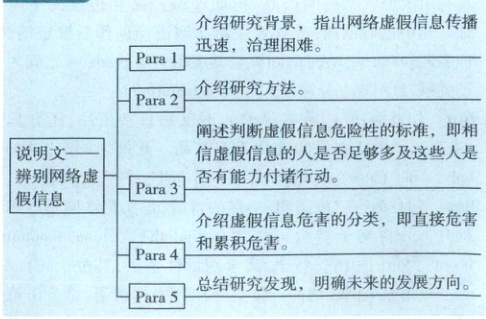
文本解构
说明文——辨别网络虚假信息
Para 1 介绍研究背景,指出网络虚假信息传播迅速,治理困难。
Para 2 介绍研究方法。
Para 3 阐述判断虚假信息危险性的标准,即相信虚假信息的人是否足够多及这些人是否有能力付诸行动。
Para 4 介绍虚假信息危害的分类,即直接危害和累积危害。
Para 5 总结研究发现,明确未来的发展方向。
[语篇导读]本文是一篇说明文。文章介绍了在因特网虚假信息泛滥的背景下事实核查机构不堪重负的现状,并详细介绍了一种新的应对策略:通过系统性地评估和分类,优先处理那些最可能造成现实危害的虚假信息。
1.D 细节理解题。根据第一段中的“The powerful fact-checking organisations that try to keep the Internet honest face more claims than they can handle.”可知,事实核查机构面临的问题是需要处理的虚假信息量已经超出了其能力范围。故选D项。
2.B 推理判断题。根据第三段中的“One test of a false dangerous claim is whether enough people will believe it, so that it can cause harm.”以及“Another test is whether those believing the claim have the capacity to act on it.”可知,本段提到虚假信息的两个检验标准:一是是否有足够多的人相信,从而产生有害影响;二是相信虚假信息的那些人是否有能力据此采取行动。后文以“某些人虽然可能被误导,认为Wi-Fi信号能杀死植物,但却不大可能改变自己的行为”为例,说明“能产生行动”是虚假信息危险性的重要标志。故选B项。
3.C 词义猜测题。根据画线单词后的“contributing to a false narrative about so-called success science”以及后文的“Cumulative harm is harder to assess in a short time... see how often a claim is repeated, and thus when a narrative is forming.”可知,这种危害在短期内较难评估,它是通过反复传播而逐渐形成的,说明它是累积性的。故可推知,C项与画线单词含义最为接近。故选C项。
4.A 细节理解题。根据最后一段中的“The fact-checking world needs to get more systematic in its approach,’ says Mr Cunliffe-Jones. ‘If this community is going to learn anything from this... it’s that data is the future.’”可知,事实核查领域需要采取更系统化的方法,而实现这一点的关键在于数据。因此,更加科学、系统地运用数据将是未来维护网络环境真实性的关键。故选A项。
文本解构
说明文——辨别网络虚假信息
Para 1 介绍研究背景,指出网络虚假信息传播迅速,治理困难。
Para 2 介绍研究方法。
Para 3 阐述判断虚假信息危险性的标准,即相信虚假信息的人是否足够多及这些人是否有能力付诸行动。
Para 4 介绍虚假信息危害的分类,即直接危害和累积危害。
Para 5 总结研究发现,明确未来的发展方向。
查看更多完整答案,请扫码查看

