

 搜索
搜索
2025年步步高大二轮专题复习高中数学
注:目前有些书本章节名称可能整理的还不是很完善,但都是按照顺序排列的,请同学们按照顺序仔细查找。练习册 2025年步步高大二轮专题复习高中数学 答案主要是用来给同学们做完题方便对答案用的,请勿直接抄袭。
第8页
- 第1页
- 第2页
- 第3页
- 第4页
- 第5页
- 第6页
- 第7页
- 第8页
- 第9页
- 第10页
- 第11页
- 第12页
- 第13页
- 第14页
- 第15页
- 第16页
- 第17页
- 第18页
- 第19页
- 第20页
- 第21页
- 第22页
- 第23页
- 第24页
- 第25页
- 第26页
- 第27页
- 第28页
- 第29页
- 第30页
- 第31页
- 第32页
- 第33页
- 第34页
- 第35页
- 第36页
- 第37页
- 第38页
- 第39页
- 第40页
- 第41页
- 第42页
- 第43页
- 第44页
- 第45页
- 第46页
- 第47页
- 第48页
- 第49页
- 第50页
- 第51页
- 第52页
- 第53页
- 第54页
- 第55页
- 第56页
- 第57页
- 第58页
- 第59页
- 第60页
- 第61页
- 第62页
- 第63页
- 第64页
- 第65页
- 第66页
- 第67页
- 第68页
- 第69页
- 第70页
- 第71页
- 第72页
- 第73页
- 第74页
- 第75页
- 第76页
- 第77页
- 第78页
- 第79页
- 第80页
- 第81页
- 第82页
- 第83页
- 第84页
- 第85页
- 第86页
- 第87页
- 第88页
- 第89页
- 第90页
- 第91页
- 第92页
- 第93页
- 第94页
- 第95页
- 第96页
- 第97页
- 第98页
- 第99页
- 第100页
- 第101页
- 第102页
- 第103页
- 第104页
- 第105页
- 第106页
- 第107页
- 第108页
- 第109页
- 第110页
- 第111页
- 第112页
- 第113页
- 第114页
例2 (2024·宝鸡模拟)已知函数$f(x)=a^{x}+x^{2}-x\ln a - b(a,b\in\mathbf{R},a > 1)$,e是自然对数的底数.
(1)当$a = e,b = 4$时,求整数k的值,使得函数$f(x)$在区间$(k,k + 1)$上存在零点;
(2)若$x\in[-1,1]$,且$b = 0$,求$f(x)$的最小值和最大值.
(1)当$a = e,b = 4$时,求整数k的值,使得函数$f(x)$在区间$(k,k + 1)$上存在零点;
(2)若$x\in[-1,1]$,且$b = 0$,求$f(x)$的最小值和最大值.
答案:
例2 解
(1)当$a = e$,$b = 4$时,
$f(x)=e^{x}+x^{2}-x - 4$,
$\therefore f'(x)=e^{x}+2x - 1$,$\therefore f'(0)=0$,
当$x>0$时,$e^{x}>1$,
$\therefore f'(x)>0$,故$f(x)$在$(0,+\infty)$上单调递增,
同理$f(x)$在$(-\infty,0)$上单调递减。
$f(-2)=e^{-2}+2>0$,
$f(-1)=e^{-1}-2<0$,
$f(0)=-3<0$,$f(1)=e - 4<0$,
$f(2)=e^{2}-2>0$,
故当$x>2$时,$f(x)>0$,当$x<-2$时,$f(x)>0$,
故当$x>0$时,函数$f(x)$的零点在$(1,2)$内,$\therefore k = 1$满足条件。
同理,当$x<0$时,函数$f(x)$的零点在$(-2,-1)$内,$\therefore k=-2$满足条件,
综上,$k = 1$,$-2$。
(2)由已知$f(x)=a^{x}+x^{2}-x\ln a$
$f'(x)=a^{x}\ln a + 2x-\ln a$
$=2x+(a^{x}-1)\ln a$,
①当$x>0$时,由$a>1$,
可知$a^{x}-1>0$,$\ln a>0$,
$\therefore f'(x)>0$;
②当$x<0$时,由$a>1$,
可知$a^{x}-1<0$,$\ln a>0$,
$\therefore f'(x)<0$;
③当$x = 0$时,$f'(x)=0$,
$\therefore f(x)$在$[-1,0]$上单调递减,在$(0,1]$上单调递增,
$\therefore$当$x\in[-1,1]$时,$f(x)_{\min}=f(0)=1$,$f(x)_{\max}=\max\{f(-1),f(1)\}$。
因为$f(1)=a + 1-\ln a$,
$f(-1)=\frac{1}{a}+1+\ln a$,
则$f(1)-f(-1)=a-\frac{1}{a}-2\ln a$,
设$g(t)=t-\frac{1}{t}-2\ln t(t>0)$,
$\because g'(t)=1+\frac{1}{t^{2}}-\frac{2}{t}=(\frac{1}{t}-1)^{2}\geqslant0$(当且仅当$t = 1$时取等号),
$\therefore g(t)$在$(0,+\infty)$上单调递增,而$g(1)=0$,
$\therefore$当$t>1$时,$g(t)>0$,即$a>1$时,$a-\frac{1}{a}-2\ln a>0$,$\therefore f(1)>f(-1)$,
即$f(x)_{\max}=f(1)=a + 1-\ln a$。
综上,$f(x)$的最小值为$1$,最大值为$a + 1-\ln a$。
(1)当$a = e$,$b = 4$时,
$f(x)=e^{x}+x^{2}-x - 4$,
$\therefore f'(x)=e^{x}+2x - 1$,$\therefore f'(0)=0$,
当$x>0$时,$e^{x}>1$,
$\therefore f'(x)>0$,故$f(x)$在$(0,+\infty)$上单调递增,
同理$f(x)$在$(-\infty,0)$上单调递减。
$f(-2)=e^{-2}+2>0$,
$f(-1)=e^{-1}-2<0$,
$f(0)=-3<0$,$f(1)=e - 4<0$,
$f(2)=e^{2}-2>0$,
故当$x>2$时,$f(x)>0$,当$x<-2$时,$f(x)>0$,
故当$x>0$时,函数$f(x)$的零点在$(1,2)$内,$\therefore k = 1$满足条件。
同理,当$x<0$时,函数$f(x)$的零点在$(-2,-1)$内,$\therefore k=-2$满足条件,
综上,$k = 1$,$-2$。
(2)由已知$f(x)=a^{x}+x^{2}-x\ln a$
$f'(x)=a^{x}\ln a + 2x-\ln a$
$=2x+(a^{x}-1)\ln a$,
①当$x>0$时,由$a>1$,
可知$a^{x}-1>0$,$\ln a>0$,
$\therefore f'(x)>0$;
②当$x<0$时,由$a>1$,
可知$a^{x}-1<0$,$\ln a>0$,
$\therefore f'(x)<0$;
③当$x = 0$时,$f'(x)=0$,
$\therefore f(x)$在$[-1,0]$上单调递减,在$(0,1]$上单调递增,
$\therefore$当$x\in[-1,1]$时,$f(x)_{\min}=f(0)=1$,$f(x)_{\max}=\max\{f(-1),f(1)\}$。
因为$f(1)=a + 1-\ln a$,
$f(-1)=\frac{1}{a}+1+\ln a$,
则$f(1)-f(-1)=a-\frac{1}{a}-2\ln a$,
设$g(t)=t-\frac{1}{t}-2\ln t(t>0)$,
$\because g'(t)=1+\frac{1}{t^{2}}-\frac{2}{t}=(\frac{1}{t}-1)^{2}\geqslant0$(当且仅当$t = 1$时取等号),
$\therefore g(t)$在$(0,+\infty)$上单调递增,而$g(1)=0$,
$\therefore$当$t>1$时,$g(t)>0$,即$a>1$时,$a-\frac{1}{a}-2\ln a>0$,$\therefore f(1)>f(-1)$,
即$f(x)_{\max}=f(1)=a + 1-\ln a$。
综上,$f(x)$的最小值为$1$,最大值为$a + 1-\ln a$。
跟踪演练2 (1)(2024·安徽省皖江名校联盟模拟)已知函数$f(x)=(x - 1)\sin x+(x + 1)\cdot\cos x$,当$x\in[0,\pi]$时,$f(x)$的最大值与最小值的和为__________.
答案:
跟踪演练2
(1)$(\frac{\sqrt{2}}{4}-1)\pi - 1$
(1)$(\frac{\sqrt{2}}{4}-1)\pi - 1$
(2)(2024·浙江省金丽衢十二校联考)已知函数$f(x)=\begin{cases}-\frac{1}{x},x < 0,\\e^{x}-2,x\geq0,\end{cases}$若$x_{1} < x_{2}$,且$f(x_{1}) = f(x_{2})$,则$x_{2}-x_{1}$的最小值为__________.
答案:
跟踪演练2
(2)$2\ln 2+\frac{1}{2}$
(2)$2\ln 2+\frac{1}{2}$
例3 (1)(2024·南充模拟)已知函数$f(x)=xe^{x + m}-\frac{1}{2}x^{2}-mx$在区间$[-1 - m,1 - m]$上有且仅有两个极值点,则实数m的取值范围为 ( )
A.$(1,2-\frac{1}{e})$
B.$(1,e)$
C.$(1,2-\frac{1}{e}]$
D.$(1,e]$
A.$(1,2-\frac{1}{e})$
B.$(1,e)$
C.$(1,2-\frac{1}{e}]$
D.$(1,e]$
答案:
例3
(1)A $[f'(x)=e^{x + m}(1 + x)-m$,
因为$f(x)$在区间$[-1 - m,1 - m]$上有且仅有两个极值点,
所以$f'(x)$在区间$(-1 - m,1 - m)$上有两个变号零点,即$e^{x + m}(1 + x)=x + m$在区间$(-1 - m,1 - m)$上有两个不等实数根。
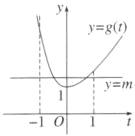
令$t=x + m$,则$x=t - m$,上式可化为$m=t + 1-\frac{t}{e^{t}}$,其中$t\in(-1,1)$。
令$g(t)=t + 1-\frac{t}{e^{t}}$,$t\in(-1,1)$,
则$g'(t)=1-\frac{1 - t}{e^{t}}=\frac{e^{t}-1 + t}{e^{t}}$。
令$h(t)=e^{t}-1 + t$,
则$h'(t)=e^{t}+1>0$,
即$h(t)$为增函数,
又$h(0)=0$,所以当$t\in(-1,0)$时,
$g'(t)<0$,$g(t)$单调递减;
当$t\in(0,1)$时,$g'(t)>0$,$g(t)$单调递增,所以当$t = 0$时,$g(t)$取得最小值,
因为$g(0)=1$,$g(-1)=e$,
$g(1)=2-\frac{1}{e}$,
所以$m$的取值范围为$(1,2-\frac{1}{e})$。]
例3
(1)A $[f'(x)=e^{x + m}(1 + x)-m$,
因为$f(x)$在区间$[-1 - m,1 - m]$上有且仅有两个极值点,
所以$f'(x)$在区间$(-1 - m,1 - m)$上有两个变号零点,即$e^{x + m}(1 + x)=x + m$在区间$(-1 - m,1 - m)$上有两个不等实数根。
令$t=x + m$,则$x=t - m$,上式可化为$m=t + 1-\frac{t}{e^{t}}$,其中$t\in(-1,1)$。
令$g(t)=t + 1-\frac{t}{e^{t}}$,$t\in(-1,1)$,
则$g'(t)=1-\frac{1 - t}{e^{t}}=\frac{e^{t}-1 + t}{e^{t}}$。
令$h(t)=e^{t}-1 + t$,
则$h'(t)=e^{t}+1>0$,
即$h(t)$为增函数,
又$h(0)=0$,所以当$t\in(-1,0)$时,
$g'(t)<0$,$g(t)$单调递减;
当$t\in(0,1)$时,$g'(t)>0$,$g(t)$单调递增,所以当$t = 0$时,$g(t)$取得最小值,
因为$g(0)=1$,$g(-1)=e$,
$g(1)=2-\frac{1}{e}$,
所以$m$的取值范围为$(1,2-\frac{1}{e})$。]
(2)若函数$f(x)=\frac{1}{3}x^{3}+x^{2}-2$在区间$(a - 4,a)$上存在最小值,则a的取值范围是________.
答案:
例3
(2)$[1,4)$
(2)$[1,4)$
跟踪演练3 (1)(2024·赤峰模拟)已知函数$f(x)=x\ln x - ax$有极值 - e,则a等于( )
A.1
B.2
C.e
D.3
A.1
B.2
C.e
D.3
答案:
跟踪演练3
(1)B
(1)B
(2)(2024·石嘴山模拟)已知函数$f(x)=ax^{2}-2x+\ln x$有两个不同的极值点$x_{1},x_{2}$,若不等式$f(x_{1})+f(x_{2})\leq t$恒成立,则实数t的最小值为__________.
答案:
跟踪演练3
(2)$-3$
(2)$-3$
查看更多完整答案,请扫码查看

