

 搜索
搜索
2026年学易优高考二轮总复习数学
注:目前有些书本章节名称可能整理的还不是很完善,但都是按照顺序排列的,请同学们按照顺序仔细查找。练习册 2026年学易优高考二轮总复习数学 答案主要是用来给同学们做完题方便对答案用的,请勿直接抄袭。
第33页
- 第1页
- 第2页
- 第3页
- 第4页
- 第5页
- 第6页
- 第7页
- 第8页
- 第9页
- 第10页
- 第11页
- 第12页
- 第13页
- 第14页
- 第15页
- 第16页
- 第17页
- 第18页
- 第19页
- 第20页
- 第21页
- 第22页
- 第23页
- 第24页
- 第25页
- 第26页
- 第27页
- 第28页
- 第29页
- 第30页
- 第31页
- 第32页
- 第33页
- 第34页
- 第35页
- 第36页
- 第37页
- 第38页
- 第39页
- 第40页
- 第41页
- 第42页
- 第43页
- 第44页
- 第45页
- 第46页
- 第47页
- 第48页
- 第49页
- 第50页
- 第51页
- 第52页
- 第53页
- 第54页
- 第55页
- 第56页
- 第57页
- 第58页
- 第59页
- 第60页
- 第61页
- 第62页
- 第63页
- 第64页
- 第65页
- 第66页
- 第67页
- 第68页
- 第69页
- 第70页
- 第71页
- 第72页
- 第73页
- 第74页
- 第75页
- 第76页
- 第77页
- 第78页
- 第79页
- 第80页
- 第81页
- 第82页
- 第83页
- 第84页
- 第85页
- 第86页
- 第87页
训练 2 (1)(多选)(2025·连云港调研)设 $ \boldsymbol{a} $,$ \boldsymbol{b} $,$ \boldsymbol{c} $是三个非零向量,且相互不共线,则下列说法正确的是(
A.若 $ |\boldsymbol{a} + \boldsymbol{b}| = |\boldsymbol{a} - \boldsymbol{b}| $,则 $ \boldsymbol{a} \perp \boldsymbol{b} $
B.若 $ |\boldsymbol{a}| = |\boldsymbol{b}| $,则 $ (\boldsymbol{a} + \boldsymbol{b}) \perp (\boldsymbol{a} - \boldsymbol{b}) $
C.若 $ \boldsymbol{a} · \boldsymbol{c} = \boldsymbol{b} · \boldsymbol{c} $,则 $ \boldsymbol{a} - \boldsymbol{b} $不与 $ \boldsymbol{c} $垂直
D.$ (\boldsymbol{b} · \boldsymbol{c})\boldsymbol{a} - (\boldsymbol{a} · \boldsymbol{c})\boldsymbol{b} $不与 $ \boldsymbol{c} $垂直
AB
)A.若 $ |\boldsymbol{a} + \boldsymbol{b}| = |\boldsymbol{a} - \boldsymbol{b}| $,则 $ \boldsymbol{a} \perp \boldsymbol{b} $
B.若 $ |\boldsymbol{a}| = |\boldsymbol{b}| $,则 $ (\boldsymbol{a} + \boldsymbol{b}) \perp (\boldsymbol{a} - \boldsymbol{b}) $
C.若 $ \boldsymbol{a} · \boldsymbol{c} = \boldsymbol{b} · \boldsymbol{c} $,则 $ \boldsymbol{a} - \boldsymbol{b} $不与 $ \boldsymbol{c} $垂直
D.$ (\boldsymbol{b} · \boldsymbol{c})\boldsymbol{a} - (\boldsymbol{a} · \boldsymbol{c})\boldsymbol{b} $不与 $ \boldsymbol{c} $垂直
答案:
(1)AB $a$,$b$,$c$是三个非零向量,$\vert a + b\vert=\vert a - b\vert$两边平方得$(a + b)^{2}=(a - b)^{2}$,即$a^{2}+2a· b + b^{2}=a^{2}-2a· b + b^{2}$,
故$a· b = 0$,则$a\perp b$,故A正确;
$(a + b)·(a - b)=\vert a\vert^{2}-\vert b\vert^{2}=\vert a\vert^{2}-\vert b\vert^{2}$,因为$\vert a\vert=\vert b\vert$,
所以$(a + b)·(a - b)=0$,故$(a + b)\perp(a - b)$,故B正确;
$a· c = b· c$,
故$a· c - b· c=(a - b)· c = 0$,
又$a$与$b$不共线,有$a\neq b$,
则$a - b$与$c$垂直,故C错误;
$[(b· c)a-(a· c)b]· c=(b· c)(a· c)-(a· c)(b· c)=0$,故$(b· c)a-(a· c)b$与$c$垂直,故D错误.
(1)AB $a$,$b$,$c$是三个非零向量,$\vert a + b\vert=\vert a - b\vert$两边平方得$(a + b)^{2}=(a - b)^{2}$,即$a^{2}+2a· b + b^{2}=a^{2}-2a· b + b^{2}$,
故$a· b = 0$,则$a\perp b$,故A正确;
$(a + b)·(a - b)=\vert a\vert^{2}-\vert b\vert^{2}=\vert a\vert^{2}-\vert b\vert^{2}$,因为$\vert a\vert=\vert b\vert$,
所以$(a + b)·(a - b)=0$,故$(a + b)\perp(a - b)$,故B正确;
$a· c = b· c$,
故$a· c - b· c=(a - b)· c = 0$,
又$a$与$b$不共线,有$a\neq b$,
则$a - b$与$c$垂直,故C错误;
$[(b· c)a-(a· c)b]· c=(b· c)(a· c)-(a· c)(b· c)=0$,故$(b· c)a-(a· c)b$与$c$垂直,故D错误.
(2)(2025·济南质检)平行四边形 $ ABCD $中,$ AB = 3 $,$ AD = 4 $,$ \angle BAD = \frac{\pi}{3} $,若 $ \overrightarrow{BE} = \overrightarrow{EC} $,$ \overrightarrow{CF} = 2\overrightarrow{FD} $,则 $ \overrightarrow{AE} · \overrightarrow{AF} = $(
A.4
B.6
C.18
D.22
C
)A.4
B.6
C.18
D.22
答案:
(2)C 由题意可知,以A为坐标原点,建立平面直角坐标系如图所示.
因为$AB = 3$,$AD = 4$,$\angle BAD=\frac{\pi}{3}$,
所以$A(0,0)$,$B(3,0)$,$C(5,2\sqrt{3})$,$D(2,2\sqrt{3})$.
设$E(x,y)$,则$\overrightarrow{BE}=(x - 3,y)$,$\overrightarrow{EC}=(5 - x,2\sqrt{3}-y)$,由$\overrightarrow{BE}=\overrightarrow{EC}$,得$(x - 3,y)=(5 - x,2\sqrt{3}-y)$,即$\begin{cases}x - 3 = 5 - x,\\y = 2\sqrt{3}-y,\end{cases}$解得$\begin{cases}x = 4,\\y = \sqrt{3},\end{cases}$所以$E(4,\sqrt{3})$. 设$F(x_{1},y_{1})$,则$\overrightarrow{CF}=(x_{1}-5,y_{1}-2\sqrt{3})$,$\overrightarrow{FD}=(2 - x_{1},2\sqrt{3}-y_{1})$,由$\overrightarrow{CF}=2\overrightarrow{FD}$,得$(x_{1}-5,y_{1}-2\sqrt{3})=2(2 - x_{1},2\sqrt{3}-y_{1})$,即$\begin{cases}x_{1}-5 = 4 - 2x_{1},\\y_{1}-2\sqrt{3}=4\sqrt{3}-2y_{1},\end{cases}$解得$\begin{cases}x_{1}=3,\\y_{1}=2\sqrt{3},\end{cases}$
所以$F(3,2\sqrt{3})$. 所以$\overrightarrow{AE}=(4,\sqrt{3})$,$\overrightarrow{AF}=(3,2\sqrt{3})$,$\overrightarrow{AE}·\overrightarrow{AF}=(4,\sqrt{3})·(3,2\sqrt{3})=4×3+\sqrt{3}×2\sqrt{3}=18$. 故选C.
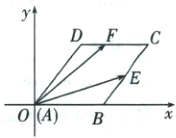
(2)C 由题意可知,以A为坐标原点,建立平面直角坐标系如图所示.
因为$AB = 3$,$AD = 4$,$\angle BAD=\frac{\pi}{3}$,
所以$A(0,0)$,$B(3,0)$,$C(5,2\sqrt{3})$,$D(2,2\sqrt{3})$.
设$E(x,y)$,则$\overrightarrow{BE}=(x - 3,y)$,$\overrightarrow{EC}=(5 - x,2\sqrt{3}-y)$,由$\overrightarrow{BE}=\overrightarrow{EC}$,得$(x - 3,y)=(5 - x,2\sqrt{3}-y)$,即$\begin{cases}x - 3 = 5 - x,\\y = 2\sqrt{3}-y,\end{cases}$解得$\begin{cases}x = 4,\\y = \sqrt{3},\end{cases}$所以$E(4,\sqrt{3})$. 设$F(x_{1},y_{1})$,则$\overrightarrow{CF}=(x_{1}-5,y_{1}-2\sqrt{3})$,$\overrightarrow{FD}=(2 - x_{1},2\sqrt{3}-y_{1})$,由$\overrightarrow{CF}=2\overrightarrow{FD}$,得$(x_{1}-5,y_{1}-2\sqrt{3})=2(2 - x_{1},2\sqrt{3}-y_{1})$,即$\begin{cases}x_{1}-5 = 4 - 2x_{1},\\y_{1}-2\sqrt{3}=4\sqrt{3}-2y_{1},\end{cases}$解得$\begin{cases}x_{1}=3,\\y_{1}=2\sqrt{3},\end{cases}$
所以$F(3,2\sqrt{3})$. 所以$\overrightarrow{AE}=(4,\sqrt{3})$,$\overrightarrow{AF}=(3,2\sqrt{3})$,$\overrightarrow{AE}·\overrightarrow{AF}=(4,\sqrt{3})·(3,2\sqrt{3})=4×3+\sqrt{3}×2\sqrt{3}=18$. 故选C.
例 3 已知 $ \omega > 0 $,$ \boldsymbol{a} = (\sqrt{3}\sin\omega x, -\cos\omega x) $,$ \boldsymbol{b} = (\cos\omega x, \cos\omega x) $,$ f(x) = \boldsymbol{a} · \boldsymbol{b} $,$ x_1 $,$ x_2 $是 $ y = f(x) - \frac{1}{2} $的两个零点,且 $ |x_1 - x_2|_{\min} = \pi $。
(1)求 $ f(x) $的单调递增区间;
(2)若 $ \alpha \in (0, \frac{\pi}{2}) $,$ f(\frac{\alpha}{2}) = \frac{1}{10} $,求 $ \sin2\alpha $的值。
(1)求 $ f(x) $的单调递增区间;
(2)若 $ \alpha \in (0, \frac{\pi}{2}) $,$ f(\frac{\alpha}{2}) = \frac{1}{10} $,求 $ \sin2\alpha $的值。
答案:
解:
(1)$f(x)=\sqrt{3}\sin\omega x\cos\omega x-\cos^{2}\omega x=\frac{\sqrt{3}}{2}\sin2\omega x-\frac{1}{2}\cos2\omega x-\frac{1}{2}=\sin(2\omega x-\frac{\pi}{6})-\frac{1}{2}$
$\because x_{1}$,$x_{2}$是函数$y = f(x)-\frac{1}{2}=\sin(2\omega x-\frac{\pi}{6})-1$的两个零点,
即$x_{1}$,$x_{2}$是方程$\sin(2\omega x-\frac{\pi}{6}) = 1$的两个实根,
且$\vert x_{1}-x_{2}\vert_{\min}=\pi$,
$\therefore T=\frac{2\pi}{2\omega}=\pi$,$\therefore\omega = 1$.
$\therefore f(x)=\sin(2x-\frac{\pi}{6})-\frac{1}{2}$.
由$-\frac{\pi}{2}+2k\pi\leqslant2x-\frac{\pi}{6}\leqslant\frac{\pi}{2}+2k\pi$,$k\in\mathbf{Z}$,
得$-\frac{\pi}{6}+k\pi\leqslant x\leqslant\frac{\pi}{3}+k\pi$,$k\in\mathbf{Z}$.
$\therefore f(x)$的单调递增区间为$[-\frac{\pi}{6}+k\pi,\frac{\pi}{3}+k\pi](k\in\mathbf{Z})$.
(2)$f(\frac{\alpha}{2})=\sin(\alpha-\frac{\pi}{6})-\frac{1}{2}=\frac{1}{10}$,
$\therefore\sin(\alpha-\frac{\pi}{6})=\frac{3}{5}$.
$\because0\lt\alpha\lt\frac{\pi}{2}$,$\therefore-\frac{\pi}{6}\lt\alpha-\frac{\pi}{6}\lt\frac{\pi}{3}$
$\therefore\cos(\alpha-\frac{\pi}{6})=\frac{4}{5}$.
$\because\sin\alpha=\sin[(\alpha-\frac{\pi}{6})+\frac{\pi}{6}]=\sin(\alpha-\frac{\pi}{6})\cos\frac{\pi}{6}+\cos(\alpha-\frac{\pi}{6})\sin\frac{\pi}{6}=\frac{4 + 3\sqrt{3}}{10}$,
$\cos\alpha=\cos[(\alpha-\frac{\pi}{6})+\frac{\pi}{6}]=\cos(\alpha-\frac{\pi}{6})\cos\frac{\pi}{6}-\sin(\alpha-\frac{\pi}{6})\sin\frac{\pi}{6}=\frac{4\sqrt{3}-3}{10}$,
$\therefore\sin2\alpha=2\sin\alpha\cos\alpha=2×\frac{4 + 3\sqrt{3}}{10}×\frac{4\sqrt{3}-3}{10}=\frac{24 + 7\sqrt{3}}{50}$
(1)$f(x)=\sqrt{3}\sin\omega x\cos\omega x-\cos^{2}\omega x=\frac{\sqrt{3}}{2}\sin2\omega x-\frac{1}{2}\cos2\omega x-\frac{1}{2}=\sin(2\omega x-\frac{\pi}{6})-\frac{1}{2}$
$\because x_{1}$,$x_{2}$是函数$y = f(x)-\frac{1}{2}=\sin(2\omega x-\frac{\pi}{6})-1$的两个零点,
即$x_{1}$,$x_{2}$是方程$\sin(2\omega x-\frac{\pi}{6}) = 1$的两个实根,
且$\vert x_{1}-x_{2}\vert_{\min}=\pi$,
$\therefore T=\frac{2\pi}{2\omega}=\pi$,$\therefore\omega = 1$.
$\therefore f(x)=\sin(2x-\frac{\pi}{6})-\frac{1}{2}$.
由$-\frac{\pi}{2}+2k\pi\leqslant2x-\frac{\pi}{6}\leqslant\frac{\pi}{2}+2k\pi$,$k\in\mathbf{Z}$,
得$-\frac{\pi}{6}+k\pi\leqslant x\leqslant\frac{\pi}{3}+k\pi$,$k\in\mathbf{Z}$.
$\therefore f(x)$的单调递增区间为$[-\frac{\pi}{6}+k\pi,\frac{\pi}{3}+k\pi](k\in\mathbf{Z})$.
(2)$f(\frac{\alpha}{2})=\sin(\alpha-\frac{\pi}{6})-\frac{1}{2}=\frac{1}{10}$,
$\therefore\sin(\alpha-\frac{\pi}{6})=\frac{3}{5}$.
$\because0\lt\alpha\lt\frac{\pi}{2}$,$\therefore-\frac{\pi}{6}\lt\alpha-\frac{\pi}{6}\lt\frac{\pi}{3}$
$\therefore\cos(\alpha-\frac{\pi}{6})=\frac{4}{5}$.
$\because\sin\alpha=\sin[(\alpha-\frac{\pi}{6})+\frac{\pi}{6}]=\sin(\alpha-\frac{\pi}{6})\cos\frac{\pi}{6}+\cos(\alpha-\frac{\pi}{6})\sin\frac{\pi}{6}=\frac{4 + 3\sqrt{3}}{10}$,
$\cos\alpha=\cos[(\alpha-\frac{\pi}{6})+\frac{\pi}{6}]=\cos(\alpha-\frac{\pi}{6})\cos\frac{\pi}{6}-\sin(\alpha-\frac{\pi}{6})\sin\frac{\pi}{6}=\frac{4\sqrt{3}-3}{10}$,
$\therefore\sin2\alpha=2\sin\alpha\cos\alpha=2×\frac{4 + 3\sqrt{3}}{10}×\frac{4\sqrt{3}-3}{10}=\frac{24 + 7\sqrt{3}}{50}$
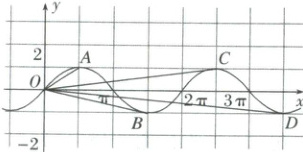
训练 3 (2025·武汉统考)如图所示,$ A $,$ B $,$ C $,$ D $是正弦函数 $ y = \sin x $图象上四个点,且在 $ A $,$ C $两点函数值最大,在 $ B $,$ D $两点函数值最小,则 $ (\overrightarrow{OA} + \overrightarrow{OB}) · (\overrightarrow{OC} + \overrightarrow{OD}) = $
12\pi^{2}
。
答案:
训练3 $12\pi^{2}$ 由题图知,$A(\frac{\pi}{2},1)$,$B(\frac{3\pi}{2}, - 1)$,$C(\frac{5\pi}{2},1)$,$D(\frac{7\pi}{2}, - 1)$,
所以$\overrightarrow{OA}=(\frac{\pi}{2},1)$,$\overrightarrow{OB}=(\frac{3\pi}{2}, - 1)$,$\overrightarrow{OC}=(\frac{5\pi}{2},1)$,$\overrightarrow{OD}=(\frac{7\pi}{2}, - 1)$,
所以$\overrightarrow{OA}+\overrightarrow{OB}=(2\pi,0)$,$\overrightarrow{OC}+\overrightarrow{OD}=(6\pi,0)$,
所以$(\overrightarrow{OA}+\overrightarrow{OB})·(\overrightarrow{OC}+\overrightarrow{OD})=2\pi×6\pi+0×0 = 12\pi^{2}$.
所以$\overrightarrow{OA}=(\frac{\pi}{2},1)$,$\overrightarrow{OB}=(\frac{3\pi}{2}, - 1)$,$\overrightarrow{OC}=(\frac{5\pi}{2},1)$,$\overrightarrow{OD}=(\frac{7\pi}{2}, - 1)$,
所以$\overrightarrow{OA}+\overrightarrow{OB}=(2\pi,0)$,$\overrightarrow{OC}+\overrightarrow{OD}=(6\pi,0)$,
所以$(\overrightarrow{OA}+\overrightarrow{OB})·(\overrightarrow{OC}+\overrightarrow{OD})=2\pi×6\pi+0×0 = 12\pi^{2}$.
1. (2025·北京卷)已知平面直角坐标系 $xOy$ 中,$\vert \overrightarrow{OA}\vert =\vert \overrightarrow{OB}\vert =\sqrt{2}$,$\vert \overrightarrow{AB}\vert =2$,设 $C(3,4)$,则$\vert 2\overrightarrow{CA}+\overrightarrow{AB}\vert$的取值范围是(
A.$[6,14]$
B.$[6,12]$
C.$[8,14]$
D.$[8,12]$
D
)A.$[6,14]$
B.$[6,12]$
C.$[8,14]$
D.$[8,12]$
答案:
1.D 因为$\vert\overrightarrow{OA}\vert=\vert\overrightarrow{OB}\vert=\sqrt{2}$,$\vert\overrightarrow{AB}\vert=2$,由$\overrightarrow{AB}=\overrightarrow{OB}-\overrightarrow{OA}$平方可得,$\overrightarrow{OA}·\overrightarrow{OB}=0$,所以$\langle\overrightarrow{OA},\overrightarrow{OB}\rangle=\frac{\pi}{2}$。
$2\overrightarrow{CA}+\overrightarrow{AB}=2(\overrightarrow{OA}-\overrightarrow{OC})+\overrightarrow{OB}-\overrightarrow{OA}=\overrightarrow{OA}+\overrightarrow{OB}-2\overrightarrow{OC}$,
$\vert\overrightarrow{OC}\vert=\sqrt{3^{2}+4^{2}}=5$,
所以$\vert2\overrightarrow{CA}+\overrightarrow{AB}\vert^{2}=\overrightarrow{OA}^{2}+\overrightarrow{OB}^{2}+4\overrightarrow{OC}^{2}-4(\overrightarrow{OA}+\overrightarrow{OB})·\overrightarrow{OC}$
$=2 + 2 + 4×25 - 4(\overrightarrow{OA}+\overrightarrow{OB})·\overrightarrow{OC}=104 - 4(\overrightarrow{OA}+\overrightarrow{OB})·\overrightarrow{OC}$,
又$\vert(\overrightarrow{OA}+\overrightarrow{OB})·\overrightarrow{OC}\vert\leq\vert\overrightarrow{OA}+\overrightarrow{OB}\vert\vert\overrightarrow{OC}\vert=5×\sqrt{2 + 2}=10$,即$-10\leq(\overrightarrow{OA}+\overrightarrow{OB})·\overrightarrow{OC}\leq10$,
所以$\vert2\overrightarrow{CA}+\overrightarrow{AB}\vert^{2}\in[64,144]$,即$\vert2\overrightarrow{CA}+\overrightarrow{AB}\vert\in[8,12]$。故选D。
$2\overrightarrow{CA}+\overrightarrow{AB}=2(\overrightarrow{OA}-\overrightarrow{OC})+\overrightarrow{OB}-\overrightarrow{OA}=\overrightarrow{OA}+\overrightarrow{OB}-2\overrightarrow{OC}$,
$\vert\overrightarrow{OC}\vert=\sqrt{3^{2}+4^{2}}=5$,
所以$\vert2\overrightarrow{CA}+\overrightarrow{AB}\vert^{2}=\overrightarrow{OA}^{2}+\overrightarrow{OB}^{2}+4\overrightarrow{OC}^{2}-4(\overrightarrow{OA}+\overrightarrow{OB})·\overrightarrow{OC}$
$=2 + 2 + 4×25 - 4(\overrightarrow{OA}+\overrightarrow{OB})·\overrightarrow{OC}=104 - 4(\overrightarrow{OA}+\overrightarrow{OB})·\overrightarrow{OC}$,
又$\vert(\overrightarrow{OA}+\overrightarrow{OB})·\overrightarrow{OC}\vert\leq\vert\overrightarrow{OA}+\overrightarrow{OB}\vert\vert\overrightarrow{OC}\vert=5×\sqrt{2 + 2}=10$,即$-10\leq(\overrightarrow{OA}+\overrightarrow{OB})·\overrightarrow{OC}\leq10$,
所以$\vert2\overrightarrow{CA}+\overrightarrow{AB}\vert^{2}\in[64,144]$,即$\vert2\overrightarrow{CA}+\overrightarrow{AB}\vert\in[8,12]$。故选D。
2. (2023·全国乙卷)已知$\odot O$的半径为 $1$,直线 $PA$ 与$\odot O$相切于点 $A$,直线 $PB$ 与$\odot O$交于 $B$,$C$ 两点,$D$ 为 $BC$ 的中点,若$\vert PO\vert =\sqrt{2}$,则$\overrightarrow{PA}· \overrightarrow{PD}$的最大值为(
A.$\frac{1+\sqrt{2}}{2}$
B.$\frac{1+2\sqrt{2}}{2}$
C.$1+\sqrt{2}$
D.$2+\sqrt{2}$
A
)A.$\frac{1+\sqrt{2}}{2}$
B.$\frac{1+2\sqrt{2}}{2}$
C.$1+\sqrt{2}$
D.$2+\sqrt{2}$
答案:
2.A 解法一 连接$OA$,由题可知$\vert OA\vert=1$,$OA\perp PA$,因为$\vert OP\vert=\sqrt{2}$,所以由勾股定理可得$\vert PA\vert=1$,则$\angle POA=\frac{\pi}{4}$。设直线$OP$绕点$P$按逆时针旋转$\theta$后与直线$PD$重合,则$-\frac{\pi}{4}<\theta<\frac{\pi}{4}$,$\angle APD=\frac{\pi}{4}+\theta$,且$\vert PD\vert=\sqrt{2}\cos\theta$。
所以$\overrightarrow{PA}·\overrightarrow{PD}=\vert\overrightarrow{PA}\vert\vert\overrightarrow{PD}\vert\cos(\frac{\pi}{4}+\theta)$
$=\sqrt{2}\cos\theta\cos(\frac{\pi}{4}+\theta)=\sqrt{2}\cos\theta(\frac{\sqrt{2}}{2}\cos\theta-\frac{\sqrt{2}}{2}\sin\theta)$
$=\cos^{2}\theta-\sin\theta\cos\theta=\frac{1}{2}+\frac{1}{2}\cos2\theta-\frac{1}{2}\sin2\theta$
$=\frac{1}{2}+\frac{\sqrt{2}}{2}\cos(2\theta+\frac{\pi}{4})\leq\frac{1}{2}+\frac{\sqrt{2}}{2}$,故选A。
解法二 以圆心$O$为坐标原点建立平面直角坐标系,设圆$O$:$x^{2}+y^{2}=1$,点$P(\sqrt{2},0)$,因为$\vert OA\vert=1$,且$OA\perp PA$,所以$\angle POA=\frac{\pi}{4}$,不妨设$A(\frac{\sqrt{2}}{2},\frac{\sqrt{2}}{2})$。
设直线$PD$的方程为$y=k(x - \sqrt{2})$,$B(x_{1},y_{1})$,$C(x_{2},y_{2})$,
由$\begin{cases}y=k(x - \sqrt{2})\\x^{2}+y^{2}=1\end{cases}$
得$(k^{2}+1)x^{2}-2\sqrt{2}k^{2}x+2k^{2}-1=0$,由$\Delta=8k^{4}-4(k^{2}+1)(2k^{2}-1)=4 - 4k^{2}>0$,解得$-1<k<1$,则$x_{1}+x_{2}=\frac{2\sqrt{2}k^{2}}{k^{2}+1}$,$y_{1}+y_{2}=k(x_{1}+x_{2}-2\sqrt{2})=-\frac{2\sqrt{2}k}{k^{2}+1}$,所以$D(\frac{\sqrt{2}k^{2}}{k^{2}+1},-\frac{\sqrt{2}k}{k^{2}+1})$。
于是$\overrightarrow{PA}=(-\frac{\sqrt{2}}{2},\frac{\sqrt{2}}{2})$,$\overrightarrow{PD}=(\frac{\sqrt{2}}{k^{2}+1},-\frac{\sqrt{2}k}{k^{2}+1})$,所以$\overrightarrow{PA}·\overrightarrow{PD}=\frac{1 - k}{k^{2}+1}$。设$t=1 - k$,则$0<t<2$,$\overrightarrow{PA}·\overrightarrow{PD}=\frac{t}{(1 - t)^{2}+1}=\frac{t}{t^{2}-2t+2}=\frac{1}{t+\frac{2}{t}-2}\leq\frac{1}{2\sqrt{2}-2}=\frac{1}{2}+\frac{\sqrt{2}}{2}$,当且仅当$t=\sqrt{2}$,即$k=1-\sqrt{2}$时等号成立,故选A。
所以$\overrightarrow{PA}·\overrightarrow{PD}=\vert\overrightarrow{PA}\vert\vert\overrightarrow{PD}\vert\cos(\frac{\pi}{4}+\theta)$
$=\sqrt{2}\cos\theta\cos(\frac{\pi}{4}+\theta)=\sqrt{2}\cos\theta(\frac{\sqrt{2}}{2}\cos\theta-\frac{\sqrt{2}}{2}\sin\theta)$
$=\cos^{2}\theta-\sin\theta\cos\theta=\frac{1}{2}+\frac{1}{2}\cos2\theta-\frac{1}{2}\sin2\theta$
$=\frac{1}{2}+\frac{\sqrt{2}}{2}\cos(2\theta+\frac{\pi}{4})\leq\frac{1}{2}+\frac{\sqrt{2}}{2}$,故选A。
解法二 以圆心$O$为坐标原点建立平面直角坐标系,设圆$O$:$x^{2}+y^{2}=1$,点$P(\sqrt{2},0)$,因为$\vert OA\vert=1$,且$OA\perp PA$,所以$\angle POA=\frac{\pi}{4}$,不妨设$A(\frac{\sqrt{2}}{2},\frac{\sqrt{2}}{2})$。
设直线$PD$的方程为$y=k(x - \sqrt{2})$,$B(x_{1},y_{1})$,$C(x_{2},y_{2})$,
由$\begin{cases}y=k(x - \sqrt{2})\\x^{2}+y^{2}=1\end{cases}$
得$(k^{2}+1)x^{2}-2\sqrt{2}k^{2}x+2k^{2}-1=0$,由$\Delta=8k^{4}-4(k^{2}+1)(2k^{2}-1)=4 - 4k^{2}>0$,解得$-1<k<1$,则$x_{1}+x_{2}=\frac{2\sqrt{2}k^{2}}{k^{2}+1}$,$y_{1}+y_{2}=k(x_{1}+x_{2}-2\sqrt{2})=-\frac{2\sqrt{2}k}{k^{2}+1}$,所以$D(\frac{\sqrt{2}k^{2}}{k^{2}+1},-\frac{\sqrt{2}k}{k^{2}+1})$。
于是$\overrightarrow{PA}=(-\frac{\sqrt{2}}{2},\frac{\sqrt{2}}{2})$,$\overrightarrow{PD}=(\frac{\sqrt{2}}{k^{2}+1},-\frac{\sqrt{2}k}{k^{2}+1})$,所以$\overrightarrow{PA}·\overrightarrow{PD}=\frac{1 - k}{k^{2}+1}$。设$t=1 - k$,则$0<t<2$,$\overrightarrow{PA}·\overrightarrow{PD}=\frac{t}{(1 - t)^{2}+1}=\frac{t}{t^{2}-2t+2}=\frac{1}{t+\frac{2}{t}-2}\leq\frac{1}{2\sqrt{2}-2}=\frac{1}{2}+\frac{\sqrt{2}}{2}$,当且仅当$t=\sqrt{2}$,即$k=1-\sqrt{2}$时等号成立,故选A。
查看更多完整答案,请扫码查看

