

 搜索
搜索
第37页
- 第1页
- 第2页
- 第3页
- 第4页
- 第5页
- 第6页
- 第7页
- 第8页
- 第9页
- 第10页
- 第11页
- 第12页
- 第13页
- 第14页
- 第15页
- 第16页
- 第17页
- 第18页
- 第19页
- 第20页
- 第21页
- 第22页
- 第23页
- 第24页
- 第25页
- 第26页
- 第27页
- 第28页
- 第29页
- 第30页
- 第31页
- 第32页
- 第33页
- 第34页
- 第35页
- 第36页
- 第37页
- 第38页
- 第39页
- 第40页
- 第41页
- 第42页
- 第43页
- 第44页
- 第45页
- 第46页
- 第47页
- 第48页
- 第49页
- 第50页
- 第51页
- 第52页
- 第53页
- 第54页
- 第55页
- 第56页
- 第57页
- 第58页
- 第59页
- 第60页
- 第61页
- 第62页
- 第63页
- 第64页
- 第65页
- 第66页
- 第67页
- 第68页
- 第69页
- 第70页
- 第71页
- 第72页
- 第73页
- 第74页
- 第75页
- 第76页
- 第77页
- 第78页
- 第79页
- 第80页
- 第81页
- 第82页
- 第83页
- 第84页
A
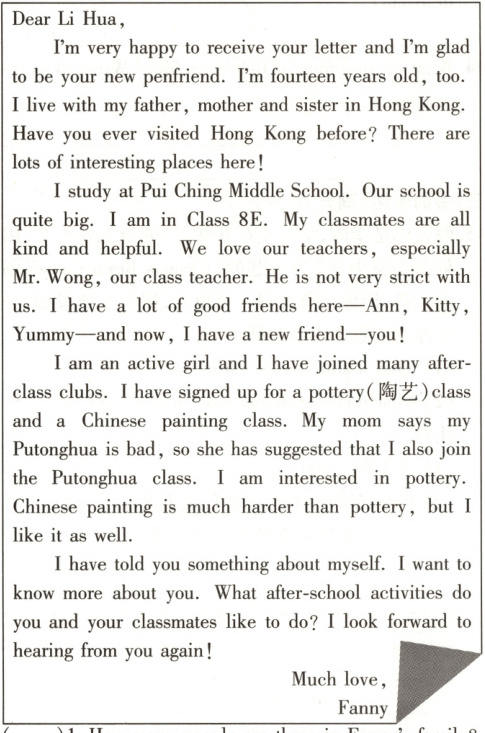
()1. How many people are there in Fanny's family?
A. 6.
B. 5.
C. 4.
D. 3.
()2. From Paragraph 2, what can we know about Fanny?
A. She is an active girl.
B. She loves her family.
C. She enjoys her school life.
D. She has many hobbies.
()3. Fanny's mother suggested she join the class.
A. art
B. Putonghua
C. pottery
D. Chinese painting
()4. Li Hua will write about in her reply to Fanny.
A. her family
B. her visit to Hong Kong
C. her hobbies
D. her after-school activities
()1. How many people are there in Fanny's family?
A. 6.
B. 5.
C. 4.
D. 3.
()2. From Paragraph 2, what can we know about Fanny?
A. She is an active girl.
B. She loves her family.
C. She enjoys her school life.
D. She has many hobbies.
()3. Fanny's mother suggested she join the class.
A. art
B. Putonghua
C. pottery
D. Chinese painting
()4. Li Hua will write about in her reply to Fanny.
A. her family
B. her visit to Hong Kong
C. her hobbies
D. her after-school activities
答案:
[语篇导读] 本文是Fanny写给李华的信,介绍自己的家庭、学校生活、兴趣爱好。信中表达对新笔友的期待,并询问对方课外活动情况,展现跨地域青少年交流的热情。
1.C
2.C [解析]根据第二段“My classmates are all kind and helpful. We love our teachers, especially Mr. Wong, our class teacher. He is not very strict with us. I have a lot of good friends here—Ann, Kitty, Yummy—and now, I have a new friend—you!”可知,Fanny喜欢她的学校生活。故选C。
3.B
4.D
1.C
2.C [解析]根据第二段“My classmates are all kind and helpful. We love our teachers, especially Mr. Wong, our class teacher. He is not very strict with us. I have a lot of good friends here—Ann, Kitty, Yummy—and now, I have a new friend—you!”可知,Fanny喜欢她的学校生活。故选C。
3.B
4.D
B
In a small village, there lived a famous old carpenter (木匠). People traveled from far and wide to buy his furniture.
One day, a young apprentice (学徒) came to learn from him. The young man loved working with wood but was always hurrying to finish things. After a few days of learning from the carpenter, the young man thought, “I can make furniture faster.”
The old carpenter noticed this and said, “I can teach you to make furniture quickly, but first, you need to do a simple job.” He then handed the apprentice a rough board and said, “Make this board smooth.”
The man thought it was easy. He sanded (用砂纸打磨) the board a few times and gave it back soon. The old carpenter felt the board and said, “It is not smooth enough. Try again.”
A little impatient, the young man sanded harder. But the old carpenter shook his head once again. Feeling sad, the man started to think more. He wasn't in a hurry anymore and sanded every part of the board carefully. Finally, the board was as smooth as a mirror.
This time, the old carpenter smiled and said, “You have learned an important lesson. Success needs not only skill but also patience. The simpler the job, the more patience we need. When you perfect every part, you can make a perfect piece.”
The young man understood that carpentry was not only about making things but also about shaping the mind. Life is like this: a successful person moves forward step by step.
()5. At first, the young man preferred doing things .
A. carefully
B. quickly
C. slowly
D. patiently
()6. The underlined word “rough” probably means “” in Chinese.
A. 平滑的
B. 厚重的
C. 劣质的
D. 粗糙的
()7. How did the young man succeed at last?
A. By sanding every part carefully.
B. By practising again and again.
C. By taking action as soon as possible.
D. By working together with the old carpenter.
()8. What can we learn from the story?
A. Good things take time.
B. Great things take great work.
C. Doing good brings goodness.
D. Not giving up makes a success.
In a small village, there lived a famous old carpenter (木匠). People traveled from far and wide to buy his furniture.
One day, a young apprentice (学徒) came to learn from him. The young man loved working with wood but was always hurrying to finish things. After a few days of learning from the carpenter, the young man thought, “I can make furniture faster.”
The old carpenter noticed this and said, “I can teach you to make furniture quickly, but first, you need to do a simple job.” He then handed the apprentice a rough board and said, “Make this board smooth.”
The man thought it was easy. He sanded (用砂纸打磨) the board a few times and gave it back soon. The old carpenter felt the board and said, “It is not smooth enough. Try again.”
A little impatient, the young man sanded harder. But the old carpenter shook his head once again. Feeling sad, the man started to think more. He wasn't in a hurry anymore and sanded every part of the board carefully. Finally, the board was as smooth as a mirror.
This time, the old carpenter smiled and said, “You have learned an important lesson. Success needs not only skill but also patience. The simpler the job, the more patience we need. When you perfect every part, you can make a perfect piece.”
The young man understood that carpentry was not only about making things but also about shaping the mind. Life is like this: a successful person moves forward step by step.
()5. At first, the young man preferred doing things .
A. carefully
B. quickly
C. slowly
D. patiently
()6. The underlined word “rough” probably means “” in Chinese.
A. 平滑的
B. 厚重的
C. 劣质的
D. 粗糙的
()7. How did the young man succeed at last?
A. By sanding every part carefully.
B. By practising again and again.
C. By taking action as soon as possible.
D. By working together with the old carpenter.
()8. What can we learn from the story?
A. Good things take time.
B. Great things take great work.
C. Doing good brings goodness.
D. Not giving up makes a success.
答案:
[语篇导读] 本文主要讲述了一个年轻的学徒向老木匠学习,起初急于求成,经过老木匠的引导,通过多次打磨木板,年轻人终于明白了成功不仅需要技巧,还需要耐心。
5.B [解析]细节理解题。根据第二段“The young man loved working with wood but was always hurrying to finish things”可知,他喜欢快速做事情。故选B。
6.D
7.A
8.A [解析]主旨大意题。根据倒数第二段“You have learned an important lesson. Success needs not only skill but also patience. The simpler the job, the more patience we need. When you perfect every part, you can make a perfect piece”可知,我们可以学到:好事多磨。故选A。
5.B [解析]细节理解题。根据第二段“The young man loved working with wood but was always hurrying to finish things”可知,他喜欢快速做事情。故选B。
6.D
7.A
8.A [解析]主旨大意题。根据倒数第二段“You have learned an important lesson. Success needs not only skill but also patience. The simpler the job, the more patience we need. When you perfect every part, you can make a perfect piece”可知,我们可以学到:好事多磨。故选A。
查看更多完整答案,请扫码查看

