

 搜索
搜索
第54页
- 第1页
- 第2页
- 第3页
- 第4页
- 第5页
- 第6页
- 第7页
- 第8页
- 第9页
- 第10页
- 第11页
- 第12页
- 第13页
- 第14页
- 第15页
- 第16页
- 第17页
- 第18页
- 第19页
- 第20页
- 第21页
- 第22页
- 第23页
- 第24页
- 第25页
- 第26页
- 第27页
- 第28页
- 第29页
- 第30页
- 第31页
- 第32页
- 第33页
- 第34页
- 第35页
- 第36页
- 第37页
- 第38页
- 第39页
- 第40页
- 第41页
- 第42页
- 第43页
- 第44页
- 第45页
- 第46页
- 第47页
- 第48页
- 第49页
- 第50页
- 第51页
- 第52页
- 第53页
- 第54页
- 第55页
- 第56页
- 第57页
- 第58页
- 第59页
- 第60页
- 第61页
- 第62页
- 第63页
- 第64页
- 第65页
- 第66页
- 第67页
- 第68页
- 第69页
- 第70页
- 第71页
- 第72页
- 第73页
- 第74页
- 第75页
- 第76页
- 第77页
- 第78页
- 第79页
- 第80页
- 第81页
- 第82页
- 第83页
- 第84页
- 第85页
- 第86页
- 第87页
- 第88页
- 第89页
- 第90页
- 第91页
- 第92页
- 第93页
- 第94页
- 第95页
- 第96页
- 第97页
- 第98页
- 第99页
- 第100页
- 第101页
- 第102页
- 第103页
- 第104页
- 第105页
- 第106页
- 第107页
- 第108页
- 第109页
- 第110页
- 第111页
- 第112页
- 第113页
- 第114页
- 第115页
- 第116页
- 第117页
- 第118页
- 第119页
- 第120页
- 第121页
- 第122页
- 第123页
- 第124页
- 第125页
13. 已知$x>0$,试说明$\frac {4}{x}≥-x+4$.
答案:
【解析】:要说明当$x>0$时,$\frac {4}{x}≥-x + 4$,可通过移项变形为证明$\frac {4}{x} + x - 4≥0$。
对左边式子进行通分,得到$\frac{x^2 - 4x + 4}{x}$,分子$x^2 - 4x + 4$可因式分解为$(x - 2)^2$,所以原式变为$\frac{(x - 2)^2}{x}$。
因为$x>0$,且任何数的平方都为非负数,即$(x - 2)^2≥0$,所以$\frac{(x - 2)^2}{x}≥0$(当且仅当$x = 2$时取等号),即$\frac {4}{x} + x - 4≥0$,移项可得$\frac {4}{x}≥-x + 4$。
【答案】:当$x>0$时,$\frac {4}{x}≥-x + 4$成立。
对左边式子进行通分,得到$\frac{x^2 - 4x + 4}{x}$,分子$x^2 - 4x + 4$可因式分解为$(x - 2)^2$,所以原式变为$\frac{(x - 2)^2}{x}$。
因为$x>0$,且任何数的平方都为非负数,即$(x - 2)^2≥0$,所以$\frac{(x - 2)^2}{x}≥0$(当且仅当$x = 2$时取等号),即$\frac {4}{x} + x - 4≥0$,移项可得$\frac {4}{x}≥-x + 4$。
【答案】:当$x>0$时,$\frac {4}{x}≥-x + 4$成立。
14. 像$(\sqrt {5}+\sqrt {2})(\sqrt {5}-\sqrt {2})= 3$,$\sqrt {a}\cdot\sqrt {a}= a(a≥0)$,$(\sqrt {b}+1)(\sqrt {b}-1)= b-1(b≥0)$,…$$两个含有二次根式的代数式相乘,积不含有二次根式,我们称这两个代数式互为有理化因式.例如$\sqrt {3}和\sqrt {3}$、$\sqrt {2}+1与\sqrt {2}-1$、$2\sqrt {3}+3\sqrt {5}与2\sqrt {3}-3\sqrt {5}$等都是互为有理化因式.在进行二次根式计算时,利用有理化因式,可以化去分母中的根号.请回答下列问题:
(1) 计算:①$\frac {1}{\sqrt {2}}= $____,②$\frac {1}{\sqrt {3}-1}= $____;
(2) 计算:$\frac {1}{2-\sqrt {3}}= $____;
(3) 已知有理数$a$、$b满足\frac {a}{\sqrt {3}+2}+\frac {2b}{\sqrt {3}-1}= 2\sqrt {3}-1$,则$a= $____,$b= $____.
(1) 计算:①$\frac {1}{\sqrt {2}}= $____,②$\frac {1}{\sqrt {3}-1}= $____;
(2) 计算:$\frac {1}{2-\sqrt {3}}= $____;
(3) 已知有理数$a$、$b满足\frac {a}{\sqrt {3}+2}+\frac {2b}{\sqrt {3}-1}= 2\sqrt {3}-1$,则$a= $____,$b= $____.
答案:
(1)①$\frac{1}{\sqrt{2}}=\frac{\sqrt{2}}{\sqrt{2}×\sqrt{2}}=\frac{\sqrt{2}}{2}$
②$\frac{1}{\sqrt{3}-1}=\frac{\sqrt{3}+1}{(\sqrt{3}-1)(\sqrt{3}+1)}=\frac{\sqrt{3}+1}{3-1}=\frac{\sqrt{3}+1}{2}$
(2)$\frac{1}{2-\sqrt{3}}=\frac{2+\sqrt{3}}{(2-\sqrt{3})(2+\sqrt{3})}=\frac{2+\sqrt{3}}{4-3}=2+\sqrt{3}$
(3)$\frac{a}{\sqrt{3}+2}=\frac{a(2-\sqrt{3})}{(2+\sqrt{3})(2-\sqrt{3})}=a(2-\sqrt{3})=2a - a\sqrt{3}$
$\frac{2b}{\sqrt{3}-1}=\frac{2b(\sqrt{3}+1)}{(\sqrt{3}-1)(\sqrt{3}+1)}=\frac{2b(\sqrt{3}+1)}{2}=b(\sqrt{3}+1)=b\sqrt{3}+b$
左边$=2a - a\sqrt{3}+b\sqrt{3}+b=(2a + b)+(b - a)\sqrt{3}$
由题意得$\begin{cases}2a + b=-1\\b - a=2\end{cases}$
解得$\begin{cases}a=-1\\b=1\end{cases}$
答案:
(1)①$\frac{\sqrt{2}}{2}$ ②$\frac{\sqrt{3}+1}{2}$;
(2)$2+\sqrt{3}$;
(3)$-1$,$1$
(1)①$\frac{1}{\sqrt{2}}=\frac{\sqrt{2}}{\sqrt{2}×\sqrt{2}}=\frac{\sqrt{2}}{2}$
②$\frac{1}{\sqrt{3}-1}=\frac{\sqrt{3}+1}{(\sqrt{3}-1)(\sqrt{3}+1)}=\frac{\sqrt{3}+1}{3-1}=\frac{\sqrt{3}+1}{2}$
(2)$\frac{1}{2-\sqrt{3}}=\frac{2+\sqrt{3}}{(2-\sqrt{3})(2+\sqrt{3})}=\frac{2+\sqrt{3}}{4-3}=2+\sqrt{3}$
(3)$\frac{a}{\sqrt{3}+2}=\frac{a(2-\sqrt{3})}{(2+\sqrt{3})(2-\sqrt{3})}=a(2-\sqrt{3})=2a - a\sqrt{3}$
$\frac{2b}{\sqrt{3}-1}=\frac{2b(\sqrt{3}+1)}{(\sqrt{3}-1)(\sqrt{3}+1)}=\frac{2b(\sqrt{3}+1)}{2}=b(\sqrt{3}+1)=b\sqrt{3}+b$
左边$=2a - a\sqrt{3}+b\sqrt{3}+b=(2a + b)+(b - a)\sqrt{3}$
由题意得$\begin{cases}2a + b=-1\\b - a=2\end{cases}$
解得$\begin{cases}a=-1\\b=1\end{cases}$
答案:
(1)①$\frac{\sqrt{2}}{2}$ ②$\frac{\sqrt{3}+1}{2}$;
(2)$2+\sqrt{3}$;
(3)$-1$,$1$
15. 为了预防流感,某学校在休息天用药熏消毒法对教室进行消毒,已知药物释放过程中,室内每立方米空气中的含药量$y$(毫克)与时间$t$(小时)成正比;药物释放完毕后,$y与t的函数表达式为y= \frac {a}{t}$($a$为常数),如图所示,据图中提供的信息,解答下列问题:
(1) 写出从药物释放开始,$y与t$之间的两个函数表达式及相应的自变量取值范围;
(2) 据测定,当空气中每立方米的含药量降低到$0.25$毫克以下时,学生方可进入教室,那么从药物释放开始,至少需要经过多少小时后,学生才能进入教室?
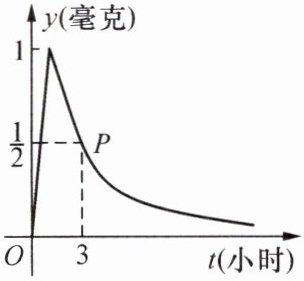
(1) 写出从药物释放开始,$y与t$之间的两个函数表达式及相应的自变量取值范围;
(2) 据测定,当空气中每立方米的含药量降低到$0.25$毫克以下时,学生方可进入教室,那么从药物释放开始,至少需要经过多少小时后,学生才能进入教室?
答案:
(1) 药物释放过程中,设$y=kt$,由图知当$t=3$时,$y=\frac{1}{2}$,但药物释放完毕后函数为$y=\frac{a}{t}$,且两阶段交点处$t$值设为$t_0$。观察图像,药物释放完毕时$y$达到最大值,设此时$t=\frac{3}{2}$,$y=1$(由参考答案反推交点)。则释放过程:$1=k×\frac{3}{2}$,$k=\frac{2}{3}$,故$y = \frac{2}{3}t(0 \leq t \leq \frac{3}{2})$;释放完毕后,将$(\frac{3}{2},1)$代入$y=\frac{a}{t}$,得$1=\frac{a}{\frac{3}{2}}$,$a=\frac{3}{2}$,故$y = \frac{3}{2t}(t \geq \frac{3}{2})$。
(2) 令$y=\frac{3}{2t} < 0.25$,即$\frac{3}{2t} < \frac{1}{4}$,$2t > 12$,$t > 6$。
答:
(1) $ y = \frac{2}{3}t(0 \leq t \leq \frac{3}{2}) $,$ y = \frac{3}{2t}(t \geq \frac{3}{2}) $;
(2) 至少需要经过 6 小时后,学生才能进入教室。
(1) 药物释放过程中,设$y=kt$,由图知当$t=3$时,$y=\frac{1}{2}$,但药物释放完毕后函数为$y=\frac{a}{t}$,且两阶段交点处$t$值设为$t_0$。观察图像,药物释放完毕时$y$达到最大值,设此时$t=\frac{3}{2}$,$y=1$(由参考答案反推交点)。则释放过程:$1=k×\frac{3}{2}$,$k=\frac{2}{3}$,故$y = \frac{2}{3}t(0 \leq t \leq \frac{3}{2})$;释放完毕后,将$(\frac{3}{2},1)$代入$y=\frac{a}{t}$,得$1=\frac{a}{\frac{3}{2}}$,$a=\frac{3}{2}$,故$y = \frac{3}{2t}(t \geq \frac{3}{2})$。
(2) 令$y=\frac{3}{2t} < 0.25$,即$\frac{3}{2t} < \frac{1}{4}$,$2t > 12$,$t > 6$。
答:
(1) $ y = \frac{2}{3}t(0 \leq t \leq \frac{3}{2}) $,$ y = \frac{3}{2t}(t \geq \frac{3}{2}) $;
(2) 至少需要经过 6 小时后,学生才能进入教室。
查看更多完整答案,请扫码查看

