

 搜索
搜索
24. (8 分)已知关于 $ x $ 的一元二次方程 $ kx^{2}+(k + 1)x+\frac{k}{4}=0 $ 有实数根。
(1)求 $ k $ 的取值范围;
(2)是否存在实数 $ k $,使方程有两个不相等的实数根且它们的倒数和为 0?若存在,求出 $ k $ 的值;若不存在,请说明理由。
(1)求 $ k $ 的取值范围;
(2)是否存在实数 $ k $,使方程有两个不相等的实数根且它们的倒数和为 0?若存在,求出 $ k $ 的值;若不存在,请说明理由。
答案:
解:
(1) 由题意,得 $\Delta = (k + 1)^2 - 4k \cdot \frac{k}{4} = 2k + 1 \geq 0$,且 $k \neq 0$,解得 $k \geq -\frac{1}{2}$ 且 $k \neq 0$。
(2) 不存在。理由如下:设方程的两根分别是 $x_1$ 和 $x_2$。由根与系数的关系,得 $x_1 + x_2 = -\frac{k + 1}{k}$,$x_1x_2 = \frac{1}{4}$。$\because \frac{1}{x_1} + \frac{1}{x_2} = \frac{x_1 + x_2}{x_1x_2} = 0$,$\therefore \frac{-\frac{k + 1}{k}}{\frac{1}{4}} = 0$,即 $-\frac{4(k + 1)}{k} = 0$,解得 $k = -1$。经检验,$k = -1$ 是分式方程的解。由
(1)知 $k \geq -\frac{1}{2}$,$\therefore k = -1$ 不符合题意,舍去,$\therefore$ 不存在实数 $k$,使方程有两个不相等的实数根,且它们的倒数和为 0。
(1) 由题意,得 $\Delta = (k + 1)^2 - 4k \cdot \frac{k}{4} = 2k + 1 \geq 0$,且 $k \neq 0$,解得 $k \geq -\frac{1}{2}$ 且 $k \neq 0$。
(2) 不存在。理由如下:设方程的两根分别是 $x_1$ 和 $x_2$。由根与系数的关系,得 $x_1 + x_2 = -\frac{k + 1}{k}$,$x_1x_2 = \frac{1}{4}$。$\because \frac{1}{x_1} + \frac{1}{x_2} = \frac{x_1 + x_2}{x_1x_2} = 0$,$\therefore \frac{-\frac{k + 1}{k}}{\frac{1}{4}} = 0$,即 $-\frac{4(k + 1)}{k} = 0$,解得 $k = -1$。经检验,$k = -1$ 是分式方程的解。由
(1)知 $k \geq -\frac{1}{2}$,$\therefore k = -1$ 不符合题意,舍去,$\therefore$ 不存在实数 $k$,使方程有两个不相等的实数根,且它们的倒数和为 0。
25. (10 分)如图,经过点 $ A(1,0) $ 的直线 $ l $ 与双曲线 $ y=\frac{m}{x}(x>0) $ 交于点 $ B(2,1) $,直线 $ y = 2 $ 分别交双曲线 $ y=\frac{m}{x}(x>0) $ 和 $ y=-\frac{m}{x}(x<0) $ 于点 $ M,N $,交直线 $ l $ 于点 $ P(p,p - 1)(p>1) $,连接 $ BM,AN $。
(1)求 $ m $ 的值及直线 $ l $ 的表达式;
(2)求证:$ BM// AN $。
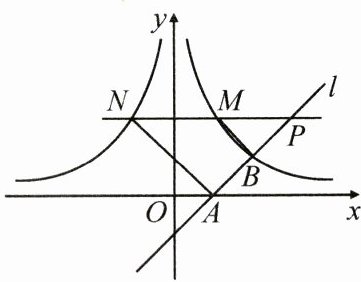
(1)求 $ m $ 的值及直线 $ l $ 的表达式;
(2)求证:$ BM// AN $。
答案:
(1) 解:把点 $B(2, 1)$ 代入 $y = \frac{m}{x}$,得 $m = 2$。设直线 $l$ 的表达式是 $y = kx + b(k \neq 0)$。把点 $A$,$B$ 的坐标代入,得 $\begin{cases} k + b = 0, \\ 2k + b = 1, \end{cases}$ 解得 $\begin{cases} k = 1, \\ b = -1, \end{cases}$ $\therefore$ 直线 $l$ 的表达式是 $y = x - 1$。
(2) 证明:$\because$ 点 $P(p, p - 1)$ 在直线 $y = 2$ 上,$\therefore p - 1 = 2$,解得 $p = 3$,$\therefore$ 点 $P$ 的坐标是 $(3, 2)$。把 $y = 2$ 代入 $y = \frac{2}{x}$,得 $x = 1$,$\therefore$ 点 $M$ 的坐标是 $(1, 2)$,$\therefore PM = 3 - 1 = 2$。把 $y = 2$ 代入 $y = -\frac{2}{x}$,得 $x = -1$,$\therefore$ 点 $N$ 的坐标是 $(-1, 2)$,$\therefore PN = 3 - (-1) = 4$。$\because$ 点 $P$,$A$,$B$ 的坐标分别为 $P(3, 2)$,$A(1, 0)$,$B(2, 1)$,$\therefore PB = \sqrt{(3 - 2)^2 + (2 - 1)^2} = \sqrt{2}$,$PA = \sqrt{(3 - 1)^2 + (2 - 0)^2} = 2\sqrt{2}$,$\therefore \frac{PM}{PN} = \frac{PB}{PA} = \frac{1}{2}$。$\because \angle MPB = \angle NPA$,$\therefore \triangle MPB \sim \triangle NPA$,$\therefore \angle PMB = \angle PNA$,$\therefore BM // AN$。
(1) 解:把点 $B(2, 1)$ 代入 $y = \frac{m}{x}$,得 $m = 2$。设直线 $l$ 的表达式是 $y = kx + b(k \neq 0)$。把点 $A$,$B$ 的坐标代入,得 $\begin{cases} k + b = 0, \\ 2k + b = 1, \end{cases}$ 解得 $\begin{cases} k = 1, \\ b = -1, \end{cases}$ $\therefore$ 直线 $l$ 的表达式是 $y = x - 1$。
(2) 证明:$\because$ 点 $P(p, p - 1)$ 在直线 $y = 2$ 上,$\therefore p - 1 = 2$,解得 $p = 3$,$\therefore$ 点 $P$ 的坐标是 $(3, 2)$。把 $y = 2$ 代入 $y = \frac{2}{x}$,得 $x = 1$,$\therefore$ 点 $M$ 的坐标是 $(1, 2)$,$\therefore PM = 3 - 1 = 2$。把 $y = 2$ 代入 $y = -\frac{2}{x}$,得 $x = -1$,$\therefore$ 点 $N$ 的坐标是 $(-1, 2)$,$\therefore PN = 3 - (-1) = 4$。$\because$ 点 $P$,$A$,$B$ 的坐标分别为 $P(3, 2)$,$A(1, 0)$,$B(2, 1)$,$\therefore PB = \sqrt{(3 - 2)^2 + (2 - 1)^2} = \sqrt{2}$,$PA = \sqrt{(3 - 1)^2 + (2 - 0)^2} = 2\sqrt{2}$,$\therefore \frac{PM}{PN} = \frac{PB}{PA} = \frac{1}{2}$。$\because \angle MPB = \angle NPA$,$\therefore \triangle MPB \sim \triangle NPA$,$\therefore \angle PMB = \angle PNA$,$\therefore BM // AN$。
查看更多完整答案,请扫码查看

