

 搜索
搜索
第29页
- 第1页
- 第2页
- 第3页
- 第4页
- 第5页
- 第6页
- 第7页
- 第8页
- 第9页
- 第10页
- 第11页
- 第12页
- 第13页
- 第14页
- 第15页
- 第16页
- 第17页
- 第18页
- 第19页
- 第20页
- 第21页
- 第22页
- 第23页
- 第24页
- 第25页
- 第26页
- 第27页
- 第28页
- 第29页
- 第30页
- 第31页
- 第32页
- 第33页
- 第34页
- 第35页
- 第36页
- 第37页
- 第38页
- 第39页
- 第40页
- 第41页
- 第42页
- 第43页
- 第44页
- 第45页
- 第46页
- 第47页
- 第48页
- 第49页
- 第50页
- 第51页
- 第52页
- 第53页
- 第54页
- 第55页
- 第56页
- 第57页
- 第58页
- 第59页
- 第60页
- 第61页
- 第62页
- 第63页
- 第64页
- 第65页
- 第66页
- 第67页
- 第68页
- 第69页
- 第70页
- 第71页
- 第72页
- 第73页
- 第74页
- 第75页
- 第76页
- 第77页
- 第78页
- 第79页
- 第80页
- 第81页
- 第82页
- 第83页
- 第84页
- 第85页
- 第86页
- 第87页
- 第88页
- 第89页
- 第90页
- 第91页
- 第92页
- 第93页
- 第94页
- 第95页
- 第96页
- 第97页
- 第98页
- 第99页
- 第100页
- 第101页
- 第102页
- 第103页
- 第104页
- 第105页
- 第106页
- 第107页
- 第108页
- 第109页
- 第110页
- 第111页
- 第112页
- 第113页
- 第114页
- 第115页
- 第116页
- 第117页
- 第118页
- 第119页
- 第120页
- 第121页
- 第122页
- 第123页
- 第124页
- 第125页
- 第126页
- 第127页
- 第128页
- 第129页
- 第130页
- 第131页
- 第132页
- 第133页
- 第134页
- 第135页
- 第136页
- 第137页
- 第138页
- 第139页
- 第140页
- 第141页
- 第142页
- 第143页
- 第144页
3. 如图,在四边形ABCD中,$∠B= ∠C,AB= 20cm,BC= 15cm$,点E为AB的中点,如果点P在线段BC上以5 cm/s的速度由点B向点C运动,同时,点Q在线段CD上由点C向点D运动.
(1)若点Q的运动速度与点P的运动速度相等,经过1s后,$△BPE与△CQP$是否全等?请说明理由.
(2)若点Q的运动速度与点P的运动速度不相等,当点Q的运动速度为多少时,某时刻能够使$△BPE与△CQP$全等?
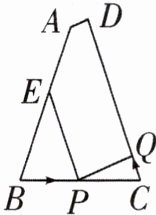
(1)若点Q的运动速度与点P的运动速度相等,经过1s后,$△BPE与△CQP$是否全等?请说明理由.
(2)若点Q的运动速度与点P的运动速度不相等,当点Q的运动速度为多少时,某时刻能够使$△BPE与△CQP$全等?
答案:
(1) $ \triangle BPE $ 与 $ \triangle CQP $ 全等。理由如下:$\because $ 点 $ E $ 为 $ AB $ 的中点,$ AB = 20 \text{ cm} $,$\therefore BE = \frac{1}{2}AB = \frac{1}{2} \times 20 = 10 (\text{cm}) $。$\because $ 点 $ P $,$ Q $ 的速度都是 $ 5 \text{ cm/s} $,$\therefore $ 经过 $ 1 \text{ s} $ 后,$ BP = 5 \text{ cm} $,$ PC = BC - BP = 15 - 5 = 10 (\text{cm}) $,$ CQ = 5 \text{ cm} $。在 $ \triangle BPE $ 与 $ \triangle CQP $ 中,$\begin{cases} BE = CP, \\ \angle B = \angle C, \\ BP = CQ, \end{cases}$ $\therefore \triangle BPE \cong \triangle CQP (SAS) $。
(2) $ \triangle BPE $ 与 $ \triangle CQP $ 全等时,① 若 $ CQ = BE = 10 \text{ cm} $,则 $ BP = CP = 7.5 \text{ cm} $,点 $ Q $ 的运动速度为 $ v_Q = 10 \div (7.5 \div 5) = \frac{20}{3} (\text{cm/s}) $;② 若 $ CP = BE = 10 \text{ cm} $,$ BP = CQ = 5 \text{ cm} $,点 $ Q $ 的运动速度为 $ v_Q = 5 \div (5 \div 5) = 5 (\text{cm/s}) $。$\because $ 点 $ Q $ 的运动速度与点 $ P $ 的运动速度不相等,$\therefore v_Q = 5 \text{ cm/s} $ 舍去,$\therefore $ 点 $ Q $ 的运动速度为 $ \frac{20}{3} \text{ cm/s} $ 时,能够使 $ \triangle BPE $ 与 $ \triangle CQP $ 全等。
(1) $ \triangle BPE $ 与 $ \triangle CQP $ 全等。理由如下:$\because $ 点 $ E $ 为 $ AB $ 的中点,$ AB = 20 \text{ cm} $,$\therefore BE = \frac{1}{2}AB = \frac{1}{2} \times 20 = 10 (\text{cm}) $。$\because $ 点 $ P $,$ Q $ 的速度都是 $ 5 \text{ cm/s} $,$\therefore $ 经过 $ 1 \text{ s} $ 后,$ BP = 5 \text{ cm} $,$ PC = BC - BP = 15 - 5 = 10 (\text{cm}) $,$ CQ = 5 \text{ cm} $。在 $ \triangle BPE $ 与 $ \triangle CQP $ 中,$\begin{cases} BE = CP, \\ \angle B = \angle C, \\ BP = CQ, \end{cases}$ $\therefore \triangle BPE \cong \triangle CQP (SAS) $。
(2) $ \triangle BPE $ 与 $ \triangle CQP $ 全等时,① 若 $ CQ = BE = 10 \text{ cm} $,则 $ BP = CP = 7.5 \text{ cm} $,点 $ Q $ 的运动速度为 $ v_Q = 10 \div (7.5 \div 5) = \frac{20}{3} (\text{cm/s}) $;② 若 $ CP = BE = 10 \text{ cm} $,$ BP = CQ = 5 \text{ cm} $,点 $ Q $ 的运动速度为 $ v_Q = 5 \div (5 \div 5) = 5 (\text{cm/s}) $。$\because $ 点 $ Q $ 的运动速度与点 $ P $ 的运动速度不相等,$\therefore v_Q = 5 \text{ cm/s} $ 舍去,$\therefore $ 点 $ Q $ 的运动速度为 $ \frac{20}{3} \text{ cm/s} $ 时,能够使 $ \triangle BPE $ 与 $ \triangle CQP $ 全等。
4. (2024·镇江期中)如图,AE与BD相交于点C,$AC= EC,BC= DC,AB= 4cm$,点P从点A出发,沿$A→B→A$方向以3 cm/s的速度运动,点Q从点D出发,沿$D→E$方向以1 cm/s的速度运动,P,Q两点同时出发.当点P到达点A时,P,Q两点同时停止运动.设点P的运动时间为$t(s).$
(1)求证:$AB// DE;$
(2)写出线段AP的长(用含t的式子表示);
(3)连接PQ,当线段PQ经过点C时,求t的值.
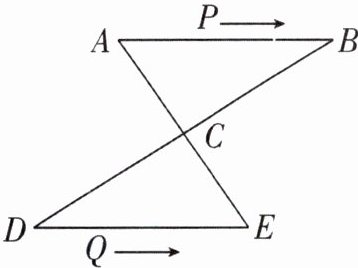
(1)求证:$AB// DE;$
(2)写出线段AP的长(用含t的式子表示);
(3)连接PQ,当线段PQ经过点C时,求t的值.
答案:
(1) 在 $ \triangle ABC $ 和 $ \triangle EDC $ 中,$\begin{cases} AC = EC, \\ \angle ACB = \angle ECD, \\ BC = DC, \end{cases}$ $\therefore \triangle ABC \cong \triangle EDC (SAS)$,$\therefore \angle A = \angle E $,$ AB = DE = 4 \text{ cm} $,$\therefore AB // DE $。
(2) 当 $ 0 \leq t \leq \frac{4}{3} $ 时,$ AP = 3t \text{ cm} $;当 $ \frac{4}{3} < t \leq \frac{8}{3} $ 时,$ BP = (3t - 4) \text{ cm} $,则 $ AP = 4 - (3t - 4) = (8 - 3t) \text{ cm} $。
(3) 如图,由
(1) 得,$ \angle A = \angle E $,$ ED = AB = 4 \text{ cm} $,在 $ \triangle ACP $ 和 $ \triangle ECQ $ 中,$\begin{cases} \angle A = \angle E, \\ AC = EC, \\ \angle ACP = \angle ECQ, \end{cases}$ $\therefore \triangle ACP \cong \triangle ECQ (ASA)$,$\therefore AP = EQ $。当 $ 0 \leq t \leq \frac{4}{3} $ 时,$ 3t = 4 - t $,解得 $ t = 1 $;当 $ \frac{4}{3} < t \leq \frac{8}{3} $ 时,$ 8 - 3t = 4 - t $,解得 $ t = 2 $。综上所述,当线段 $ PQ $ 经过点 $ C $ 时,$ t $ 的值为 1 或 2。
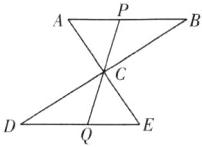
(1) 在 $ \triangle ABC $ 和 $ \triangle EDC $ 中,$\begin{cases} AC = EC, \\ \angle ACB = \angle ECD, \\ BC = DC, \end{cases}$ $\therefore \triangle ABC \cong \triangle EDC (SAS)$,$\therefore \angle A = \angle E $,$ AB = DE = 4 \text{ cm} $,$\therefore AB // DE $。
(2) 当 $ 0 \leq t \leq \frac{4}{3} $ 时,$ AP = 3t \text{ cm} $;当 $ \frac{4}{3} < t \leq \frac{8}{3} $ 时,$ BP = (3t - 4) \text{ cm} $,则 $ AP = 4 - (3t - 4) = (8 - 3t) \text{ cm} $。
(3) 如图,由
(1) 得,$ \angle A = \angle E $,$ ED = AB = 4 \text{ cm} $,在 $ \triangle ACP $ 和 $ \triangle ECQ $ 中,$\begin{cases} \angle A = \angle E, \\ AC = EC, \\ \angle ACP = \angle ECQ, \end{cases}$ $\therefore \triangle ACP \cong \triangle ECQ (ASA)$,$\therefore AP = EQ $。当 $ 0 \leq t \leq \frac{4}{3} $ 时,$ 3t = 4 - t $,解得 $ t = 1 $;当 $ \frac{4}{3} < t \leq \frac{8}{3} $ 时,$ 8 - 3t = 4 - t $,解得 $ t = 2 $。综上所述,当线段 $ PQ $ 经过点 $ C $ 时,$ t $ 的值为 1 或 2。
5. (2025·无锡期中)如图①,$AB= 4cm,AC⊥AB,BD⊥AB,AC= BD= 3cm$.点P在线段AB上以1 cm/s的速度由点A向点B运动,同时,点Q在线段BD上由点B向点D运动.它们运动的时间为$t(s).$
(1)若点Q的运动速度与点P的运动速度相等,当$t= 1$时,$△ACP与△BPQ$是否全等? 请说明理由,并判断此时线段PC和线段PQ的位置关系.
(2)如图②,将图①中的“$AC⊥AB,BD⊥AB$”改为“$∠CAB= ∠DBA= 60^{\circ }$”,其他条件不变.设点Q的运动速度为x cm/s,是否存在x,使得$△ACP与△BPQ$全等? 若存在,求出相应的x,t的值;若不存在,请说明理由.
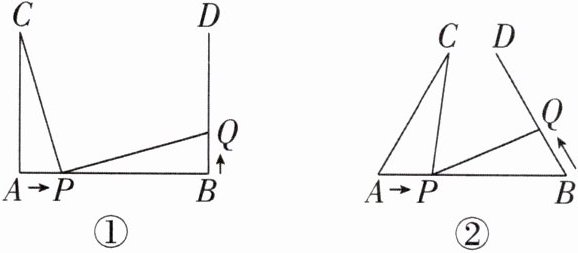
(1)若点Q的运动速度与点P的运动速度相等,当$t= 1$时,$△ACP与△BPQ$是否全等? 请说明理由,并判断此时线段PC和线段PQ的位置关系.
(2)如图②,将图①中的“$AC⊥AB,BD⊥AB$”改为“$∠CAB= ∠DBA= 60^{\circ }$”,其他条件不变.设点Q的运动速度为x cm/s,是否存在x,使得$△ACP与△BPQ$全等? 若存在,求出相应的x,t的值;若不存在,请说明理由.
答案:
(1) $ \triangle ACP \cong \triangle BPQ $,且 $ PC \perp PQ $。理由如下:当 $ t = 1 $ 时,$ AP = BQ = 1 \text{ cm} $,$ BP = AC = 3 \text{ cm} $。$\because AC \perp AB $,$ BD \perp AB $,$\therefore \angle A = \angle B = 90^\circ $。在 $ \triangle ACP $ 和 $ \triangle BPQ $ 中,$\begin{cases} AP = BQ, \\ \angle A = \angle B, \\ AC = BP, \end{cases}$ $\therefore \triangle ACP \cong \triangle BPQ (SAS)$,$\therefore \angle ACP = \angle BPQ $,$\therefore \angle APC + \angle BPQ = \angle APC + \angle ACP = 90^\circ $,$\therefore \angle CPQ = 90^\circ $,即 $ PC \perp PQ $。
(2) 存在满足条件的 $ x $ 值及相应的 $ t $ 值。① 若 $ \triangle ACP \cong \triangle BPQ $,则 $ AC = BP $,$ AP = BQ $。可得 $ \begin{cases} 3 = 4 - t, \\ t = xt, \end{cases} $ 解得 $ \begin{cases} t = 1, \\ x = 1. \end{cases} $ ② 若 $ \triangle ACP \cong \triangle BQP $,则 $ AC = BQ $,$ AP = BP $,可得 $ \begin{cases} 3 = xt, \\ t = 4 - t. \end{cases} $ 解得 $ \begin{cases} t = 2, \\ x = 1.5. \end{cases} $ 综上所述,存在 $ t = 1 $,$ x = 1 $ 或 $ t = 2 $,$ x = 1.5 $,使得 $ \triangle ACP $ 与 $ \triangle BPQ $ 全等。
(1) $ \triangle ACP \cong \triangle BPQ $,且 $ PC \perp PQ $。理由如下:当 $ t = 1 $ 时,$ AP = BQ = 1 \text{ cm} $,$ BP = AC = 3 \text{ cm} $。$\because AC \perp AB $,$ BD \perp AB $,$\therefore \angle A = \angle B = 90^\circ $。在 $ \triangle ACP $ 和 $ \triangle BPQ $ 中,$\begin{cases} AP = BQ, \\ \angle A = \angle B, \\ AC = BP, \end{cases}$ $\therefore \triangle ACP \cong \triangle BPQ (SAS)$,$\therefore \angle ACP = \angle BPQ $,$\therefore \angle APC + \angle BPQ = \angle APC + \angle ACP = 90^\circ $,$\therefore \angle CPQ = 90^\circ $,即 $ PC \perp PQ $。
(2) 存在满足条件的 $ x $ 值及相应的 $ t $ 值。① 若 $ \triangle ACP \cong \triangle BPQ $,则 $ AC = BP $,$ AP = BQ $。可得 $ \begin{cases} 3 = 4 - t, \\ t = xt, \end{cases} $ 解得 $ \begin{cases} t = 1, \\ x = 1. \end{cases} $ ② 若 $ \triangle ACP \cong \triangle BQP $,则 $ AC = BQ $,$ AP = BP $,可得 $ \begin{cases} 3 = xt, \\ t = 4 - t. \end{cases} $ 解得 $ \begin{cases} t = 2, \\ x = 1.5. \end{cases} $ 综上所述,存在 $ t = 1 $,$ x = 1 $ 或 $ t = 2 $,$ x = 1.5 $,使得 $ \triangle ACP $ 与 $ \triangle BPQ $ 全等。
查看更多完整答案,请扫码查看

