

 搜索
搜索
第36页
- 第1页
- 第2页
- 第3页
- 第4页
- 第5页
- 第6页
- 第7页
- 第8页
- 第9页
- 第10页
- 第11页
- 第12页
- 第13页
- 第14页
- 第15页
- 第16页
- 第17页
- 第18页
- 第19页
- 第20页
- 第21页
- 第22页
- 第23页
- 第24页
- 第25页
- 第26页
- 第27页
- 第28页
- 第29页
- 第30页
- 第31页
- 第32页
- 第33页
- 第34页
- 第35页
- 第36页
- 第37页
- 第38页
- 第39页
- 第40页
- 第41页
- 第42页
- 第43页
- 第44页
- 第45页
- 第46页
- 第47页
- 第48页
- 第49页
- 第50页
- 第51页
- 第52页
- 第53页
- 第54页
- 第55页
- 第56页
- 第57页
- 第58页
- 第59页
- 第60页
- 第61页
- 第62页
- 第63页
- 第64页
- 第65页
- 第66页
- 第67页
- 第68页
- 第69页
- 第70页
- 第71页
- 第72页
- 第73页
- 第74页
- 第75页
- 第76页
- 第77页
- 第78页
- 第79页
- 第80页
- 第81页
- 第82页
- 第83页
- 第84页
- 第85页
- 第86页
- 第87页
- 第88页
- 第89页
- 第90页
- 第91页
- 第92页
- 第93页
- 第94页
- 第95页
- 第96页
- 第97页
- 第98页
- 第99页
- 第100页
- 第101页
- 第102页
- 第103页
- 第104页
- 第105页
- 第106页
- 第107页
- 第108页
- 第109页
- 第110页
- 第111页
- 第112页
- 第113页
- 第114页
- 第115页
- 第116页
- 第117页
- 第118页
- 第119页
- 第120页
- 第121页
- 第122页
- 第123页
- 第124页
- 第125页
- 第126页
- 第127页
- 第128页
- 第129页
- 第130页
- 第131页
- 第132页
- 第133页
- 第134页
- 第135页
- 第136页
- 第137页
- 第138页
- 第139页
- 第140页
- 第141页
- 第142页
- 第143页
- 第144页
- 第145页
- 第146页
- 第147页
- 第148页
- 第149页
- 第150页
- 第151页
一、完形填空(每小题1分,满分10分)
Captain James Cook was a great explorer(探险家). Before he 1 exploring, maps of the Pacific Ocean(太平洋) were almost empty. He 2 hundreds of islands across the Pacific Ocean and put them in the 3 places on the map. He made maps of the coastlines of Australia and New Zealand.
James Cook was born in England in 1728. His parents were poor farm workers. When James was 18, he found a 4 on a coastal ship for John Walker. He got his first taste for sailing as a navy apprentice(海军学徒) with Walker's small ship. Cook studied Maths, navigation, and astronomy. These were skills that would be 5 if he were to command his own ship. In 1755, Walker offered him the command(掌控) of his own ship, but he didn't 6 this chance. When he was 27 years old, he 7 the Royal navy. He fought in Canada in a war against France, and he mapped some of the eastern coasts of Canada. In 1768, King George made him Captain of a ship and sent him to the Pacific. Nearly three years later, he returned and was seen as a national 8 .
He started his third voyage in 1776. He was the first 9 to visit Hawaii. Then, he mapped the western coast of North America. After that he returned to Hawaii. 10 , there was some trouble between the Hawaiians and the white men. Cook was killed in a fight against the local.
( )1. A. minded B. stopped C. enjoyed D. started
( )2. A. visited B. realized C. spread D. returned
( )3. A. personal B. correct C. wrong D. careful
( )4. A. model B. help C. job D. studio
( )5. A. usual B. medical C. popular D. necessary
( )6. A. return B. complete C. accept D. lose
( )7. A. told B. passed C. joined D. found
( )8. A. hero B. policeman C. volunteer D. manage
( )9. A. African B. Asian C. American D. European
( )10. A. Happily B. Particularly C. Unluckily D. Amazingly
Captain James Cook was a great explorer(探险家). Before he 1 exploring, maps of the Pacific Ocean(太平洋) were almost empty. He 2 hundreds of islands across the Pacific Ocean and put them in the 3 places on the map. He made maps of the coastlines of Australia and New Zealand.
James Cook was born in England in 1728. His parents were poor farm workers. When James was 18, he found a 4 on a coastal ship for John Walker. He got his first taste for sailing as a navy apprentice(海军学徒) with Walker's small ship. Cook studied Maths, navigation, and astronomy. These were skills that would be 5 if he were to command his own ship. In 1755, Walker offered him the command(掌控) of his own ship, but he didn't 6 this chance. When he was 27 years old, he 7 the Royal navy. He fought in Canada in a war against France, and he mapped some of the eastern coasts of Canada. In 1768, King George made him Captain of a ship and sent him to the Pacific. Nearly three years later, he returned and was seen as a national 8 .
He started his third voyage in 1776. He was the first 9 to visit Hawaii. Then, he mapped the western coast of North America. After that he returned to Hawaii. 10 , there was some trouble between the Hawaiians and the white men. Cook was killed in a fight against the local.
( )1. A. minded B. stopped C. enjoyed D. started
( )2. A. visited B. realized C. spread D. returned
( )3. A. personal B. correct C. wrong D. careful
( )4. A. model B. help C. job D. studio
( )5. A. usual B. medical C. popular D. necessary
( )6. A. return B. complete C. accept D. lose
( )7. A. told B. passed C. joined D. found
( )8. A. hero B. policeman C. volunteer D. manage
( )9. A. African B. Asian C. American D. European
( )10. A. Happily B. Particularly C. Unluckily D. Amazingly
答案:
答案速递
完形填空 1~5 DABCD 6~10 CCADC
一、完形填空
【文章大意】本文是一篇记叙文,主要讲述了英国著名的探险家和航海家詹姆斯·库克的人生经历。
1. D 根据“He 2 hundreds of islands across the Pacific Ocean and put them in the 3 places on the map. He made maps of the coastlines of Australia and New Zealand.”可知,库克到过太平洋的很多岛屿,并把这些地方画在了地图上,他绘制了澳大利亚和新西兰的海岸线,由此可推断他开始探险之前,关于太平洋的地图几乎是空白的。故选D。
2. A 根据下文“He made maps of the coastlines of Australia and New Zealand.”可推断出,他到过这些地方。故选A。
3. B 根据下文“He made maps of the coastlines of Australia and New Zealand.”可推断出,他把地点标在了地图的正确位置上。故选B。
4. C 根据下文“He got his first taste for sailing as a navy apprentice with Walker's small ship.”可知,他找到了一份在船上的工作,并且后来得到了一次驾船出海的机会。故选C。
5. D 根据上文“Cook studied Maths, navigation, and astronomy.”可知,这些技能对驾船出海是必要的。故选D。
6. C 根据“but he didn't”和下文“When he was 27 years old, he 7 the Royal navy.”可知,他没有接受这个机会。故选C。
7. C 根据下文“He fought in Canada in a war against France, and he mapped some of the eastern coasts of Canada. In 1768, King George made him Captain of a ship and sent him to the Pacific.”可知,他加入了皇家海军。故选C。
8. A 根据“He fought in Canada in a war against France, and he mapped some of the eastern coasts of Canada. In 1768, King George made him Captain of a ship and sent him to the Pacific.”可知,他对国家是做出了贡献的,所以应该是被视为英雄。故选A。
9. D 根据第二段第一句“James Cook was born in England in 1728.”可知,库克是欧洲人。故选D。
10. C 根据最后一句话“Cook was killed in a fight against the local.”可知,此处指不幸的事情发生了。故选C。
完形填空 1~5 DABCD 6~10 CCADC
一、完形填空
【文章大意】本文是一篇记叙文,主要讲述了英国著名的探险家和航海家詹姆斯·库克的人生经历。
1. D 根据“He 2 hundreds of islands across the Pacific Ocean and put them in the 3 places on the map. He made maps of the coastlines of Australia and New Zealand.”可知,库克到过太平洋的很多岛屿,并把这些地方画在了地图上,他绘制了澳大利亚和新西兰的海岸线,由此可推断他开始探险之前,关于太平洋的地图几乎是空白的。故选D。
2. A 根据下文“He made maps of the coastlines of Australia and New Zealand.”可推断出,他到过这些地方。故选A。
3. B 根据下文“He made maps of the coastlines of Australia and New Zealand.”可推断出,他把地点标在了地图的正确位置上。故选B。
4. C 根据下文“He got his first taste for sailing as a navy apprentice with Walker's small ship.”可知,他找到了一份在船上的工作,并且后来得到了一次驾船出海的机会。故选C。
5. D 根据上文“Cook studied Maths, navigation, and astronomy.”可知,这些技能对驾船出海是必要的。故选D。
6. C 根据“but he didn't”和下文“When he was 27 years old, he 7 the Royal navy.”可知,他没有接受这个机会。故选C。
7. C 根据下文“He fought in Canada in a war against France, and he mapped some of the eastern coasts of Canada. In 1768, King George made him Captain of a ship and sent him to the Pacific.”可知,他加入了皇家海军。故选C。
8. A 根据“He fought in Canada in a war against France, and he mapped some of the eastern coasts of Canada. In 1768, King George made him Captain of a ship and sent him to the Pacific.”可知,他对国家是做出了贡献的,所以应该是被视为英雄。故选A。
9. D 根据第二段第一句“James Cook was born in England in 1728.”可知,库克是欧洲人。故选D。
10. C 根据最后一句话“Cook was killed in a fight against the local.”可知,此处指不幸的事情发生了。故选C。
二、阅读理解(每小题2分,满分30分)
A
A Versailles Bike Tour
Take a tour of Versailles in a different way—by bicycle! It's the only way to see Versailles' large gardens and you'll get to see the beauty of Versailles that most visitors miss.
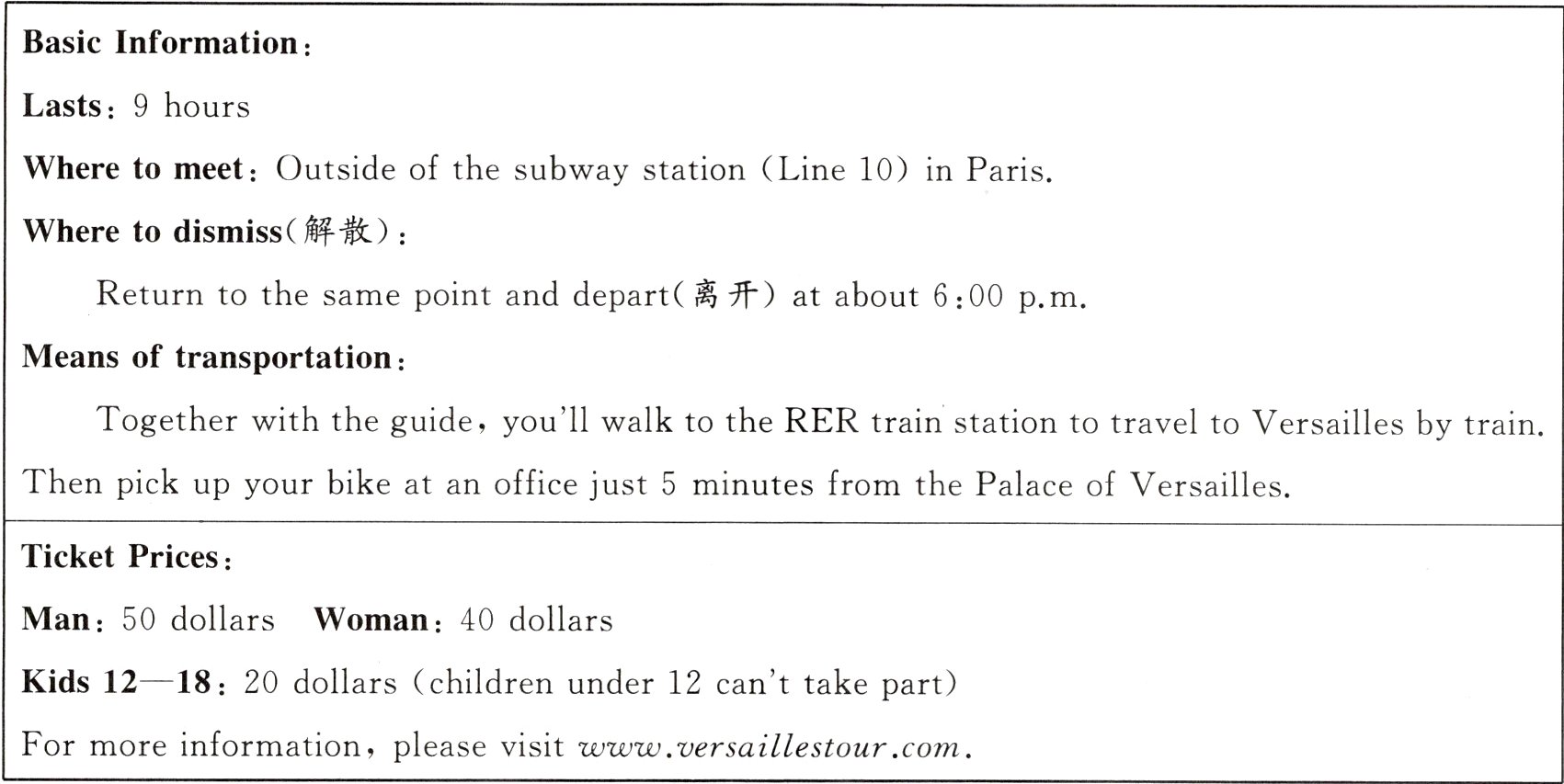
Basic Information:
Lasts: 9 hours
Where to meet: Outside of the subway station (Line 10) in Paris.
Where to dismiss(解散):
Return to the same point and depart(离开) at about 6:00 p.m.
Means of transportation:
Together with the guide, you'll walk to the RER train station to travel to Versailles by train. Then pick up your bike at an office just 5 minutes from the Palace of Versailles.
Ticket Prices:
Man: 50 dollars Woman: 40 dollars
Kids 12—18: 20 dollars (children under 12 can't take part)
For more information, please visit www.versaillestour.com .

( )11. When should the visitors and tour guide meet at the subway station?
A. At about 9:00 a.m.
B. At about 11:00 a.m.
C. At about 1:00 p.m.
D. At about 9:00 p.m.
( )12. If 14 - year - old John and his parents take part in the Versailles bike tour, how much will they spend?
A. 60 dollars.
B. 70 dollars.
C. 110 dollars.
D. 120 dollars.
( )13. What is the theme of the passage?
A. History.
B. News.
C. Travel.
D. Culture.
B
The 30th Beijing International Book Fair wrapped up(结束) on Sunday, after five exciting days. It brought together 1,600 exhibitors(展出者) from 71 different countries and regions, showing off 220,000 amazing books in both Chinese and other languages.
This huge book fair, which is the second biggest in the world, had over 1,000 fun cultural events. People reached over 2,100 agreements or plans to share book rights between countries. It helped Chinese culture reach a wider audience and made it easier for different civilizations to learn from each other.
Chinese publishing houses showcased books that tell the story of China's growth, successes, and rich heritage(遗产;传统). Zhao Jianying, the head of China Social Sciences Press, said they wanted these books to give the world a colourful and lively picture of China.
The fair also gave Chinese and foreign publishers, writers, and translators a chance to talk and learn from each other. They discussed how books can help people from different cultures understand and respect each other better.
More than 20 countries set up special booths to show their books and cultures. Saudi Arabia, the special guest this year, used colourful displays to show off its ancient and thriving culture.
With book tours, meetings with writers, and translator cafes, the fair offered many ways for visitors to enjoy and learn about different civilizations. Nearly 300,000 people came to the fair, making strong connections between China's publishing world and the rest of the world. It was a great example of how sharing books and ideas can bring cultures closer together and promote(促进) shared prosperity(繁荣).
( )14. What do we know about the 30th Beijing International Book Fair from the passage?
A. It was the biggest book fair ever.
B. It didn't help anyone learn about other cultures.
C. Only books in Chinese were shown at the fair.
D. Many people from different countries came to see books.
( )15. What kind of books does Zhao Jianying think China wants to share with the world?
A. Books about Chinese food.
B. Books about Chinese story.
C. Books about Chinese technology.
D. Books about Chinese culture.
( )16. In Paragraph 5, the underlined word “booths” means “ ” in Chinese.
A. 展位
B. 建筑
C. 设施
D. 系统
( )17. What is the main contribution of the book fair?
A. It encourages the arrival of tourists and the development of the tourism industry.
B. It allows writers to communicate with each other, inspiring their creativity.
C. It strengthens international publishing connections, promotes cultural development.
D. It greatly increases people's interest in reading different books.
C
Traditionally, tourists like to make use of every second of the day. They rush from one place to another. When they finally get to their hotel rooms at night, they often find it hard to sleep though they are tired. Most city hotels may be in the city centre. But it usually also means noisy traffic and bright streetlights. As a result, many people simply do not sleep well in these hotels.
To solve this problem, many hotels are offering special sleep suites(套间). These suites are made to provide quietness and darkness. Some hotels are even buying smart beds for these suites. They can not only help users relax their bodies but also record their sleep.
In addition, many hotels use other ways to help people sleep better. Some provide a menu of relaxing teas. Others offer services such as massages(按摩) after meals.
Some sleep scientists believe these sleep suites are a result of the pandemic(流行病) in the past. In those days, many people had trouble sleeping because of illness and worries. So after the pandemic, hotels have paid more attention to sleep problems.
Sleep suites are a huge step forward for the travel industry. Only when we are well rested while travelling can we feel more relaxed after we return home!
( )18. Why do some people have trouble sleeping when they travel?
A. Because they don't have time to sleep.
B. Because they often meet traffic jams.
C. Because it's hard for them to find a hotel.
D. Because they choose hotels in the city centre.
( )19. What is offered in special sleep suites to solve sleeping problem?
A. Bright lights.
B. Menus of fruits.
C. Smart beds.
D. Massages before meals.
( )20. What is the fourth paragraph mainly about?
A. Why hotels make a change.
B. When scientists ended the pandemic.
C. How sleeping troubles happen.
D. What people are worrying about.
( )21. Which of the following opinions may come from the writer?
A. Never have massages in a city hotel.
B. Try to record your sleeping time when travelling.
C. Hotels should keep improving sleeping environment.
D. Scientists need to solve sleeping problems for everyone.
D
Finally, in March of 1703, the Adventure set sail for India. The winds were good until we got near Madagascar, an island off the east coast of Africa. Then a strong wind began to blow. We were trapped in the wind for twenty days. After many hours, the wind finally stopped and the sea became quieter. The storm had blown the Adventure hundreds of kilometres to the east.
“Where are we?” I asked the captain(船长).
“I can't tell for sure,” he said. “We are running out of water. We must reach land soon to fill our water barrels(桶).” Many days passed and we saw nothing but the sea. One morning, before everyone died of thirst, a sailor cried out, “Land!” Everyone on the ship was silent for a second. And quickly the ship sailed closer to the land. The sailors suddenly became ▲ and all cheered.
“You men,” said the captain to the sailors, “take the rowboats(划艇) and go. Fill the water barrels with fresh water.”
“Captain,” I said, “may I go with them to take a look at this place?”
“Of course,” he replied. “You can tell me later what it is like.”
When the rowboats reached the coast, one of the sailors said, “We will have to walk along the coast to look for fresh water.”
“I'm going to take a little walk,” I told them. “I will meet you back here in an hour.”
I walked about a kilometre, enjoying being on land again. Then I turned and walked back to meet the sailors.
When I arrived on the beach, the sailors were not there. They were in the rowboats, rowing as fast as they could towards the Adventure. I was going to shout out to them when I saw a very huge man walking through the sea. I was trying to catch up with the rowboats. The sailors were almost at the ship, and I could see that the huge man would not be able to catch them. Instead, it was coming towards me. Great fear went through my mind.
( )22. What happened when they got near the east coast of Africa?
A. They decided to set sail for India.
B. The captain lost his sense of direction.
C. A storm came and blew the ship heavily.
D. The captain couldn't tell where they were.
( )23. Which of the following is most suitable to fill in “ ▲ ”?
A. sad
B. excited
C. bored
D. relaxed
( )24. Why did the writer get off the ship after reaching the land?
A. Because he planned to help get fresh water for everyone.
B. Because he got tired of travelling and decided to live on the land.
C. Because he wanted to take a walk and look around.
D. Because he was looking for the huge man on the land.
( )25. What would most probably happen next?
A. The writer saw the sailors were caught by the huge man.
B. The sailors failed to get on the ship because it was too far away.
C. The writer tried to run away as fast as possible.
D. The huge man caught the captain and controlled the ship.
A
A Versailles Bike Tour
Take a tour of Versailles in a different way—by bicycle! It's the only way to see Versailles' large gardens and you'll get to see the beauty of Versailles that most visitors miss.
Basic Information:
Lasts: 9 hours
Where to meet: Outside of the subway station (Line 10) in Paris.
Where to dismiss(解散):
Return to the same point and depart(离开) at about 6:00 p.m.
Means of transportation:
Together with the guide, you'll walk to the RER train station to travel to Versailles by train. Then pick up your bike at an office just 5 minutes from the Palace of Versailles.
Ticket Prices:
Man: 50 dollars Woman: 40 dollars
Kids 12—18: 20 dollars (children under 12 can't take part)
For more information, please visit www.versaillestour.com .
( )11. When should the visitors and tour guide meet at the subway station?
A. At about 9:00 a.m.
B. At about 11:00 a.m.
C. At about 1:00 p.m.
D. At about 9:00 p.m.
( )12. If 14 - year - old John and his parents take part in the Versailles bike tour, how much will they spend?
A. 60 dollars.
B. 70 dollars.
C. 110 dollars.
D. 120 dollars.
( )13. What is the theme of the passage?
A. History.
B. News.
C. Travel.
D. Culture.
B
The 30th Beijing International Book Fair wrapped up(结束) on Sunday, after five exciting days. It brought together 1,600 exhibitors(展出者) from 71 different countries and regions, showing off 220,000 amazing books in both Chinese and other languages.
This huge book fair, which is the second biggest in the world, had over 1,000 fun cultural events. People reached over 2,100 agreements or plans to share book rights between countries. It helped Chinese culture reach a wider audience and made it easier for different civilizations to learn from each other.
Chinese publishing houses showcased books that tell the story of China's growth, successes, and rich heritage(遗产;传统). Zhao Jianying, the head of China Social Sciences Press, said they wanted these books to give the world a colourful and lively picture of China.
The fair also gave Chinese and foreign publishers, writers, and translators a chance to talk and learn from each other. They discussed how books can help people from different cultures understand and respect each other better.
More than 20 countries set up special booths to show their books and cultures. Saudi Arabia, the special guest this year, used colourful displays to show off its ancient and thriving culture.
With book tours, meetings with writers, and translator cafes, the fair offered many ways for visitors to enjoy and learn about different civilizations. Nearly 300,000 people came to the fair, making strong connections between China's publishing world and the rest of the world. It was a great example of how sharing books and ideas can bring cultures closer together and promote(促进) shared prosperity(繁荣).
( )14. What do we know about the 30th Beijing International Book Fair from the passage?
A. It was the biggest book fair ever.
B. It didn't help anyone learn about other cultures.
C. Only books in Chinese were shown at the fair.
D. Many people from different countries came to see books.
( )15. What kind of books does Zhao Jianying think China wants to share with the world?
A. Books about Chinese food.
B. Books about Chinese story.
C. Books about Chinese technology.
D. Books about Chinese culture.
( )16. In Paragraph 5, the underlined word “booths” means “ ” in Chinese.
A. 展位
B. 建筑
C. 设施
D. 系统
( )17. What is the main contribution of the book fair?
A. It encourages the arrival of tourists and the development of the tourism industry.
B. It allows writers to communicate with each other, inspiring their creativity.
C. It strengthens international publishing connections, promotes cultural development.
D. It greatly increases people's interest in reading different books.
C
Traditionally, tourists like to make use of every second of the day. They rush from one place to another. When they finally get to their hotel rooms at night, they often find it hard to sleep though they are tired. Most city hotels may be in the city centre. But it usually also means noisy traffic and bright streetlights. As a result, many people simply do not sleep well in these hotels.
To solve this problem, many hotels are offering special sleep suites(套间). These suites are made to provide quietness and darkness. Some hotels are even buying smart beds for these suites. They can not only help users relax their bodies but also record their sleep.
In addition, many hotels use other ways to help people sleep better. Some provide a menu of relaxing teas. Others offer services such as massages(按摩) after meals.
Some sleep scientists believe these sleep suites are a result of the pandemic(流行病) in the past. In those days, many people had trouble sleeping because of illness and worries. So after the pandemic, hotels have paid more attention to sleep problems.
Sleep suites are a huge step forward for the travel industry. Only when we are well rested while travelling can we feel more relaxed after we return home!
( )18. Why do some people have trouble sleeping when they travel?
A. Because they don't have time to sleep.
B. Because they often meet traffic jams.
C. Because it's hard for them to find a hotel.
D. Because they choose hotels in the city centre.
( )19. What is offered in special sleep suites to solve sleeping problem?
A. Bright lights.
B. Menus of fruits.
C. Smart beds.
D. Massages before meals.
( )20. What is the fourth paragraph mainly about?
A. Why hotels make a change.
B. When scientists ended the pandemic.
C. How sleeping troubles happen.
D. What people are worrying about.
( )21. Which of the following opinions may come from the writer?
A. Never have massages in a city hotel.
B. Try to record your sleeping time when travelling.
C. Hotels should keep improving sleeping environment.
D. Scientists need to solve sleeping problems for everyone.
D
Finally, in March of 1703, the Adventure set sail for India. The winds were good until we got near Madagascar, an island off the east coast of Africa. Then a strong wind began to blow. We were trapped in the wind for twenty days. After many hours, the wind finally stopped and the sea became quieter. The storm had blown the Adventure hundreds of kilometres to the east.
“Where are we?” I asked the captain(船长).
“I can't tell for sure,” he said. “We are running out of water. We must reach land soon to fill our water barrels(桶).” Many days passed and we saw nothing but the sea. One morning, before everyone died of thirst, a sailor cried out, “Land!” Everyone on the ship was silent for a second. And quickly the ship sailed closer to the land. The sailors suddenly became ▲ and all cheered.
“You men,” said the captain to the sailors, “take the rowboats(划艇) and go. Fill the water barrels with fresh water.”
“Captain,” I said, “may I go with them to take a look at this place?”
“Of course,” he replied. “You can tell me later what it is like.”
When the rowboats reached the coast, one of the sailors said, “We will have to walk along the coast to look for fresh water.”
“I'm going to take a little walk,” I told them. “I will meet you back here in an hour.”
I walked about a kilometre, enjoying being on land again. Then I turned and walked back to meet the sailors.
When I arrived on the beach, the sailors were not there. They were in the rowboats, rowing as fast as they could towards the Adventure. I was going to shout out to them when I saw a very huge man walking through the sea. I was trying to catch up with the rowboats. The sailors were almost at the ship, and I could see that the huge man would not be able to catch them. Instead, it was coming towards me. Great fear went through my mind.
( )22. What happened when they got near the east coast of Africa?
A. They decided to set sail for India.
B. The captain lost his sense of direction.
C. A storm came and blew the ship heavily.
D. The captain couldn't tell where they were.
( )23. Which of the following is most suitable to fill in “ ▲ ”?
A. sad
B. excited
C. bored
D. relaxed
( )24. Why did the writer get off the ship after reaching the land?
A. Because he planned to help get fresh water for everyone.
B. Because he got tired of travelling and decided to live on the land.
C. Because he wanted to take a walk and look around.
D. Because he was looking for the huge man on the land.
( )25. What would most probably happen next?
A. The writer saw the sailors were caught by the huge man.
B. The sailors failed to get on the ship because it was too far away.
C. The writer tried to run away as fast as possible.
D. The huge man caught the captain and controlled the ship.
答案:
阅读理解 【A】11~13 ACC 【B】14~17 DBAC 【C】18~21 DCAC 【D】22~25 CBCC
二、阅读理解
A
【文章大意】本文是一篇应用文,主要介绍了骑自行车参观凡尔赛宫的相关事项。
11. A 推理判断题。根据“Lasts:9 hours”和“Return to the same point and depart at about 6:00 p.m.”可知,结束时间是下午6点,整个行程持续9个小时;据此可以推断,见面时间是早上9点。故选A。
12. C 数字计算题。根据“Man:50 dollars Woman:40 dollars Kids 12—18:20 dollars (children under 12 can't take part)”可推断,14岁的约翰和父母共需支付20 + 50 + 40 = 110美元。故选C。
13. C 主旨大意题。综合全文,尤其是根据文章的标题“A Versailles Bike Tour”可知,文章主要介绍了骑自行车参观凡尔赛宫的相关事项,所以本文的主题是旅行。故选C。
B
【文章大意】本文是一篇说明文,主要介绍了第30届北京国际图书博览会汇聚全球出版业,通过展示书籍、促进版权交易和文化交流活动,加强了中外文化交流与理解。
14. D 推理判断题。根据“It brought together 1,600 exhibitors from 71 different countries and regions”可知许多来自不同国家的人参加或参观了书展。故选D。
15. B 细节理解题。根据第三段“Chinese publishing houses showcased books that tell the story of China's growth, successes, and rich heritage. Zhao Jianying, the head of China Social Sciences Press, said they wanted these books to give the world a colourful and lively picture of China.”可知Zhao Jianying认为中国希望向世界展示中国的一系列故事。故选B。
16. A 词义猜测题。根据“More than 20 countries set up special booths to show their books and cultures. Saudi Arabia, the special guest this year, used colourful displays to show off its ancient and thriving culture.”及语境可知20多个国家设立了专门的……,展示他们的书籍和文化。这里将“展位”代入是最恰当的。故选A。
17. C 主旨大意题。根据全文,尤其是最后一段的“It was a great example of how sharing books and ideas can bring cultures closer together and promote shared prosperity.”可知书展的主要贡献是加强了国际出版联系,促进文化共同繁荣。故选C。
C
【文章大意】本文是一篇说明文,主要介绍了游客在酒店难以入睡的问题,为解决这个问题,许多酒店推出了特殊睡眠套房。
18. D 细节理解题。根据文中第一段“Most city hotels may be in the city centre. But it usually also means noisy traffic and bright streetlights. As a result, many people simply do not sleep well in these hotels.”可知,游客们之所以睡不好是因为他们选的酒店通常在又吵又亮的市中心,所以影响到了他们的睡眠。故选D。
19. C 细节理解题。根据文中第二段“Some hotels are even buying smart beds for these suites.”可知,一些酒店为解决游客睡眠的问题提供了特殊睡眠套房;在特殊睡眠套房里,有的甚至还提供了智能床。故选C。
20. A 段落大意题。结合第四段的内容可知,第四段主要介绍了酒店之所以变得更加关注游客睡眠问题,可能是之前流行病的原因。故选A。
21. C 推理判断题。根据文中最后一段“Sleep suites are a huge step forward for the travel industry. Only when we are well rested while travelling can we feel more relaxed after we return home!”可知,作者赞成酒店应该继续改进环境,来提高游客的睡眠质量。故选C。
D
【文章大意】本文是一篇记叙文,主要讲述了作者在起航前往印度的过程中,被困在强风中二十天,淡水用完了。在航行很多天之后,他们发现了陆地,前往寻找淡水,但是在作者回到和水手相约见面的地方时,发现他们已经走了,这时一个大个子男人却朝作者走来。
22. C 细节理解题。根据“Then a strong wind began to blow. We were trapped in the wind for twenty days... The storm had blown the Adventure hundreds of kilometres to the east.”可知一股强风开始吹,暴风雨将冒险号吹向东方数百公里。故选C。
23. B 单词回填题。根据“The sailors suddenly became... and all cheered.”以及上文可知,他们发现了陆地,开始欢呼,可见他们非常兴奋。故选B。
24. C 细节理解题。根据“may I go with them to take a look at this place”以及“I walked about a kilometre, enjoying being on land again.”可知作者想下船去走一走,看一看。故选C。
25. C 推理判断题。根据“it was coming towards me. Great fear went through my mind”可知它朝作者走来,巨大的恐惧掠过作者的脑海,由此可推断作者接下来会逃跑。故选C。
二、阅读理解
A
【文章大意】本文是一篇应用文,主要介绍了骑自行车参观凡尔赛宫的相关事项。
11. A 推理判断题。根据“Lasts:9 hours”和“Return to the same point and depart at about 6:00 p.m.”可知,结束时间是下午6点,整个行程持续9个小时;据此可以推断,见面时间是早上9点。故选A。
12. C 数字计算题。根据“Man:50 dollars Woman:40 dollars Kids 12—18:20 dollars (children under 12 can't take part)”可推断,14岁的约翰和父母共需支付20 + 50 + 40 = 110美元。故选C。
13. C 主旨大意题。综合全文,尤其是根据文章的标题“A Versailles Bike Tour”可知,文章主要介绍了骑自行车参观凡尔赛宫的相关事项,所以本文的主题是旅行。故选C。
B
【文章大意】本文是一篇说明文,主要介绍了第30届北京国际图书博览会汇聚全球出版业,通过展示书籍、促进版权交易和文化交流活动,加强了中外文化交流与理解。
14. D 推理判断题。根据“It brought together 1,600 exhibitors from 71 different countries and regions”可知许多来自不同国家的人参加或参观了书展。故选D。
15. B 细节理解题。根据第三段“Chinese publishing houses showcased books that tell the story of China's growth, successes, and rich heritage. Zhao Jianying, the head of China Social Sciences Press, said they wanted these books to give the world a colourful and lively picture of China.”可知Zhao Jianying认为中国希望向世界展示中国的一系列故事。故选B。
16. A 词义猜测题。根据“More than 20 countries set up special booths to show their books and cultures. Saudi Arabia, the special guest this year, used colourful displays to show off its ancient and thriving culture.”及语境可知20多个国家设立了专门的……,展示他们的书籍和文化。这里将“展位”代入是最恰当的。故选A。
17. C 主旨大意题。根据全文,尤其是最后一段的“It was a great example of how sharing books and ideas can bring cultures closer together and promote shared prosperity.”可知书展的主要贡献是加强了国际出版联系,促进文化共同繁荣。故选C。
C
【文章大意】本文是一篇说明文,主要介绍了游客在酒店难以入睡的问题,为解决这个问题,许多酒店推出了特殊睡眠套房。
18. D 细节理解题。根据文中第一段“Most city hotels may be in the city centre. But it usually also means noisy traffic and bright streetlights. As a result, many people simply do not sleep well in these hotels.”可知,游客们之所以睡不好是因为他们选的酒店通常在又吵又亮的市中心,所以影响到了他们的睡眠。故选D。
19. C 细节理解题。根据文中第二段“Some hotels are even buying smart beds for these suites.”可知,一些酒店为解决游客睡眠的问题提供了特殊睡眠套房;在特殊睡眠套房里,有的甚至还提供了智能床。故选C。
20. A 段落大意题。结合第四段的内容可知,第四段主要介绍了酒店之所以变得更加关注游客睡眠问题,可能是之前流行病的原因。故选A。
21. C 推理判断题。根据文中最后一段“Sleep suites are a huge step forward for the travel industry. Only when we are well rested while travelling can we feel more relaxed after we return home!”可知,作者赞成酒店应该继续改进环境,来提高游客的睡眠质量。故选C。
D
【文章大意】本文是一篇记叙文,主要讲述了作者在起航前往印度的过程中,被困在强风中二十天,淡水用完了。在航行很多天之后,他们发现了陆地,前往寻找淡水,但是在作者回到和水手相约见面的地方时,发现他们已经走了,这时一个大个子男人却朝作者走来。
22. C 细节理解题。根据“Then a strong wind began to blow. We were trapped in the wind for twenty days... The storm had blown the Adventure hundreds of kilometres to the east.”可知一股强风开始吹,暴风雨将冒险号吹向东方数百公里。故选C。
23. B 单词回填题。根据“The sailors suddenly became... and all cheered.”以及上文可知,他们发现了陆地,开始欢呼,可见他们非常兴奋。故选B。
24. C 细节理解题。根据“may I go with them to take a look at this place”以及“I walked about a kilometre, enjoying being on land again.”可知作者想下船去走一走,看一看。故选C。
25. C 推理判断题。根据“it was coming towards me. Great fear went through my mind”可知它朝作者走来,巨大的恐惧掠过作者的脑海,由此可推断作者接下来会逃跑。故选C。
查看更多完整答案,请扫码查看

