

 搜索
搜索
第47页
- 第1页
- 第2页
- 第3页
- 第4页
- 第5页
- 第6页
- 第7页
- 第8页
- 第9页
- 第10页
- 第11页
- 第12页
- 第13页
- 第14页
- 第15页
- 第16页
- 第17页
- 第18页
- 第19页
- 第20页
- 第21页
- 第22页
- 第23页
- 第24页
- 第25页
- 第26页
- 第27页
- 第28页
- 第29页
- 第30页
- 第31页
- 第32页
- 第33页
- 第34页
- 第35页
- 第36页
- 第37页
- 第38页
- 第39页
- 第40页
- 第41页
- 第42页
- 第43页
- 第44页
- 第45页
- 第46页
- 第47页
- 第48页
- 第49页
- 第50页
- 第51页
- 第52页
- 第53页
- 第54页
- 第55页
- 第56页
- 第57页
- 第58页
- 第59页
- 第60页
- 第61页
- 第62页
- 第63页
- 第64页
- 第65页
- 第66页
- 第67页
- 第68页
- 第69页
- 第70页
- 第71页
- 第72页
- 第73页
- 第74页
- 第75页
- 第76页
- 第77页
- 第78页
- 第79页
- 第80页
- 第81页
- 第82页
- 第83页
- 第84页
- 第85页
- 第86页
- 第87页
- 第88页
- 第89页
- 第90页
- 第91页
- 第92页
- 第93页
- 第94页
- 第95页
- 第96页
- 第97页
- 第98页
- 第99页
- 第100页
- 第101页
- 第102页
- 第103页
- 第104页
- 第105页
- 第106页
- 第107页
- 第108页
- 第109页
- 第110页
- 第111页
- 第112页
- 第113页
- 第114页
- 第115页
- 第116页
- 第117页
- 第118页
- 第119页
四、阅读表达(共10小题;计10分)
A.补全短文 根据短文内容,从短文后的A—F选项中,选出5个适当的选项补全短文。(共5小题;每小题1分,计5分)
Why do I feel cold?
In spring, some people wear T-shirts while others are in down coats. 1
There are sensors (传感器) on our skin that can feel cold, cool, warm, and hot temperatures. These sensors are also found in our noses and bodies.
When bodies are the same size, how much body fat we have can be different and influence how we feel temperatures. 3
Surprisingly, another reason is height. 4
Metabolism (新陈代谢) also influences how we feel temperatures. It shows how fast our bodies use energy. People with a higher metabolism always feel hotter than others. 5
A. How does body fat cause the difference?
B. In fact, people don't feel air temperature directly.
C. The more body fat one has, the warmer he or she feels.
D. We need blood to move around our bodies to keep us warm.
E. It seems that people's bodies react differently to the same air temperatures.
F. That's because they produce more heat and may take more time to cool down.
A.补全短文 根据短文内容,从短文后的A—F选项中,选出5个适当的选项补全短文。(共5小题;每小题1分,计5分)
Why do I feel cold?
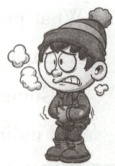
In spring, some people wear T-shirts while others are in down coats. 1
E
Why does this happen?There are sensors (传感器) on our skin that can feel cold, cool, warm, and hot temperatures. These sensors are also found in our noses and bodies.
When bodies are the same size, how much body fat we have can be different and influence how we feel temperatures. 3
C
This is because the fat under the skin helps keep heat, according to the website The Swaddle. As a result, old people often feel colder than young people as the fat layer under the skin gets thinner with age.Surprisingly, another reason is height. 4
D
Since most people's hearts are about the same size, it takes more effort and time for the blood to move around in taller people. So taller people might feel colder, said the newsletter Mic.Metabolism (新陈代谢) also influences how we feel temperatures. It shows how fast our bodies use energy. People with a higher metabolism always feel hotter than others. 5
F
For example, people with more muscles (肌肉) often feel warmer according to Medicover Genetics.A. How does body fat cause the difference?
B. In fact, people don't feel air temperature directly.
C. The more body fat one has, the warmer he or she feels.
D. We need blood to move around our bodies to keep us warm.
E. It seems that people's bodies react differently to the same air temperatures.
F. That's because they produce more heat and may take more time to cool down.
答案:
1—5 EBCDF
B.完成图表 根据短文内容,完成图表中所缺信息。(共5小题;每小题1分,计5分)
Sage of calligraphy
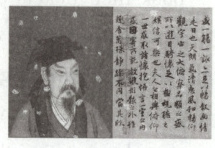
Wang Xizhi was born in Linyi of Shandong Province. He used to be a general and officer in the Jin Dynasty, a famous calligrapher of the Eastern Jin Dynasty. Wang is still known as the calligraphy sage.
Wang's uncles and cousins were all famous calligraphers of their time. At seven, Wang began a systematic (系统的) study of calligraphy under a female calligrapher, Wei Shuo. He kept copying the Wei-style calligraphy for years and learned much from the works of calligraphers.
To practice calligraphy, wherever he went, he would try to find out the styles of previous calligraphers and copy them, collecting many calligraphic materials. There were writing brushes, ink sticks and ink stones in his study, yard and even outside the toilet. Whenever he thought of a well-structured character, he would write it down right away.
Wang wrote with smoothness and grandness. Some people have described his calligraphy as “the dragon jumping over the heavenly gate and the tiger lying in the palace of the phoenix”. Wang was good at many types of calligraphy but the xingshu-style Preface to the Orchid Pavilion Collection (《兰亭集序》) is the most popular of his works.
There is a story behind this work. In 353, Wang invited famous people to get together at a party with 41 guests at the Orchid Pavilion, where they drank. The guests were asked to write poems. The poems were collected, and Wang wrote Preface to the Orchid Pavilion Collection on his own, describing how happy these men were. Wang's talents in calligraphy were brought into full play during it.
The Song Dynasty scholar Mi Fu called Preface to the Orchid Pavilion Collection is the world's best work in xingshu style. It's said that Emperor Taizong of the Tang Dynasty treasured the work and had it buried in his tomb. He left behind calligraphic works. Preface to the Orchid Pavilion is one of them, as well as Yue Yi Dissertation and Huangting Classics in kaishu style.
His 6
▲being born into a family of calligraphers
▲working as a general and officer
▲studying calligraphy at 7 under Wei Shuo
▲copying for years and learning from the works
His calligraphy style
▲practicing frequently, and recording his 7
▲praising his calligraphy as “the dragon jumping over the heavenly gate and the tiger lying in the palace to the phoenix”
The introduction to Wang Xizhi
Preface to Orchid Pavilion Collection
The birth of the work
▲In 353, Wang hosted a party at the Orchid Pavilion. His guests drank and wrote poems before Wang 8
▲It shows the happy scene of these men and Wang's calligraphy 9
The influence of the work
▲Song Dynasty Mi Fu praised that no works can 10
▲Tang Dynasty Emperor Taizong valued this work so much that he had it buried with him.
Sage of calligraphy
Wang Xizhi was born in Linyi of Shandong Province. He used to be a general and officer in the Jin Dynasty, a famous calligrapher of the Eastern Jin Dynasty. Wang is still known as the calligraphy sage.
Wang's uncles and cousins were all famous calligraphers of their time. At seven, Wang began a systematic (系统的) study of calligraphy under a female calligrapher, Wei Shuo. He kept copying the Wei-style calligraphy for years and learned much from the works of calligraphers.
To practice calligraphy, wherever he went, he would try to find out the styles of previous calligraphers and copy them, collecting many calligraphic materials. There were writing brushes, ink sticks and ink stones in his study, yard and even outside the toilet. Whenever he thought of a well-structured character, he would write it down right away.
Wang wrote with smoothness and grandness. Some people have described his calligraphy as “the dragon jumping over the heavenly gate and the tiger lying in the palace of the phoenix”. Wang was good at many types of calligraphy but the xingshu-style Preface to the Orchid Pavilion Collection (《兰亭集序》) is the most popular of his works.
There is a story behind this work. In 353, Wang invited famous people to get together at a party with 41 guests at the Orchid Pavilion, where they drank. The guests were asked to write poems. The poems were collected, and Wang wrote Preface to the Orchid Pavilion Collection on his own, describing how happy these men were. Wang's talents in calligraphy were brought into full play during it.
The Song Dynasty scholar Mi Fu called Preface to the Orchid Pavilion Collection is the world's best work in xingshu style. It's said that Emperor Taizong of the Tang Dynasty treasured the work and had it buried in his tomb. He left behind calligraphic works. Preface to the Orchid Pavilion is one of them, as well as Yue Yi Dissertation and Huangting Classics in kaishu style.
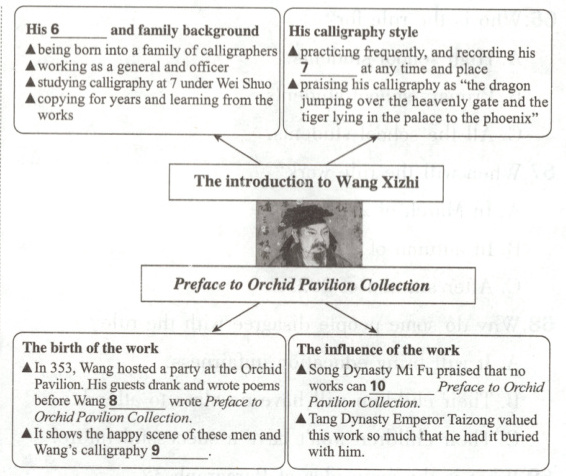
His 6
life experience(s)
and family background▲being born into a family of calligraphers
▲working as a general and officer
▲studying calligraphy at 7 under Wei Shuo
▲copying for years and learning from the works
His calligraphy style
▲practicing frequently, and recording his 7
inspiration(s)/thoughts/ideas
at any time and place▲praising his calligraphy as “the dragon jumping over the heavenly gate and the tiger lying in the palace to the phoenix”
The introduction to Wang Xizhi
Preface to Orchid Pavilion Collection
The birth of the work
▲In 353, Wang hosted a party at the Orchid Pavilion. His guests drank and wrote poems before Wang 8
himself/independently
wrote Preface to Orchid Pavilion Collection.▲It shows the happy scene of these men and Wang's calligraphy 9
talents
.The influence of the work
▲Song Dynasty Mi Fu praised that no works can 10
be compared with/to
Preface to Orchid Pavilion Collection.▲Tang Dynasty Emperor Taizong valued this work so much that he had it buried with him.
答案:
6 life experience(s) 7 inspiration(s)/thoughts/ideas 8 himself/independently 9 talents 10 be compared with/to
查看更多完整答案,请扫码查看

