

 搜索
搜索
2025年学霸高考黑题数学人教版
注:目前有些书本章节名称可能整理的还不是很完善,但都是按照顺序排列的,请同学们按照顺序仔细查找。练习册 2025年学霸高考黑题数学人教版 答案主要是用来给同学们做完题方便对答案用的,请勿直接抄袭。
第6页
- 第1页
- 第2页
- 第3页
- 第4页
- 第5页
- 第6页
- 第7页
- 第8页
- 第9页
- 第10页
- 第11页
- 第12页
- 第13页
- 第14页
- 第15页
- 第16页
- 第17页
- 第18页
- 第19页
- 第20页
- 第21页
- 第22页
- 第23页
- 第24页
- 第25页
- 第26页
- 第27页
- 第28页
- 第29页
- 第30页
- 第31页
- 第32页
- 第33页
- 第34页
- 第35页
- 第36页
- 第37页
- 第38页
- 第39页
- 第40页
- 第41页
- 第42页
- 第43页
- 第44页
- 第45页
- 第46页
- 第47页
- 第48页
- 第49页
- 第50页
- 第51页
- 第52页
- 第53页
- 第54页
- 第55页
- 第56页
- 第57页
- 第58页
- 第59页
- 第60页
- 第61页
- 第62页
- 第63页
- 第64页
- 第65页
- 第66页
- 第67页
- 第68页
- 第69页
- 第70页
- 第71页
- 第72页
- 第73页
- 第74页
- 第75页
- 第76页
- 第77页
- 第78页
- 第79页
- 第80页
- 第81页
- 第82页
- 第83页
- 第84页
- 第85页
- 第86页
- 第87页
- 第88页
- 第89页
- 第90页
- 第91页
- 第92页
- 第93页
- 第94页
- 第95页
- 第96页
- 第97页
- 第98页
- 第99页
- 第100页
- 第101页
- 第102页
- 第103页
- 第104页
- 第105页
- 第106页
- 第107页
- 第108页
- 第109页
- 第110页
- 第111页
- 第112页
- 第113页
- 第114页
- 第115页
- 第116页
- 第117页
- 第118页
- 第119页
- 第120页
- 第121页
- 第122页
- 第123页
- 第124页
- 第125页
- 第126页
- 第127页
- 第128页
- 第129页
- 第130页
- 第131页
- 第132页
典型例题3. (全国高考)在平面四边形ABCD中,∠ADC=90°,∠A=45°,AB=2,BD=5.
(1)求cos∠ADB;
(2)若DC=2√2,求BC的长.
(1)求cos∠ADB;
(2)若DC=2√2,求BC的长.
答案:
典型例题3. 解:
(1)方法一:正弦定理+平方关系
在$\triangle ABD$中,由正弦定理得$\frac{BD}{\sin A} = \frac{AB}{\sin \angle ADB}$,代人数值并解得$\sin \angle ADB = \frac{\sqrt{2}}{5}$.又因为$BD > AB$,所以$\angle A > \angle ADB$,即$\angle ADB$为锐角,所
以$\cos \angle ADB = \frac{\sqrt{23}}{5}$.
方法二:余弦定理
在$\triangle ABD$中,$BD^{2} = AB^{2} + AD^{2} - 2AB · AD \cos 45^{\circ}$,即$25 = 4 + AD^{2} - 2 ×2 × AD × \frac{\sqrt{2}}{2}$,解得$AD = \sqrt{2} + \sqrt{23}$,所以$\cos \angle ADB = \frac{AD^{2} + BD^{2} - AB^{2}}{2AD · BD} =\frac{(\sqrt{2} + \sqrt{23})^{2} + 25 - 4}{2 × (\sqrt{2} + \sqrt{23}) × 5} = \frac{\sqrt{23}}{5}$.
方法三:利用平面几何知识
过点$B$作$BE \perp AD$,垂足为$E$,因为$\angle A = 45^{\circ}$,$AB = 2$,所
以$AE = BE = \sqrt{2}$.在$Rt \triangle BED$中,因为$BD = 5$,所以$DE = \sqrt{BD^{2} - BE^{2}} = \sqrt{5^{2} - (\sqrt{2})^{2}} = \sqrt{23}$.所以$\cos \angle ADB = \frac{\sqrt{23}}{5}$.
(2)方法一:余弦定理
由
(1)得$\cos \angle ADB = \frac{\sqrt{23}}{5}$,则$\sin \angle ADB = \frac{\sqrt{2}}{5}$.在$\triangle BCD$中,$BC^{2} = BD^{2} +DC^{2} - 2BD · DC · \cos (90^{\circ} - \angle ADB) = 5^{2} + (2\sqrt{2})^{2} - 2 × 5 ×2\sqrt{2} \sin \angle ADB = 25$,
方法二:利用平面几何知识
作$BF \perp DC$,垂足为$F$,易求得$BF = \sqrt{23}$,$FC = \sqrt{2}$,由勾股定理得
$BC = 5$.
(1)方法一:正弦定理+平方关系
在$\triangle ABD$中,由正弦定理得$\frac{BD}{\sin A} = \frac{AB}{\sin \angle ADB}$,代人数值并解得$\sin \angle ADB = \frac{\sqrt{2}}{5}$.又因为$BD > AB$,所以$\angle A > \angle ADB$,即$\angle ADB$为锐角,所
以$\cos \angle ADB = \frac{\sqrt{23}}{5}$.
方法二:余弦定理
在$\triangle ABD$中,$BD^{2} = AB^{2} + AD^{2} - 2AB · AD \cos 45^{\circ}$,即$25 = 4 + AD^{2} - 2 ×2 × AD × \frac{\sqrt{2}}{2}$,解得$AD = \sqrt{2} + \sqrt{23}$,所以$\cos \angle ADB = \frac{AD^{2} + BD^{2} - AB^{2}}{2AD · BD} =\frac{(\sqrt{2} + \sqrt{23})^{2} + 25 - 4}{2 × (\sqrt{2} + \sqrt{23}) × 5} = \frac{\sqrt{23}}{5}$.
方法三:利用平面几何知识
过点$B$作$BE \perp AD$,垂足为$E$,因为$\angle A = 45^{\circ}$,$AB = 2$,所
以$AE = BE = \sqrt{2}$.在$Rt \triangle BED$中,因为$BD = 5$,所以$DE = \sqrt{BD^{2} - BE^{2}} = \sqrt{5^{2} - (\sqrt{2})^{2}} = \sqrt{23}$.所以$\cos \angle ADB = \frac{\sqrt{23}}{5}$.
(2)方法一:余弦定理
由
(1)得$\cos \angle ADB = \frac{\sqrt{23}}{5}$,则$\sin \angle ADB = \frac{\sqrt{2}}{5}$.在$\triangle BCD$中,$BC^{2} = BD^{2} +DC^{2} - 2BD · DC · \cos (90^{\circ} - \angle ADB) = 5^{2} + (2\sqrt{2})^{2} - 2 × 5 ×2\sqrt{2} \sin \angle ADB = 25$,
方法二:利用平面几何知识
作$BF \perp DC$,垂足为$F$,易求得$BF = \sqrt{23}$,$FC = \sqrt{2}$,由勾股定理得
$BC = 5$.
变式训练5. (2025·重庆一中月考)已知△ABC的内角A,B,C的对边分别是a,b,c,(2ac+4c²)cos B=a²-b²-c².
(1)求角B;
(2)若D为△ABC外一点,在四边形ABCD中,边长BC=2,∠DCB=∠B,∠CAD=30°,求边CD的最小值.
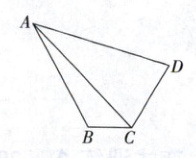
(1)求角B;
(2)若D为△ABC外一点,在四边形ABCD中,边长BC=2,∠DCB=∠B,∠CAD=30°,求边CD的最小值.
答案:
变式训练5. 解:
(1)因为$(2ac + 4c^{2}) \cos B = a^{2} - b^{2} - c^{2}$,由余弦定理$a^{2} =b^{2} + c^{2} - 2bc \cos A$,所以$(a + 2c) \cos B = -b \cos A$,由正弦定理可得$\sin A \cos B + 2 \sin C \cos B = - \sin B \cos A$,
即$\sin A \cos B + \sin B \cos A + 2 \sin C \cos B = 0$,所以$\sin C + 2 \sin C \cos B = 0$.
又$C \in (0,\pi)$,所以$\sin C > 0$,所以$1 + 2 \cos B = 0$,即$\cos B = - \frac{1}{2}$,又$B \in(0,\pi)$,所以$B = \frac{2\pi}{3}$
(2) 在$\triangle ACD$和$\triangle ABC$中,由正弦定理可得$\frac{CD}{\sin 30^{\circ}} = \frac{AC}{\sin \angle ADC'}$,
$\frac{BC}{\sin \angle CAB} = \frac{AC}{\sin 120^{\circ}}$,设$\angle ACB = \theta$,$0^{\circ} < \theta < 60^{\circ}$,则$\angle ACD = 120^{\circ} - \theta$,
$\angle ADC = 30^{\circ} + \theta$,$\angle CAB = 60^{\circ} - \theta$,故两式相除得$\frac{2CD \sin (60^{\circ} - \theta)}{2} = \frac{\sqrt{3}}{2}$,即$CD = \frac{\sqrt{3}}{2 \sin (30^{\circ} + \theta) \sin (60^{\circ} - \theta)} = \frac{\sqrt{3}}{\cos [(30^{\circ} + \theta) - (60^{\circ} - \theta)] - \cos [(30^{\circ} + \theta) + (60^{\circ} - \theta)]} = \frac{\sqrt{3}}{\cos (2\theta - 30^{\circ})}$,故
当$2\theta - 30^{\circ} = 0^{\circ}$时,即$\theta = 15^{\circ}$时,此时$\cos (2\theta - 30^{\circ})$取最大值$1$,故$CD$取
最小值$\sqrt{3}$.
(1)因为$(2ac + 4c^{2}) \cos B = a^{2} - b^{2} - c^{2}$,由余弦定理$a^{2} =b^{2} + c^{2} - 2bc \cos A$,所以$(a + 2c) \cos B = -b \cos A$,由正弦定理可得$\sin A \cos B + 2 \sin C \cos B = - \sin B \cos A$,
即$\sin A \cos B + \sin B \cos A + 2 \sin C \cos B = 0$,所以$\sin C + 2 \sin C \cos B = 0$.
又$C \in (0,\pi)$,所以$\sin C > 0$,所以$1 + 2 \cos B = 0$,即$\cos B = - \frac{1}{2}$,又$B \in(0,\pi)$,所以$B = \frac{2\pi}{3}$
(2) 在$\triangle ACD$和$\triangle ABC$中,由正弦定理可得$\frac{CD}{\sin 30^{\circ}} = \frac{AC}{\sin \angle ADC'}$,
$\frac{BC}{\sin \angle CAB} = \frac{AC}{\sin 120^{\circ}}$,设$\angle ACB = \theta$,$0^{\circ} < \theta < 60^{\circ}$,则$\angle ACD = 120^{\circ} - \theta$,
$\angle ADC = 30^{\circ} + \theta$,$\angle CAB = 60^{\circ} - \theta$,故两式相除得$\frac{2CD \sin (60^{\circ} - \theta)}{2} = \frac{\sqrt{3}}{2}$,即$CD = \frac{\sqrt{3}}{2 \sin (30^{\circ} + \theta) \sin (60^{\circ} - \theta)} = \frac{\sqrt{3}}{\cos [(30^{\circ} + \theta) - (60^{\circ} - \theta)] - \cos [(30^{\circ} + \theta) + (60^{\circ} - \theta)]} = \frac{\sqrt{3}}{\cos (2\theta - 30^{\circ})}$,故
当$2\theta - 30^{\circ} = 0^{\circ}$时,即$\theta = 15^{\circ}$时,此时$\cos (2\theta - 30^{\circ})$取最大值$1$,故$CD$取
最小值$\sqrt{3}$.
变式训练6. (2025·山东济南模拟)如图,在平面四边形ABCD中,已知AD=1,CD=2,△ABC为等边三角形,记∠ADC=α.
(1)若α=π/3,求△ABD的面积;
(2)若α∈(π/2,π),求四边形ABCD面积的取值范围.
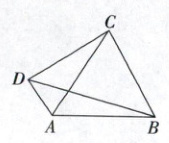
(1)若α=π/3,求△ABD的面积;
(2)若α∈(π/2,π),求四边形ABCD面积的取值范围.
答案:
变式训练6. 解:
(1)在$\triangle ACD$中,由余弦定理$AC^{2} = AD^{2} + CD^{2} - 2AD ·CD \cos \alpha = 1 + 4 - 2 × 1 × 2 × \cos \frac{\pi}{3} = 3$,所以$AC = \sqrt{3}$,则$AD^{2} + AC^{2} = CD^{2}$,
所以$\angle DAC = \frac{\pi}{2}$.又因为$\triangle ABC$为等边三角形,所以$AB = AC = \sqrt{3}$,且
$\angle BAD = \angle BAC + \angle DAC = \frac{5\pi}{6}$,所以$S_{\triangle ABD} = \frac{1}{2} AB · AD · \sin \angle BAD = \frac{1}{2} × \sqrt{3} × 1 × \sin \frac{5\pi}{6} = \frac{\sqrt{3}}{4}$,则$\triangle ABD$的面积为$\frac{\sqrt{3}}{4}$.
(2)在$\triangle ACD$中,由余弦定理得$AC^{2} = AD^{2} + CD^{2} - 2AD · CD · \cos \alpha = 1 +4 - 2 × 1 × 2 \cos \alpha = 5 - 4 \cos \alpha$,所以$S_{\triangle ABC} = \frac{\sqrt{3}}{4} AC^{2} = \frac{\sqrt{3}}{4} (5 - 4 \cos \alpha)$,$S_{\triangle ACD} = \frac{1}{2} × 1 × 2 \sin \alpha = \sin \alpha$,所以四边形$ABCD$的面积$S = S_{\triangle ACD} +S_{\triangle ABC} = \frac{\sqrt{3}}{4} (5 - 4 \cos \alpha) + \sin \alpha = \sin \alpha - \sqrt{3} \cos \alpha + \frac{5\sqrt{3}}{4} = 2 \sin (\alpha - \frac{\pi}{3}) +\frac{5\sqrt{3}}{4}$.又因为$\alpha \in (\frac{\pi}{2},\pi)$,所以$\alpha - \frac{\pi}{3} \in (\frac{\pi}{6},\frac{2\pi}{3})$,所以
$\sin (\alpha - \frac{\pi}{3}) \in (\frac{1}{2},1]$,$2 \sin (\alpha - \frac{\pi}{3}) + \frac{5\sqrt{3}}{4} \in (\frac{1 + 5\sqrt{3}}{4},\frac{2 + 5\sqrt{3}}{4}]$,
即四边形$ABCD$的面积的取值范围为$(1 + \frac{5\sqrt{3}}{4},2 + \frac{5\sqrt{3}}{4}]$.
(1)在$\triangle ACD$中,由余弦定理$AC^{2} = AD^{2} + CD^{2} - 2AD ·CD \cos \alpha = 1 + 4 - 2 × 1 × 2 × \cos \frac{\pi}{3} = 3$,所以$AC = \sqrt{3}$,则$AD^{2} + AC^{2} = CD^{2}$,
所以$\angle DAC = \frac{\pi}{2}$.又因为$\triangle ABC$为等边三角形,所以$AB = AC = \sqrt{3}$,且
$\angle BAD = \angle BAC + \angle DAC = \frac{5\pi}{6}$,所以$S_{\triangle ABD} = \frac{1}{2} AB · AD · \sin \angle BAD = \frac{1}{2} × \sqrt{3} × 1 × \sin \frac{5\pi}{6} = \frac{\sqrt{3}}{4}$,则$\triangle ABD$的面积为$\frac{\sqrt{3}}{4}$.
(2)在$\triangle ACD$中,由余弦定理得$AC^{2} = AD^{2} + CD^{2} - 2AD · CD · \cos \alpha = 1 +4 - 2 × 1 × 2 \cos \alpha = 5 - 4 \cos \alpha$,所以$S_{\triangle ABC} = \frac{\sqrt{3}}{4} AC^{2} = \frac{\sqrt{3}}{4} (5 - 4 \cos \alpha)$,$S_{\triangle ACD} = \frac{1}{2} × 1 × 2 \sin \alpha = \sin \alpha$,所以四边形$ABCD$的面积$S = S_{\triangle ACD} +S_{\triangle ABC} = \frac{\sqrt{3}}{4} (5 - 4 \cos \alpha) + \sin \alpha = \sin \alpha - \sqrt{3} \cos \alpha + \frac{5\sqrt{3}}{4} = 2 \sin (\alpha - \frac{\pi}{3}) +\frac{5\sqrt{3}}{4}$.又因为$\alpha \in (\frac{\pi}{2},\pi)$,所以$\alpha - \frac{\pi}{3} \in (\frac{\pi}{6},\frac{2\pi}{3})$,所以
$\sin (\alpha - \frac{\pi}{3}) \in (\frac{1}{2},1]$,$2 \sin (\alpha - \frac{\pi}{3}) + \frac{5\sqrt{3}}{4} \in (\frac{1 + 5\sqrt{3}}{4},\frac{2 + 5\sqrt{3}}{4}]$,
即四边形$ABCD$的面积的取值范围为$(1 + \frac{5\sqrt{3}}{4},2 + \frac{5\sqrt{3}}{4}]$.
查看更多完整答案,请扫码查看

