

 搜索
搜索
17. (8 分)已知二次函数 $y= x^2+bx+c$ 的图象经过 $A(0,2)$,$B(1,-3)$ 两点.
(1)求 $b$ 和 $c$ 的值.
(2)自变量 $x$ 在什么范围内取值时,$y$ 随 $x$ 的增大而减小?
(1)求 $b$ 和 $c$ 的值.
(2)自变量 $x$ 在什么范围内取值时,$y$ 随 $x$ 的增大而减小?
答案:
(1)把 $A(0,2)$,$B(1,-3)$ 两点的坐标代入二次函数 $y=x^{2}+bx+c$ 中,得 $\begin{cases} c=2 \\ 1+b+c=-3 \end{cases}$,
解得 $b=-6$,$c=2$。
(2)由
(1)得 $y=x^{2}-6x+2$,则该二次函数图象的对称轴为直线 $x=3$,开口向上,
$\therefore$ 当 $x<3$ 时,$y$ 随 $x$ 的增大而减小。
(1)把 $A(0,2)$,$B(1,-3)$ 两点的坐标代入二次函数 $y=x^{2}+bx+c$ 中,得 $\begin{cases} c=2 \\ 1+b+c=-3 \end{cases}$,
解得 $b=-6$,$c=2$。
(2)由
(1)得 $y=x^{2}-6x+2$,则该二次函数图象的对称轴为直线 $x=3$,开口向上,
$\therefore$ 当 $x<3$ 时,$y$ 随 $x$ 的增大而减小。
18. (8 分)现有 5 张奖券,其中 2 张有奖,小明和同学做抽奖游戏.
(1)从 5 张奖券中随机抽取 1 张,中奖的概率是多少?
(2)小明说:“从 5 张奖券中一次随机抽取 2 张,中奖的概率一定是一次随机抽取 1 张中奖概率的 2 倍.”你认为小明的说法对吗? 请用树状图或列表说明理由. 用 $A$ 代表中奖奖券,$B$ 代表不中奖奖券.
(1)从 5 张奖券中随机抽取 1 张,中奖的概率是多少?
(2)小明说:“从 5 张奖券中一次随机抽取 2 张,中奖的概率一定是一次随机抽取 1 张中奖概率的 2 倍.”你认为小明的说法对吗? 请用树状图或列表说明理由. 用 $A$ 代表中奖奖券,$B$ 代表不中奖奖券.
答案:
(1)$\because$ 现有5张奖券,其中2张有奖,
$\therefore$ 从5张奖券中随机抽取1张,中奖的概率是 $\frac{2}{5}$。
(2)小明的说法不对。
一次随机抽取2张,画树状图得
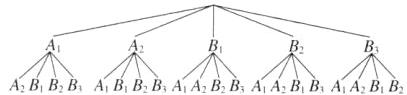
$\because$ 共有20种情况(每种情况出现的可能性相同),中奖的有14种情况,
$\therefore$ 从5张奖券中一次随机抽取2张,中奖的概率为 $\frac{14}{20}=\frac{7}{10}$,
$\because$ 一次随机抽取1张中奖概率的2倍为 $\frac{4}{5}$。
$\therefore$ 小明的说法不对。
(1)$\because$ 现有5张奖券,其中2张有奖,
$\therefore$ 从5张奖券中随机抽取1张,中奖的概率是 $\frac{2}{5}$。
(2)小明的说法不对。
一次随机抽取2张,画树状图得
$\because$ 共有20种情况(每种情况出现的可能性相同),中奖的有14种情况,
$\therefore$ 从5张奖券中一次随机抽取2张,中奖的概率为 $\frac{14}{20}=\frac{7}{10}$,
$\because$ 一次随机抽取1张中奖概率的2倍为 $\frac{4}{5}$。
$\therefore$ 小明的说法不对。
19. (8 分)在平面直角坐标系中,设二次函数 $y_1= (x+a)(x-a-1)$,其中 $a\neq0$.
(1)若函数 $y_1$ 的图象经过点 $(1,-2)$,求函数 $y_1$ 的表达式.
(2)若一次函数 $y_2= ax+b$ 的图象与 $y_1$ 的图象经过 $x$ 轴上同一点,探究实数 $a,b$ 满足的关系式.
(1)若函数 $y_1$ 的图象经过点 $(1,-2)$,求函数 $y_1$ 的表达式.
(2)若一次函数 $y_2= ax+b$ 的图象与 $y_1$ 的图象经过 $x$ 轴上同一点,探究实数 $a,b$ 满足的关系式.
答案:
(1)$\because$ 二次函数 $y_{1}=(x+a)(x-a-1)$ 的图象过点 $(1,-2)$,$\therefore -a(1+a)=-2$,$\therefore a=-2$ 或1,
$\therefore y_{1}=(x-2)(x+1)=x^{2}-x-2$。
(2)令 $y_{1}=0$,则 $x=-a$ 或 $1+a$,$\therefore$ 函数 $y_{1}$ 的图象与 $x$ 轴的交点坐标分别为 $(-a,0)$ 和 $(1+a,0)$。
$\because$ 一次函数 $y_{2}$ 的图象与 $y_{1}$ 的图象经过 $x$ 轴上同一点,
$\therefore$ 点 $(-a,0)$ 或 $(1+a,0)$ 在 $y_{2}$ 的图象上,
$\therefore b-a^{2}=0$ 或 $a^{2}+a+b=0$。
(1)$\because$ 二次函数 $y_{1}=(x+a)(x-a-1)$ 的图象过点 $(1,-2)$,$\therefore -a(1+a)=-2$,$\therefore a=-2$ 或1,
$\therefore y_{1}=(x-2)(x+1)=x^{2}-x-2$。
(2)令 $y_{1}=0$,则 $x=-a$ 或 $1+a$,$\therefore$ 函数 $y_{1}$ 的图象与 $x$ 轴的交点坐标分别为 $(-a,0)$ 和 $(1+a,0)$。
$\because$ 一次函数 $y_{2}$ 的图象与 $y_{1}$ 的图象经过 $x$ 轴上同一点,
$\therefore$ 点 $(-a,0)$ 或 $(1+a,0)$ 在 $y_{2}$ 的图象上,
$\therefore b-a^{2}=0$ 或 $a^{2}+a+b=0$。
20. (8 分)如图,四边形 $ABCD$ 内接于 $\odot O$,$AD$ 为直径,$DB$ 平分 $\angle ADC$,$CA= CD$,$DB$ 与 $CA$ 交于点 $E$,延长 $AB$,$DC$ 交于点 $F$.
(1)求线段 $AB$ 与线段 $BC$ 的数量关系.
(2)求证:$\triangle AFC\cong\triangle DEC$.

(1)求线段 $AB$ 与线段 $BC$ 的数量关系.
(2)求证:$\triangle AFC\cong\triangle DEC$.
答案:
(1)$\because DB$ 平分 $\angle ADC$,$\therefore \angle ADB=\angle CDB$,
$\therefore \overset{\frown}{AB}=\overset{\frown}{BC}$,$\therefore AB=BC$。
(2)证明:$\because AD$ 为直径,
$\therefore \angle ACD=90^{\circ}$,$\therefore \angle ACF=90^{\circ}$,
$\therefore \angle ACF=\angle DCE=90^{\circ}$。
$\because \overset{\frown}{BC}=\overset{\frown}{BC}$,
$\therefore \angle FAC=\angle EDC$。
在 $\triangle AFC$ 和 $\triangle DEC$ 中,
$\begin{cases} \angle FAC=\angle EDC \\ AC=DC \\ \angle ACF=\angle DCE \end{cases}$
$\therefore \triangle AFC\cong \triangle DEC(ASA)$。
(1)$\because DB$ 平分 $\angle ADC$,$\therefore \angle ADB=\angle CDB$,
$\therefore \overset{\frown}{AB}=\overset{\frown}{BC}$,$\therefore AB=BC$。
(2)证明:$\because AD$ 为直径,
$\therefore \angle ACD=90^{\circ}$,$\therefore \angle ACF=90^{\circ}$,
$\therefore \angle ACF=\angle DCE=90^{\circ}$。
$\because \overset{\frown}{BC}=\overset{\frown}{BC}$,
$\therefore \angle FAC=\angle EDC$。
在 $\triangle AFC$ 和 $\triangle DEC$ 中,
$\begin{cases} \angle FAC=\angle EDC \\ AC=DC \\ \angle ACF=\angle DCE \end{cases}$
$\therefore \triangle AFC\cong \triangle DEC(ASA)$。
21. (8 分)图 1 中窗户的上部分是由 4 个全等小正方形组成的大正方形,下部分是矩形,如图 2. 如果制作一个窗户(如图 2)边框的材料总长度为 10 m,设小正方形的边长为 $x(m)$,窗户的透光面积为 $y(m^2)$.
(1)求 $y$ 关于 $x$ 的函数表达式.
(2)当 $x$ 取何值时,透光面积最大? 最大透光面积是多少?

(1)求 $y$ 关于 $x$ 的函数表达式.
(2)当 $x$ 取何值时,透光面积最大? 最大透光面积是多少?
答案:
(1)由题意知,下部分矩形的长 $=\frac{10-14x}{2}=5-7x$,由 $0<5-7x$,得 $0<x<\frac{5}{7}$。
$\therefore y=(5-7x+2x)\cdot 2x=-10x^{2}+10x\left(0<x<\frac{5}{7}\right)$。
(2)$y=-10x^{2}+10x=-10\left(x-\frac{1}{2}\right)^{2}+\frac{5}{2}$。
$\because x=\frac{1}{2}$ 在 $0<x<\frac{5}{7}$ 范围内,
$\therefore$ 当 $x=\frac{1}{2}$ 时 $y$ 取到最大值,最大值为 $\frac{5}{2}$。
答:当 $x=\frac{1}{2}$ 时,透光面积最大,最大透光面积是 $\frac{5}{2}\ m^{2}$。
(1)由题意知,下部分矩形的长 $=\frac{10-14x}{2}=5-7x$,由 $0<5-7x$,得 $0<x<\frac{5}{7}$。
$\therefore y=(5-7x+2x)\cdot 2x=-10x^{2}+10x\left(0<x<\frac{5}{7}\right)$。
(2)$y=-10x^{2}+10x=-10\left(x-\frac{1}{2}\right)^{2}+\frac{5}{2}$。
$\because x=\frac{1}{2}$ 在 $0<x<\frac{5}{7}$ 范围内,
$\therefore$ 当 $x=\frac{1}{2}$ 时 $y$ 取到最大值,最大值为 $\frac{5}{2}$。
答:当 $x=\frac{1}{2}$ 时,透光面积最大,最大透光面积是 $\frac{5}{2}\ m^{2}$。
查看更多完整答案,请扫码查看

