

 搜索
搜索
第43页
- 第1页
- 第2页
- 第3页
- 第4页
- 第5页
- 第6页
- 第7页
- 第8页
- 第9页
- 第10页
- 第11页
- 第12页
- 第13页
- 第14页
- 第15页
- 第16页
- 第17页
- 第18页
- 第19页
- 第20页
- 第21页
- 第22页
- 第23页
- 第24页
- 第25页
- 第26页
- 第27页
- 第28页
- 第29页
- 第30页
- 第31页
- 第32页
- 第33页
- 第34页
- 第35页
- 第36页
- 第37页
- 第38页
- 第39页
- 第40页
- 第41页
- 第42页
- 第43页
- 第44页
- 第45页
- 第46页
- 第47页
- 第48页
- 第49页
- 第50页
- 第51页
- 第52页
- 第53页
- 第54页
- 第55页
- 第56页
- 第57页
- 第58页
- 第59页
- 第60页
- 第61页
- 第62页
- 第63页
- 第64页
- 第65页
- 第66页
- 第67页
- 第68页
- 第69页
- 第70页
- 第71页
- 第72页
- 第73页
- 第74页
- 第75页
- 第76页
- 第77页
- 第78页
- 第79页
- 第80页
- 第81页
- 第82页
- 第83页
- 第84页
- 第85页
- 第86页
- 第87页
- 第88页
- 第89页
- 第90页
- 第91页
- 第92页
- 第93页
- 第94页
- 第95页
- 第96页
- 第97页
- 第98页
- 第99页
- 第100页
- 第101页
- 第102页
- 第103页
- 第104页
- 第105页
- 第106页
- 第107页
- 第108页
- 第109页
- 第110页
- 第111页
- 第112页
- 第113页
- 第114页
- 第115页
- 第116页
- 第117页
- 第118页
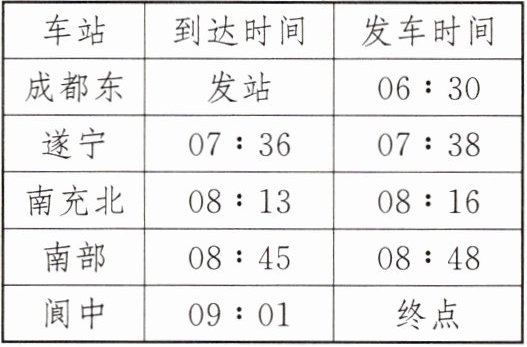
15. (杭州模拟)阆中是中国历史文化名城,阆中不仅有汉桓侯祠、中天楼、滕王阁、锦屏山等风景名胜,还有中国保存最完好、面积最大的科举博物馆,全国罕见的科举文化体验胜地——贡院。小田一家国庆节期间从成都东站出发乘火车去阆中旅游,已知成都东到阆中铁路全程293km,他们乘坐的C5804次列车时刻表如表所示。求:
(1)该次火车运行的平均速度;
(2)若将来成都东到阆中有条件开通运行平均速度为300km/h的高铁,运行时间将比现在节约多少分钟;(结果保留一位小数)
(3)一辆客车在某高速公路上行驶,在经过某直线路段时,司机驾车做匀速直线运动,司机发现其正要通过正前方高山悬崖下的隧道,于是鸣笛,经$t_{1}= 6s$后听到回声,听到回声后又行驶$t_{2}= 16s$,司机第二次鸣笛,又经$t_{3}= 2s$后听到回声,请根据以上数据计算客车运行时的速度。(声音在空气中的传播速度为340m/s)
(1)该次火车运行的平均速度;
(2)若将来成都东到阆中有条件开通运行平均速度为300km/h的高铁,运行时间将比现在节约多少分钟;(结果保留一位小数)
(3)一辆客车在某高速公路上行驶,在经过某直线路段时,司机驾车做匀速直线运动,司机发现其正要通过正前方高山悬崖下的隧道,于是鸣笛,经$t_{1}= 6s$后听到回声,听到回声后又行驶$t_{2}= 16s$,司机第二次鸣笛,又经$t_{3}= 2s$后听到回声,请根据以上数据计算客车运行时的速度。(声音在空气中的传播速度为340m/s)
答案:
解:
(1)$t_{\text{火车}}=9\ \text{h}\,{1\ \text{min}}-6\ \text{h}\,{30\ \text{min}}=2\ \text{h}\,{31\ \text{min}}=\frac{151}{60}\ \text{h}$,
$v_{\text{火车}}=\frac{s_{\text{火车}}}{t_{\text{火车}}}=\frac{293\ \text{km}}{\frac{151}{60}\ \text{h}}\approx 116.\,4\ \text{km/h}$;
(2)$t_{\text{高铁}}=\frac{s_{\text{高铁}}}{v_{\text{高铁}}}=\frac{293\ \text{km}}{300\ \text{km/h}}=\frac{293}{300}\ \text{h}=58.6\ \text{min}$,
$\Delta t=2\ \text{h}\,{31\ \text{min}}-58.6\ \text{min}=92.4\ \text{min}$;
(3)设客车第一次鸣笛时与悬崖的距离为L,客车匀速行驶的速度为v,整个过程如图所示:
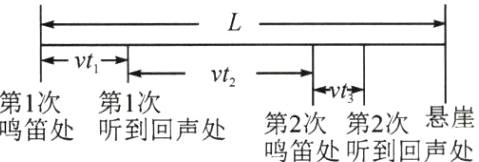
第一次鸣笛时,$2L=v_{\text{声}}t_{1}+vt_{1}$……①
听到回声后又行驶$t_{2}= 16\ \text{s}$,客车离悬崖的距离为$L - vt_{1}-vt_{2}$,
第二次鸣笛时,$2(L - vt_{1}-vt_{2})=v_{\text{声}}t_{3}+vt_{3}$……②
①式 - ②式可得:
$v=\frac{v_{\text{声}}(t_{1}-t_{3})}{t_{1}+2t_{2}+t_{3}}=\frac{340\ \text{m/s}×(6\ \text{s}-2\ \text{s})}{6\ \text{s}+2× 16\ \text{s}+2\ \text{s}} =34\ \text{m/s}=122.4\ \text{km/h}$。
解:
(1)$t_{\text{火车}}=9\ \text{h}\,{1\ \text{min}}-6\ \text{h}\,{30\ \text{min}}=2\ \text{h}\,{31\ \text{min}}=\frac{151}{60}\ \text{h}$,
$v_{\text{火车}}=\frac{s_{\text{火车}}}{t_{\text{火车}}}=\frac{293\ \text{km}}{\frac{151}{60}\ \text{h}}\approx 116.\,4\ \text{km/h}$;
(2)$t_{\text{高铁}}=\frac{s_{\text{高铁}}}{v_{\text{高铁}}}=\frac{293\ \text{km}}{300\ \text{km/h}}=\frac{293}{300}\ \text{h}=58.6\ \text{min}$,
$\Delta t=2\ \text{h}\,{31\ \text{min}}-58.6\ \text{min}=92.4\ \text{min}$;
(3)设客车第一次鸣笛时与悬崖的距离为L,客车匀速行驶的速度为v,整个过程如图所示:
第一次鸣笛时,$2L=v_{\text{声}}t_{1}+vt_{1}$……①
听到回声后又行驶$t_{2}= 16\ \text{s}$,客车离悬崖的距离为$L - vt_{1}-vt_{2}$,
第二次鸣笛时,$2(L - vt_{1}-vt_{2})=v_{\text{声}}t_{3}+vt_{3}$……②
①式 - ②式可得:
$v=\frac{v_{\text{声}}(t_{1}-t_{3})}{t_{1}+2t_{2}+t_{3}}=\frac{340\ \text{m/s}×(6\ \text{s}-2\ \text{s})}{6\ \text{s}+2× 16\ \text{s}+2\ \text{s}} =34\ \text{m/s}=122.4\ \text{km/h}$。
查看更多完整答案,请扫码查看

