

 搜索
搜索
第14页
- 第1页
- 第2页
- 第3页
- 第4页
- 第5页
- 第6页
- 第7页
- 第8页
- 第9页
- 第10页
- 第11页
- 第12页
- 第13页
- 第14页
- 第15页
- 第16页
- 第17页
- 第18页
- 第19页
- 第20页
- 第21页
- 第22页
- 第23页
- 第24页
- 第25页
- 第26页
- 第27页
- 第28页
- 第29页
- 第30页
- 第31页
- 第32页
- 第33页
- 第34页
- 第35页
- 第36页
- 第37页
- 第38页
- 第39页
- 第40页
- 第41页
- 第42页
- 第43页
- 第44页
- 第45页
- 第46页
- 第47页
- 第48页
- 第49页
- 第50页
- 第51页
- 第52页
- 第53页
- 第54页
- 第55页
- 第56页
- 第57页
- 第58页
- 第59页
- 第60页
- 第61页
- 第62页
- 第63页
- 第64页
- 第65页
- 第66页
- 第67页
- 第68页
- 第69页
- 第70页
- 第71页
- 第72页
- 第73页
- 第74页
- 第75页
- 第76页
- 第77页
- 第78页
- 第79页
- 第80页
- 第81页
- 第82页
- 第83页
- 第84页
- 第85页
- 第86页
- 第87页
- 第88页
- 第89页
- 第90页
- 第91页
- 第92页
- 第93页
- 第94页
- 第95页
- 第96页
- 第97页
- 第98页
- 第99页
- 第100页
- 第101页
- 第102页
- 第103页
- 第104页
- 第105页
- 第106页
- 第107页
- 第108页
- 第109页
- 第110页
- 第111页
- 第112页
- 第113页
- 第114页
- 第115页
- 第116页
- 第117页
- 第118页
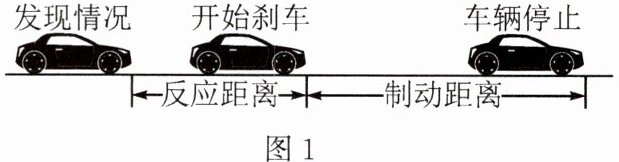
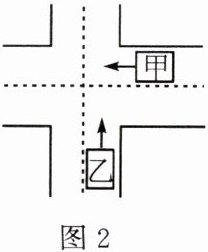
3. (长沙期中)随着汽车大量增加,交通事故也大量增加。目前发生交通事故的一个重要原因是遇到意外情况时车不能立即停下来。司机从看到情况到做动作操纵制动器来刹车需要一段时间,这段时间叫反应时间,在这段时间内汽车要保持原速前进一段距离,叫反应距离。从操纵制动器刹车,到车停下来,汽车又要前进一段距离,这叫制动距离,如图1所示。反应距离与制动距离的和称为停车距离。在如图2所示中,甲、乙两辆汽车分别在相互垂直的道路上(限速60km/h)向前匀速行驶,且车辆左侧沿各自道宽的中心线(图中虚线所示),甲车的速度为15m/s,当甲、乙两车的车头离十字路口(道路中心线)的距离分别为30m、40m时,甲车发现前方信号灯为红灯,赶快踩刹车(乙车由于司机未注意一直匀速直线行驶),若该司机的反应时间为0.7s,刹车后甲车继续滑行2.3s停止,已知该车的制动距离为19m,若两车型号相同,汽车的车长为5.1m,车宽为2m。
(1)这辆车的反应距离是多少米?
(2)试判断在穿过路口的过程中,要保证两车不相撞,乙车车速的范围。
(3)无论乙车速度为多少,要保证两车不相撞,则甲车司机的反应时间不得大于多少?
(1)这辆车的反应距离是多少米?
(2)试判断在穿过路口的过程中,要保证两车不相撞,乙车车速的范围。
(3)无论乙车速度为多少,要保证两车不相撞,则甲车司机的反应时间不得大于多少?
答案:
(1)$t_{1}=0.7\ \text{s}$,$s_{1}=v_{\text{甲}}t_{1}=15\ \text{m/s}×0.7\ \text{s}=10.5\ \text{m}$;
(2)甲车停车时间$t=t_{1}+t_{2}=0.7\ \text{s}+2.3\ \text{s}=3.0\ \text{s}$,$s_{2}=L_{2}+L_{\text{乙车长}}+L_{\text{甲车宽}}=40\ \text{m}+5.1\ \text{m}+2\ \text{m}=47.1\ \text{m}$,$v_{\text{乙}}=\frac{s_{2}}{t}=\frac{47.1\ \text{m}}{3\ \text{s}}=15.7\ \text{m/s}=56.52\ \text{km/h}$,乙车车速的范围是$56.52\ \text{km/h}~60\ \text{km/h}$;
(3)$s_{3}=L_{1}-L_{\text{乙车宽}}=30\ \text{m}-2\ \text{m}=28\ \text{m}$,$s_{4}=s_{3}-s_{\text{制动}}=28\ \text{m}-19\ \text{m}=9\ \text{m}$,$t_{4}=\frac{s_{4}}{v_{\text{甲}}}=\frac{9\ \text{m}}{15\ \text{m/s}}=0.6\ \text{s}$,甲车的反应时间不得大于$0.6\ \text{s}$。
(1)$t_{1}=0.7\ \text{s}$,$s_{1}=v_{\text{甲}}t_{1}=15\ \text{m/s}×0.7\ \text{s}=10.5\ \text{m}$;
(2)甲车停车时间$t=t_{1}+t_{2}=0.7\ \text{s}+2.3\ \text{s}=3.0\ \text{s}$,$s_{2}=L_{2}+L_{\text{乙车长}}+L_{\text{甲车宽}}=40\ \text{m}+5.1\ \text{m}+2\ \text{m}=47.1\ \text{m}$,$v_{\text{乙}}=\frac{s_{2}}{t}=\frac{47.1\ \text{m}}{3\ \text{s}}=15.7\ \text{m/s}=56.52\ \text{km/h}$,乙车车速的范围是$56.52\ \text{km/h}~60\ \text{km/h}$;
(3)$s_{3}=L_{1}-L_{\text{乙车宽}}=30\ \text{m}-2\ \text{m}=28\ \text{m}$,$s_{4}=s_{3}-s_{\text{制动}}=28\ \text{m}-19\ \text{m}=9\ \text{m}$,$t_{4}=\frac{s_{4}}{v_{\text{甲}}}=\frac{9\ \text{m}}{15\ \text{m/s}}=0.6\ \text{s}$,甲车的反应时间不得大于$0.6\ \text{s}$。
查看更多完整答案,请扫码查看

