

 搜索
搜索
第54页
- 第4页
- 第5页
- 第6页
- 第7页
- 第8页
- 第9页
- 第10页
- 第11页
- 第12页
- 第13页
- 第14页
- 第15页
- 第16页
- 第17页
- 第18页
- 第19页
- 第20页
- 第21页
- 第22页
- 第23页
- 第24页
- 第25页
- 第26页
- 第27页
- 第28页
- 第29页
- 第30页
- 第31页
- 第32页
- 第33页
- 第34页
- 第35页
- 第36页
- 第37页
- 第38页
- 第39页
- 第40页
- 第41页
- 第42页
- 第43页
- 第44页
- 第45页
- 第46页
- 第47页
- 第48页
- 第49页
- 第50页
- 第51页
- 第52页
- 第53页
- 第54页
- 第55页
- 第56页
- 第57页
- 第58页
- 第59页
- 第60页
- 第61页
- 第62页
- 第63页
- 第64页
- 第65页
- 第66页
- 第67页
- 第68页
- 第69页
- 第70页
- 第71页
- 第72页
- 第73页
- 第74页
- 第75页
- 第76页
- 第77页
- 第78页
- 第79页
- 第80页
- 第81页
- 第82页
- 第83页
- 第84页
- 第85页
- 第86页
- 第87页
- 第88页
- 第89页
- 第90页
- 第91页
- 第92页
- 第93页
- 第94页
- 第95页
- 第96页
- 第97页
- 第98页
- 第99页
- 第100页
- 第101页
- 第102页
- 第103页
- 第104页
- 第105页
- 第106页
- 第107页
- 第108页
- 第109页
- 第110页
- 第111页
- 第112页
- 第113页
- 第114页
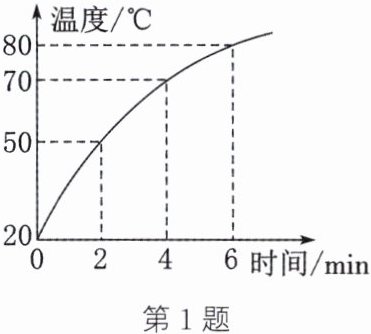
1. 某物理兴趣小组的同学,用煤炉给水加热,同时他们绘制了如图所示的加热过程中水的温度随时间变化的图线,在6min内完全燃烧了0.2kg的煤,水的比热容为$4.2×10^3J/(kg·℃),$煤的热值约为$3×10^7J/kg。$
(1)求煤完全燃烧产生的热量。
(2)若该煤炉烧水的热效率为42%,则水吸收了多少热量?
(3)求煤炉中水的质量。
(1)求煤完全燃烧产生的热量。
(2)若该煤炉烧水的热效率为42%,则水吸收了多少热量?
(3)求煤炉中水的质量。
答案:
(1) 煤完全燃烧放出的热量 $ Q_{\text{放}} = m_{\text{煤}} q_{\text{煤}} = 0.2 \, \text{kg} \times 3 \times 10^{7} \, \text{J/kg} = 6 \times 10^{6} \, \text{J} $
(2) 水吸收的热量 $ Q_{\text{吸}} = Q_{\text{放}} \eta = 6 \times 10^{6} \, \text{J} \times 42\% = 2.52 \times 10^{6} \, \text{J} $
(3) 由图可知,在 $ 6 \, \text{min} $ 内水升高的温度 $ \Delta t = t - t_{0} = 80 \, \text{°C} - 20 \, \text{°C} = 60 \, \text{°C} $,煤炉中水的质量 $ m_{\text{水}} = \frac{Q_{\text{吸}}}{c_{\text{水}} \Delta t} = \frac{2.52 \times 10^{6} \, \text{J}}{4.2 \times 10^{3} \, \text{J/(kg·°C)} \times 60 \, \text{°C}} = 10 \, \text{kg} $
(1) 煤完全燃烧放出的热量 $ Q_{\text{放}} = m_{\text{煤}} q_{\text{煤}} = 0.2 \, \text{kg} \times 3 \times 10^{7} \, \text{J/kg} = 6 \times 10^{6} \, \text{J} $
(2) 水吸收的热量 $ Q_{\text{吸}} = Q_{\text{放}} \eta = 6 \times 10^{6} \, \text{J} \times 42\% = 2.52 \times 10^{6} \, \text{J} $
(3) 由图可知,在 $ 6 \, \text{min} $ 内水升高的温度 $ \Delta t = t - t_{0} = 80 \, \text{°C} - 20 \, \text{°C} = 60 \, \text{°C} $,煤炉中水的质量 $ m_{\text{水}} = \frac{Q_{\text{吸}}}{c_{\text{水}} \Delta t} = \frac{2.52 \times 10^{6} \, \text{J}}{4.2 \times 10^{3} \, \text{J/(kg·°C)} \times 60 \, \text{°C}} = 10 \, \text{kg} $
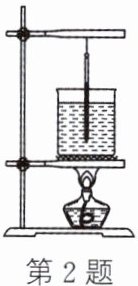
2. (2024·常州)中国工程师利用焦炉气中的氢气与工业尾气中的二氧化碳,合成液态燃料,作为第19届亚洲运动会主火炬的燃料。工程师在科普馆用如图所示的装置为同学们演示模拟实验,测量该燃料的热值。
① 在空酒精灯内加入适量该液态燃料,得到"燃料灯"。
② 在空烧杯内加入1kg水,测得水的初温为31℃,点燃"燃料灯"开始加热。
③ 当水恰好沸腾时,立即熄灭"燃料灯",测得"燃料灯"消耗燃料30g。
已知实验时气压为标准大气压,c_水$= 4.2×10^3J/(kg·℃),$用该装置加热水的效率为42%。求:
(1)此过程中,烧杯内水吸收的热量。
(2)该液态燃料的热值。
① 在空酒精灯内加入适量该液态燃料,得到"燃料灯"。
② 在空烧杯内加入1kg水,测得水的初温为31℃,点燃"燃料灯"开始加热。
③ 当水恰好沸腾时,立即熄灭"燃料灯",测得"燃料灯"消耗燃料30g。
已知实验时气压为标准大气压,c_水$= 4.2×10^3J/(kg·℃),$用该装置加热水的效率为42%。求:
(1)此过程中,烧杯内水吸收的热量。
(2)该液态燃料的热值。
答案:
(1) 水吸收的热量 $ Q_{\text{吸}} = c_{\text{水}} m (t - t_{0}) = 4.2 \times 10^{3} \, \text{J/(kg·°C)} \times 1 \, \text{kg} \times (100 \, \text{°C} - 31 \, \text{°C}) = 2.898 \times 10^{5} \, \text{J} $
(2) 燃料燃烧放出的热量 $ Q_{\text{放}} = \frac{Q_{\text{吸}}}{\eta} = \frac{2.898 \times 10^{5} \, \text{J}}{42\%} = 6.9 \times 10^{5} \, \text{J} $; $ q_{\text{燃料}} = \frac{Q_{\text{放}}}{m_{\text{燃料}}} = \frac{6.9 \times 10^{5} \, \text{J}}{0.03 \, \text{kg}} = 2.3 \times 10^{7} \, \text{J/kg} $
(1) 水吸收的热量 $ Q_{\text{吸}} = c_{\text{水}} m (t - t_{0}) = 4.2 \times 10^{3} \, \text{J/(kg·°C)} \times 1 \, \text{kg} \times (100 \, \text{°C} - 31 \, \text{°C}) = 2.898 \times 10^{5} \, \text{J} $
(2) 燃料燃烧放出的热量 $ Q_{\text{放}} = \frac{Q_{\text{吸}}}{\eta} = \frac{2.898 \times 10^{5} \, \text{J}}{42\%} = 6.9 \times 10^{5} \, \text{J} $; $ q_{\text{燃料}} = \frac{Q_{\text{放}}}{m_{\text{燃料}}} = \frac{6.9 \times 10^{5} \, \text{J}}{0.03 \, \text{kg}} = 2.3 \times 10^{7} \, \text{J/kg} $
查看更多完整答案,请扫码查看

