

 搜索
搜索
2025年天星教育金考卷一轮复习单元滚动双测卷英语
注:目前有些书本章节名称可能整理的还不是很完善,但都是按照顺序排列的,请同学们按照顺序仔细查找。练习册 2025年天星教育金考卷一轮复习单元滚动双测卷英语 答案主要是用来给同学们做完题方便对答案用的,请勿直接抄袭。
第29页
- 第1页
- 第2页
- 第3页
- 第4页
- 第5页
- 第6页
- 第7页
- 第8页
- 第9页
- 第10页
- 第11页
- 第12页
- 第13页
- 第14页
- 第15页
- 第16页
- 第17页
- 第18页
- 第19页
- 第20页
- 第21页
- 第22页
- 第23页
- 第24页
- 第25页
- 第26页
- 第27页
- 第28页
- 第29页
- 第30页
- 第31页
- 第32页
- 第33页
- 第34页
- 第35页
- 第36页
- 第37页
- 第38页
- 第39页
- 第40页
- 第41页
- 第42页
- 第43页
- 第44页
- 第45页
- 第46页
- 第47页
- 第48页
- 第49页
- 第50页
- 第51页
- 第52页
- 第53页
- 第54页
- 第55页
- 第56页
- 第57页
- 第58页
- 第59页
- 第60页
- 第61页
- 第62页
- 第63页
- 第64页
- 第65页
- 第66页
- 第67页
- 第68页
- 第69页
- 第70页
- 第71页
- 第72页
- 第73页
- 第74页
- 第75页
- 第76页
- 第77页
- 第78页
- 第79页
- 第80页
- 第81页
- 第82页
- 第83页
- 第84页
- 第85页
- 第86页
- 第87页
- 第88页
- 第89页
- 第90页
- 第91页
- 第92页
- 第93页
- 第94页
- 第95页
- 第96页
- 第97页
- 第98页
- 第99页
- 第100页
- 第101页
- 第102页
- 第103页
- 第104页
- 第105页
- 第106页
- 第107页
- 第108页
- 第109页
- 第110页
- 第111页
- 第112页
- 第113页
- 第114页
- 第115页
- 第116页
- 第117页
- 第118页
- 第119页
- 第120页
- 第121页
- 第122页
- 第123页
- 第124页
- 第125页
- 第126页
- 第127页
- 第128页
- 第129页
- 第130页
- 第131页
- 第132页
- 第133页
- 第134页
- 第135页
- 第136页
- 第137页
- 第138页
- 第139页
- 第140页
- 第141页
- 第142页
- 第143页
- 第144页
D
’ 思辨能力>[2025江苏南通期中]Imagining a human being without historical sense is scary. The thought of living exclusively (仅仅) in a present moment is scary. Scarier still is the thought of an entire generation, not to mention society, operating with a lack of a sense of history. And yet that is exactly the situation in which we find ourselves today.
The people and events of history may be rooted in the past, but how we talk about those things, what we write about them, and how we teach them—in other words, how we practise history as the record of human experience—tell us a lot about who we are and what we value right now. Thinking of ourselves as a chapter in an as yet unwritten history book, on the other hand, is likely to force deeper self - reflection: Whose stories will we stand up for? What values will we defend? What models will we offer following generations? In an era of environmental change, rising inequality and great shifts in the international context, we need to understand how our institutions have developed. History gives us power.
No other subject helps us to understand so comprehensively what it is to be human.
The consequences of ignorance of what has happened are incredible, but the ignorance itself isn’t entirely surprising given the position of the discipline of history in most schools. “History fights for its place in the curriculum with geography,” Dr. Bain observed, “but its attention to time, place and context is what makes it really distinct.” In other words, history doesn’t simply tell us how to be good citizens: It equips us with the knowledge we need to comprehend our world clearly, and the ability to analyze it accurately.
Clearly, in an age of “fake (假的) news”, engaged citizens need to be culturally literate, critical thinkers. There is no better subject than history to develop an appreciation of context and an ability to look for evidence. We should expect a logical history curriculum for our children. If it were common to hear graduates claim that they’d never learned to add, subtract(减), multiply and divide, there would be a severe protest. So should there be now.
32. What is the situation the author mentioned in paragraph 1?
A. The fear of the past.
B. The ignorance of history.
C. The exclusion of the present.
D. The dissatisfaction of society.
33. What does the author mainly stress in paragraph 2?
A. Consequences of overlooking history.
B. Significance of mastering all subjects.
C. Insights from history for today and tomorrow.
D. Resolutions of the current international issues.
34. Which statement might Dr. Bain agree with?
A. Critical thinking is key to studying history well.
B. Schools should enhance the status of history curriculum.
C. Ignorance of history is not as terrible as expected in schools.
D. History proves more meaningful and practical than geography.
35. What does the underlined sentence mean?
A. The historical sense can help us differentiate the news.
B. People are dissatisfied with graduates’ ability to calculate.
C. We should make history curriculum more logical and critical.
D. We should pay the same attention to history as to other subjects.
’ 思辨能力>[2025江苏南通期中]Imagining a human being without historical sense is scary. The thought of living exclusively (仅仅) in a present moment is scary. Scarier still is the thought of an entire generation, not to mention society, operating with a lack of a sense of history. And yet that is exactly the situation in which we find ourselves today.
The people and events of history may be rooted in the past, but how we talk about those things, what we write about them, and how we teach them—in other words, how we practise history as the record of human experience—tell us a lot about who we are and what we value right now. Thinking of ourselves as a chapter in an as yet unwritten history book, on the other hand, is likely to force deeper self - reflection: Whose stories will we stand up for? What values will we defend? What models will we offer following generations? In an era of environmental change, rising inequality and great shifts in the international context, we need to understand how our institutions have developed. History gives us power.
No other subject helps us to understand so comprehensively what it is to be human.
The consequences of ignorance of what has happened are incredible, but the ignorance itself isn’t entirely surprising given the position of the discipline of history in most schools. “History fights for its place in the curriculum with geography,” Dr. Bain observed, “but its attention to time, place and context is what makes it really distinct.” In other words, history doesn’t simply tell us how to be good citizens: It equips us with the knowledge we need to comprehend our world clearly, and the ability to analyze it accurately.
Clearly, in an age of “fake (假的) news”, engaged citizens need to be culturally literate, critical thinkers. There is no better subject than history to develop an appreciation of context and an ability to look for evidence. We should expect a logical history curriculum for our children. If it were common to hear graduates claim that they’d never learned to add, subtract(减), multiply and divide, there would be a severe protest. So should there be now.
32. What is the situation the author mentioned in paragraph 1?
A. The fear of the past.
B. The ignorance of history.
C. The exclusion of the present.
D. The dissatisfaction of society.
33. What does the author mainly stress in paragraph 2?
A. Consequences of overlooking history.
B. Significance of mastering all subjects.
C. Insights from history for today and tomorrow.
D. Resolutions of the current international issues.
34. Which statement might Dr. Bain agree with?
A. Critical thinking is key to studying history well.
B. Schools should enhance the status of history curriculum.
C. Ignorance of history is not as terrible as expected in schools.
D. History proves more meaningful and practical than geography.
35. What does the underlined sentence mean?
A. The historical sense can help us differentiate the news.
B. People are dissatisfied with graduates’ ability to calculate.
C. We should make history curriculum more logical and critical.
D. We should pay the same attention to history as to other subjects.
答案:
32.B 细节理解题。根据第一段的“Imagining a human being... today”可知,想象一个没有历史感的人是可怕的。只活在当下的想法是可怕的。更可怕的是,整整一代人,更不用说整个社会,在缺乏历史感的情况下运作。然而,这正是我们今天所处的境地。由此可知,作者在第一段提到了人们对历史的无知。
33.C 推理判断题。
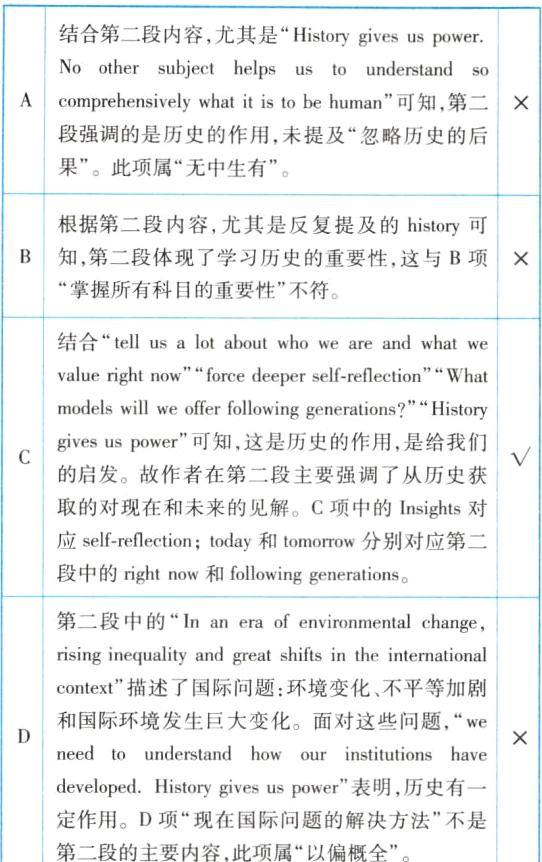
A 结合第二段内容,尤其是“History gives us power. No other subject helps us to understand so comprehensively what it is to be human”可知,第二段强调的是历史的作用,未提及“忽略历史的后果”。此项属“无中生有”。
B 根据第二段内容,尤其是反复提及的history可知,第二段体现了学习历史的重要性,这与B项“掌握所有科目的重要性”不符。
C 结合“tell us a lot about who we are and what we value right now”“force deeper self - reflection”“What models will we offer following generations?”“History gives us power”可知,这是历史的作用,是给我们的启发。作者在第二段主要强调了从历史获取的对现在和未来的见解。C项中的Insights对应self - reflection;today和tomorrow分别对应第二段中的right now和following generations。
D 第二段中的“In an era of environmental change, rising inequality and great shifts in the international context”描述了国际问题:环境变化、不平等加剧和国际环境发生巨大变化。面对这些问题,“we need to understand how our institutions have developed. History gives us power”表明,历史有一定作用。D项“现在国际问题的解决方法”不是第二段的主要内容,此项属“以偏概全”。
34.B 推理判断题。根据第三段的“The consequences of ignorance... given the position of the discipline of history in most schools”可知,对历史一无所知的后果是令人难以置信的,但鉴于历史学科在大多数学校中的地位,无知本身并不完全令人惊讶。这表明,如今历史学科在学校中不受重视。根据Dr. Bain的话“but its attention to time, place and context is what makes it really distinct”可知,Dr. Bain认为历史对时间、地点和背景的关注使它真正与众不同,他重视历史学科。下文中的“history... and the ability to analyze it accurately”表明,历史不仅仅告诉我们如何成为好公民,它还让我们具备了清晰地理解世界所需的知识,以及准确分析世界的能力,这证明历史是如此重要。由此可知,历史学科如今在学校中不受重视,但是它又如此重要,Dr. Bain重视历史学科,他应该会赞同“学校应该提高历史课程的地位”这一观点。
35.D 句意理解题。根据最后一段“There is no better subject... expect a logical history curriculum for our children”可知,没有比历史更适合培养对背景的鉴赏能力和寻找证据的能力的学科了,我们应该为我们的孩子要求一个合乎逻辑的历史课程。由此可知,作者呼吁重视历史课。根据“If it were... be now”可知,如果经常听到毕业生声称他们从未学过加减乘除,那一定会引起强烈的抗议,历史课也应该是这样。作者认为历史学科应该受到和其他学科一样的重视。故D项“我们对待历史课应该像对待其他学科一样重视”正确。
32.B 细节理解题。根据第一段的“Imagining a human being... today”可知,想象一个没有历史感的人是可怕的。只活在当下的想法是可怕的。更可怕的是,整整一代人,更不用说整个社会,在缺乏历史感的情况下运作。然而,这正是我们今天所处的境地。由此可知,作者在第一段提到了人们对历史的无知。
33.C 推理判断题。
A 结合第二段内容,尤其是“History gives us power. No other subject helps us to understand so comprehensively what it is to be human”可知,第二段强调的是历史的作用,未提及“忽略历史的后果”。此项属“无中生有”。
B 根据第二段内容,尤其是反复提及的history可知,第二段体现了学习历史的重要性,这与B项“掌握所有科目的重要性”不符。
C 结合“tell us a lot about who we are and what we value right now”“force deeper self - reflection”“What models will we offer following generations?”“History gives us power”可知,这是历史的作用,是给我们的启发。作者在第二段主要强调了从历史获取的对现在和未来的见解。C项中的Insights对应self - reflection;today和tomorrow分别对应第二段中的right now和following generations。
D 第二段中的“In an era of environmental change, rising inequality and great shifts in the international context”描述了国际问题:环境变化、不平等加剧和国际环境发生巨大变化。面对这些问题,“we need to understand how our institutions have developed. History gives us power”表明,历史有一定作用。D项“现在国际问题的解决方法”不是第二段的主要内容,此项属“以偏概全”。
34.B 推理判断题。根据第三段的“The consequences of ignorance... given the position of the discipline of history in most schools”可知,对历史一无所知的后果是令人难以置信的,但鉴于历史学科在大多数学校中的地位,无知本身并不完全令人惊讶。这表明,如今历史学科在学校中不受重视。根据Dr. Bain的话“but its attention to time, place and context is what makes it really distinct”可知,Dr. Bain认为历史对时间、地点和背景的关注使它真正与众不同,他重视历史学科。下文中的“history... and the ability to analyze it accurately”表明,历史不仅仅告诉我们如何成为好公民,它还让我们具备了清晰地理解世界所需的知识,以及准确分析世界的能力,这证明历史是如此重要。由此可知,历史学科如今在学校中不受重视,但是它又如此重要,Dr. Bain重视历史学科,他应该会赞同“学校应该提高历史课程的地位”这一观点。
35.D 句意理解题。根据最后一段“There is no better subject... expect a logical history curriculum for our children”可知,没有比历史更适合培养对背景的鉴赏能力和寻找证据的能力的学科了,我们应该为我们的孩子要求一个合乎逻辑的历史课程。由此可知,作者呼吁重视历史课。根据“If it were... be now”可知,如果经常听到毕业生声称他们从未学过加减乘除,那一定会引起强烈的抗议,历史课也应该是这样。作者认为历史学科应该受到和其他学科一样的重视。故D项“我们对待历史课应该像对待其他学科一样重视”正确。
查看更多完整答案,请扫码查看

