

 搜索
搜索
2025年通城学典组合训练七年级英语人教版江西专版
注:目前有些书本章节名称可能整理的还不是很完善,但都是按照顺序排列的,请同学们按照顺序仔细查找。练习册 2025年通城学典组合训练七年级英语人教版江西专版 答案主要是用来给同学们做完题方便对答案用的,请勿直接抄袭。
第36页
- 第1页
- 第2页
- 第3页
- 第4页
- 第5页
- 第6页
- 第7页
- 第8页
- 第9页
- 第10页
- 第11页
- 第12页
- 第13页
- 第14页
- 第15页
- 第16页
- 第17页
- 第18页
- 第19页
- 第20页
- 第21页
- 第22页
- 第23页
- 第24页
- 第25页
- 第26页
- 第27页
- 第28页
- 第29页
- 第30页
- 第31页
- 第32页
- 第33页
- 第34页
- 第35页
- 第36页
- 第37页
- 第38页
- 第39页
- 第40页
- 第41页
- 第42页
- 第43页
- 第44页
- 第45页
- 第46页
- 第47页
- 第48页
- 第49页
- 第50页
- 第51页
- 第52页
- 第53页
- 第54页
- 第55页
- 第56页
- 第57页
- 第58页
- 第59页
- 第60页
- 第61页
- 第62页
- 第63页
- 第64页
- 第65页
- 第66页
- 第67页
- 第68页
- 第69页
- 第70页
- 第71页
- 第72页
- 第73页
- 第74页
- 第75页
- 第76页
- 第77页
- 第78页
- 第79页
- 第80页
- 第81页
- 第82页
- 第83页
- 第84页
- 第85页
- 第86页
- 第87页
- 第88页
- 第89页
- 第90页
- 第91页
- 第92页
- 第93页
- 第94页
- 第95页
- 第96页
- 第97页
- 第98页
- 第99页
- 第100页
- 第101页
- 第102页
- 第103页
- 第104页
- 第105页
- 第106页
- 第107页
- 第108页
- 第109页
- 第110页
- 第111页
- 第112页
- 第113页
- 第114页
- 第115页
- 第116页
- 第117页
- 第118页
- 第119页
- 第120页
- 第121页
- 第122页
- 第123页
- 第124页
- 第125页
- 第126页
- 第127页
- 第128页
- 第129页
- 第130页
- 第131页
- 第132页
一、完形填空
范畴:人与社会 主题:风俗习惯 体裁:说明文 难度:★★★ 建议用时:7 分钟 评价:___/15
The Spring Festival is coming. It's the best 1 to give gifts to family members and friends. 2 in different countries, there are different taboos(禁忌). 3 are those in China?
Chinese people usually don't give a 4 to each other. "Clock" sounds like "zhong" 5 Chinese, which means "the end". So giving someone a clock is like 6 "Your time is up." People would 7 it is not lucky, especially the elderly(上了年纪的人).
Buying pears or an umbrella is not a good 8, either. "Pear" sounds like " 9 " in Chinese. "Umbrella" 10 "san" in Chinese. 11 are not good gifts for friends.
"Hongbao" with money in it is the most popular 12 in China. People give "hongbao" to show 13 love. People put a 14 amount(数额) of money in "hongbao". Six and eight are lucky 15 in China.
(
(
(
(
(
(
(
(
(
(
(
(
(
(
(
范畴:人与社会 主题:风俗习惯 体裁:说明文 难度:★★★ 建议用时:7 分钟 评价:___/15
The Spring Festival is coming. It's the best 1 to give gifts to family members and friends. 2 in different countries, there are different taboos(禁忌). 3 are those in China?
Chinese people usually don't give a 4 to each other. "Clock" sounds like "zhong" 5 Chinese, which means "the end". So giving someone a clock is like 6 "Your time is up." People would 7 it is not lucky, especially the elderly(上了年纪的人).
Buying pears or an umbrella is not a good 8, either. "Pear" sounds like " 9 " in Chinese. "Umbrella" 10 "san" in Chinese. 11 are not good gifts for friends.
"Hongbao" with money in it is the most popular 12 in China. People give "hongbao" to show 13 love. People put a 14 amount(数额) of money in "hongbao". Six and eight are lucky 15 in China.
(
C
)1. A. place B. life C. time D. wish(
B
)2. A. And B. But C. So D. Or(
D
)3. A. When B. Where C. How D. What(
A
)4. A. clock B. watch C. book D. map(
C
)5. A. with B. by C. in D. to(
A
)6. A. saying B. speaking C. talking D. writing(
A
)7. A. think B. know C. remember D. forget(
B
)8. A. key B. idea C. rule D. ticket(
C
)9. A. ping B. le C. li D. wan(
D
)10. A. looks like B. feels like C. smells like D. sounds like(
A
)11. A. They B. Them C. We D. Us(
C
)12. A. love B. food C. gift D. money(
C
)13. A. your B. our C. their D. my(
B
)14. A. right B. lucky C. modern D. true(
C
)15. A. pictures B. times C. numbers D. signs
答案:
1~5 C B D A C 6~10 A A B C D 11~15 A C C B C
中国人送礼物时有很多忌讳,如不能给别人送钟、梨、伞等,因为它们会被误解为“送终”“分离”“散”等,而红包在中国是最受欢迎的礼物。
1. C 由前句“The Spring Festival is coming.”可知,春节是给家人和朋友赠送礼物的最好时刻。
2. B 在不同的国家有不同的禁忌。上下句为转折关系,此处用连词 But。
3. D 句意:在中国那些(禁忌)是什么?用 What。
4. A 根据下文中的“‘Clock’ sounds like ...”可判断,这里谈论的是钟。
5. C 表示“在汉语中”,用介词 in。
6. A 送某人钟就像在说“你的时限已到”。
7. A 人们会认为这不吉利。
8. B 根据语境可推知,买梨或伞也不是一个好主意。
9. C pear 梨,在中文里,它的发音听起来像“离”,有分离之意。
10. D 根据上文中“‘Pear’ sounds like ‘li’ in Chinese.”可推断,这里表达的是“‘伞’听起来像汉语中的‘散’”。sound like 意为“听起来像”。
11. A 主格 They 作句子的主语,代指前面的“梨”和“伞”。
12. C 装有钱的红包在中国是最流行的礼物。
13. C 句子主语为 People,是第三人称复数,其对应的形容词性物主代词为 their。
14. B 根据最后一句中的 Six and eight 可知,红包里面的钱数是幸运数字。
15. C 根据常识可知,在中国,6 和 8 是幸运数字。
中国人送礼物时有很多忌讳,如不能给别人送钟、梨、伞等,因为它们会被误解为“送终”“分离”“散”等,而红包在中国是最受欢迎的礼物。
1. C 由前句“The Spring Festival is coming.”可知,春节是给家人和朋友赠送礼物的最好时刻。
2. B 在不同的国家有不同的禁忌。上下句为转折关系,此处用连词 But。
3. D 句意:在中国那些(禁忌)是什么?用 What。
4. A 根据下文中的“‘Clock’ sounds like ...”可判断,这里谈论的是钟。
5. C 表示“在汉语中”,用介词 in。
6. A 送某人钟就像在说“你的时限已到”。
7. A 人们会认为这不吉利。
8. B 根据语境可推知,买梨或伞也不是一个好主意。
9. C pear 梨,在中文里,它的发音听起来像“离”,有分离之意。
10. D 根据上文中“‘Pear’ sounds like ‘li’ in Chinese.”可推断,这里表达的是“‘伞’听起来像汉语中的‘散’”。sound like 意为“听起来像”。
11. A 主格 They 作句子的主语,代指前面的“梨”和“伞”。
12. C 装有钱的红包在中国是最流行的礼物。
13. C 句子主语为 People,是第三人称复数,其对应的形容词性物主代词为 their。
14. B 根据最后一句中的 Six and eight 可知,红包里面的钱数是幸运数字。
15. C 根据常识可知,在中国,6 和 8 是幸运数字。
范畴:人与社会 主题:和谐家庭 体裁:应用文 难度:★★★ 建议用时:5 分钟 评价:___/3
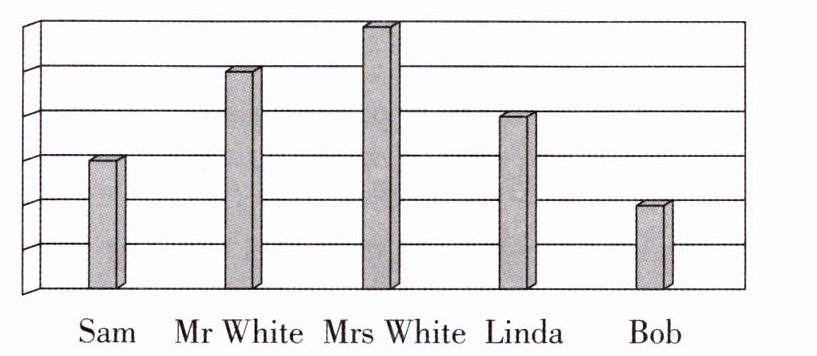
Everyone in Mr White's family shares the housework. This is how much housework each member does in his family.
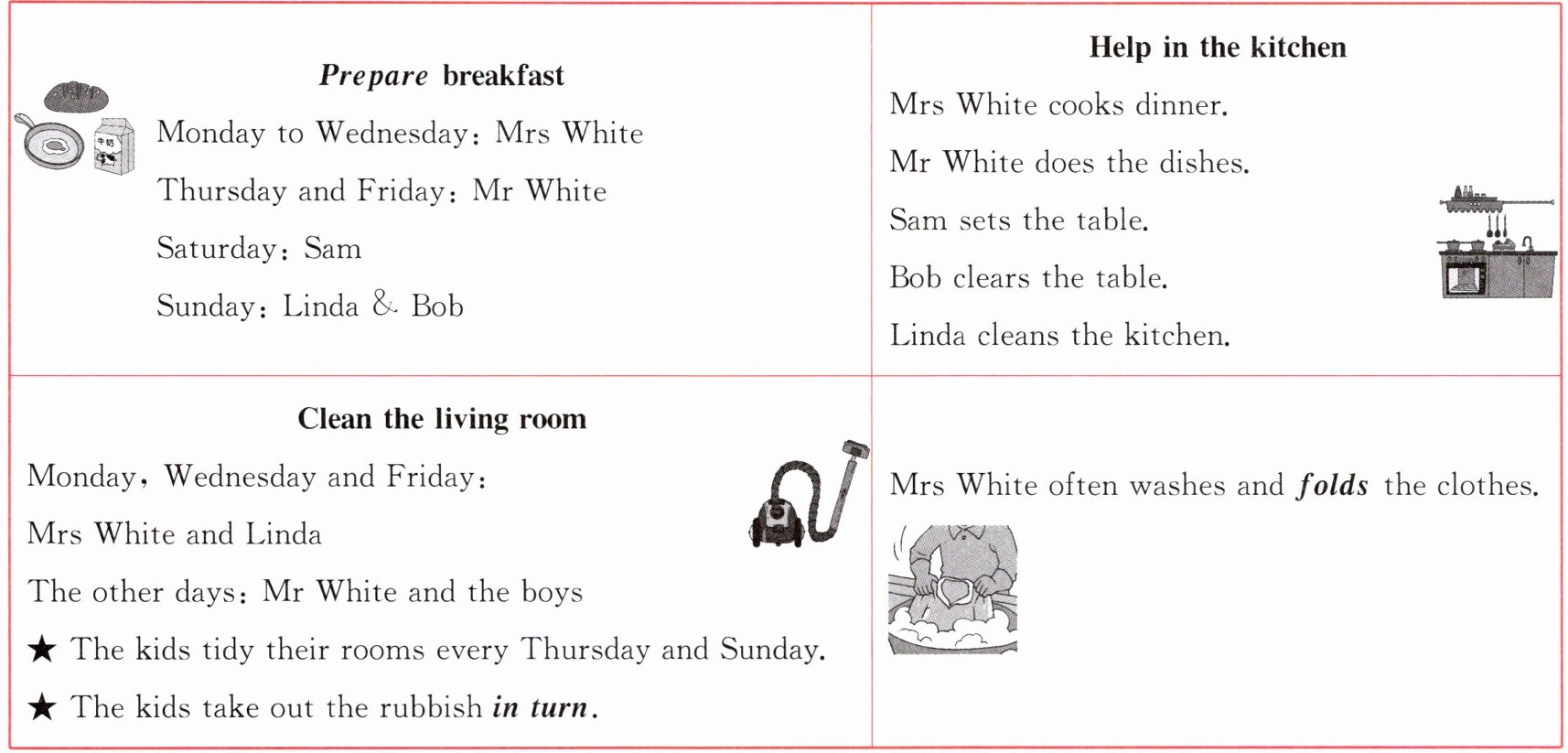
Let's see what they often do.
(
A. Three. B. Four. C. Five. D. Six.
(
A. Only 4 times. B. About 8 times.
C. Less than 10 times. D. About 12 times.
(
A. Linda cooks breakfast every Saturday.
B. The kids tidy their rooms twice a week.
C. Mr White often clears and sets the table.
D. Sam prepares dinners at weekends.
Everyone in Mr White's family shares the housework. This is how much housework each member does in his family.
Let's see what they often do.
(
C
)1. How many people are there in Mr White's family?A. Three. B. Four. C. Five. D. Six.
(
D
)2. How many times does Mrs White prepare breakfast every month?A. Only 4 times. B. About 8 times.
C. Less than 10 times. D. About 12 times.
(
B
)3. Which of the following statements is TRUE?A. Linda cooks breakfast every Saturday.
B. The kids tidy their rooms twice a week.
C. Mr White often clears and sets the table.
D. Sam prepares dinners at weekends.
答案:
1. C 细节理解题。根据柱状图中的信息可知,Mr White 的家中一共有 5 口人。
2. D 推理判断题。根据 Prepare breakfast 中的“Monday to Wednesday:Mrs White”可知,Mrs White 每周周一到周三做早餐,每周三次,一个月大约四周,她大约做 12 顿早餐。
3. B 细节理解题。根据“The kids tidy their rooms every Thursday and Sunday.”可知,孩子们每周四和周日需要整理房间,一周两次。
2. D 推理判断题。根据 Prepare breakfast 中的“Monday to Wednesday:Mrs White”可知,Mrs White 每周周一到周三做早餐,每周三次,一个月大约四周,她大约做 12 顿早餐。
3. B 细节理解题。根据“The kids tidy their rooms every Thursday and Sunday.”可知,孩子们每周四和周日需要整理房间,一周两次。
查看更多完整答案,请扫码查看

