

 搜索
搜索
第128页
- 第1页
- 第2页
- 第3页
- 第4页
- 第5页
- 第6页
- 第7页
- 第8页
- 第9页
- 第10页
- 第11页
- 第12页
- 第13页
- 第14页
- 第15页
- 第16页
- 第17页
- 第18页
- 第19页
- 第20页
- 第21页
- 第22页
- 第23页
- 第24页
- 第25页
- 第26页
- 第27页
- 第28页
- 第29页
- 第30页
- 第31页
- 第32页
- 第33页
- 第34页
- 第35页
- 第36页
- 第37页
- 第38页
- 第39页
- 第40页
- 第41页
- 第42页
- 第43页
- 第44页
- 第45页
- 第46页
- 第47页
- 第48页
- 第49页
- 第50页
- 第51页
- 第52页
- 第53页
- 第54页
- 第55页
- 第56页
- 第57页
- 第58页
- 第59页
- 第60页
- 第61页
- 第62页
- 第63页
- 第64页
- 第65页
- 第66页
- 第67页
- 第68页
- 第69页
- 第70页
- 第71页
- 第72页
- 第73页
- 第74页
- 第75页
- 第76页
- 第77页
- 第78页
- 第79页
- 第80页
- 第81页
- 第82页
- 第83页
- 第84页
- 第85页
- 第86页
- 第87页
- 第88页
- 第89页
- 第90页
- 第91页
- 第92页
- 第93页
- 第94页
- 第95页
- 第96页
- 第97页
- 第98页
- 第99页
- 第100页
- 第101页
- 第102页
- 第103页
- 第104页
- 第105页
- 第106页
- 第107页
- 第108页
- 第109页
- 第110页
- 第111页
- 第112页
- 第113页
- 第114页
- 第115页
- 第116页
- 第117页
- 第118页
- 第119页
- 第120页
- 第121页
- 第122页
- 第123页
- 第124页
- 第125页
- 第126页
- 第127页
- 第128页
- 第129页
- 第130页
- 第131页
- 第132页
- 第133页
- 第134页
- 第135页
- 第136页
- 第137页
- 第138页
- 第139页
- 第140页
- 第141页
- 第142页
- 第143页
- 第144页
- 第145页
- 第146页
- 第147页
- 第148页
- 第149页
- 第150页
- 第151页
- 第152页
- 第153页
- 第154页
- 第155页
- 第156页
- 第157页
- 第158页
- 第159页
- 第160页
- 第161页
- 第162页
- 第163页
- 第164页
- 第165页
- 第166页
- 第167页
- 第168页
- 第169页
- 第170页
- 第171页
- 第172页
- 第173页
- 第174页
- 第175页
- 第176页
- 第177页
- 第178页
- 第179页
- 第180页
- 第181页
- 第182页
- 第183页
- 第184页
- 第185页
- 第186页
- 第187页
- 第188页
- 第189页
- 第190页
- 第191页
- 第192页
- 第193页
- 第194页
- 第195页
4. 某兴趣小组为测定实验室中一瓶久置的过氧化氢溶液中溶质的质量分数,实验测得相关数据为:

|$\begin{matrix}过氧化氢溶液\\68.0g\end{matrix} $|+|$\begin{matrix}二氧化锰\\1.0g\end{matrix} $|$\xrightarrow{至质量不再减轻}$|$\begin{matrix}剩余的混合物\\67.4g\end{matrix} $|
(1)反应生成氧气的质量为____g。
(2)计算该过氧化氢溶液的溶质质量分数。
(3)实验表明,三氯化铁溶液在该反应中也能起到二氧化锰的作用。若用5.6g三氯化铁代替二氧化锰进行本实验,计算剩余的溶液中溶质的质量分数。
|$\begin{matrix}过氧化氢溶液\\68.0g\end{matrix} $|+|$\begin{matrix}二氧化锰\\1.0g\end{matrix} $|$\xrightarrow{至质量不再减轻}$|$\begin{matrix}剩余的混合物\\67.4g\end{matrix} $|
(1)反应生成氧气的质量为____g。
(2)计算该过氧化氢溶液的溶质质量分数。
(3)实验表明,三氯化铁溶液在该反应中也能起到二氧化锰的作用。若用5.6g三氯化铁代替二氧化锰进行本实验,计算剩余的溶液中溶质的质量分数。
答案:
(1)1.6 (2)5.0% (3)7.8%
5. 电解水时,可在水中加入硫酸使反应容易进行,硫酸本身并不被分解。现用45g溶质质量分数为8%的硫酸溶液进行电解水的实验,一段时间后,产生1g氢气。计算:
(1)被电解的水的质量。
(2)电解后的硫酸溶液的溶质质量分数。
(1)被电解的水的质量。
(2)电解后的硫酸溶液的溶质质量分数。
答案:
(1)9 g (2)10%
6. 为了测定某含杂质7%的黄铜样品中铜的质量分数(主要成分是铜和锌,杂质不溶于水,不与其他物质反应,受热也不分解),某化学小组进行了如下实验:
|$\begin{matrix}$黄铜样品粉末$100g\end{matrix} $|$\xrightarrow{加入100g\ 19.6\%的稀硫酸}$|$\begin{matrix}$恰好完全反应$\end{matrix} $|$\xrightarrow{过滤}$|$\begin{matrix}$不溶性物质$\\\end{matrix}\\ $|
|$\begin{matrix}\\\end{matrix}$|$\begin{matrix}\\ $|$\begin{matrix}\\\end{matrix}$|$\begin{matrix}\\ $|$\begin{matrix}\\\end{matrix}$|$\begin{matrix}\\ $|$\begin{matrix}\\\end{matrix}$|$\begin{matrix}\\ $
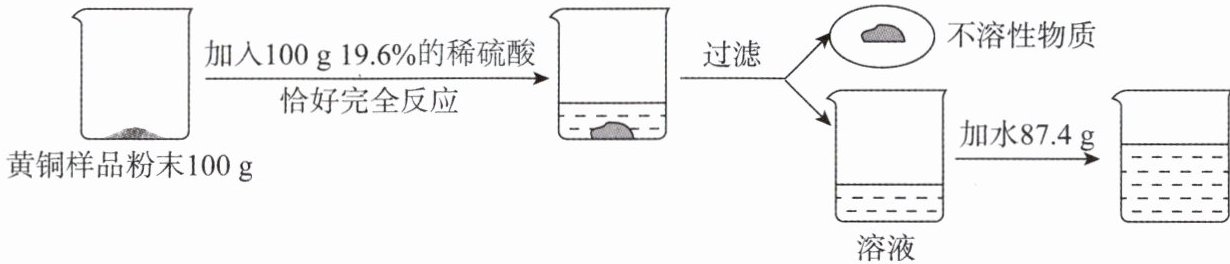 |$\begin{matrix}$溶液$\\\end{matrix}\\ $|$\xrightarrow{加水87.4g}$|$\begin{matrix}\\\end{matrix}\begin{matrix}\\ $|
(1)该黄铜样品中铜的质量分数为多少?
(2)向过滤后所得滤液中加入87.4g水,计算最终所得溶液中溶质的质量分数。
|$\begin{matrix}$黄铜样品粉末$100g\end{matrix} $|$\xrightarrow{加入100g\ 19.6\%的稀硫酸}$|$\begin{matrix}$恰好完全反应$\end{matrix} $|$\xrightarrow{过滤}$|$\begin{matrix}$不溶性物质$\\\end{matrix}\\ $|
|$\begin{matrix}\\\end{matrix}$|$\begin{matrix}\\ $|$\begin{matrix}\\\end{matrix}$|$\begin{matrix}\\ $|$\begin{matrix}\\\end{matrix}$|$\begin{matrix}\\ $|$\begin{matrix}\\\end{matrix}$|$\begin{matrix}\\ $
|$\begin{matrix}$溶液$\\\end{matrix}\\ $|$\xrightarrow{加水87.4g}$|$\begin{matrix}\\\end{matrix}\begin{matrix}\\ $|(1)该黄铜样品中铜的质量分数为多少?
(2)向过滤后所得滤液中加入87.4g水,计算最终所得溶液中溶质的质量分数。
答案:
(1)80% (2)16.1%
查看更多完整答案,请扫码查看

