

 搜索
搜索
1. 如图,在$\triangle ABC$中,$AB= AC= 10$,$BC= 12$,$AD\perp BC$,$O为AC$的中点,$E为AD$上的一点,以点$O$为圆心,$OE长为半径作\odot O$。
(1)当$\odot O与BC$相切,且$DE<AE$时,$DE$的长为______;
(2)求$\odot O与\triangle ABC的交点个数及对应的OE$的取值范围。
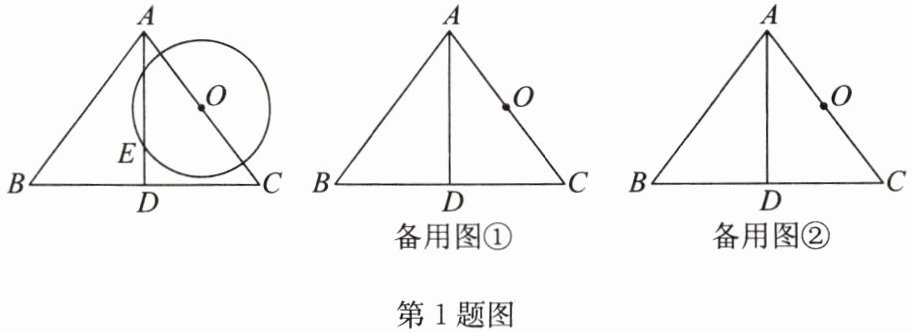
(1)当$\odot O与BC$相切,且$DE<AE$时,$DE$的长为______;
(2)求$\odot O与\triangle ABC的交点个数及对应的OE$的取值范围。
答案:
(1)$4 - \sqrt{7}$解析:如答图,过点O作$OM⊥AD$于点M,作$ON⊥BC$于点N,连接OE。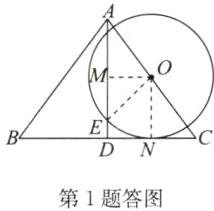
在等腰$\triangle ABC$中,$AB = AC = 10$,$AD⊥BC$,$BC = 12$,
$\therefore BD = DC = 6$。在$Rt\triangle ADC$中,O为AC的中点,$AC = 10$,$\therefore AO = CO = 5$,
由勾股定理得$AD = 8$。
$\because AD⊥OM$,$AD⊥CD$且O为AC的中点,$\therefore$M为AD的中点,$AM = DM = 4$。同理可知$OM = DN = 3$。
在$Rt\triangle OEM$中,$ME = \sqrt{OE^{2} - OM^{2}} = \sqrt{4^{2} - 3^{2}} = \sqrt{7}$,
$\therefore DE = MD - ME = 4 - \sqrt{7}$。
(2)解:由
(1)可知,OE最小为3(此时$OE⊥AD$),$\because$O为定点,E为AD上的动点,且OE为$\odot O$的半径,$\therefore$OE最长为5。当$3\leq OE\lt4$时,$\odot O$与$\triangle ABC$有2个交点。
当$OE = 4$时,$\odot O$与$\triangle ABC$有3个交点。
当$4\lt OE\lt\frac{24}{5}$时,$\odot O$与$\triangle ABC$有4个交点。
当$OE = \frac{24}{5}$时,$\odot O$与AB边相切,$\odot O$与$\triangle ABC$有5个交点。
当$\frac{24}{5}\lt OE\lt5$时,$\odot O$与$\triangle ABC$有6个交点。
当$OE = 5$时,$\odot O$与$\triangle ABC$有4个交点。
(1)$4 - \sqrt{7}$解析:如答图,过点O作$OM⊥AD$于点M,作$ON⊥BC$于点N,连接OE。
在等腰$\triangle ABC$中,$AB = AC = 10$,$AD⊥BC$,$BC = 12$,
$\therefore BD = DC = 6$。在$Rt\triangle ADC$中,O为AC的中点,$AC = 10$,$\therefore AO = CO = 5$,
由勾股定理得$AD = 8$。
$\because AD⊥OM$,$AD⊥CD$且O为AC的中点,$\therefore$M为AD的中点,$AM = DM = 4$。同理可知$OM = DN = 3$。
在$Rt\triangle OEM$中,$ME = \sqrt{OE^{2} - OM^{2}} = \sqrt{4^{2} - 3^{2}} = \sqrt{7}$,
$\therefore DE = MD - ME = 4 - \sqrt{7}$。
(2)解:由
(1)可知,OE最小为3(此时$OE⊥AD$),$\because$O为定点,E为AD上的动点,且OE为$\odot O$的半径,$\therefore$OE最长为5。当$3\leq OE\lt4$时,$\odot O$与$\triangle ABC$有2个交点。
当$OE = 4$时,$\odot O$与$\triangle ABC$有3个交点。
当$4\lt OE\lt\frac{24}{5}$时,$\odot O$与$\triangle ABC$有4个交点。
当$OE = \frac{24}{5}$时,$\odot O$与AB边相切,$\odot O$与$\triangle ABC$有5个交点。
当$\frac{24}{5}\lt OE\lt5$时,$\odot O$与$\triangle ABC$有6个交点。
当$OE = 5$时,$\odot O$与$\triangle ABC$有4个交点。
2. 如图,在矩形$ABCD$中,$AB= 4$,$BC= 6$。$E为射线CB$上一动点,以$DE为直径的\odot O交AD于点F$,过点$F作FG\perp AE于点G$。
(1)若$E为BC$的中点,求证:$FG为\odot O$的切线;
(2)若$CE= m$,求$\odot O与线段AB的交点个数及相应的m$的取值范围。
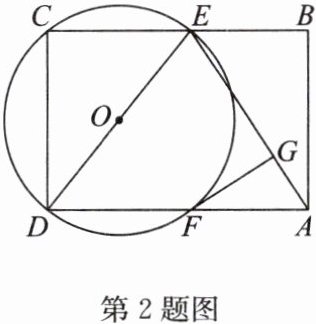
(1)若$E为BC$的中点,求证:$FG为\odot O$的切线;
(2)若$CE= m$,求$\odot O与线段AB的交点个数及相应的m$的取值范围。
答案:
(1)证明:如答图①,连接EF,OF。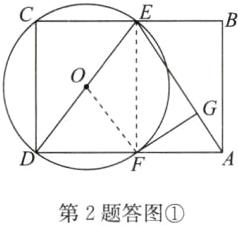
由矩形ABCD可得$∠B = ∠C$,$CD = BA$,$CB// DA$。
$\because$E为BC的中点,$\therefore CE = BE$,
$\therefore \triangle CDE\cong\triangle BAE(SAS)$,$\therefore ∠CED = ∠BEA$。
$\because CB// DA$,$\therefore ∠CED = ∠EDA$,$∠BEA = ∠EAD$。
在$\odot O$中,$\because OD = OF$,$\therefore ∠ODF = ∠OFD$,
$\therefore ∠OFD = ∠EAD$,$\therefore OF// EA$。
$\because FG⊥AE$,$\therefore OF⊥FG$。
$\because$点F在$\odot O$上,$\therefore$FG是$\odot O$的切线。
(2)解:如答图②,当$\odot O$与线段AB相切于点H时,连接HO并延长,交CD于点M。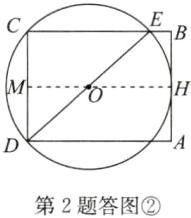
$\because \odot O$与线段AB相切,$\therefore OH⊥AB$。
$\because$四边形ABCD是矩形,$\therefore CD// AB$,$\therefore OM⊥CD$,
$\therefore DM = CM = \frac{1}{2}CD = 2$。设$OD = OH = x$,则$OM = 6 - x$。
在$Rt\triangle DOM$中,根据勾股定理,得$OM^{2} + DM^{2} = OD^{2}$,
$\therefore (6 - x)^{2} + 2^{2} = x^{2}$,解得$x = \frac{10}{3}$,
$\therefore OM = 6 - x = 6 - \frac{10}{3} = \frac{8}{3}$。
$\because$点M,O分别是CD,DE的中点,
$\therefore$OM是$\triangle CDE$的中位线,$\therefore OM = \frac{1}{2}CE = \frac{8}{3}$。
$\because CE = m$,$\therefore m = 2×\frac{8}{3} = \frac{16}{3}$,
$\therefore$当$m = \frac{16}{3}$时,$\odot O$与线段AB只有1个交点,
当$0\leq m\lt\frac{16}{3}$时,$\odot O$与线段AB没有交点。
如答图③,当点E与点B重合时,$CE = CB = 6$,即$m = 6$,此时$\odot O$与线段AB有2个交点。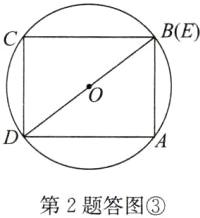
如答图④,当$\frac{16}{3}\lt CE\lt6$,即$\frac{16}{3}\lt m\lt6$时,$\odot O$与线段AB有2个交点。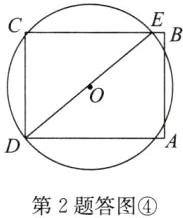
如答图⑤,当点E在点B的右侧时,$CE\gt CB = 6$,即$m\gt6$,此时$\odot O$与线段AB没有交点。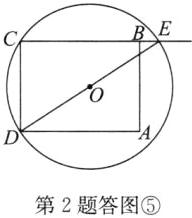
综上所述:当$0\leq m\lt\frac{16}{3}$或当$m\gt6$时,$\odot O$与线段AB没有交点;当$m = \frac{16}{3}$时,$\odot O$与线段AB有1个交点;当$\frac{16}{3}\lt m\leq6$时,$\odot O$与线段AB有2个交点。
(1)证明:如答图①,连接EF,OF。
由矩形ABCD可得$∠B = ∠C$,$CD = BA$,$CB// DA$。
$\because$E为BC的中点,$\therefore CE = BE$,
$\therefore \triangle CDE\cong\triangle BAE(SAS)$,$\therefore ∠CED = ∠BEA$。
$\because CB// DA$,$\therefore ∠CED = ∠EDA$,$∠BEA = ∠EAD$。
在$\odot O$中,$\because OD = OF$,$\therefore ∠ODF = ∠OFD$,
$\therefore ∠OFD = ∠EAD$,$\therefore OF// EA$。
$\because FG⊥AE$,$\therefore OF⊥FG$。
$\because$点F在$\odot O$上,$\therefore$FG是$\odot O$的切线。
(2)解:如答图②,当$\odot O$与线段AB相切于点H时,连接HO并延长,交CD于点M。
$\because \odot O$与线段AB相切,$\therefore OH⊥AB$。
$\because$四边形ABCD是矩形,$\therefore CD// AB$,$\therefore OM⊥CD$,
$\therefore DM = CM = \frac{1}{2}CD = 2$。设$OD = OH = x$,则$OM = 6 - x$。
在$Rt\triangle DOM$中,根据勾股定理,得$OM^{2} + DM^{2} = OD^{2}$,
$\therefore (6 - x)^{2} + 2^{2} = x^{2}$,解得$x = \frac{10}{3}$,
$\therefore OM = 6 - x = 6 - \frac{10}{3} = \frac{8}{3}$。
$\because$点M,O分别是CD,DE的中点,
$\therefore$OM是$\triangle CDE$的中位线,$\therefore OM = \frac{1}{2}CE = \frac{8}{3}$。
$\because CE = m$,$\therefore m = 2×\frac{8}{3} = \frac{16}{3}$,
$\therefore$当$m = \frac{16}{3}$时,$\odot O$与线段AB只有1个交点,
当$0\leq m\lt\frac{16}{3}$时,$\odot O$与线段AB没有交点。
如答图③,当点E与点B重合时,$CE = CB = 6$,即$m = 6$,此时$\odot O$与线段AB有2个交点。
如答图④,当$\frac{16}{3}\lt CE\lt6$,即$\frac{16}{3}\lt m\lt6$时,$\odot O$与线段AB有2个交点。
如答图⑤,当点E在点B的右侧时,$CE\gt CB = 6$,即$m\gt6$,此时$\odot O$与线段AB没有交点。
综上所述:当$0\leq m\lt\frac{16}{3}$或当$m\gt6$时,$\odot O$与线段AB没有交点;当$m = \frac{16}{3}$时,$\odot O$与线段AB有1个交点;当$\frac{16}{3}\lt m\leq6$时,$\odot O$与线段AB有2个交点。
查看更多完整答案,请扫码查看

