

 搜索
搜索
第127页
- 第1页
- 第2页
- 第3页
- 第4页
- 第5页
- 第6页
- 第7页
- 第8页
- 第9页
- 第10页
- 第11页
- 第12页
- 第13页
- 第14页
- 第15页
- 第16页
- 第17页
- 第18页
- 第19页
- 第20页
- 第21页
- 第22页
- 第23页
- 第24页
- 第25页
- 第26页
- 第27页
- 第28页
- 第29页
- 第30页
- 第31页
- 第32页
- 第33页
- 第34页
- 第35页
- 第36页
- 第37页
- 第38页
- 第39页
- 第40页
- 第41页
- 第42页
- 第43页
- 第44页
- 第45页
- 第46页
- 第47页
- 第48页
- 第49页
- 第50页
- 第51页
- 第52页
- 第53页
- 第54页
- 第55页
- 第56页
- 第57页
- 第58页
- 第59页
- 第60页
- 第61页
- 第62页
- 第63页
- 第64页
- 第65页
- 第66页
- 第67页
- 第68页
- 第69页
- 第70页
- 第71页
- 第72页
- 第73页
- 第74页
- 第75页
- 第76页
- 第77页
- 第78页
- 第79页
- 第80页
- 第81页
- 第82页
- 第83页
- 第84页
- 第85页
- 第86页
- 第87页
- 第88页
- 第89页
- 第90页
- 第91页
- 第92页
- 第93页
- 第94页
- 第95页
- 第96页
- 第97页
- 第98页
- 第99页
- 第100页
- 第101页
- 第102页
- 第103页
- 第104页
- 第105页
- 第106页
- 第107页
- 第108页
- 第109页
- 第110页
- 第111页
- 第112页
- 第113页
- 第114页
- 第115页
- 第116页
- 第117页
- 第118页
- 第119页
- 第120页
- 第121页
- 第122页
- 第123页
- 第124页
- 第125页
- 第126页
- 第127页
- 第128页
- 第129页
- 第130页
- 第131页
- 第132页
- 第133页
- 第134页
- 第135页
- 第136页
- 第137页
- 第138页
- 第139页
- 第140页
- 第141页
- 第142页
- 第143页
- 第144页
- 第145页
- 第146页
- 第147页
- 第148页
- 第149页
- 第150页
- 第151页
- 第152页
- 第153页
- 第154页
- 第155页
- 第156页
- 第157页
- 第158页
- 第159页
- 第160页
- 第161页
- 第162页
- 第163页
- 第164页
二、信息还原
阅读下面短文,从方框中选出能填入空白处的最佳选项。选项中有两项多余。
|题目|体裁|字数|难度|建议用时|实际用时|正确率|
|马面裙|说明文|291|★★★★|7 分钟|____分钟|____/5|
The tradition of wearing new clothes to celebrate the Chinese New Year has made *hanfu* experience big growth during the festival. 1
The horse-face skirt, also known as *mamianqun*, first appeared in the Song Dynasty and soon became popular because it was both practical and pretty. It remained a great choice during the Yuan, Ming, and Qing dynasties.
2
The horse-face skirt is colourful, mostly red and blue. Red is the most popular colour in traditional Chinese culture because it is a symbol of good luck and joy. Women usually wear red skirts during celebrations such as weddings and festivals. 4
Today’s horse-face skirts are different from those in ancient times. They have been modernized in a number of ways, but they still help connect the past with the present. 5
A. They don’t like to wear clothes in other colours.
B. Is the horse-face skirt only popular with young people?
C. In the Qing Dynasty, blue *mamianqun* was also common(常见的).
D. Later on, people used the term(术语) *mamian* to describe the skirt.
E. Among the many types of *hanfu*, the horse-face skirt stands out.
F. Does the name of the stylish skirt have anything to do with horses?
G. They show how Chinese culture and fashion have changed over time.
阅读下面短文,从方框中选出能填入空白处的最佳选项。选项中有两项多余。
|题目|体裁|字数|难度|建议用时|实际用时|正确率|
|马面裙|说明文|291|★★★★|7 分钟|____分钟|____/5|
The tradition of wearing new clothes to celebrate the Chinese New Year has made *hanfu* experience big growth during the festival. 1
E
The horse-face skirt, also known as *mamianqun*, first appeared in the Song Dynasty and soon became popular because it was both practical and pretty. It remained a great choice during the Yuan, Ming, and Qing dynasties.
2
F
The answer is no. In fact, the horse-face skirt got its name because it looked similar to the Mamian fortress(堡垒)—a part of the city wall. The pleats(褶) on the sides of the skirt looked like the stairs on the Mamian fortress. 3D
The horse-face skirt is colourful, mostly red and blue. Red is the most popular colour in traditional Chinese culture because it is a symbol of good luck and joy. Women usually wear red skirts during celebrations such as weddings and festivals. 4
C
As a popular colour at that time, blue was often paired with black and yellow.Today’s horse-face skirts are different from those in ancient times. They have been modernized in a number of ways, but they still help connect the past with the present. 5
G
A. They don’t like to wear clothes in other colours.
B. Is the horse-face skirt only popular with young people?
C. In the Qing Dynasty, blue *mamianqun* was also common(常见的).
D. Later on, people used the term(术语) *mamian* to describe the skirt.
E. Among the many types of *hanfu*, the horse-face skirt stands out.
F. Does the name of the stylish skirt have anything to do with horses?
G. They show how Chinese culture and fashion have changed over time.
答案:
1. E 2. F 3. D 4. C 5. G
三、任务型阅读
阅读下面短文,并根据所读内容在文章后的表格里填入最恰当的单词,每个空格只填一个单词。
|题目|体裁|字数|难度|建议用时|实际用时|正确率|
|时尚焦虑|议论文|357|★★★★|12 分钟|____分钟|____/10|
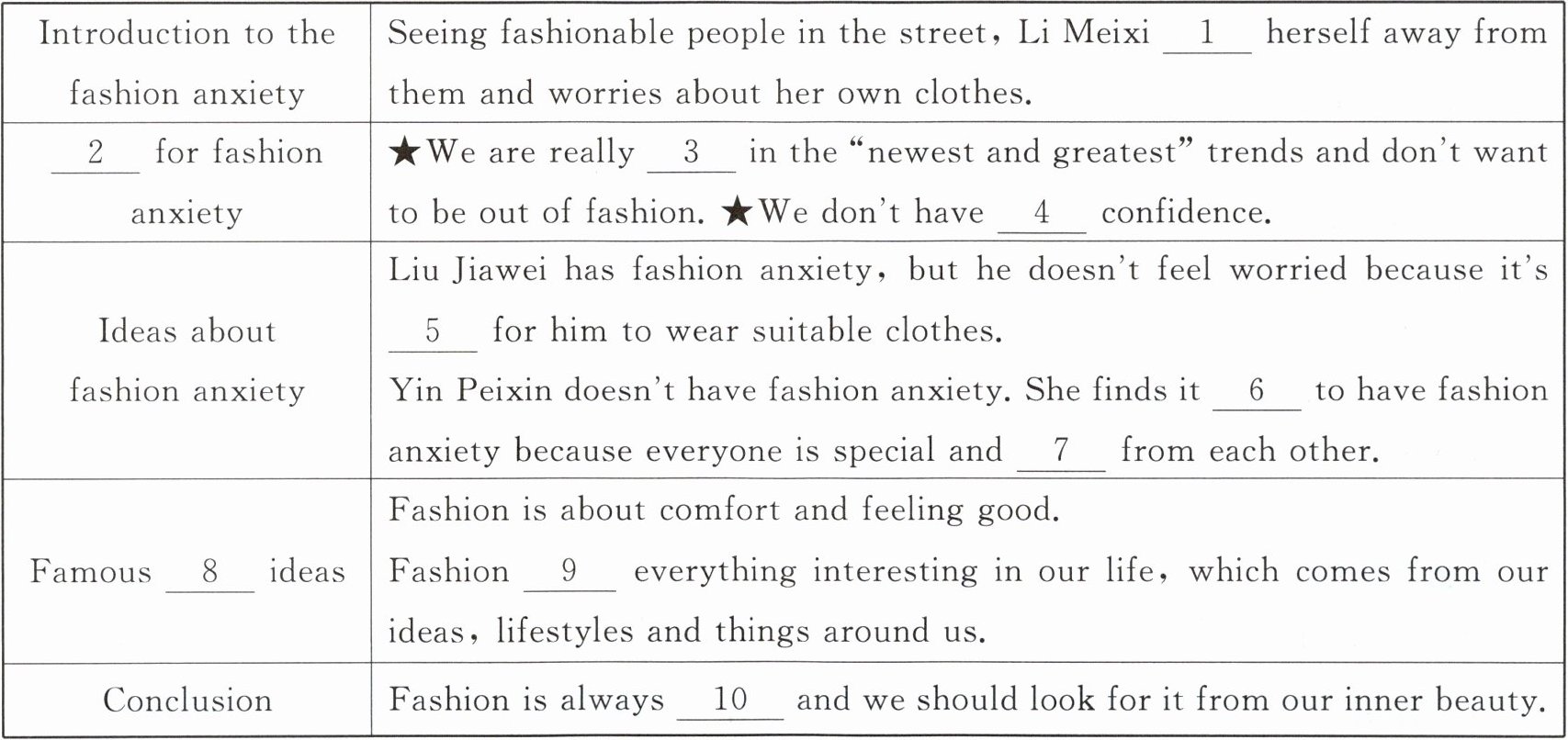
Li Meixi is a girl from Chengdu, Sichuan. When she sees fashionable people in the street, she tries to keep away from them. “I am afraid that they think I’m out of fashion,” said Li. This is called fashion anxiety(焦虑). It is a hot topic online. These days, many people feel worried about their clothes.
Fashion anxiety comes from two causes. Fashion magazines and advertisements(广告) sell the “newest and greatest” trends(趋势). They tell us what to wear and greatly interest us. If we don’t follow the trends, we may worry that people think we’re unfashionable. Also, fashion anxiety comes because we are not confident(自信的) enough.
Ideas about fashion anxiety Do you have fashion anxiety? What do you think about it? Let’s look at how some teenagers feel.
Liu Jiawei, 14, Songyuan, Jilin I have fashion anxiety. When I see some people wearing trendy clothes, I’m afraid to look at them. But this doesn’t bring me much trouble. I still want to buy good-value(性价比高的) clothes. Being suitable is of great importance.
Yin Peixin, 11, Wuhan, Hubei I love fashion. But my fashion taste is a little more traditional, such as long dresses and skirts. I don’t think I have fashion anxiety. But I feel bad for people with fashion anxiety. They shouldn’t be ashamed(羞愧的) of their clothes, because everyone is different—they are special in their own way.
What is fashion? ①Fashion is about comfort and feeling good. —Max Azria, the USA fashion designer. ②Fashion is not something that is only in dresses. Fashion is in the sky, in the street. Fashion has to do with ideas, the way we live, what is happening. —Coco Chanel, French fashion designer.
In fact, fashion changes every season. Anyone can make it. If you can wear something with confidence, you will be the one starting a trend. Clothes just show what you look like, not who you are. What matters is inner(内心的) beauty.
1.
6.
阅读下面短文,并根据所读内容在文章后的表格里填入最恰当的单词,每个空格只填一个单词。
|题目|体裁|字数|难度|建议用时|实际用时|正确率|
|时尚焦虑|议论文|357|★★★★|12 分钟|____分钟|____/10|
Li Meixi is a girl from Chengdu, Sichuan. When she sees fashionable people in the street, she tries to keep away from them. “I am afraid that they think I’m out of fashion,” said Li. This is called fashion anxiety(焦虑). It is a hot topic online. These days, many people feel worried about their clothes.
Fashion anxiety comes from two causes. Fashion magazines and advertisements(广告) sell the “newest and greatest” trends(趋势). They tell us what to wear and greatly interest us. If we don’t follow the trends, we may worry that people think we’re unfashionable. Also, fashion anxiety comes because we are not confident(自信的) enough.
Ideas about fashion anxiety Do you have fashion anxiety? What do you think about it? Let’s look at how some teenagers feel.
Liu Jiawei, 14, Songyuan, Jilin I have fashion anxiety. When I see some people wearing trendy clothes, I’m afraid to look at them. But this doesn’t bring me much trouble. I still want to buy good-value(性价比高的) clothes. Being suitable is of great importance.
Yin Peixin, 11, Wuhan, Hubei I love fashion. But my fashion taste is a little more traditional, such as long dresses and skirts. I don’t think I have fashion anxiety. But I feel bad for people with fashion anxiety. They shouldn’t be ashamed(羞愧的) of their clothes, because everyone is different—they are special in their own way.
What is fashion? ①Fashion is about comfort and feeling good. —Max Azria, the USA fashion designer. ②Fashion is not something that is only in dresses. Fashion is in the sky, in the street. Fashion has to do with ideas, the way we live, what is happening. —Coco Chanel, French fashion designer.
In fact, fashion changes every season. Anyone can make it. If you can wear something with confidence, you will be the one starting a trend. Clothes just show what you look like, not who you are. What matters is inner(内心的) beauty.
1.
keeps
2. Reasons
3. interested
4. enough
5. important
6.
wrong
7. different
8. designers'
9. includes
10. changing
答案:
1. keeps 2. Reasons 3. interested 4. enough 5. important 6. wrong 7. different 8. designers' 9. includes/is 10. changing
查看更多完整答案,请扫码查看

